10 Questions to Ask Your Solar Installer Before Signing Anything
Getting solar installed is one of the bigger financial decisions a homeowner makes. A quality system can pay itself off in three to five years and run reliably for two decades. A poor one can leave you with a voided warranty, a dodgy installation, and a company that’s gone quiet the moment your panels are on the roof.
The problem is that most solar quotes look similar on paper. Same panel brands, similar prices, glossy brochures. The real differences are buried in the contract terms, the installer’s credentials, and the way a company behaves after the job is done.
These ten questions cut through the noise. Ask every installer you’re considering, and pay close attention to how they answer. Hesitation, vagueness, or irritation at being asked are red flags in themselves.
Before you sign anything: A reputable solar company will answer all of these questions clearly and without pressure. If they can’t, or won’t, walk away.
1. Are Your Installers Licensed Electricians?
Solar panels connect directly to your home’s electrical system. In Western Australia, all electrical work must be carried out by a licensed electrician registered with EnergySafety WA. This isn’t optional, and it isn’t a formality.
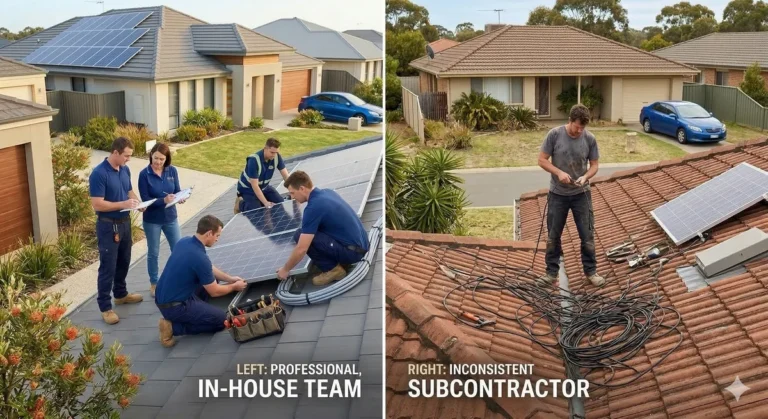
Some installers use a licensed electrician to sign off on the work while unlicensed labourers do the actual installation. This is more common than most homeowners realise, and it creates real risk: faulty wiring, failed inspections, and insurance complications if something goes wrong.
What a good answer looks like: The company employs its own licensed electricians who carry out every installation. They should be able to give you the licence number on request.
Talk Energy uses in-house licensed electricians on every job, not subcontractors. It’s one of the clearest ways to tell a quality installer from a volume operation.
2. Do You Use Your Own Installers or Subcontractors?
This is a separate question from licencing, and it matters just as much. Many solar retailers operate as sales organisations: they take your money, then outsource the actual installation to a third-party crew they may have little ongoing relationship with.
When something goes wrong six months later, the retailer points to the subcontractor, and the subcontractor has moved on. You’re left chasing accountability across two businesses.
What a good answer looks like: The company has its own employed installation team. If they do use subcontractors in some cases, they should be able to explain how those contractors are vetted, supervised, and held to the same standards.
- Ask: “Who will physically be on my roof on the day?”
- Ask: “Are they employed by you, or are they a third-party contractor?”
- Ask: “If there’s a problem with the installation, who do I call?”
The answers reveal a lot about how seriously a company takes accountability.
3. What Does the Warranty Actually Cover?
Solar warranties are one of the most misunderstood parts of any quote. There are typically three separate warranties involved, and they’re not interchangeable.
| Warranty Type | What It Covers | Typical Duration |
|---|---|---|
| Product warranty | Manufacturing defects in the panels themselves | 10–15 years (some 25 years) |
| Performance warranty | That panels will produce a minimum % of rated output | 25 years |
| Workmanship warranty | The quality of the installation work | 1–10 years (varies widely) |
The workmanship warranty is the one most installers try to gloss over, because it’s where they’re most exposed. A short workmanship warranty (one to two years) means the company isn’t confident in the longevity of their own work.
What a good answer looks like: A workmanship warranty of at least ten years, clearly documented in the contract. Talk Energy offers a 20-year workmanship warranty, which is among the strongest in Perth and reflects genuine confidence in their installation quality.
Ask for all three warranties in writing before you sign. If a company can’t produce them, that’s your answer.
4. Is the Company CEC Accredited?
The Clean Energy Council (CEC) is Australia’s peak body for the renewable energy industry. CEC accreditation means the installer has met nationally recognised standards for design and installation of solar systems.
This matters for two practical reasons. First, only CEC-accredited installers can install systems that are eligible for Small-scale Technology Certificates (STCs), which are the federal government rebates that reduce your upfront cost. Second, it gives you an independent benchmark that the company has been assessed against a professional standard.
What a good answer looks like: The company holds current CEC accreditation, and the specific installer assigned to your job is individually accredited. You can verify accreditation directly on the CEC website before committing.
Red flag: A company that says they’re “CEC approved” without being able to provide an accreditation number is likely conflating accreditation with CEC membership, which are different things.
5. How Long Has the Company Been Operating?
The Australian solar industry has seen a wave of companies enter the market, offer cheap installations, then collapse or exit before honouring their warranties. Dozens of solar companies have gone out of business in Australia over the past decade, leaving customers with warranties that are effectively worthless.
A company’s age doesn’t guarantee quality, but it does tell you they’ve survived market cycles, stood behind their work, and built a customer base that kept them in business.
What a good answer looks like: At least five years of continuous operation in the WA market, with verifiable reviews that go back over time (not just a sudden spike of five-star reviews in the last few months).
- Check ProductReview.com.au and Google Reviews for the volume and spread of reviews over time.
- Look at whether negative reviews exist and how the company responded to them.
- A company with 250+ reviews built over several years is a very different proposition from one with 30 reviews from the past six weeks.
6. What Happens After Installation? What Does Aftercare Look Like?
This is the question most homeowners forget to ask, and it’s often the one that matters most. Solar systems are long-term assets. Inverters need occasional attention, monitoring apps need setup, and questions come up months or years after installation day.
Many companies are responsive right up until the moment they’ve been paid. After that, you’re dealing with a call centre, a ticketing system, or silence.
What a good answer looks like: A dedicated aftercare process with a local point of contact. The company should be able to explain exactly what happens if:
- Your system stops producing power
- Your inverter displays a fault code
- You want to add a battery later
- You have a billing or feed-in tariff question
Ask specifically: “If I call you in two years with a problem, who answers?” The answer tells you whether you’re buying a product or a long-term service relationship.
Talk Energy offers ongoing aftercare support and is locally based in Perth, meaning you’re not waiting on a national call centre to route your query to someone who’s never seen a WA network connection.
7. What Financing Options Are Available, and What Are the True Terms?
Solar financing has become a major selling tool, and “no upfront cost” or “pay from your savings” headlines are everywhere. The offers can be genuinely good, but the terms vary significantly and some are structured in ways that cost you more over time.
Before agreeing to any finance arrangement, get clear answers on these specifics:
| Question | Why It Matters |
|---|---|
| What is the interest rate? | Zero-interest periods sometimes revert to high rates |
| What is the total repayment amount? | Compare this to the cash price |
| Is there a balloon payment or residual? | Some products have a lump sum at the end |
| Can I pay it off early without penalty? | Prepayment fees can eliminate savings |
| Who is the lender? | Is it the solar company or a third-party financier? |
What a good answer looks like: The company offers finance options with transparent terms, no hidden fees, and a clear total cost of borrowing. They should be willing to show you the full comparison between paying cash and financing before you commit.
Talk Energy offers fast, flexible financing and is upfront about the full cost of each option, so you can make a genuine comparison rather than being dazzled by a low weekly repayment figure.
8. Will This System Be Eligible for WA Government Rebates and Battery Schemes?
Western Australia has its own energy landscape, distinct from the eastern states. The Synergy network has specific requirements, and WA homeowners have access to state-level battery incentive schemes that not all installers are set up to participate in.
A good installer should be across all of this without you having to ask. If they’re not, it’s a sign they’re not deeply embedded in the WA market.
What a good answer looks like: The installer is familiar with:
- The current federal STC rebate and how it applies to your system size
- Synergy’s Distributed Energy Buyback Scheme (DEBS) and current feed-in rates
- Any active WA battery incentive programs and whether your property is eligible
- Network connection requirements specific to Western Power’s grid
Red flag: An installer who gives you vague answers about rebates, or who quotes you a price without clearly showing how rebates are applied, may be inflating the headline price and discounting back to a number that was always the real price.
Talk Energy actively participates in WA battery schemes and keeps up with the state’s evolving energy policy, which is particularly relevant as WA’s grid management rules continue to change.
9. Can You Provide References or Show Me Verified Reviews?
Any company can put testimonials on their own website. What you want is independently verified reviews on platforms where the company can’t edit or remove negative feedback.
What a good answer looks like: The company can point you to a substantial volume of reviews on Google, ProductReview.com.au, or SolarQuotes, with enough history to show a consistent pattern rather than a recent burst of activity.
When reading reviews, look beyond the star rating:
- Do reviewers mention the installation team by name? (Suggests a consistent, employed crew)
- Are there reviews that mention post-installation support? (Suggests the company follows through)
- How does the company respond to the occasional negative review? (Dismissiveness is a warning sign; genuine resolution is a green flag)
Talk Energy has over 250 five-star reviews, and the pattern across those reviews consistently mentions the quality of the installation crew and responsiveness of the team after the job is done.
10. What’s Your Price Match Policy?
Quality solar doesn’t have to mean paying a premium. If you’ve done your research and found a comparable quote from another reputable installer, a confident company will engage with that rather than dismiss it.
Price matching isn’t just about getting a lower number. It’s a signal that the company is secure enough in their offering to compete on value rather than pressure tactics.
What a good answer looks like: A clear, no-fuss price match policy with defined conditions. The company should be able to explain what “comparable” means to them: same panel brand, same system size, same warranty terms. Matching a cheap quote with inferior components doesn’t count.
What to watch for: High-pressure tactics like “this price is only available today” or “we have a cancellation and can fit you in this week” are designed to prevent you from asking these questions at all. A reputable installer will give you time to compare.
Talk Energy offers price matching and is willing to put their quote side by side with competitors, because the comparison includes warranty terms, installation quality, and aftercare, not just the headline price.
Frequently Asked Questions
What questions should I ask a solar installer before signing a contract?
Ask about licensing (are installers licensed electricians?), whether they use in-house teams or subcontractors, what the workmanship warranty covers and for how long, CEC accreditation status, company operating history, aftercare support, financing terms, WA rebate eligibility, verified reviews, and price match policy. A reputable installer will answer all ten clearly and in writing.
Why does it matter if a solar company uses subcontractors?
When an installer subcontracts the work, accountability becomes split between two businesses. If something goes wrong, the retailer may point to the subcontractor, who may have moved on. Companies with in-house installation teams maintain direct accountability for every job, making warranty claims straightforward and ensuring consistent quality control across installations.
What is the most important solar warranty to check?
The workmanship warranty from your installer is the most important for day-to-day protection. It covers installation faults, labour, call-out fees, and roof damage. The legal minimum in Australia is 5 years, but quality installers offer 10–20 years. Panel product and performance warranties (from the manufacturer) are also important but cover different things.
How do I verify if a solar installer is CEC accredited?
You can verify CEC accreditation directly on the Clean Energy Council website. Ask for the specific accreditation number of the installer assigned to your job, not just the company’s membership. Only CEC-accredited installers can create STCs (the federal rebate), so this directly affects your upfront cost.
What are the biggest red flags when choosing a solar installer?
The biggest red flags are: high-pressure sales tactics (“price only available today”), an ABN history shorter than the warranty period, use of subcontractors with no clear accountability chain, inability to provide warranty terms in writing, no defined aftercare process, vague answers about WA-specific rebates, and a sudden burst of reviews with no history. Any evasiveness when asked direct questions is itself a red flag.
The Bottom Line
A good solar installer will welcome every one of these questions. They’ve heard them before, they have clear answers, and they understand that a homeowner doing their due diligence is exactly the kind of customer they want.
If an installer gets evasive, rushes you, or can’t produce documentation on warranties and licencing, that’s your answer. There are plenty of quality operators in Perth who will treat this as the significant investment it is.
Talk Energy ticks every box on this list: in-house licensed electricians, a 20-year workmanship warranty, 250+ verified five-star reviews, participation in WA battery schemes, transparent financing, and a price match guarantee. If you’re ready to get a quote from a company you can hold accountable, get in touch with Talk Energy today.