Best Solar Installer in Perth for After-Sales Support: Why It Matters More Than Price
Quick Answer: The best solar installer in Perth is not the one with the lowest price — it is the one that still answers the phone, still sends licensed electricians, and still fixes faults under warranty five, ten, or fifteen years later. After-sales support — workmanship warranty length, response time guarantees, and in-house electricians — is the single most important factor in your 25-year solar investment.
The After-Sales Problem Perth Solar Buyers Don’t See Coming
Most Perth homeowners spend weeks comparing solar quotes on price. They scrutinise cost per watt, panel brands, and inverter specs. What almost nobody researches is what happens after the installation crew drives away. That is where the real risk lives.
A solar system is a 25-year investment. The installation itself takes one day. Everything that happens after that day — faults, performance issues, warranty claims — depends entirely on whether your installer is still around, still answering the phone, and contractually obligated to fix your problem fast.
WA Consumer Protection received 67 complaints about solar installers in 2022 — an 18% increase on the previous year. Around 13% of those complaints involved homeowners who simply could not get in touch with their installer at all. Some companies had shut up shop entirely. Others were ignoring calls and emails from customers with legitimate faults.
Solar systems look identical on paper. Two quotes for a 6.6kW system with similar panels and the same inverter brand can differ by $2,000 or more. Most buyers choose the cheaper one and assume the product is the same. Often it is. The problem is the service contract isn’t.
What the Cheaper Quote Usually Doesn’t Include
- A defined response time if something goes wrong
- In-house licensed electricians who can actually perform repairs (rather than subcontractors who have moved on)
- A workmanship warranty longer than the legal minimum of 5 years
- A local team with a physical address you can show up at
Perth’s solar market is intensely competitive, which keeps prices low but creates pressure on margins. Some installers cut costs by using subcontracted labour, offering minimal workmanship warranties, or operating as a sales-only business that outsources all technical work. When a fault develops three years later, those structures often collapse.
What a Real Fault Looks Like
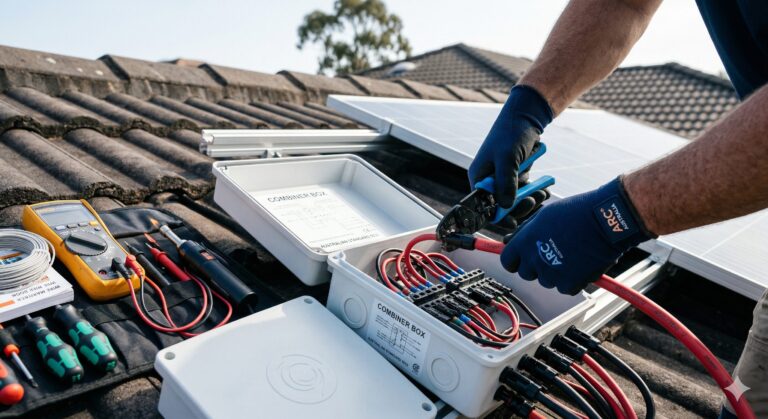
The most common post-installation issues in Perth include:
- Inverter faults — the inverter stops communicating with the grid or shuts down intermittently
- Earth isolation faults — often caused by a damaged panel, which causes the system to shut down during rain
- Mounting and waterproofing issues — wiring conduit or roof penetrations that weren’t sealed correctly during installation
- Performance degradation — panels producing significantly less than expected due to shading miscalculation or faulty strings
Every one of these issues is fixable. The question is whether your installer will fix it, and how quickly. To understand the end-to-end process, read about how Talk Energy handles warranty repairs from diagnosis through to resolution.
The part most coverage misses: a fault that’s ignored doesn’t stay a minor fault. An earth isolation issue that goes unresolved for months can damage the inverter — turning a $200 repair into a $2,000+ replacement. Response time is a financial issue, not just a convenience one.
What Strong After-Sales Support Actually Looks Like
Genuine after-sales support is defined by specific, contractual commitments — not vague promises on a website. When evaluating any Perth solar installer, these are the benchmarks that separate real support from marketing language.
Workmanship Warranty: Length and Coverage
The manufacturer warranties on panels (typically 25 years) and inverters (10—25 years) are separate from the workmanship warranty, which covers the actual installation: wiring, mounting, waterproofing, and electrical connections. This is the warranty that matters most when something goes wrong, because most post-installation faults are installation-related, not product-related.
| Warranty Level | Coverage Period | What It Means |
|---|---|---|
| Minimum legal standard | 5 years | Bare compliance; many installers offer exactly this |
| Industry average | 5—10 years | Adequate but leaves you exposed for most of the system’s life |
| Premium standard | 20 years | Covers the full productive life of your system |
A 20-year workmanship warranty is significantly above the industry standard. It signals that the installer is confident enough in their work to stand behind it for the life of your system, and that they are financially stable enough to honour that commitment long-term.
Response Time Guarantee
A workmanship warranty without a defined response time is almost meaningless. Knowing your installer will eventually fix a fault is different from knowing they will fix it within 48 hours. Every day a fault goes unresolved is a day your system isn’t generating power — and in Perth, where electricity rates sit at 32 cents per kWh with Synergy, the daily cost of a non-functioning system adds up fast. See exactly what Talk Energy commits to in our guide to the 48-hour fix or replace guarantee explained.
What to look for: a written guarantee that specifies the maximum time between reporting a fault and an on-site response. Any installer unwilling to put a number in writing is telling you something important.
In-House Electricians vs Subcontractors
This is the structural question that determines whether after-sales support is even possible. An installer who uses subcontractors for installation has no reliable mechanism to get those same electricians back on your roof two years later. The subcontractors may be working for a different company, in a different city, or no longer in the industry.
In-house licensed electricians, employed directly by the installer, are accountable to the same business that sold you the system. That accountability is what makes warranty claims and fault responses actually work.
Accreditation and Compliance Markers
Legitimate after-sales support is also correlated with formal accreditation. Look for:
- CEC (Clean Energy Council) accreditation — the baseline standard for solar installers in Australia
- NETCC (New Energy Tech Consumer Code) approval — a voluntary code with consumer protection standards that go beyond the legal minimum
- SAA (Solar Accreditation Australia) registration — the body responsible for installer accreditation since February 2024
- Licensed electrical contractor status — not just an accredited installer, but a business with a formal electrical licence tied to the company
Questions to Ask Before You Sign
Price comparison is easy. After-sales support comparison requires asking the right questions directly. Before signing any solar contract in Perth, get written answers to these:
- What is your workmanship warranty period? Anything under 10 years warrants scrutiny. Under 5 years is a red flag.
- Do you use in-house electricians or subcontractors? Ask specifically who will be on your roof and whether they are employees of the company.
- What is your guaranteed response time if my system develops a fault? Push for a specific number of hours or days, in writing.
- What does the warranty claim process look like? A reputable installer will have a clear, simple answer. Vague responses suggest the process doesn’t exist.
- Are you NETCC-approved and CEC-accredited? Both are verifiable online. Any installer who hesitates on this question is not accredited.
- Do you service regional WA, or only metro Perth? If you are outside the metro area, confirm your installer has the capacity to reach you within the guaranteed response window.
- What happens to my warranty if your company closes? A fair question. The honest answer is that workmanship warranties are only as good as the company behind them, which is why longevity and financial stability matter.
For a more comprehensive checklist, Talk Energy’s guide to questions to ask your solar installer covers the full range of pre-signing due diligence. You can also request an obligation-free quote to discuss your requirements directly.
Why Talk Energy Leads on After-Sales Support in Perth
Talk Energy Solar & Battery is a Perth-based installer that has built its entire service model around post-installation accountability. Every element of their after-sales support is specific, contractual, and independently verifiable.
The 48-Hour Fix or Replace Guarantee
If a Talk Energy installation develops a fault, the company commits to diagnosing and resolving it within 48 hours of it being reported. This applies across both metro Perth and regional Western Australia. The guarantee covers inverter faults, panel performance issues, and any installation-related defects, including wiring, mounting, and system configuration problems.
To make a claim, customers call (08) 6255 5914 or email wattsup@talkenergy.com.au. Talk Energy assesses the issue remotely where possible and schedules an on-site visit within 48 hours if required. The 48-hour window is not a target or an aspiration — it is a written commitment that runs from the day of installation alongside the workmanship warranty.
20-Year Workmanship Warranty
The industry standard workmanship warranty in Perth is 5—10 years. Talk Energy offers 20 years — four times the minimum legal requirement and double the industry average. This warranty covers structural integrity of the installation, compliance with building codes, and any defects arising from installation errors.
If a covered defect is identified within 20 years, Talk Energy repairs or replaces the affected work at no cost. The warranty applies to both solar and battery installations across the full Talk Energy service area, including regional WA.
In-House Licensed Electricians
Every Talk Energy installation is completed by in-house qualified electricians — no subcontractors. This is not a marketing claim; it is a structural commitment that makes the 48-hour guarantee deliverable. The same team that installed your system is the team that services it. There is no handoff to a third party, no chase-down of a subcontractor’s contact details, and no gap in accountability.
Verified Track Record
With 250+ five-star Google reviews and accreditations including CEC approval, NETCC status, SAA registration, and Tesla Certified Installer status, Talk Energy’s after-sales reputation is publicly documented and independently verifiable.
The Real Cost of Choosing Price Over Support
It is worth doing the maths on what poor after-sales support actually costs.
A 6.6kW solar system in Perth generates roughly 26—28 kWh per day under good conditions. At Synergy’s standard tariff of 32 cents per kWh, that is around $8.50—$9.00 per day in electricity value. A system that is offline for two weeks while you chase an unresponsive installer costs you $119—$126 in lost generation alone, on top of the grid electricity you are paying for during that period.
Stretch that to a month of unresolved faults — which is not uncommon based on WA Consumer Protection complaint data — and you are looking at $250—$270 in lost savings, plus the stress and time of pursuing a company that is ignoring your calls.
The price gap between a cheap installer and a quality one is often $1,000—$2,000 on a standard residential system. A single extended fault with an unresponsive installer can wipe out that saving entirely, before you factor in the cost of bringing in a third-party electrician to fix what the original installer won’t.
Choosing an installer based on after-sales support credentials is not paying a premium for luxury. It is paying to avoid a known, documented category of financial and practical risk.
Frequently Asked Questions
What should I look for in a solar installer’s after-sales support?
The three most important factors are workmanship warranty length (look for 10+ years, ideally 20), a written response time guarantee (such as 48 hours), and whether the installer uses in-house licensed electricians rather than subcontractors. Also verify CEC accreditation and NETCC approval, both of which are independently verifiable online. A company that ticks all these boxes is far more likely to resolve issues quickly and honour warranty claims long-term.
How much does solar system downtime cost in Perth?
A 6.6kW solar system in Perth generates approximately $8.50—$9.00 per day in electricity value at Synergy’s 32.37c/kWh tariff. Two weeks of downtime from an unresolved fault costs $119—$126 in lost generation, plus the grid electricity you pay during that period. A month of downtime costs $250—$270 in lost savings. These costs can quickly exceed the price difference between a cheap installer and one with proper after-sales support.
Why is a 20-year workmanship warranty better than a 5-year warranty?
Solar panels are designed to last 25—30 years. A 5-year workmanship warranty means that for most of your system’s life, installation-related faults — wiring issues, mounting failures, roof penetration problems — are your financial responsibility. These issues often surface at year 8, 12, or 15 as components age. A 20-year warranty like Talk Energy’s covers you through the period when most installation-related issues actually appear, and signals the installer is confident in their work quality and financially stable enough to honour long-term commitments.
Get a Free Quote
Get a Free Quote or call (08) 6255 5914 to discuss after-sales support with the Talk Energy team.