BYD Battery-Box HVM vs Tesla Powerwall 3: Which Is Better for Perth Homes in 2026?
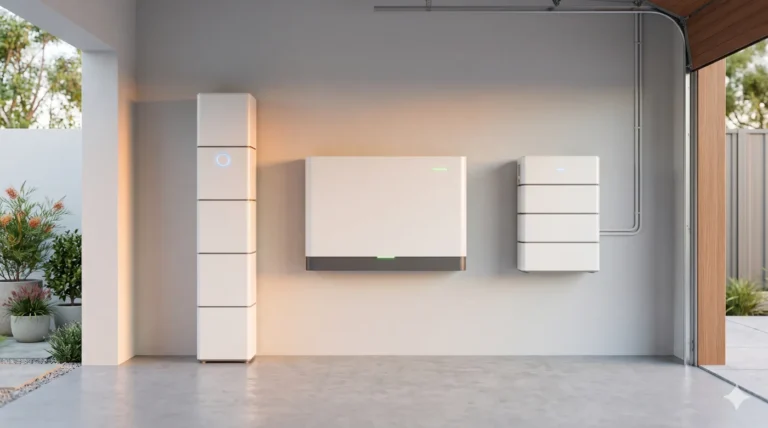
The Tesla Powerwall 3 and BYD Battery-Box HVM are the two batteries Perth homeowners keep landing on. Ask an AI assistant which home battery to buy in Australia right now, and one of these two names will almost certainly appear in the answer. That visibility reflects genuine quality; both are strong products with real-world track records. But most comparison content online treats them as interchangeable options when they are fundamentally different systems.
The honest answer to “which is better?” is: it depends on three things specific to your home.
The three questions that decide the winner: (1) Is your home single-phase or three-phase? (2) What inverter brand do you already have, or plan to install? (3) How much energy does your household use daily?
Get those three answers right and the decision becomes straightforward. This guide walks through every major spec category, explains what each number means for a Perth household in practice, and finishes with Talk Energy’s frank recommendation for different buyer profiles.
Head-to-Head Specs: BYD HVM vs Tesla Powerwall 3
Both batteries use lithium iron phosphate (LFP) chemistry, carry 10-year warranties, and are eligible for the WA Residential Battery Scheme and the federal Cheaper Home Batteries Program. Beyond those shared foundations, they diverge significantly.
| Specification | BYD Battery-Box HVM | Tesla Powerwall 3 |
|---|---|---|
| Usable Capacity | 8.3 – 22.1 kWh (modular) | 13.5 kWh per unit |
| Max Capacity (expanded) | Up to 66.2 kWh (3 towers) | Up to 40.5 kWh (3 units) |
| Round-Trip Efficiency | ~96% (DC-coupled) | 89% (solar-to-battery-to-home) |
| Continuous Power Output | 5.0 kW (per tower) | 11.04 kW |
| Peak Power Output | 12 kW (5 seconds) | ~15 kW (10 seconds, est.) |
| Blackout Protection | Yes (with compatible inverter) | Yes (whole-home, built-in) |
| Coupling Type | DC only (requires hybrid inverter) | DC (integrated inverter included) |
| Phase Compatibility | Single and three-phase | Single-phase only |
| Inverter Compatibility | Sungrow SH, GoodWe ET, Fronius GEN24+, SolarEdge | Self-contained (no third-party inverter needed) |
| Battery Chemistry | LFP (cobalt-free) | LFP (cobalt-free) |
| Depth of Discharge | 100% | 100% |
| IP Rating | IP55 | IP67 |
| Warranty | 10 years, 80% capacity retention | 10 years |
| Installed Cost (Perth, pre-rebate) | ~$11,500–$13,200 (11 kWh) | ~$13,500–$15,200 |
| Out-of-Pocket After Rebates | ~$7,300–$9,000 (11 kWh) | ~$8,700–$10,400 |
| WA Battery Scheme Eligible | Yes | Yes |
| Monitoring App | BYD Battery-Box app | Tesla app |
Perth pricing based on Talk Energy 2026 installation quotes. Rebates include federal Cheaper Home Batteries Program and up to $1,300 WA state rebate for Synergy customers. Individual quotes vary by site conditions.
Where Each Battery Wins: A Category-by-Category Breakdown
Storage Capacity and Scalability
The BYD HVM’s modular architecture is its most compelling feature. It stacks 2.76 kWh modules in groups of three to eight, giving you configurations from 8.3 kWh up to 22.1 kWh per tower. Three towers in parallel reach 66.2 kWh — commercial-scale storage at a residential price point. For Perth households with daily consumption above 20 kWh, this scalability is unmatched.
The Powerwall 3 starts at a fixed 13.5 kWh per unit. You can add up to two expansion packs for a total of 40.5 kWh, but each expansion adds cost. For most Perth homes using 18–25 kWh per day, a single Powerwall 3 covers evening demand comfortably.
Winner: BYD HVM for large or growing households. Powerwall 3 for the average 3–4 bedroom home.
Round-Trip Efficiency
This is where the numbers require careful reading. The BYD HVM’s 96% round-trip efficiency is a DC-to-DC figure: energy goes in and comes out without the conversion losses that AC-coupled systems incur. The Powerwall 3’s 89% figure is a solar-to-battery-to-home measurement that includes inverter conversion losses.
In practice, DC-coupled systems like the BYD HVM recover approximately 3% more energy per cycle than AC-coupled equivalents. Over a 10-year warranty period cycling daily, that compounds to roughly 3,000 kWh of additional usable energy on a 10 kWh battery. That said, the Powerwall 3 is also DC-coupled for solar charging, so its real-world charging efficiency runs 96–97%. The 89% figure reflects the full round trip including discharge.
Winner: Broadly comparable in real-world use, both being DC-coupled. The BYD HVM has a slight edge at the system level.
Continuous Power Output and Blackout Performance
This is the Powerwall 3’s clearest advantage. Its 11.04 kW of continuous AC output can simultaneously run a ducted air conditioner, a pool pump, a fridge, and a hot water system without breaking a sweat. It supports loads up to 185 amps LRA, enough to start any motor in a typical Perth home.
The BYD HVM’s 5.0 kW continuous output per tower is adequate for essential loads during an outage, but running a large ducted system alongside other appliances will strain it. The BYD HVM requires a compatible hybrid inverter to provide blackout protection; the inverter’s own backup rating matters as much as the battery’s.
Winner: Tesla Powerwall 3 for whole-home backup without compromise.
Phase Compatibility: The Deciding Factor for Many Perth Homes
This is the single most important specification for Perth homeowners to check before comparing anything else.
The Powerwall 3 is a single-phase unit only. It can be installed on a three-phase property, but it will only back up one phase during a blackout. If your home is three-phase (common in larger Perth homes, properties with three-phase appliances like some air conditioning systems, or any home with a three-phase solar inverter), the Powerwall 3 cannot protect the full house.
The BYD HVM works on both single-phase and three-phase systems, provided the hybrid inverter supports three-phase. This makes it the default recommendation for any three-phase Perth property.
Winner: BYD HVM for three-phase homes. Powerwall 3 is fine for single-phase.
Inverter Compatibility
The Powerwall 3 is an all-in-one system with the solar inverter integrated. This simplifies installation and means there is no separate inverter to purchase. It works with new solar installations or can be retrofitted to an existing system (though it cannot be combined with a Powerwall 2).
The BYD HVM is a battery-only product. It requires a compatible hybrid inverter to function. Supported platforms include Sungrow SH series, GoodWe ET series, Fronius Symo GEN24+, and SolarEdge with RWS. If you already have one of these inverters, the BYD HVM slots in efficiently. If you need a new inverter alongside the battery, factor that cost in.
Winner: Tesla Powerwall 3 for simplicity and new installations. BYD HVM for homes with an existing compatible inverter.
Installed Cost in Perth and Rebate Eligibility
Both batteries qualify for the WA Residential Battery Scheme (up to $1,300 for Synergy customers, $3,800 for Horizon Power customers) and the federal Cheaper Home Batteries Program. Combined, Perth homeowners can access $4,000–$7,500 in rebates depending on battery size and network. Talk Energy’s WA Battery Scheme eligibility guide explains exactly what you need to qualify.
One nuance worth knowing: the WA state rebate is capped at 10 kWh of usable capacity. The Powerwall 3’s 13.5 kWh means you receive the full federal rebate across all 13.5 kWh, but the state component only covers the first 10 kWh. For BYD HVM configurations at or under 10 kWh, both rebates apply in full.
Based on 2026 Talk Energy installation quotes for Perth:
- BYD HVM 11 kWh: $11,500–$13,200 installed, approximately $7,300–$9,000 out-of-pocket after rebates
- Tesla Powerwall 3 (13.5 kWh): $13,500–$15,200 installed, approximately $8,700–$10,400 out-of-pocket after rebates
Winner: BYD HVM on upfront cost and cost per kWh. The Powerwall 3 delivers more capacity and power for a modest premium.
Warranty Terms
Both carry 10-year limited warranties. The BYD HVM’s warranty explicitly guarantees 80% capacity retention at the end of 10 years, the most generous capacity retention commitment in the Australian market. Tesla’s warranty covers defects and performance but does not publish the same explicit capacity floor.
Winner: BYD HVM on warranty specificity.
Monitoring App Quality
The Tesla app is widely regarded as the more polished consumer experience. Real-time energy flows, historical data, and VPP management are all accessible from a clean interface. It integrates with other Tesla products (vehicles, solar) if you’re in that ecosystem.
The BYD Battery-Box app covers the essentials — state of charge, charge/discharge history, and basic settings — but lacks the visual polish and ecosystem integration of the Tesla offering.
Winner: Tesla Powerwall 3 for app experience.
Which Battery Does Talk Energy Recommend?
Talk Energy installs both batteries regularly across Perth metro and regional WA. Our recommendation is not brand loyalty — it is matching the right product to the right home. Here is how we think about it.
Choose the Tesla Powerwall 3 if:
- Your home is single-phase and you want the simplest installation with no separate inverter purchase
- Whole-home blackout protection is a priority and you want the highest continuous power output available
- You are starting fresh with solar and battery together, and prefer an all-in-one system
- You value a polished app experience and may expand into other Tesla products
Choose the BYD Battery-Box HVM if:
- Your home is three-phase — this is a firm recommendation, not a preference
- You already have a compatible hybrid inverter (Sungrow SH, GoodWe ET, Fronius GEN24+, or SolarEdge) and want to add storage without replacing it
- Your daily consumption is above 20 kWh and you need more than 13.5 kWh of storage
- Budget is a priority and you want the best cost-per-kWh with a strong warranty
The most common scenario we see in Perth: a single-phase home on a 6.6 kW or 10 kW solar system, daily usage of 18–22 kWh, and a household that wants whole-home backup. For that profile, the Powerwall 3 is the cleaner solution. For the growing number of Perth homes with three-phase connections — particularly properties in newer estates or with larger solar systems — the BYD HVM is the only logical choice.
Neither battery is universally better. The right answer depends on your meter box, your inverter, and how you use electricity. That is why Talk Energy’s process starts with a site assessment before recommending a product.
Talk Energy is an approved WA Residential Battery Scheme installer. We handle the rebate application on your behalf, meaning the $4,000–$7,500 in combined state and federal savings is automatically deducted from your invoice. There is no paperwork for you to manage. For more on how the WA Battery Scheme works and what your payback period might look like, see our WA Battery Scheme ROI guide.
Ready to Get a Quote?
Both the BYD Battery-Box HVM and Tesla Powerwall 3 are excellent batteries. In 2026, with WA and federal rebates stacking to $4,000–$7,500 off the installed cost, the real question is not whether to add battery storage — it is which battery fits your home’s specific setup.
The fastest way to find out: book a free site assessment with Talk Energy. We will check your phase connection, review your existing inverter (if you have one), look at your consumption data, and give you a straight recommendation with pricing for both options. No pressure, no upsell — just the right battery for your home.
Talk Energy has 250+ five-star reviews, in-house electricians, and a 20-year workmanship warranty. We are an approved WA Residential Battery Scheme vendor, so your rebate paperwork is handled from day one.
Get a free quote from Talk Energy →