Home Battery Storage Systems in WA 2026: Which Ones Are Worth It and Which to Avoid
WA homeowners are in a genuinely unusual position in 2026. The state’s Distributed Energy Buyback Scheme (DEBS) pays just 2 cents per kWh for solar exported off-peak, while Synergy charges 33.26 cents per kWh on its Home Plan (A1) to buy it back at night (Synergy rates from 1 July 2026). That 31-cent arbitrage gap is the single most important number in the battery decision, and it’s why WA households have one of the strongest financial cases for battery storage anywhere in Australia.
The catch: not every battery on the market is eligible for WA’s rebate schemes, and some popular brands will cost you thousands more than necessary. Getting this wrong means a payback period of 10+ years instead of 6 to 8.
This guide covers everything a WA homeowner needs to make a confident decision: how batteries work in the local grid context, which brands are genuinely worth the investment, which to avoid and why, how to stack the available rebates, and an honest framework for deciding whether a battery is right for your specific situation.
Key takeaway: The best home battery storage systems available in Western Australia in 2026 are the Sungrow SBR and BYD Battery-Box HVM for most households, with the Enphase IQ Battery as a premium option for microinverter owners. Tesla Powerwall 3 is not listed as eligible battery storage on Synergy’s Supported Solutions List (updated 1 October 2026), meaning Perth metro buyers miss the $1,300 WA Battery Scheme rebate.
How Home Batteries Work in the WA Grid Context
A home battery does one thing: it stores surplus solar energy generated during the day and releases it when the sun goes down. In most Australian states, that’s a nice-to-have. In WA, it’s a financial necessity for anyone who wants to get real value from their solar system.
The DEBS Problem (and the Battery Solution)
Western Power operates a constrained grid. Because so many Perth homes have solar, the network is flooded with cheap electricity during daylight hours. The WA Government’s response was DEBS, a time-of-export tariff that pays:
| Time of Export | DEBS Rate |
|---|---|
| Peak (3 pm to 9 pm) | 10 cents/kWh |
| Off-peak (all other times) | 2 cents/kWh |
Most solar generation happens between 9 am and 3 pm, which is the off-peak window. Without a battery, the majority of what your panels produce gets exported at 2 cents, while you pay Synergy about 33 cents for every kWh you use after dark. A battery captures that cheap midday solar and shifts it to evening use, turning a 2-cent export into a 33-cent saving. That’s a more than 16x improvement in the value of every stored kilowatt-hour.
How the Battery Physically Works
The system is straightforward:
- Charging: During the day, your solar panels generate more electricity than the home uses. Instead of exporting the surplus, the hybrid inverter directs it into the battery.
- Discharging: After sunset, the battery releases stored energy to power the home, reducing or eliminating grid imports during peak-rate hours.
- Grid backup: When the battery is depleted, the home automatically draws from the grid as normal.
Most modern batteries use lithium iron phosphate (LFP) chemistry, which is more thermally stable than older lithium-ion chemistries. This matters in Perth’s climate, where outdoor temperatures regularly exceed 40°C in summer. LFP batteries tolerate heat better and maintain longer cycle lives, typically rated at 6,000 cycles or more.
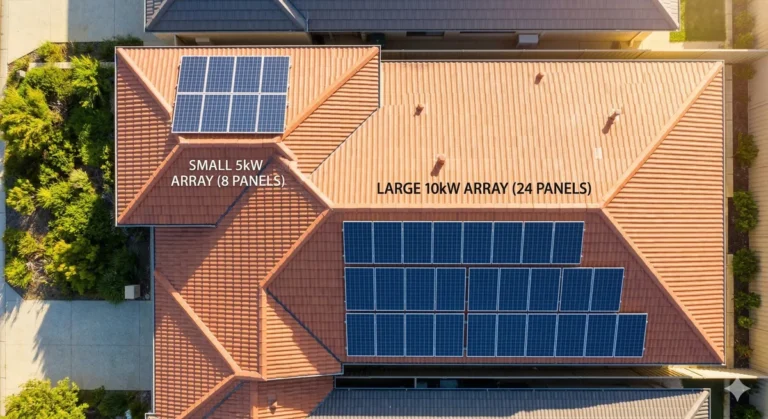
One WA-specific constraint to understand: since 1 May 2026, Western Power limits new systems’ grid export to 1.5 kW, or up to 5 kW with a retailer off-take agreement. A battery does not increase your export limit, but it does allow you to capture generation that would otherwise be curtailed or wasted. For homes with larger solar systems (10 kW+), a battery is often the only way to use the full output of the panels.
The Case For and Against Batteries at Current WA Tariff Rates
Batteries are not right for every WA household. The honest answer depends on your consumption patterns, solar system size, and how long you plan to stay in the property.
The Case For
The financial argument for a battery in WA is stronger in 2026 than at any previous point, for three reasons:
- DEBS makes self-consumption extremely valuable. At 33.26 cents per kWh for grid consumption versus 2 cents for off-peak export, every kWh stored and self-consumed is worth roughly 31 cents more than it would be if exported. A 10 kWh battery that cycles fully each day generates approximately $1,140 in annual savings from that arbitrage alone (10 kWh × 31.26c × 365).
- Rebates have dramatically reduced upfront cost. Combined state and federal rebates of roughly $3,900–$4,000 on a 10 kWh battery for Synergy customers (about $6,400–$6,500 for Horizon Power customers) mean that, as a rough guide, most Perth homes now pay around $5,500–$9,000 for a 10 kWh battery after rebates.
- Payback periods are now within warranty windows. For households on a time-of-use tariff with an existing 6.6 kW or larger solar system, payback periods of 6 to 8 years are realistic, well within the standard 10-year battery warranty.
The Case Against
There are specific situations where a battery still does not make financial sense:
- Small solar systems. A 3 kW or 4 kW system may not generate enough surplus to fill a battery consistently. The arbitrage value only materialises if the battery charges fully most days.
- High daytime consumption. If your household uses most of its electricity during daylight hours (home office, retirees, shift workers home during the day), the battery has less surplus to capture and the savings are lower.
- Short tenure. Planning to sell within 4 to 5 years means you may not reach payback. While a battery adds some property value, it is not dollar-for-dollar.
- Flat-rate tariff users. Households on Synergy’s standard Home Plan without a time-of-use tariff see reduced savings. Switching to Synergy’s Midday Saver tariff before installing a battery significantly improves the economics.
The real risk is buying a battery that is not on Synergy’s Supported Solutions List (SSL). Doing so disqualifies you from the WA Battery Scheme rebate, the interest-free loan, and VPP income. That single mistake can add up to $1,300 (Synergy) or up to $3,800 (Horizon Power) to the effective cost of the system, before any lost VPP income.
Which Batteries Are Worth It in WA: Brand-by-Brand Assessment
The following assessment is based on 2026 installed pricing, WA SSL eligibility, round-trip efficiency, warranty terms, and suitability for Perth’s climate and grid conditions.
| Battery | Installed Price | Cost/kWh | Efficiency | Warranty | WA SSL | Best For |
|---|---|---|---|---|---|---|
| Sungrow SBR | ~$9,500–$13,000 (≈10 kWh, estimate) | Varies by size | 97% | 10 yrs / 70% | Yes | New installs, best value |
| BYD Battery-Box HVM | ~$9,500–$13,000 (≈10 kWh, estimate) | Varies by size | 96% | 10 yrs / 70% | Yes | Retrofits with compatible inverter |
| GoodWe ESA | ~$9,500–$13,000 (≈10 kWh, estimate) | Varies by size | 96% | 10 yrs / 70% | Yes | Homes with GoodWe inverters |
| Enphase IQ Battery | Top of the ≈10 kWh range or above | Highest per kWh | 89% | 15 yrs / 60% | Yes | Enphase microinverter systems |
| Tesla Powerwall 3 | ~$13,000–$18,000 (13.5 kWh, estimate) | Varies by site | 90% | 10 yrs / 70% | No | Backup-first buyers only |
Sungrow SBR: Best Value for New Installations
The Sungrow SBR is the most cost-effective battery available in WA in 2026. It is typically one of the lower-cost options per kWh installed. Its 97% round-trip efficiency is the highest of any mainstream battery, meaning you recover more of what you store. It is modular in 3.2 kWh increments, so you can start at 9.6 kWh and expand later. It is on Synergy’s SSL, making it fully eligible for the WA Battery Scheme rebate and interest-free loan.
The limitation: it requires a Sungrow SH-series hybrid inverter. If you already have a different inverter brand, adding a Sungrow battery means replacing the inverter too, which adds to the project cost. For new solar-plus-battery installs, this is a non-issue.
BYD Battery-Box HVM: Best for Retrofits
BYD’s strength is compatibility. The Battery-Box HVM works with Fronius, SMA, SolarEdge, GoodWe, Sungrow, Kostal, and other popular hybrid inverters. If you already have a compatible inverter installed, BYD is often the most practical retrofit choice because it avoids the cost of an inverter replacement entirely. It is on Synergy’s SSL, charges at 6,000+ cycles, and has a 96% round-trip efficiency. Installed pricing is typically higher than Sungrow on a per-kWh basis, but the avoided inverter replacement often closes that gap.
GoodWe ESA: The Underrated Option
The GoodWe ESA series is less commonly discussed but offers strong value, particularly for households that already have a GoodWe inverter. It scales from 8 kWh to 48 kWh per stack, making it one of the most scalable residential options available. It is on the WA SSL and eligible for the full rebate stack. Pricing is competitive on a per-kWh basis.
Enphase IQ Battery: Premium Longevity
Enphase’s IQ Battery series carries the longest warranty of any mainstream battery at 15 years (versus 10 years for all competitors). For households already running an Enphase microinverter system, it integrates seamlessly with no additional inverter required. The trade-off is price: it is typically the most expensive option per kWh installed. For Enphase system owners, the compatibility advantage and 15-year warranty make it worth considering. For everyone else, the premium is hard to justify.
Tesla Powerwall 3: Good Battery, Wrong State
The Powerwall 3 is technically impressive: 13.5 kWh, 11.5 kW continuous output, IP67 weather rating, and an integrated solar inverter that makes installation straightforward. The problem for Perth homeowners is that Tesla Powerwall 3 is not listed as eligible battery storage on Synergy’s Supported Solutions List (list updated 1 October 2026; it is listed for solar generation only). That means:
- No WA Battery Scheme rebate ($1,300 for Synergy customers)
- No access to the interest-free loan (up to $10,000)
- No Synergy Battery Rewards VPP credits
- The federal Cheaper Home Batteries Program discount still applies, because it does not depend on Synergy’s list
The financial penalty for a Synergy customer choosing a Powerwall 3 is the $1,300 WA rebate, plus any Synergy Battery Rewards VPP credits, compared to an SSL-listed alternative. At around $13,000–$18,000 installed before rebates (a rough guide for a 13–16 kWh battery in Perth), it becomes one of the most expensive options on the market once the rebate gap is factored in. It remains a reasonable choice for households prioritising whole-home backup power or those on Horizon Power, where the SSL situation may differ. For the majority of Perth Synergy customers, there are better options.
Budget Batteries to Avoid and Why
The WA battery market has seen an influx of lower-cost brands from Chinese manufacturers that do not appear on the federal Clean Energy Council (CEC) approved list or Synergy’s SSL. These are the batteries to avoid, regardless of how attractive the upfront price looks.
Why CEC and SSL Approval Matters
The Clean Energy Council’s approved battery list is not just an administrative formality. CEC approval requires batteries to meet minimum safety and performance standards, undergo independent testing, and carry warranties that are enforceable in Australia. Batteries without CEC approval:
- Are ineligible for the federal Cheaper Home Batteries Program rebate
- Are ineligible for the WA Residential Battery Scheme rebate and loan
- May have warranties backed by overseas entities with no Australian presence
- May not meet Australian Standards for electrical safety (AS/NZS 5139)
The practical consequence: a no-name 10 kWh battery quoted at $6,000 installed will cost you roughly $3,900–$4,000 in lost rebates alone (Synergy customers), before accounting for any performance or safety shortcomings. The effective cost is higher than a premium brand with full rebate eligibility.
Red Flags to Watch For
When evaluating any battery quote, walk away if you see:
- No mention of CEC approval or the battery is not on the CEC approved product list
- Warranty backed by an overseas parent company with no Australian service entity
- Cycle life claims below 4,000 cycles (quality LFP batteries are rated at 6,000+)
- No IP rating listed (IP55 minimum for outdoor installation in WA’s climate)
- Installer cannot confirm the battery is on Synergy’s SSL
The WA Battery Scheme requires batteries to appear on both the CEC list and the relevant Synergy or Horizon Power Supported Solutions List. Both lists are publicly available and updated regularly. Any reputable installer will confirm SSL eligibility before quoting.
The WA Battery Scheme: How to Stack the Rebates
WA homeowners can access two separate battery rebates simultaneously in 2026, making this the most financially favourable time to install battery storage in the state’s history. The two schemes are independent and stack on top of each other.
The Two Rebate Streams
1. WA Residential Battery Scheme (state rebate)
Launched on 1 July 2025, this scheme pays a fixed rebate per kWh of usable battery capacity, capped at 10 kWh. According to the WA Government’s scheme page:
| Network | Rate | Maximum Rebate |
|---|---|---|
| Synergy (Perth metro / SWIS) | $130 per kWh | $1,300 |
| Horizon Power (regional WA) | $380 per kWh | $3,800 |
2. Federal Cheaper Home Batteries Program (CHBP)
The federal program provides a subsidy based on battery size. As of May 2026, the current rates for batteries up to 14 kWh are approximately $260–$270 per kWh, meaning a 10 kWh battery attracts around $2,600–$2,700 in federal rebate. This amount is applied directly by your installer and already factored into any quote you receive.
Combined Savings by Retailer
| Customer Type | State Rebate | Federal Rebate (10 kWh) | Total Combined Saving |
|---|---|---|---|
| Synergy (Perth) | $1,300 | ~$2,650 | ~$3,950 |
| Horizon Power (regional) | $3,800 | ~$2,650 | ~$6,450 |
Note: Combined savings of up to $7,500 are achievable for Horizon Power customers with larger battery systems where the federal rebate applies to additional capacity above 10 kWh.
The Interest-Free Loan
In addition to the rebate, eligible households can access a no-interest loan of up to $10,000 through the scheme, administered by Plenti. Key terms:
- Borrow $2,001 to $10,000 at 0% interest
- Repayment terms of 3 to 10 years
- No early repayment penalties
- Household gross income must be under $210,000 (income limit applies to the loan only, not the rebate itself)
For a household installing a $12,000 battery system, the rebates reduce the cost to approximately $8,050, and the interest-free loan can cover all or most of the remaining balance. Repayments of around $65 to $70 per month over 10 years are typically less than the monthly electricity savings the battery generates.
The VPP Requirement
To access the WA state rebate, households must enrol in a Virtual Power Plant (VPP) product for a minimum of two years. This is the condition that catches people off guard, but it is less intrusive than it sounds. VPP enrolment does not mean the grid controls your battery constantly. It means the network operator can draw a small amount of stored energy during grid stress events (typically a few times per year) in exchange for VPP credits. After the two-year commitment, you can opt out at any time.
For more detail on how to stack both rebates, Talk Energy has a dedicated guide covering the full process step by step.
Real Payback Period Calculations for Perth Households
Payback period estimates vary widely because they depend on your specific electricity usage, solar system size, and which tariff you are on. The following worked examples use real 2026 WA figures.
The Formula
Payback Period (years) = Net Battery Cost / Annual Savings
Where:
- Net Battery Cost = installed price minus all rebates
- Annual Savings = daily saving from battery self-consumption x 365
Worked Example: Typical Perth Household (Synergy, 6.6 kW Solar)
| Variable | Value |
|---|---|
| Battery: Sungrow SBR 9.6 kWh | $9,500 installed |
| State rebate (Synergy) | $1,248 |
| Federal CHBP rebate (~$265 x 9.6 kWh) | $2,544 |
| Net cost after rebates | $5,708 |
| Daily battery cycling (8 kWh average) | 8 kWh |
| Value per kWh saved (33.26c grid rate vs 2c export) | 31.26 cents |
| Annual saving | $913 |
| Payback period | ~6.3 years |
That payback sits comfortably within the 10-year battery warranty, meaning the battery pays for itself and generates free electricity for at least 3 years before the warranty expires.
Higher-Use Household: Faster Payback
A household using 10 kWh from the battery daily (larger family, evening AC use, pool pump) on the same system:
- Annual saving: 10 kWh x $0.3126 x 365 = $1,141/year
- Payback on $5,708 net cost: 5.0 years
The Interest-Free Loan Scenario
For eligible households using the scheme’s 0% loan to cover the full net cost:
- Monthly loan repayment (10-year term, $5,708): ~$48/month
- Monthly battery saving (8 kWh/day): ~$76/month
- Net monthly benefit from day one: ~$28/month
This is the scenario where a battery genuinely costs nothing in net terms from the moment it is switched on, because the savings exceed the loan repayment.
When Payback Blows Out
Payback periods extend significantly in two situations:
- Flat-rate tariff without time-of-use optimisation. Without a time-of-use rate differential driving savings, annual savings can drop to $600 to $700, pushing payback to 8 to 9 years.
- Battery not fully cycling. A 13.5 kWh battery in a household that only uses 6 kWh per evening will not fully cycle, reducing annual savings proportionally.
The key insight: battery sizing matters as much as brand selection. An oversized battery that does not fully charge and discharge each day is a poor investment regardless of how well-reviewed the product is. A good installer will size the battery to your actual consumption profile, not just sell you the largest unit available.
Why Your Installer Choice Affects Your Warranty
Battery warranties are only as good as the installer behind them. This is a point that most battery guides gloss over, but it has real consequences for WA homeowners.
The Installer Accreditation Requirement
Solar installer accreditation in Australia is administered by Solar Accreditation Australia (SAA), which took over from the Clean Energy Council. Accreditation is held by individual electricians, not by companies — so the question to ask is whether the people actually on your roof are accredited. To access the WA Battery Scheme rebate, your installer must also be on the WA RBS-approved installer list. Using an installer without accredited electricians does not just risk the rebate; it can void the battery manufacturer’s warranty entirely.
Most battery manufacturers (BYD, Sungrow, Enphase, GoodWe) require installation by an accredited installer as a condition of their product warranty. If a non-accredited installer wires the system incorrectly and causes a fault, the manufacturer has grounds to reject the warranty claim. You are left with a faulty battery and no recourse.
What to Verify Before Signing
Before committing to any installer, confirm:
- SAA accreditation: Ask for the accreditation number of the electrician who will actually do the work and verify it with Solar Accreditation Australia
- WA RBS approved installer status: Confirm they are on the WA Residential Battery Scheme approved installer list (your state retailer can verify this)
- In-house electricians: Installers who subcontract the electrical work create accountability gaps. If a fault occurs, disputes between the solar company and the subcontractor can delay repairs for months
- Workmanship warranty: The battery manufacturer covers the product. The installer covers the workmanship. A 10-year product warranty is undermined by a 1-year workmanship warranty. Ask specifically what the installer’s workmanship warranty covers and for how long
The part most guides miss: manufacturer warranties typically cover the battery unit itself, not the cost of labour to diagnose and replace it. An installer with a robust aftercare program and in-house technicians will resolve a warranty issue far faster than one who outsources service calls. For a system expected to operate for 10 to 15 years, that aftercare capability matters more than the upfront price difference between two comparable quotes.
For a detailed look at what to ask before signing, Talk Energy’s guide on questions to ask your solar installer covers the full checklist including battery-specific questions.
Is a Battery Right for Me? A Decision Framework
Use this framework to make an honest assessment before getting quotes. Answer each question and tally the results.
Step 1: Check Your Solar System
| Question | Battery-Friendly Answer |
|---|---|
| What size is your solar system? | 6.6 kW or larger |
| How much do you export daily? | More than 8 kWh |
| What inverter brand do you have? | Sungrow, Fronius, SMA, SolarEdge, GoodWe, or compatible |
| Is your inverter a hybrid model? | Yes (or willing to upgrade) |
If your solar system is under 5 kW and you export less than 6 kWh daily, a battery is unlikely to pay for itself within the warranty period. Consider upgrading your solar system first.
Step 2: Check Your Consumption Profile
- Do you use significant electricity after 6 pm? (air conditioning, cooking, TV, EV charging) Yes = battery favourable
- Are you home during the day most of the time? Yes = less battery benefit (you’re already self-consuming solar)
- Is your evening consumption above 8 kWh? Yes = battery favourable
Step 3: Check Your Financial Situation
- Are you a Synergy or Horizon Power customer? Must be yes for WA Battery Scheme
- Is your household income under $210,000? Yes = interest-free loan eligible
- Do you plan to stay in the property for 7+ years? Yes = battery favourable
- Are you on a time-of-use tariff (or willing to switch)? Yes = battery favourable
The Honest Verdict
| Profile | Recommendation |
|---|---|
| 6.6 kW+ solar, high evening use, staying 7+ years | Strong case for a battery. Get quotes now. |
| 6.6 kW+ solar, moderate evening use | Battery likely worthwhile, especially with rebates. |
| Small solar (under 5 kW), low evening use | Upgrade solar first, then reassess battery. |
| Selling within 4 years | Borderline. Battery adds some value but payback unlikely. |
| Daytime-heavy consumption, low evening use | Battery provides limited financial benefit. |
The most common mistake WA homeowners make is buying a battery that is too large for their consumption profile. A 9.6 kWh or 10 kWh battery is the right size for most Perth households. Larger systems only make sense if you have an EV, a pool, or genuinely high evening consumption above 12 kWh.
For a personalised assessment, Talk Energy offers free battery consultations with no obligation to proceed. A good consultation will review your actual electricity bills and solar export data before recommending a system size.
The Bottom Line
The best home battery storage systems available in Western Australia in 2026 are the Sungrow SBR (best value, new installs), BYD Battery-Box HVM (best for retrofits with compatible inverters), and GoodWe ESA (strong option for GoodWe inverter owners). The Enphase IQ Battery earns its premium for Enphase system owners through its 15-year warranty. The Tesla Powerwall 3 is technically capable but financially penalised in the Perth market by its absence from Synergy’s SSL.
The WA Battery Scheme’s combination of state rebates, federal CHBP stacking, and interest-free loans makes 2026 the most affordable entry point for battery storage the state has ever seen. For households with an existing 6.6 kW or larger solar system, high evening consumption, and plans to stay in the property for 7+ years, the financial case is clear.
The two decisions that matter most:
- Choose a battery that is on Synergy’s SSL. This single decision is worth up to $1,300 in WA rebates for Synergy customers (up to $3,800 for Horizon Power customers).
- Choose an installer with SAA-accredited electricians, in-house trades, and a genuine workmanship warranty. The battery is a 10 to 15-year asset. The aftercare behind it matters as much as the product itself.
Every Talk Energy installation is carried out by our own in-house SAA-accredited electricians, backed by a 20-year workmanship warranty and a 4.8-star rating from 300+ Google reviews. Get a free battery quote and we will review your electricity bills and solar data to recommend the right system and size for your household.
Related Guides
- Best battery to pair with solar in Perth: BYD vs Tesla vs Sungrow vs Enphase
- WA Battery Scheme 2026: eligibility and how to apply
- Solar battery payback calculator for Perth
- BYD Battery-Box HVM vs Tesla Powerwall 3
- Explore solar battery systems in Perth
- WA Battery Scheme
Read next: our side-by-side battery comparison — Useful if you are still deciding which battery suits your usage.