Best Battery to Pair with Solar Panels in Perth 2026: BYD vs Tesla vs Sungrow vs Enphase Compared
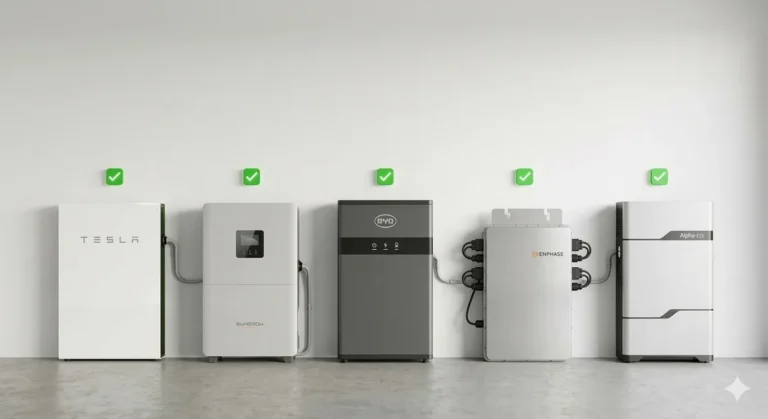
Choosing a home battery in Perth in 2026 is genuinely harder than it was two years ago. The market has matured, the incentives have stacked up, and there are now four credible tier-one options competing for your wall space: the BYD Battery-Box HVM, Tesla Powerwall 3, Sungrow SBR, and Enphase IQ Battery. Each one has a compelling case. None of them is right for every home.
The stakes are real. With Perth electricity rates continuing to climb and the WA Residential Battery Scheme now open, eligible Synergy customers can claim up to $1,300 in WA rebates, stacked on top of the Federal Government’s Cheaper Home Batteries Program (approximately $2,450 on a 10 kWh battery at current rates). That’s close to $3,750 off the installed cost before you’ve even negotiated a price.
But the rebate only matters if you choose the right battery for your household. This guide cuts through the spec sheets and gives Perth homeowners a straight answer.
What this guide covers:
- Full specs comparison across all eight decision-making criteria
- Side-by-side comparison table
- Which battery suits your household size and energy usage
- WA Battery Scheme eligibility for each model
- Installed price ranges in Perth for 2026
The Four Batteries at a Glance
Before diving into the detail, here is how all four batteries compare across the criteria that matter most to Perth homeowners. All prices are installed estimates for the Perth metro area in 2026, before any rebates are applied.
| Spec | BYD Battery-Box HVM | Tesla Powerwall 3 | Sungrow SBR | Enphase IQ Battery |
|---|---|---|---|---|
| Usable Capacity | 8.3–22.1 kWh (modular) | 13.5 kWh | 9.6–25.6 kWh (modular) | 5.0–10.0 kWh per unit |
| Round-Trip Efficiency | 96% | 90% | 97% | 89–90% |
| Continuous Power | 8 kW | 11.5 kW | 5–9.6 kW | 3.84 kW per unit |
| Warranty | 10 years / 80% retention | 10 years / 70% retention | 10 years / 60% retention | 15 years / 60% retention |
| Blackout Protection | Yes (with compatible inverter) | Yes (built-in gateway) | Yes (with Sungrow SH hybrid) | Yes (with IQ System Controller) |
| Coupling Type | DC (requires hybrid inverter) | AC (integrated inverter) | DC (Sungrow SH inverter only) | AC (Enphase microinverter system) |
| Inverter Compatibility | Fronius, SMA, SolarEdge, GoodWe, Sungrow + more | Tesla Solar Inverter only | Sungrow SH series only | Enphase microinverter system only |
| WA Scheme Eligible | Yes | Yes | Yes | Yes |
| Installed Price (Perth) | $8,500–$14,000 | $14,000–$17,000 | $7,500–$10,500 | $12,000–$15,000 |
Key takeaway: Every battery in this comparison qualifies for the WA Residential Battery Scheme. The decision comes down to your existing inverter, your household’s energy usage, and how much you value backup power versus cost per kWh.
Battery-by-Battery Breakdown
The table gives you the numbers. This section gives you the context behind them.
BYD Battery-Box HVM: Best Value and Most Flexible
The BYD HVM is the most popular home battery in Australia right now, and the reason is straightforward: it offers the best combination of capacity, efficiency, and inverter flexibility at a competitive price point.
What sets it apart:
- Modular design stacks from 8.3 kWh up to 22.1 kWh, so you only pay for what you need
- 96% round-trip efficiency means you lose very little energy in the charge-discharge cycle
- Works with a wide range of hybrid inverters including Fronius, SMA, SolarEdge, GoodWe, and Sungrow, making it the easiest retrofit option if you already have solar
- Best-in-class warranty retention: BYD guarantees 80% capacity after 10 years, compared to 70% for the Powerwall 3 and 60% for Sungrow
The one limitation worth knowing: the BYD HVM is DC-coupled and requires a compatible hybrid inverter. It cannot be paired with a standard string inverter without additional hardware. For homes with existing non-hybrid inverters, this means either replacing the inverter or choosing a different battery.
Best for: Households wanting maximum capacity flexibility, those with compatible hybrid inverters already installed, and buyers prioritising long-term capacity retention.
Tesla Powerwall 3: Simplest All-in-One, Highest Power Output
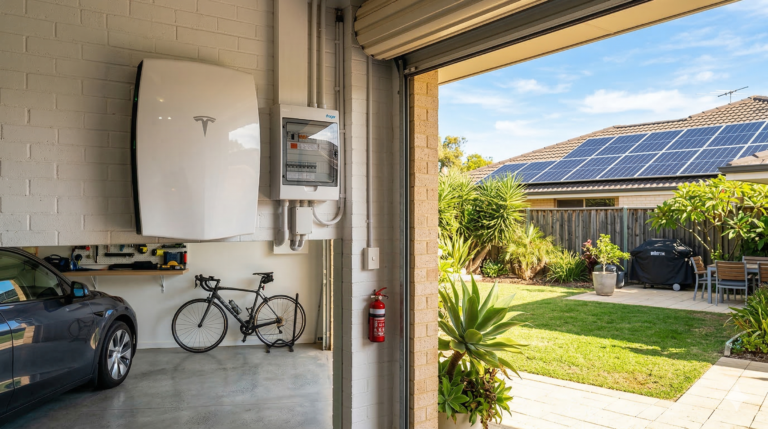
The Powerwall 3 dominates brand recognition in the battery market, and it earns that reputation in specific use cases. Its defining feature is the built-in 11.5 kW solar inverter with six MPPTs, which means the battery and solar inverter are a single unit. For a brand-new solar-plus-battery installation, this simplifies the system considerably.
What sets it apart:
- Highest continuous power output of the four at 11.5 kW, with a 22 kW peak for 10 seconds
- Built-in backup gateway enables seamless whole-home blackout protection without additional hardware
- IP67 weather rating (better than the IP55 of BYD and Sungrow) suits Perth’s outdoor conditions
- Expandable to 54 kWh with four units stacked
The trade-off is real: at 90% round-trip efficiency, the Powerwall 3 loses roughly twice as much energy per cycle as the BYD HVM or Sungrow SBR. Over a year of daily cycling, that gap translates to meaningful lost solar generation. The installed price is also the highest of the four, typically $14,000–$17,000 in Perth.
Best for: New solar installations where an all-in-one system is preferred, homes with high simultaneous power demands, and buyers who want the simplest possible setup.
Sungrow SBR: Best Value Per kWh, New Installations Only
The Sungrow SBR is the most cost-effective option on a price-per-kWh basis, with Perth installed prices ranging from $7,500 to $10,500. At 97% round-trip efficiency, it is also the most efficient battery in this comparison, meaning more of every kilowatt-hour stored actually makes it back to your home.
What sets it apart:
- Lowest installed cost of the four, making it the strongest choice for budget-conscious buyers
- Highest round-trip efficiency at over 97%
- Highly scalable: modules stack from 9.6 kWh up to 25.6 kWh, with the potential to expand to 102.4 kWh across parallel units
- Lightweight 32 kg modules allow single-person installation, reducing labour time
The critical constraint: the Sungrow SBR is compatible only with Sungrow SH-series hybrid inverters. If your home already has a different brand of inverter, you cannot simply add an SBR without replacing it. This makes the SBR an excellent choice for new installations or for homes already running Sungrow solar hardware, but a poor retrofit option for mixed-brand systems.
Best for: New solar-plus-battery installations, homes already using Sungrow inverters, and buyers who prioritise value per kWh over brand flexibility.
Enphase IQ Battery: Longest Warranty, Microinverter Ecosystem
The Enphase IQ Battery occupies a different position to the other three. It is an AC-coupled system built around Enphase’s microinverter architecture, which means it is a natural fit for homes already running Enphase microinverters on their solar panels but a poor match for everything else.
What sets it apart:
- Industry-leading 15-year warranty, five years longer than the other three
- AC-coupled design means it can be added to virtually any existing solar system without replacing the inverter (provided you use the Enphase IQ System Controller for backup)
- Modular in 5 kWh increments, scalable up to 80 kWh total
The downsides are significant for most Perth buyers. At 89–90% round-trip efficiency, it matches the Powerwall 3 as the least efficient option in this group. The installed cost per kWh is the highest of the four, typically $1,200–$1,500 per kWh installed. And continuous power output is only 3.84 kW per unit, which limits how many appliances you can run simultaneously during a blackout.
Best for: Existing Enphase microinverter customers who want to add storage, households prioritising warranty length above all else, and buyers who want AC-coupled flexibility without replacing their inverter.
Which Battery Is Right for Your Home?
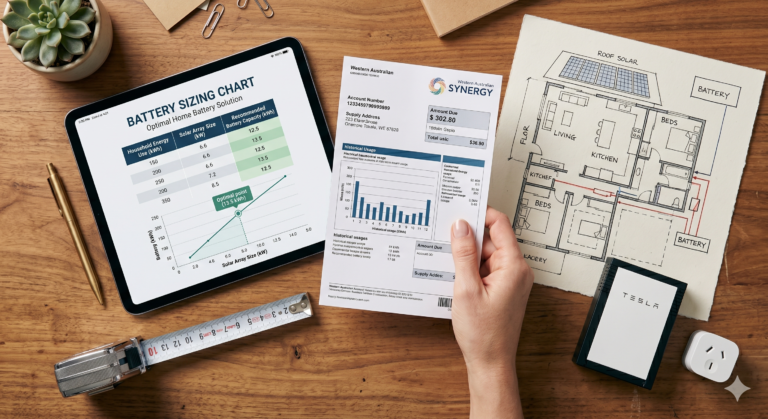
Specs tell you what a battery can do. Your household’s energy profile tells you which one actually makes sense. Use this guide as a starting point, then get a tailored recommendation from a certified installer who can review your actual consumption data.
Small Household (1–2 people, under 15 kWh/day)
A smaller home with modest energy consumption does not need the largest battery on the market. A single BYD HVM module (8.3 kWh) or a Sungrow SBR starting configuration (9.6 kWh) will cover overnight demand comfortably and qualify for the maximum WA Battery Scheme rebate at 10 kWh. The Enphase IQ Battery is also worth considering here if you value the 15-year warranty and already have Enphase solar hardware.
Recommended: Sungrow SBR (new install) or BYD HVM (retrofit with compatible inverter)
Medium Household (3–4 people, 15–25 kWh/day)
This is the most common Perth household profile, and the BYD HVM is the strongest all-round performer here. A 13.8–16.6 kWh configuration covers most overnight demand and provides meaningful backup capacity during an outage. The Tesla Powerwall 3 is also a strong option if you are starting from scratch with a new solar system and want the simplicity of a single integrated unit.
Recommended: BYD HVM 13.8–16.6 kWh or Tesla Powerwall 3 (new installation)
Large Household or High Energy Users (5+ people, 25+ kWh/day, EV charging, pool pump)
Large homes, households with EVs, or those running high-draw appliances need both capacity and power output. The Sungrow SBR shines here: its modular design allows configuration up to 25.6 kWh from a single unit at the lowest cost per kWh of the four. For homes that also want maximum backup power during outages, two Tesla Powerwall 3 units (27 kWh, 23 kW continuous) is a premium but capable solution.
Recommended: Sungrow SBR 19.2–25.6 kWh (new install) or dual Tesla Powerwall 3 (high-power backup priority)
Retrofit: Adding a Battery to Existing Solar
This is where inverter compatibility becomes the deciding factor. Check your existing inverter brand first:
| Existing Inverter | Best Battery Option |
|---|---|
| Fronius, SMA, SolarEdge, GoodWe | BYD HVM (direct DC coupling) |
| Sungrow SH-series hybrid | Sungrow SBR (native pairing) |
| Enphase microinverters | Enphase IQ Battery (native pairing) |
| Standard string inverter (non-hybrid) | Tesla Powerwall 3 (AC-coupled, no inverter replacement needed) or BYD HVM with new hybrid inverter |
If your existing inverter is not hybrid-compatible and you want to avoid replacing it, the Tesla Powerwall 3 is the cleanest retrofit option because its built-in inverter handles the AC coupling independently.
WA Battery Scheme: What Perth Homeowners Can Claim in 2026
All four batteries in this comparison are eligible for the WA Residential Battery Scheme, provided they appear on the Clean Energy Council’s approved battery list and on Synergy’s or Horizon Power’s Supported Solutions List at the time of installation.
What the Scheme Pays
The WA Government rebate is calculated per kWh of usable capacity, capped at 10 kWh:
- Synergy customers (Perth metro): Up to $1,300 (i.e., $130/kWh up to 10 kWh)
- Horizon Power customers (regional WA): Up to $3,800
Batteries larger than 10 kWh still receive the maximum rebate amount. A 16.6 kWh BYD HVM, for example, qualifies for the full $1,300 Synergy rebate, not a pro-rated amount.
Stack the WA rebate with the Federal Government’s Cheaper Home Batteries Program (approximately $2,450 on a 10 kWh battery at current 2026 rates, noting the program’s subsidy steps down at six-monthly intervals), and eligible Perth households can reduce their battery cost by close to $3,750 before installation discounts.
Key Eligibility Requirements
To claim the rebate, you must:
- Be a Synergy or Horizon Power customer
- Install a battery with at least 5 kWh usable capacity
- Join a Virtual Power Plant (VPP) as part of the scheme (mandatory, two-year initial term)
- Use an accredited scheme vendor to submit the application on your behalf
You cannot apply directly. The application must be lodged by an accredited installer. Talk Energy is an accredited WA Residential Battery Scheme vendor and handles the full application process for customers.
No-interest loans of up to $10,000 are also available for eligible households with a gross annual income under $210,000, repayable over up to 10 years through Plenti, the scheme’s financial administrator.
The Bottom Line: Four Good Batteries, One Right Answer for Your Home
There is no universally best battery in 2026. There is only the right battery for your specific home, inverter, energy usage, and budget. Here is the honest summary:
- BYD HVM is the best all-round choice for most Perth households: modular, efficient, inverter-flexible, and the strongest warranty retention of the four.
- Tesla Powerwall 3 is the premium pick for new solar installations or homes that need maximum backup power and want a single integrated unit.
- Sungrow SBR delivers the lowest cost per kWh and highest efficiency, but only makes sense if you are installing new Sungrow solar hardware alongside it.
- Enphase IQ Battery is purpose-built for the Enphase ecosystem and offers the longest warranty, but its per-kWh cost and lower power output make it a niche choice for most Perth buyers.
The part most battery comparisons miss: the battery is only half the decision. The inverter pairing, the installer’s expertise, and the quality of the installation itself determine how well any of these systems actually performs over a decade. A well-installed BYD HVM will outperform a poorly installed Powerwall 3 every time.
Talk Energy is a certified installer of all four brands and an accredited WA Battery Scheme vendor. Rather than recommending one battery to every customer, the team assesses your existing system, your energy bills, and your goals before recommending the right fit. With 250+ five-star reviews and in-house electricians backed by a 20-year workmanship warranty, Talk Energy handles everything from system design through to scheme application.
Get a free battery quote from Talk Energy and find out which battery makes the most sense for your home, with the WA Scheme rebate applied from day one.