Solar System Maintenance and Servicing in Perth: What It Covers and When to Book
Solar is low maintenance. It is not no maintenance. Perth’s long dry summers, coastal salt and strong UV are hard on rooftop equipment, and most faults do not announce themselves. A system can lose a string of panels or a failing isolator and keep producing some power for months, so nothing looks wrong until you compare the bills.
This guide covers what solar servicing actually involves, how often to book it, what you can safely do yourself, the common faults found in Perth systems, and what to do if something goes wrong. If you are after cleaning advice specifically, see our solar panel cleaning guide.
Who services and repairs your solar system?
The company that installed it is your first call. Your installer holds the workmanship warranty, knows how the system was designed and wired, and is responsible for faults caused by the installation. That is why Talk Energy services and repairs only the systems we installed.
Here is where to go, depending on your situation:
- Talk Energy installed your system: contact us directly. Faults caused by our installation work are covered by our 20-year workmanship warranty, and our 48-hour fix-or-replace guarantee applies. Request service here.
- Another company installed it and is still trading: contact them. They hold your workmanship warranty, and using a different electrician can complicate a claim.
- Your installer has closed: product warranties still apply. Contact the panel, inverter or battery manufacturer directly. Most have an Australian support line and a claims process.
- You bought a home with solar already fitted: ask the previous owner or agent for the installation paperwork. It lists the installer, the equipment and the warranty details.
Worth knowing: any work on the DC wiring, isolators, inverter or battery must be done by a licensed electrician. Solar installer accreditation in Australia now sits with Solar Accreditation Australia (SAA), and it is held by individual electricians. Ask to see it before anyone works on your system.
What a solar service checks
A solar service is an electrical and physical inspection of the whole system, not just a panel wash. The faults that cost real money, such as a failing isolator, a cracked roof seal or a string that has quietly dropped offline, are found during inspection. A typical service covers:
- Panel inspection: cracking, delamination, discolouration, hot spots, frame corrosion and heavy soiling.
- Mounting and roof check: clamps, rails, tilt frames and the seals around roof penetrations.
- DC isolator and cabling check: rooftop and inverter isolators, conduit, connectors and cable condition. Isolators exposed to Australian UV are a known long-term failure point.
- Inverter check: error and event logs, ventilation, clearances, display and firmware status.
- Electrical testing: string voltages and insulation checks, so a weak or failed string is found even when the system is still producing.
- Output verification: actual generation compared with what the system should produce for its size, orientation and the season.
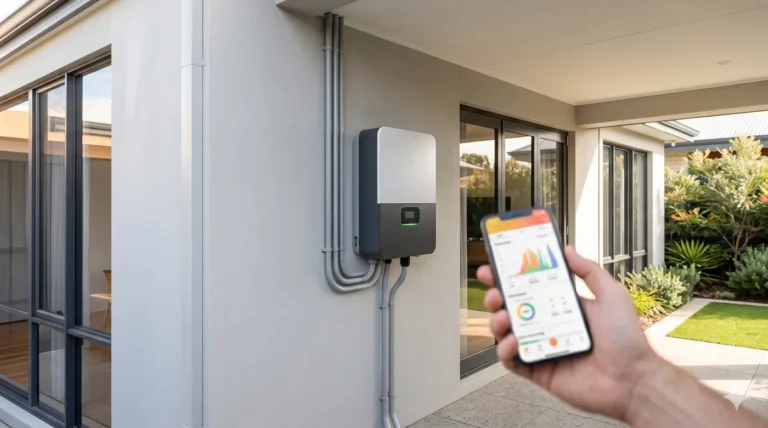
- Monitoring review: confirming the inverter is still reporting to the app, and reading the history for gradual decline or dropouts.
- Battery check (if fitted): state of health, charge and discharge behaviour, backup changeover, error history and the temperature and ventilation around the unit.
- Switchboard check: solar main switch labelling, protection devices and signs of heat or discolouration.
A good service ends with a short written record of what was checked and what was found. Keep it. It is useful for warranty claims and when you sell the house.
How often should you service a solar system in Perth?
Once a year suits most Perth homes. Book more often if your site is harder on equipment. The table below is a practical starting point.
| Your situation | Electrical service | Why |
|---|---|---|
| Standard Perth metro home | Every 12 months | Catches isolator, cabling and inverter issues before they cost you output |
| Coastal suburbs (e.g. Scarborough, Cottesloe, Rockingham) | Every 6–12 months | Salt speeds up corrosion on frames, fixings and connectors |
| Near bushland, farms or the Perth Hills | Every 6–12 months | Leaf litter, ash and pests nesting under panels |
| System with a home battery | Every 12 months | Battery health, backup changeover and firmware need checking |
| System 10+ years old | Every 12 months, no skipping | Inverters and isolators are reaching typical end of life |
| After a major storm, hail or roof work | Straight away | Physical damage and disturbed cabling are common |
Quick tip: book your annual service in autumn (March to May). Summer heat and dust have done their worst by then, and you go into winter, when every kilowatt counts, with a checked system.
Annual solar maintenance schedule
Most of the work is a few minutes a month from you, plus one professional service a year. Use this as a checklist.
| Task | How often | Who does it |
|---|---|---|
| Check daily generation in the monitoring app | Monthly | You |
| Look at the inverter display for fault codes or warning lights | Monthly | You |
| Review battery state of health and charge cycling in the app | Every 6 months | You |
| Check for new shading from trees or neighbouring buildings | Every 6 months | You (from the ground) |
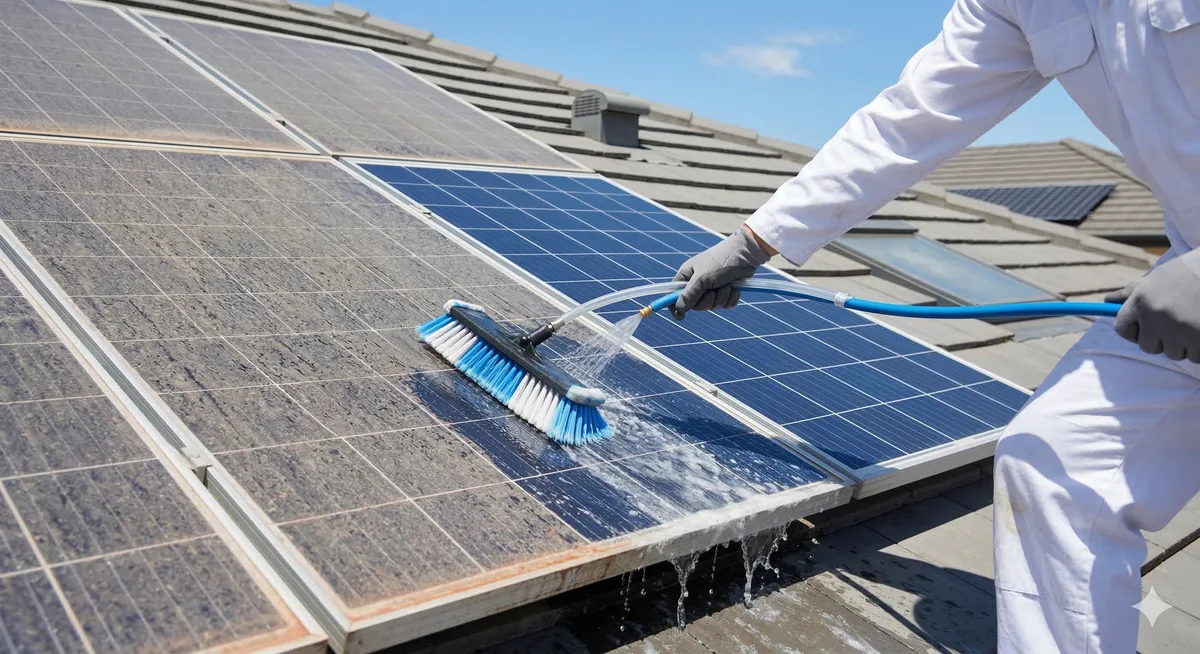
| Panel cleaning, if output has dropped from soiling | As needed (see the cleaning guide) | You from the ground, or a professional |
| Full inspection: panels, mounting, roof seals, isolators, cabling | Every 12 months | Licensed electrician |
| Inverter log review and firmware check | Every 12 months | Licensed electrician |
| Battery health report and backup test | Every 12 months | Licensed electrician |
| Compare actual yearly output with expected output | Every 12 months | You and your electrician |
How to benchmark your output: find the estimated yearly generation on your original quote. Allow for normal panel ageing of about 0.5% a year. If your actual yearly output is more than 10% below that adjusted figure with clean panels, book an inspection.
Common solar faults and repairs in Perth
Most solar repairs in Perth come down to a handful of recurring problems. Knowing them helps you spot trouble early.
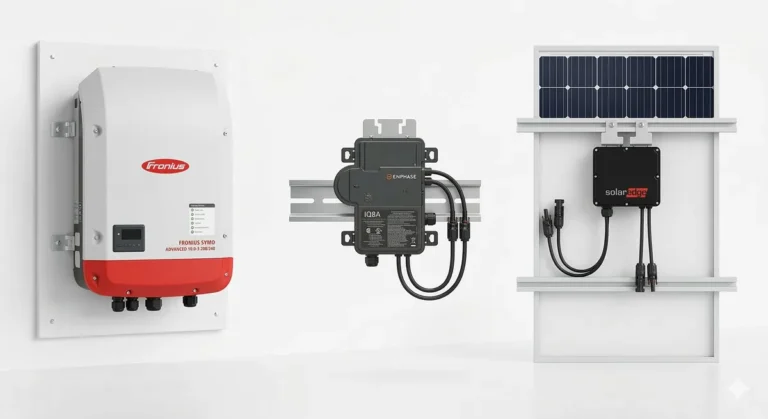
- Inverter faults. The inverter is the hardest-working part of the system. String inverters typically last 10–15 years against a 25-year panel life, so one replacement over the system’s life is normal. Partial failure is the sneaky one: the system keeps producing, just well below capacity.
- DC isolator failure. Rooftop isolators sit in full sun for years. Water entry and UV damage can cause faults and, in rare cases, overheating. They should be inspected at every service and replaced when worn.
- A string dropping offline. A loose connector or damaged cable can take a whole string of panels out. Output falls, often by a third or more, but nothing else looks wrong.
- Hot spots. Perth’s summer heat can cause hot spots where a cell is shaded, cracked or soiled. They show as brown or discoloured patches and reduce output.
- Pest damage. Birds, possums and rats nest under panels and chew cabling. Mesh critter guards around the array edges help prevent it.
- Monitoring dropouts. Systems often lose their wi-fi connection after a router or password change. Without monitoring you have no early warning of any of the faults above.
- Roof leaks. Damaged seals around roof penetrations can let water in. Treat ceiling staining below the array as urgent.
- New shading. Trees grow. Shade that did not exist on installation day can cost more output than any amount of dust.
For a closer look at fault-finding and what repairs involve, see our guide to solar repairs in Perth.
Battery maintenance: what to check
Home batteries need little hands-on care, but they do need watching. Lithium batteries age faster in sustained heat, which matters in a Perth summer, especially if the unit sits in direct sun or a poorly ventilated garage.
- State of health (SoH): most battery apps show this as a percentage of original capacity. A steady, slow decline is normal. A sudden drop is not.
- Charge and discharge pattern: the battery should fill during the day and discharge in the evening. If it sits at 100% or 0% for days, something is wrong with the settings or the hardware.
- Backup changeover: if your battery provides blackout backup, have it tested at your annual service.
- Location and airflow: keep the area around the battery clear. Do not stack boxes against it or block vents.
- VPP and settings changes: if your battery is in a virtual power plant (required if you claimed the WA Residential Battery Scheme rebate), keep an eye on whether its behaviour changes after an update.
Worth knowing: battery warranties usually guarantee a minimum capacity after a set number of years or a set amount of energy throughput. Your app’s SoH reading is the evidence you would use in a claim, so check it every six months. Read more about batteries on our solar battery page.
What you can safely do yourself
You can monitor, look and report. Anything electrical or on the roof needs a licensed electrician. The line is clear.
Safe for you to do:
- Check your monitoring app and the inverter display each month
- Review battery state of health in the app
- Rinse panels from the ground with a hose on a cool morning or evening
- Trim vegetation that is starting to shade the array (from the ground, or use an arborist)
- Keep the inverter and battery area clear and ventilated
- Keep a simple log of service dates and readings
Always leave to a licensed electrician:
- Anything on the DC side. Panels produce lethal DC voltage whenever there is daylight, and they cannot be switched off at the panel.
- Opening, resetting or replacing isolators, the inverter or the battery
- Going onto the roof. Falls from roofs cause serious injuries every year, and it is not worth the risk.
- Fault-finding on live components
- Any work needed to support a warranty or insurance claim
Never pressure wash panels or use detergents or abrasive pads. All three can damage seals or the glass coating and may void product warranties. The solar panel cleaning guide covers safe cleaning in detail.
Warning signs: when to book a service or repair
Do not wait for the annual service if you see any of these. Call your installer.
- Output down more than about 10% on the same period last year, with clean panels and similar weather
- An inverter fault code or warning light that does not clear
- The system producing nothing on a sunny day
- Power bills rising with no change in how you use power
- Visible damage to panels, frames, conduit or cabling
- Unusual buzzing, clicking or heat from the inverter
- Water staining on the ceiling below the array
- A battery that stops cycling, or a backup that failed during an outage
Maintenance, warranties and what affects the cost
Faults caused by the installation should be fixed under your installer’s workmanship warranty at no cost to you. Routine servicing, cleaning and wear-and-tear repairs outside warranty are usually paid for separately.
Most solar systems carry three kinds of warranty:
| Warranty | What it covers | Who you claim with |
|---|---|---|
| Workmanship | Installation quality: wiring, mounting, roof penetrations, connections | Your installer |
| Product | Manufacturing defects in panels, inverter or battery | The manufacturer (often via your installer) |
| Performance | Minimum panel output over time, or minimum battery capacity | The manufacturer |
Neglect can affect a claim. Ignoring fault codes, letting the array get heavily shaded or soiled, or letting an unlicensed person work on the system can all give a manufacturer grounds to refuse. A simple record of service dates protects you.
For services and repairs that are not covered by warranty, the cost depends on:
- System size and number of panels and strings
- Roof height, pitch and access (two-storey and steep roofs take longer)
- Whether a battery is included in the inspection
- Parts needed, such as a replacement isolator or inverter
- Whether the fault is found on the first visit or needs extra diagnosis
Our solar warranty page explains what Talk Energy’s warranty covers, and the 20-year warranty guide goes into more detail.
Servicing and repairs for Talk Energy customers
If Talk Energy installed your system, servicing and repairs come straight back to us. Every Talk Energy installation is fitted by our own in-house SAA-accredited electricians, with no subcontractors, and is covered by:
- A 20-year workmanship warranty. If a fault is caused by our installation work, such as wiring, mounting, roof penetrations or connections, we fix it at no cost to you.
- A 48-hour fix-or-replace guarantee. If your system develops a fault, we act on it fast, so you are not left without solar for long.
- The same in-house team. The electrician who attends works for Talk Energy and is accountable to us directly.
Maintenance and servicing are available for systems we installed. When something goes wrong, the process is simple:
- Get in touch. Call (08) 6255 5914 or request service online. Have your address and any fault code ready.
- We review the problem. Monitoring data and a description of the symptoms often narrow it down before anyone visits.
- An electrician attends if needed. One of our in-house electricians inspects and tests the system.
- Fix or replace. Installation faults are fixed under our workmanship warranty. Where a product fault is found, we help you with the manufacturer warranty claim.
To repeat the important part: we do not take on servicing, fault-finding or repairs for systems installed by other companies. If that is your situation, contact your original installer or the equipment manufacturer.
Frequently asked questions
How often should a solar system be serviced in Perth?
Once a year suits most Perth homes. Coastal homes, homes near bushland, and systems more than 10 years old benefit from a service every 6 to 12 months. Book a check straight away after a major storm, hail or roof work. Autumn is a good time for the annual service.
What does a solar system service include?
A proper service inspects the panels, mounting and roof seals, checks the DC isolators and cabling, reviews the inverter’s fault log, tests string performance, compares actual output with expected output, and confirms your monitoring is still reporting. If you have a battery, its state of health and backup function are checked too.
Does Talk Energy service or repair solar systems installed by other companies?
No. Talk Energy services and repairs only systems that Talk Energy installed. If another company installed your system, contact that installer first. If they have closed, your panel, inverter and battery manufacturer warranties still apply, so contact the manufacturer directly.
How do I know if my solar system needs a repair?
The main signs are an inverter fault code that will not clear, output more than about 10% below the same period last year with clean panels, no production on a sunny day, rising power bills with no change in use, visible damage, or water staining below the array. Check your monitoring app monthly so you notice early.
Is solar maintenance covered by warranty?
Faults caused by the installation are covered by your installer’s workmanship warranty, and manufacturing defects are covered by product warranties. Routine servicing, cleaning and wear-and-tear repairs are usually not. Talk Energy installations carry a 20-year workmanship warranty and a 48-hour fix-or-replace guarantee.
Can I maintain my solar panels myself?
You can check your monitoring app and inverter display, review battery health, trim shading vegetation and rinse panels from the ground on a cool morning or evening. Anything on the roof or involving the DC wiring, isolators, inverter or battery must be done by a licensed electrician, because solar panels carry lethal voltage whenever there is daylight.