Best Solar Inverters for Perth Homes in 2026: Fronius vs Sungrow vs Huawei
Perth homes generate more solar energy per installed kilowatt than almost anywhere else in Australia. According to Bureau of Meteorology data, Perth averages over 8 hours of peak sun daily in summer, and each kilowatt of rooftop solar produces roughly 4.4 kWh per day across the year. That output potential is only realised if the inverter converting your DC solar power to usable AC electricity is doing its job properly.
The inverter is the single most critical component in your solar system. Panels degrade slowly over decades. Inverters fail, throttle, and become obsolete far sooner. Choosing the wrong one costs you in lost generation, incompatible batteries, and poor warranty support when things go wrong.
The three brands Talk Energy installs most frequently for Perth residential systems are Fronius, Sungrow, and Huawei. Each has a distinct place in the market. This guide breaks down the real differences so you can make an informed decision before signing a contract.
Key takeaway: There is no single “best” inverter for every Perth home. The right choice depends on your roof layout, battery plans, budget, and how much you value long-term monitoring and support. Read the decision guide at the end to find your match.
String Inverters vs Hybrid Inverters: What Perth Homeowners Need to Know
Before comparing brands, it helps to understand the two inverter types relevant to Perth residential installations.
String Inverters
A string inverter is a single central unit that receives DC power from your entire panel array and converts it to AC. It is the most common and cost-effective configuration. String inverters suit straightforward north-facing roofs with minimal shading and households that are not planning to add a battery in the near term.
The trade-off: if one panel in the string underperforms (from shade, soiling, or fault), the whole string is affected. This is less of a concern on unshaded Perth roofs, but matters on complex or multi-orientation layouts.
Hybrid Inverters
A hybrid inverter does everything a string inverter does, plus it includes a built-in battery management system. This means it can charge and discharge a battery, manage self-consumption, and in some configurations, provide backup power during a grid outage.
Why this matters for Perth homes: The WA Battery Scheme provides rebates for approved battery storage systems. If you are planning to add a battery now or within the next few years, installing a hybrid inverter from day one avoids the cost of retrofitting a separate battery inverter later.
| Feature | String Inverter | Hybrid Inverter |
|---|---|---|
| Battery-ready | No (or limited) | Yes, built-in |
| Typical price (supply) | $900 to $2,300 | $1,500 to $3,700 |
| Backup power capability | No | Yes (model-dependent) |
| Best for | Simple roofs, no battery plans | Battery-ready households |
| Efficiency | 97.0 to 98.0% | 96.5 to 97.6% |
All three brands reviewed below offer both string and hybrid models. Talk Energy recommends hybrid inverters for most Perth homeowners in 2026, given the WA Battery Scheme incentives and falling battery prices.
Fronius Gen24 Plus: The Premium Choice
Origin: Austria | Type: String and Hybrid | Price range (supply): $1,800 to $3,700
Fronius has won the top spot in Australian installer surveys for five consecutive years, including SolarQuotes’ 2025 installer rankings where it received 26% of the vote. That consistency reflects a product built to last, not just to sell.
What Sets Fronius Apart
The Gen24 Plus uses active cooling (a built-in fan) rather than relying solely on passive heat dissipation. This is a meaningful advantage in Perth summers, where ambient temperatures regularly exceed 35°C and inverters mounted in sub-optimal positions can experience thermal derating. Most quality inverters begin to derate output at around 45 to 50°C ambient temperature. Fronius’s active cooling system helps maintain full output for longer in high-heat conditions.
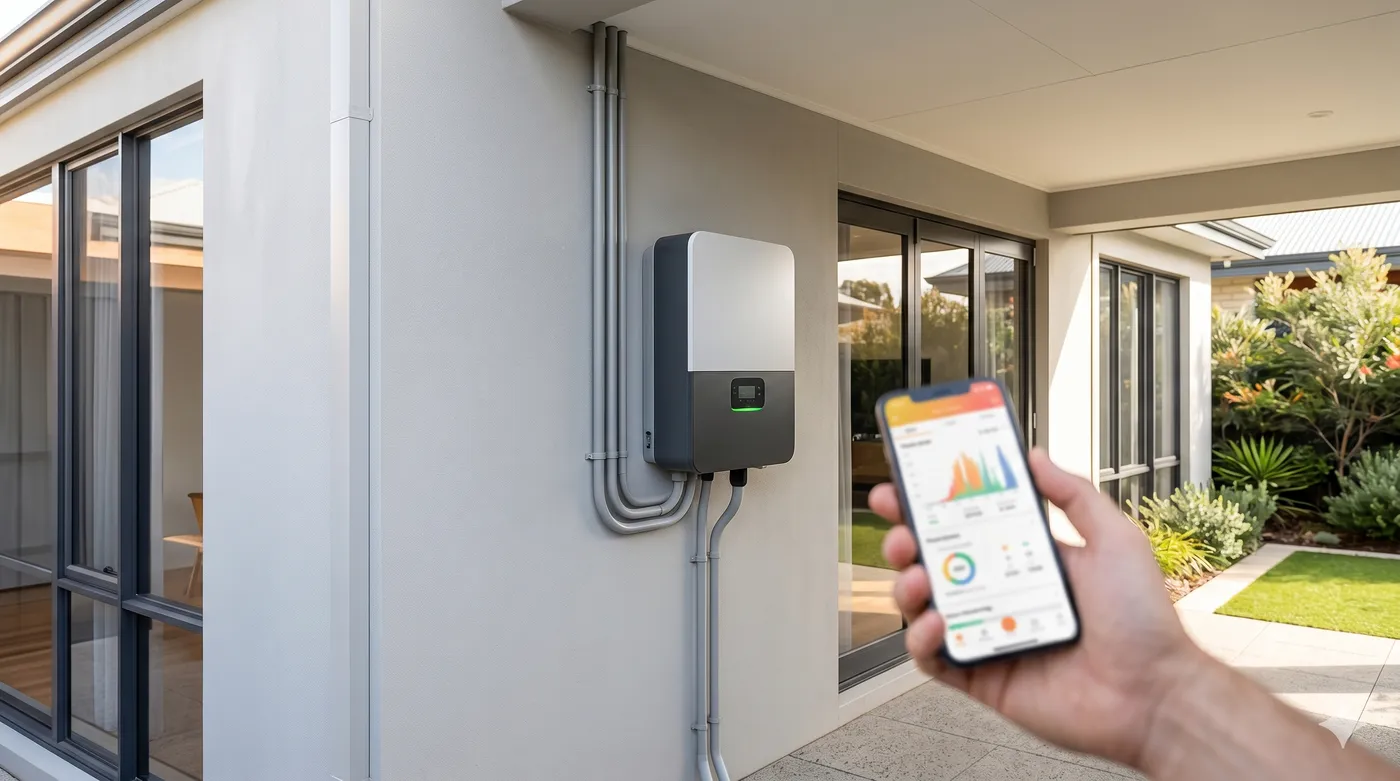
The monitoring platform, Fronius Solar.web, is widely regarded as the most detailed in the residential market. It provides real-time generation data, fault alerts, and historical performance tracking via a browser or mobile app.
Battery Compatibility
The Gen24 Plus is natively compatible with BYD Battery-Box and select other batteries. It is not locked to a proprietary battery ecosystem, which gives Perth homeowners flexibility if they want to compare battery options. Note that Fronius Primo single-phase string inverters require a software upgrade (approximately $1,000) when adding a battery later, which is worth factoring into the total cost of ownership.
Warranty
- Standard: 5 years
- Extended (with product registration): 10 years
- Talk Energy’s 20-year workmanship warranty applies to all Fronius installations
Fronius: At a Glance
- Efficiency: 97.6% (Gen24 Plus hybrid)
- Sizes available: 3 kW to 10 kW
- Best for: Households prioritising long-term reliability, detailed monitoring, and premium build quality
- Watch out for: Higher upfront cost; extended warranty requires registration; some models periodically on backorder in WA
Sungrow SH Series: The Best-Value Hybrid
Origin: China | Type: String and Hybrid | Price range (supply): $900 to $2,800
Sungrow is the world’s second-largest solar inverter manufacturer by installed capacity, and its SH hybrid series is one of the most commonly installed residential inverters across Australia. In the same SolarQuotes installer survey, Sungrow took second place with 19% of the vote, and it has placed on the podium every year since the survey began in 2021.
What Sets Sungrow Apart
The SH series offers a compelling combination of reliability, battery integration, and competitive pricing. At roughly $1,000 less than an equivalent Fronius for a 10 kW unit (Sungrow SG10RS at approximately $2,300 vs Fronius Gen24 10.0 at approximately $3,700), the savings are substantial.
Sungrow’s hybrid inverters pair natively with the Sungrow SBR battery series, which is one of the more cost-effective battery options available under the WA Battery Scheme. The ecosystem is well-integrated: the iSolarCloud monitoring app communicates seamlessly with both the inverter and battery, and firmware updates are delivered over the air.
Heat Performance
Sungrow inverters use passive cooling with large heat sinks, and the SH series is rated to operate at ambient temperatures up to 60°C. In practice, Perth homeowners should still follow best-practice installation guidelines: mount the inverter on a shaded, south or east-facing wall with adequate clearance for airflow. Proper placement eliminates thermal derating as a real-world concern for the vast majority of Perth installations.
Monitoring
The iSolarCloud platform provides real-time data, historical generation reports, and fault alerts. It is functional and reliable, though the interface is less polished than Fronius Solar.web. A mobile app is available for iOS and Android.
Warranty
- Standard: 10 years (no registration required)
- Talk Energy’s 20-year workmanship warranty applies to all Sungrow installations
Sungrow: At a Glance
- Efficiency: 97.5% (SH hybrid series)
- Sizes available: 2.5 kW to 25 kW (single and three-phase)
- Best for: Budget-conscious households wanting a reliable hybrid with strong battery integration
- Watch out for: Monitoring app is less feature-rich than Fronius; not ideal for complex multi-orientation roofs without additional optimisers
Huawei SUN2000: The Smart String Option
Origin: China | Type: Optimised String and Hybrid | Price range (supply): $1,500 to $3,000
Huawei’s SUN2000 series occupies a different niche from Fronius and Sungrow. Rather than competing purely on string inverter performance, it differentiates through panel-level optimisation. Each SUN2000 can be paired with Huawei Smart Power Sensors and optional Smart String optimisers, giving it shade-management capabilities that standard string inverters lack.
An important note for Perth homeowners: Huawei inverters stopped being shipped directly to Australia in early 2024. They are now available locally under the iStore brand name, which is an Australian company that sells and supports the products. Talk Energy works with the iStore supply chain, so availability in WA is maintained, but it is worth understanding this context when comparing warranties and support pathways.
What Sets Huawei Apart
The SUN2000’s standout feature is its 98.0% peak efficiency, the highest of the three brands reviewed here. It also ships with a 10-year warranty as standard, matching Sungrow and bettering Fronius’s base 5-year term.
The FusionSolar monitoring app provides panel-level data when optimisers are installed, which is more granular than what Sungrow’s iSolarCloud offers at the string level. However, some Australian users have reported reliability issues with the FusionSolar app, including connectivity dropouts, which is worth noting if remote monitoring is a priority.
Battery Compatibility
The SUN2000 pairs natively with Huawei’s LUNA2000 battery. Third-party battery compatibility is more limited than Fronius or Sungrow, which matters if you want to compare battery options or take advantage of different WA Battery Scheme-approved products. If you are committed to the Huawei ecosystem (inverter plus LUNA2000 battery), the integration is seamless. If you want flexibility, Sungrow or Fronius offer more open compatibility.
Warranty
- Standard: 10 years
- Talk Energy’s 20-year workmanship warranty applies to all Huawei/iStore installations
Huawei SUN2000: At a Glance
- Efficiency: 98.0% (highest of the three)
- Sizes available: 2 kW to 20 kW (single and three-phase)
- Best for: Roofs with partial shading, households planning to use the Huawei LUNA2000 battery
- Watch out for: Limited third-party battery compatibility; FusionSolar app reliability issues reported; supply now via iStore rather than Huawei direct
Side-by-Side Comparison: Fronius vs Sungrow vs Huawei
| Fronius Gen24 Plus | Sungrow SH Series | Huawei SUN2000 | |
|---|---|---|---|
| Origin | Austria | China | China (via iStore AU) |
| Type | String / Hybrid | String / Hybrid | Optimised String / Hybrid |
| Peak efficiency | 97.6% | 97.5% | 98.0% |
| Standard warranty | 5 years | 10 years | 10 years |
| Extended warranty | 10 years (with registration) | 10 years | 10 years |
| Supply price range | $1,800 to $3,700 | $900 to $2,800 | $1,500 to $3,000 |
| Battery compatibility | BYD, open ecosystem | Sungrow SBR, open | LUNA2000 (limited 3rd party) |
| Monitoring platform | Fronius Solar.web (excellent) | iSolarCloud (good) | FusionSolar (variable) |
| Heat management | Active cooling (fan) | Passive (heat sink, 60°C rated) | Passive (heat sink) |
| Shade management | Standard MPPT | Standard MPPT | Smart String optimisers available |
| WA Battery Scheme compatible | Yes | Yes | Yes (via approved batteries) |
| Talk Energy approved | Yes | Yes | Yes |
All prices are indicative supply-only figures for 2026 and will vary based on system size and configuration. Installed prices are higher; contact Talk Energy for a current quote specific to your home.
Heat Performance in Perth: What You Actually Need to Know
Perth’s climate is the most relevant test environment for any inverter sold in WA. The city regularly records temperatures above 35°C in summer, and heatwave days above 40°C occur most years. According to Bureau of Meteorology data analysed for Perth, over 80% of days in a given year have a maximum temperature above 20°C, and more than 25% exceed 30°C.
The key risk is thermal derating. When an inverter’s internal temperature exceeds its programmed threshold, it reduces output to protect its electronics. This is not a fault; it is a safety feature. But it does mean lost generation on your hottest days, which are also often your highest-consumption days (air conditioning running hard).
Most quality inverters, including all three reviewed here, begin to derate at ambient temperatures of 45 to 50°C. The practical takeaway is that inverter placement matters far more than brand specification in Perth conditions.
Installation Placement: The Biggest Heat Variable
Regardless of which inverter you choose, Talk Energy’s installers follow these placement rules to minimise thermal derating risk:
- Mount on a shaded wall — south or east-facing is ideal in Perth. Avoid west-facing walls exposed to afternoon sun.
- Keep it off the garage floor — enclosed garages with poor ventilation trap heat and can push ambient temperatures well above outdoor levels.
- Maintain clearance — all three brands specify minimum clearance distances in their installation manuals. These must be followed.
- Never mount in direct sunlight — an inverter in direct sun can reach temperatures 15 to 20°C above ambient, pushing it into derating territory on days when you need it most.
Fronius’s active cooling fan gives it a marginal advantage in genuinely extreme conditions. For most Perth homes where the inverter is correctly placed, however, all three brands perform reliably across summer. The bigger risk is poor installation practice, not brand choice.
Which Inverter Is Right for Your System? Talk Energy’s Decision Guide
Use this guide to identify the most suitable inverter for your situation. These are Talk Energy’s recommendations based on real Perth installations, not generic advice.
Choose Fronius Gen24 Plus if:
- You want the most reliable inverter on the Australian market and are willing to pay a premium for it
- Detailed, long-term monitoring data is important to you (Solar.web is the best platform available)
- You have a three-phase power connection and want a premium hybrid
- You are pairing with a BYD battery and want a well-tested, open-ecosystem setup
- Long-term resale value and brand recognition matter to you
Choose Sungrow SH Series if:
- You want a reliable hybrid inverter at a significantly lower price point than Fronius
- You are planning to pair with a Sungrow SBR battery (one of the most cost-effective WA Battery Scheme-approved options)
- Your roof is straightforward with good north-facing orientation and minimal shading
- You want a 10-year standard warranty without needing to register the product
- You are working within a tighter budget but do not want to compromise on quality
Choose Huawei SUN2000 if:
- Your roof has partial shading from trees, chimneys, or neighbouring structures
- You want panel-level optimisation without the cost of a full microinverter system
- You are committed to the Huawei LUNA2000 battery and want seamless ecosystem integration
- Peak efficiency matters and you are comfortable with the iStore supply arrangement
Not Sure? Talk Energy’s Recommendation for Most Perth Homes
For the majority of Perth residential installations in 2026, Talk Energy recommends the Sungrow SH hybrid series as the default choice. It offers a 10-year warranty, proven reliability, strong battery integration, and a price point that makes the hybrid upgrade from a string inverter financially straightforward. The savings over Fronius ($1,000 to $1,500 on a typical 10 kW unit) can be redirected toward a larger battery or additional panels.
Upgrade to Fronius if you value best-in-class monitoring, active cooling, or are installing a premium system where long-term performance data matters.
Consider Huawei if shading is a genuine issue on your roof and you want smart string optimisation without committing to a full microinverter system.
All three brands are on Talk Energy’s approved inverter list and are backed by Talk Energy’s 20-year workmanship warranty and 48-hour fix guarantee.
Frequently Asked Questions
What is the lifespan of a solar inverter?
Most quality inverters last 10 to 15 years. All three brands reviewed here offer 10-year warranties. Solar panels typically last 25 to 30 years, so most homeowners will replace their inverter at least once over the system’s life. Choosing a brand with strong Australian support makes that process straightforward.
Do I need a hybrid inverter if I am not ready to add a battery yet?
Not necessarily, but it is worth considering. A hybrid inverter costs approximately $500 to $1,000 more than an equivalent string inverter. If you think you will add a battery within the next three to five years, paying that premium now avoids replacing the inverter later. Talk Energy can model both scenarios for your home.
Will my inverter work with the WA Battery Scheme?
The WA Battery Scheme requires an approved battery, not a specific inverter. However, the inverter must be compatible with your chosen battery. Fronius and Sungrow hybrids work with multiple approved batteries. Huawei SUN2000 is most naturally paired with the LUNA2000. Talk Energy will confirm compatibility before any system is designed.
Does inverter brand affect my STC rebate?
No. STCs are calculated based on system size and location, not the inverter brand. All CEC-approved inverters qualify equally. Talk Energy handles STC paperwork as part of every installation.
What happens if my inverter fails?
Talk Energy’s 48-hour fix guarantee applies regardless of when a fault is reported. In-house electricians handle inverter faults directly, without subcontracting.
Is Fronius worth the extra cost over Sungrow?
For most Perth homeowners, Sungrow delivers 95% of Fronius’s performance at roughly 70% of the price. The difference is primarily in monitoring depth and active cooling. If those features matter to you, Fronius is worth the premium. Otherwise, the savings are better directed toward a larger battery or more panels.
Get a Quote from Talk Energy
Talk Energy installs Fronius, Sungrow, and Huawei inverters across Perth metro and regional WA. Every installation is completed by in-house SAA-accredited electricians and backed by a 20-year workmanship warranty with a 48-hour fix or replace guarantee.
If you are not sure which inverter suits your home, Talk Energy’s team will assess your roof layout, energy usage, battery plans, and budget before making a recommendation. There is no obligation and no pressure to choose the most expensive option.
Ready to compare quotes? Visit talkenergy.com.au/solar-quote-perth or call 08 6255 5914 to speak with a Perth-based solar specialist.
You can also explore Talk Energy’s full range of approved inverters, panels, and batteries at talkenergy.com.au/partners, or use the solar savings calculator to estimate your return before booking a consultation.