Solar and Battery Installation in Canning Vale, Willetton and the City of Canning
Quick answer: Most houses in Canning Vale, Willetton and the rest of the City of Canning can add rooftop solar without development approval, as long as the work meets the normal planning rules. City of Canning residents can also claim a council rooftop solar rebate of $500 ($700 for concession card holders) for a first-time system in 2026/27. A battery can attract up to $1,300 from the WA Residential Battery Scheme (Synergy customers) plus the federal Cheaper Home Batteries discount. Check your property title for estate covenants before you sign.
This guide covers what is specific to your area: which council you are in, the City of Canning’s own solar rebate, estate covenants, and how the battery rebates stack.
Which council covers your suburb?
Most suburbs here sit inside the City of Canning, but a few are shared with neighbouring councils. Council rebates and planning policies only apply inside the boundary.
| Suburb | Council area |
|---|---|
| Willetton, Riverton, Shelley, Rossmoyne, Ferndale, Lynwood, Parkwood, Cannington | City of Canning |
| Canning Vale | Shared: City of Canning and City of Gosnells |
| Bentley | Shared: City of Canning and Town of Victoria Park |
| Leeming | Split: Canning, Melville and Cockburn |
| Bull Creek (neighbouring) | City of Melville |
Worth knowing: Canning Vale is split between two councils. Your rates notice shows which one you pay rates to. That tells you whether City of Canning rebates and policies apply to your home.
If you are in Bull Creek or the Melville side of Leeming, our guide to solar and batteries in Melville, Applecross and Booragoon covers your council.
Do you need council approval for solar in the City of Canning?
Usually not, for a standard rooftop system on a house. There are two separate approvals to know about.
Building permit
WA’s Building Regulations 2012 exempt the attachment of solar panels to the roof of a house (a Class 1 or 10a building) from needing a building permit, unless the home is in cyclonic wind region C or D. Those regions are in the north of the state, not Perth. The exemption covers attaching the panels only. If your roof needs extra structural strengthening, that work may need a permit. The permit authority, usually the local council, makes the final call.
Development (planning) approval
The City of Canning says single houses are exempt from development approval where the work meets the deemed-to-comply rules of the Residential Design Codes, the City’s Local Planning Scheme No. 42 and its local planning policies. Any variation to those rules needs approval.
As general guidance, panels mounted flat to a house roof rarely trigger planning issues. Heritage-listed homes, strata properties, ground-mounted or tilt-frame arrays and commercial buildings deserve a check first.
If you are unsure, the City of Canning runs a General Planning Advice Service. Ask before you sign, not after.
The City of Canning rooftop solar rebate
City of Canning residents installing solar for the first time can claim $500 back from the council, or $700 with a concession card. This sits on top of the federal STC discount that is already built into most solar quotes.
The key conditions for the 2026/27 round (1 July 2026 to 30 June 2027) are:
- First-time solar only. Homes with existing or previous panels, add-ons and replacement panels or inverters don’t qualify.
- Residential homes only. Apartment blocks and businesses are excluded.
- Owners, tenants and landlords can apply. Tenants need a landlord consent letter.
- One claim per household.
- Approved seller and accredited installer. Panels must come from a New Energy Tech Consumer Code (NETCC) Approved Seller and be installed by a Solar Accreditation Australia (SAA) accredited installer.
- Purchase within the financial year you apply in.
- Batteries, solar hot water and pool heating aren’t covered.
You apply online through the City’s Rebately portal with your invoice, proof of residence, a recent power bill, your STC form or electrical safety certificate, and photos of the panels. It is first-come, first-served until the year’s budget runs out.
Quick tip: Ask any installer to confirm they meet the NETCC seller and SAA installer conditions in writing. Check the City of Canning Eco Rebates page to make sure the round is still open. If you are on the City of Gosnells side of Canning Vale, this rebate doesn’t apply to you.
Estate covenants: check your title first
Some newer estates carry restrictive covenants, so read yours before you design a system. A covenant is registered on your Certificate of Title and binds you as the owner, even where council rules would allow the work.
WA’s planning bulletin on restrictive covenants notes that private developers use them to add controls beyond the local planning scheme “to enhance the amenity and character of an estate”. In practice that can cover roof materials, what is visible from the street, or where equipment can go. Wording varies from estate to estate, so don’t assume your neighbour’s rules match yours.
- Check the “Limitations, Interests, Encumbrances and Notifications” section of your Certificate of Title (order a copy from Landgate if needed).
- If a restrictive covenant is listed, read the instrument it refers to.
- If it mentions roof-mounted equipment, raise it at the quote stage so the layout can work around it.
Important: Covenants can be varied by agreement or Supreme Court order, but that takes time. Designing around one is usually easier.
Is your Canning or Willetton home a good fit for solar and a battery?
Most detached homes in the area are good candidates, but your own roof decides it. Look at four things.
- Roof direction. North-facing roofs produce the most over a year. East and west roofs still work well, and west-facing panels produce more in the late afternoon when power is dearest.
- Shade. Mature street and garden trees can shade parts of a roof. A site check shows the real picture.
- Your switchboard and meter. Older boards may need work first. Whether your home is single-phase or three-phase affects inverter choice; a site visit confirms it.
- When you use power. Households that use a lot in the evening get the most from a battery.
Why evenings matter: on Synergy’s Midday Saver plan, power costs 8.85c/kWh from 9am to 3pm but 55.33c/kWh from 3pm to 9pm (from 1 July 2026). DEBS pays only 10c/kWh for exports in that peak and 2c/kWh otherwise. Storing midday solar for the evening is usually worth more than exporting it.
Rough 2026 costs
As a rough guide, most Perth homes pay around the amounts below in 2026. Your price depends on your roof, your switchboard and the equipment you choose.
| System | Typical Perth estimate (installed, incl. GST) |
|---|---|
| 6.6 kW solar | $5,000–$7,500 after STCs |
| 10 kW solar | $8,000–$11,000 after STCs |
| 13 kW solar | $10,000–$14,000 after STCs |
| ~10 kWh battery | $9,500–$13,000 before rebates; ~$5,500–$9,000 after federal + WA rebates |
| ~13–16 kWh battery | $13,000–$18,000 before rebates; ~$8,000–$12,500 after federal + WA rebates |
For a fixed figure for your home, get a free quote.
Battery rebates: WA scheme plus federal discount
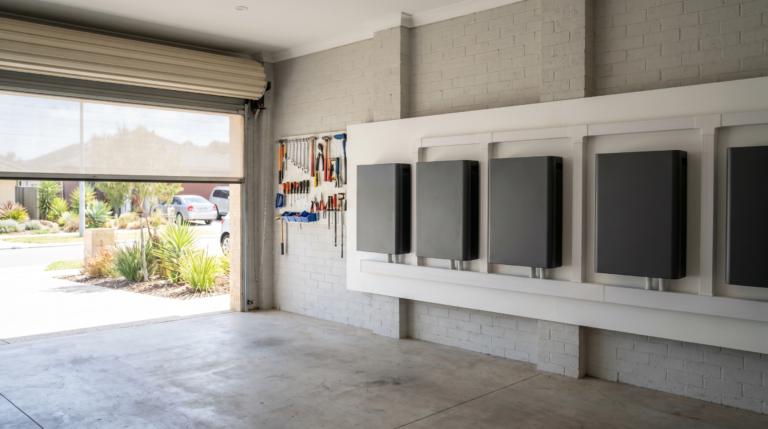
Two battery rebates can apply to the same install. The WA Residential Battery Scheme pays up to $1,300 for Synergy customers, and most Perth households buy their power from Synergy. The federal Cheaper Home Batteries program takes about $2,600–$2,700 off a 10 kWh battery in 2026. Combined, that is roughly $3,900–$4,000 on a 10 kWh battery.
The WA scheme’s main conditions:
- You must join a virtual power plant (VPP). This is mandatory.
- The battery and inverter must be on Synergy’s Supported Solutions List.
- The battery must be at least 5 kWh. There is no maximum, but the rebate caps at 10 kWh.
- One rebate per property. Owners, renters (with the landlord’s written consent) and investment properties (with the tenant’s consent) can apply.
- The rebate isn’t means-tested. An optional no-interest loan of $2,001–$10,000 is available to households earning under $210,000 a year.
The federal discount drops from 1 January 2027, from 6.8 to 5.7 STCs per kWh. Our WA Battery Scheme eligibility checklist walks through each step. The solar battery page explains how a battery fits with your panels.
Worth knowing: A first-time solar and battery install in the City of Canning could use all three rebates: council (solar), WA (battery) and federal (battery).
How a solar and battery install works
A typical install follows five steps.
- Site check. Bills, roof, shading, switchboard, meter and any covenant.
- Design and fixed quote. Panel layout, inverter and battery size are matched to when you use power. The quote should show which rebates have been applied.
- Paperwork. Network connection approval with Western Power, plus the WA battery rebate application if you’re adding a battery.
- Installation. Panels, inverter and any battery go in, followed by testing and commissioning.
- Handover. You get your safety certificate, warranties and a monitoring app walk-through, then lodge any council rebate claim.
Suburbs we cover in and around the City of Canning
Talk Energy Solar & Battery installs across the City of Canning and neighbouring suburbs, including:
- Canning Vale (both the Canning and Gosnells sides)
- Willetton, Riverton, Shelley and Rossmoyne
- Ferndale, Lynwood and Parkwood
- Bentley and Cannington
- Leeming, and Bull Creek in the neighbouring City of Melville
Our office is at 16 Ogilvie Rd, Mount Pleasant, a short drive from Willetton and Bull Creek. See the full list on our Perth service areas guide.
Get a solar or battery quote in Canning Vale or Willetton
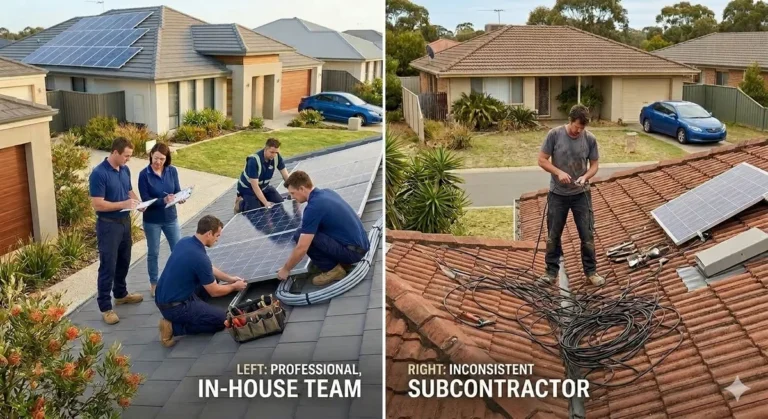
Talk Energy Solar & Battery has been installing in Perth for 7+ years, with 5,000+ installations. Every job is done by our in-house SAA-accredited electricians, not subcontractors (WA electrical contractor licence EC15564). We install Sigenergy SigenStor batteries, and back our work with a 20-year workmanship warranty and a 48-hour fix-or-replace guarantee. Customers rate us 4.8 stars from 300+ Google reviews.
See how we approach solar installations in Perth, then request a free, fixed quote or call (08) 6255 5914.
Frequently asked questions
How much does solar cost in Canning Vale in 2026?
As a rough guide, most Perth homes, including Canning Vale, pay around $5,000–$7,500 for a 6.6 kW solar system and $8,000–$11,000 for 10 kW in 2026, after the federal STC discount. Your price depends on your roof, your switchboard and the equipment you choose. City of Canning residents installing solar for the first time may also claim a $500 council rebate, or $700 with a concession card.
Is there a City of Canning solar rebate?
Yes. The City of Canning pays $500, or $700 for concession card holders, toward a first-time rooftop solar system in the 2026/27 financial year. It is one claim per household, for homes inside the City of Canning only. Panels must come from a NETCC Approved Seller and be installed by an SAA-accredited installer. The rebate is first-come, first-served, so check the City’s Eco Rebates page before you buy.
Do I need council approval for solar panels in Willetton?
Usually not for standard panels on a house. WA’s Building Regulations 2012 exempt attaching solar panels to a house roof from a building permit outside cyclonic regions, and the City of Canning exempts single-house work from development approval where it meets the R-Codes and its planning scheme. Heritage homes, strata properties, ground-mounted systems and estate covenants can change that, so check first.
Is Canning Vale in the City of Canning or the City of Gosnells?
Both. Canning Vale is shared between the City of Canning and the City of Gosnells. Your rates notice shows which council your home is in. That decides whether City of Canning rebates and planning policies apply to you.
Can I get the WA battery rebate in Canning Vale?
Yes, if you meet the scheme rules. Synergy customers can get up to $1,300 from the WA Residential Battery Scheme, on top of the federal Cheaper Home Batteries discount of about $2,600–$2,700 on a 10 kWh battery in 2026. You must join a virtual power plant, and the battery and inverter must be on Synergy’s Supported Solutions List.
Do you service systems installed by other companies?
No. Talk Energy Solar & Battery only services and repairs systems that we installed. If another company installed your system, contact that installer or the equipment manufacturer for warranty and repair work.