Synergy DEBS Feed-In Tariff 2026: What It Is and What It Pays in Perth
Quick answer: DEBS (the Distributed Energy Buyback Scheme) is how Synergy pays you for the solar power your home sends back to the grid. In 2026 it pays 10c per kWh for energy exported between 3pm and 9pm and 2c per kWh for energy exported at any other time, on up to 50 kWh a day. The rates have not changed since 1 July 2024, and they appear as a credit on your Synergy bill.
If your first solar credit looks small, that is normal. DEBS rewards evening exports, not midday ones. Once you know how it works, you can get far more value from every kWh your panels make.
What is DEBS?
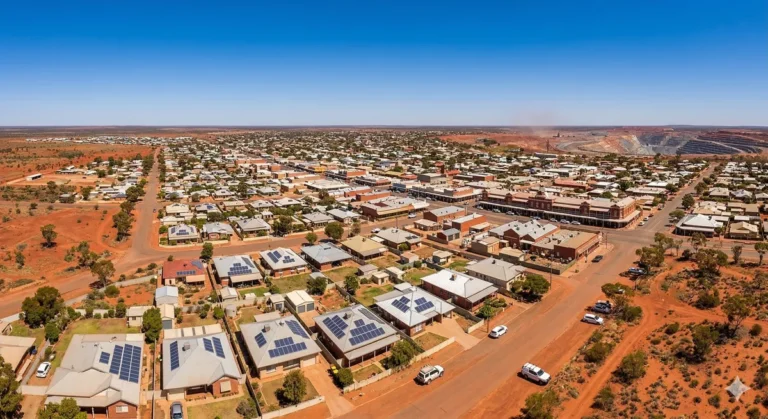
DEBS is Western Australia’s solar buyback scheme for homes on the main grid (the SWIS, which covers Perth and the South West). It replaced the older Renewable Energy Buyback Scheme (REBS) for new and upgraded systems from 8 September 2020. Synergy runs it for its customers. Horizon Power runs its own version in regional WA.
The key idea is time-of-export pricing. Instead of one flat rate, DEBS pays more for power that reaches the grid when the grid needs it most. In Perth that is late afternoon and evening, when rooftop solar drops away and everyone gets home and switches on the air con, oven and TV.
- Peak export (3pm–9pm): 10c/kWh.
- Off-peak export (before 3pm or after 9pm): 2c/kWh. This includes the middle of the day, when most solar systems export the most.
- Daily cap: retailers only have to pay for the first 50 kWh exported per day, per property.
Synergy DEBS rates in 2026
Synergy’s DEBS rates for 2026 are 10c/kWh peak and 2c/kWh off-peak, “correct as at 1 July 2026”. Synergy confirmed there were no changes to the DEBS or REBS buyback rates in its 2026 price update. The rates are reviewed each year along with other WA electricity prices.
| Scheme / window | Rate (c/kWh) | Notes |
|---|---|---|
| Synergy DEBS – peak (3pm–9pm) | 10 | Unchanged since DEBS began in 2020 |
| Synergy DEBS – off-peak (before 3pm or after 9pm) | 2 | 2c since 1 July 2024; no change in 2025 or 2026 |
| Horizon Power DEBS – peak | 10 | Most Horizon Power customers; some towns pay more |
| Horizon Power DEBS – off-peak | 3 | Most Horizon Power customers; some towns pay more |
| Synergy REBS (legacy, closed to new systems) | 7.135 flat | Only while your system stays unchanged |
| Synergy Temporary Export Credit | 7.135 (net) | Paid only while you wait for your meter to be changed |
Worth knowing: you may see older articles quoting 2.25c, 2.5c or 3c for the off-peak rate. Those figures are out of date. The Synergy off-peak rate dropped to 2c on 1 July 2024 and has stayed there.
Is GST added to DEBS payments?
Synergy’s price schedule says the DEBS rates exclude GST unless the DEBS terms and conditions provide otherwise. If you are not registered for GST (most households are not), the credit you see is simply 10c and 2c per kWh. If you run a GST-registered business from the property, check the DEBS terms or ask your accountant.
Who is eligible for DEBS?
Most Perth homes with a standard rooftop solar system are eligible for DEBS. Energy Policy WA sets out the main rules:
- Who: residential customers using no more than 50 MWh of electricity a year, plus schools, other educational institutions and not-for-profit organisations. Standard businesses are not covered.
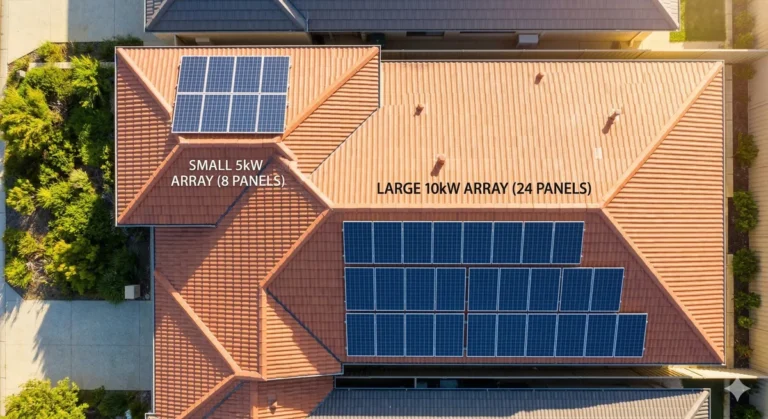
- System size: a generating capacity between 500 W and 5 kW. The limit is measured at the inverter, so a 6.6 kW set of panels on a 5 kW inverter counts as 5 kW. That is why the 6.6 kW / 5 kW combination is so common in Perth.
- Batteries and EVs: there is no size limit on home batteries or vehicle-to-grid capable EVs, and both can export under DEBS.
- Remote turn-off: new or upgraded systems must support emergency remote disconnection (formerly Emergency Solar Management, ESM), which lets the grid operator switch rooftop solar off remotely in rare emergencies. Systems that can’t meet ESM need an export limit and a separate application.
- Meter: you need a meter that can record exports by time of day. If yours can’t, Western Power upgrades or reprograms it.
Larger systems can still connect, but they are usually export-limited. From 1 May 2026, Western Power’s rules allow systems up to 30 kVA, with export limited to 1.5 kW, or up to 5 kW with a retailer off-take agreement; check with Synergy how DEBS applies to a system above 5 kW. From 1 May 2026, Western Power’s rules allow systems up to 30 kVA, with export limited to 1.5 kW, or up to 5 kW with a retailer off-take agreement; check with Synergy how DEBS applies to a system above 5 kW. From 1 May 2026, Western Power’s rules allow systems up to 30 kVA, with export limited to 1.5 kW, or up to 5 kW with a retailer off-take agreement; check with Synergy how DEBS applies to a system above 5 kW. New WA technical requirements also apply to systems up to 30 kVA from 1 May 2026.
Synergy or Horizon Power: who pays you?
Your electricity retailer pays the buyback, not Western Power. If you live in Perth, Mandurah, Bunbury or anywhere else on the main South West grid, that is Synergy. If you are in a regional town supplied by Horizon Power (for example in the Pilbara, the Kimberley, Carnarvon or Esperance), Horizon Power pays its own DEBS rates, which are 10c peak and 3c off-peak for most customers. You apply through whichever retailer supplies your home.
How much will DEBS pay you? A worked example
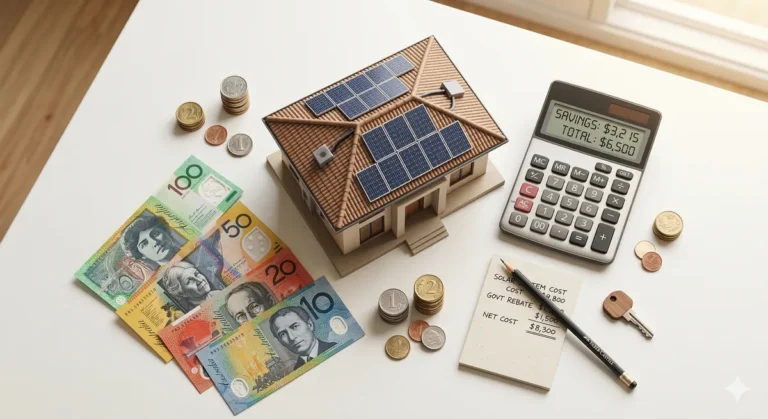
A typical 6.6 kW Perth system with no battery earns roughly $150–$250 a year from DEBS. The exact figure depends on your roof direction, your daytime usage and the season. Here is how the maths works.
Estimates only, using a year-round daily average.
| 6.6 kW solar, no battery (estimate) | kWh per day | Value per day |
|---|---|---|
| Solar generated | ~26 | – |
| Used in the home while the sun is up | ~8 | ~$2.66 saved (at A1 33.26c) |
| Exported before 3pm (off-peak, 2c) | ~16 | ~$0.32 |
| Exported 3pm–9pm (peak, 10c) | ~2 | ~$0.20 |
| DEBS credit | ~18 | ~$0.52 (~$190 a year) |
Most of the export lands in the 2c window, because a north-facing system peaks around midday. And the 8 kWh the household uses directly is worth about five times more than the 18 kWh it exports.
Quick tip: west-facing panels produce more in the late afternoon, moving a little more export into the 10c window and covering more of your own 3pm–6pm usage.
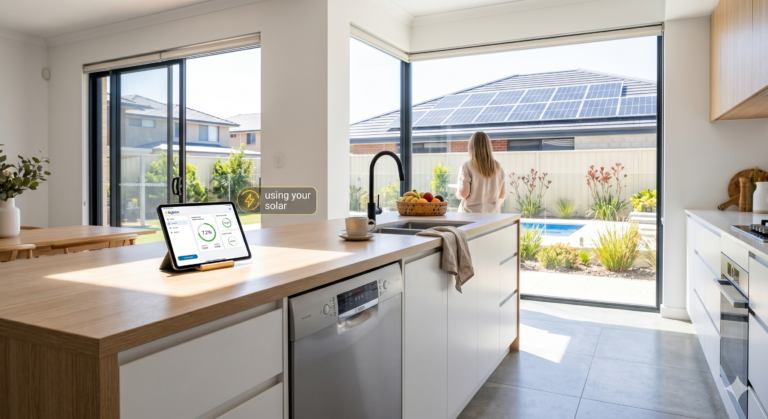
Why using your solar beats exporting it at 2c
Every kWh of solar you use yourself saves you the full price of buying that kWh from Synergy. Every kWh you export before 3pm earns just 2c. On the standard Synergy Home Plan (A1), grid power costs 33.26c/kWh from 1 July 2026. So using a unit of solar is worth about 16 times more than exporting it at midday.
| What happens to 1 kWh of your solar | Value |
|---|---|
| Exported before 3pm (DEBS off-peak) | 2c |
| Exported 3pm–9pm (DEBS peak) | 10c |
| Used at home instead of buying on Home Plan A1 | 33.26c |
| Used 3pm–9pm instead of buying on Midday Saver peak | 55.33c |
So treat DEBS as a small bonus and focus on self-consumption:
- Run the dishwasher, washing machine and dryer between about 9am and 3pm.
- Set the pool pump and any electric or heat-pump hot water system to run in the middle of the day.
- Pre-cool or pre-heat the house in the early afternoon in summer and winter, so the air con works less after 3pm.
- Charge an EV at home during the day when you can.
Worth knowing: Synergy’s Midday Saver plan charges 8.85c/kWh from 9am to 3pm, 55.33c from 3pm to 9pm and 24.34c from 9pm to 9am. It suits homes that can shift usage to the middle of the day, often with a battery for the evening. Our Synergy plans comparison walks through which plan suits which household. (The Smart Home Plan you may read about elsewhere is closed to new customers.)
How a battery shifts your exports into the 3pm–9pm window
A home battery stores the midday solar you would otherwise export at 2c and releases it after 3pm, when it is worth far more. In most Perth homes that stored energy is best used to run the house through the evening. Any battery energy you do export between 3pm and 9pm earns the 10c peak rate rather than 2c.
Here is the same 6.6 kW home with a battery of about 10 kWh added. Again, these are estimates for illustration only.
| Where ~10 kWh of midday surplus goes | Value per day (estimate) |
|---|---|
| Exported at 2c (no battery) | ~$0.20 |
| Stored, then exported 3pm–9pm at 10c (~9 kWh after losses) | ~$0.90 |
| Stored, then used at home on Home Plan A1 (~9 kWh at 33.26c) | ~$2.99 |
| Stored, then used at home 3pm–9pm on Midday Saver (~9 kWh at 55.33c) | ~$4.98 |
A battery’s main value comes from cutting what you buy, not from DEBS. Exporting stored energy at 10c only makes sense once your evening usage is covered. Over a year, using that energy at home on A1 instead of exporting it at 2c is worth roughly $1,000 (estimate). The federal Cheaper Home Batteries program and the WA Residential Battery Scheme (up to $1,300 for Synergy customers) also cut the upfront cost. See our solar battery options for Perth homes.
Synergy Battery Rewards: 70c/kWh during VPP events
If you install a battery under the WA Residential Battery Scheme, you must join Synergy’s virtual power plant, called Battery Rewards. During an event, Synergy can call on your battery to export, and you receive an activation credit of 70c/kWh for that energy. There are up to 30 events a year over a two-year initial term, and you need to be on Home Plan A1, K1, Midday Saver or EV Add On.
As a rough illustration, if Synergy called all 30 events and your battery exported 5 kWh in each, that would be about $105 in activation credits for the year. Fewer events means less. It is a useful extra, not a reason to buy a battery on its own. Our VPP guide for Perth explains how events work and what they mean for your battery.
How to apply for DEBS and how it shows on your bill
You apply for DEBS through Synergy’s online Distributed Energy System form, and either you or your solar installer can complete it. DEBS is not automatic, so check who is lodging it before your install day. The usual steps for a new system in Perth are:
- Design and approval: your installer sizes the system and checks Western Power’s export rules for your address.
- DEBS application: you or your installer submit Synergy’s Distributed Energy System form. A small one-off DEBS administration fee (under $10) is added to your next bill.
- Installation: the system is installed and certified by an SAA-accredited installer.
- Meter change: Western Power upgrades your meter ($108.84) or reprograms it ($111.60) if it can’t already record exports by time of day. These charges appear on your Synergy bill.
- DEBS starts: once the meter work is done, DEBS rates apply. While you wait, Synergy may pay a Temporary Export Credit of 7.135c/kWh, calculated on a net basis.
On your bill, the buyback appears as a credit that reduces what you owe. If your credit looks lower than expected, compare the exported kWh on your bill with the export data in your inverter app. Most of the time the reason is simple: most of your export happened before 3pm at 2c.
Still on REBS? Read this before you upgrade
If your system was connected before September 2020, you may still be on the legacy REBS rate of 7.135c/kWh for every unit you export. You keep REBS only while your system stays unchanged. Adding panels, adding a battery or V2G EV, or replacing your inverter with a different model moves you to DEBS.
For a solar-only home that exports mostly at midday, REBS pays more per exported kWh. But if a battery would cut your evening grid use, the bill savings can outweigh the lower export rate. Our solar payback guide for Perth shows how to work out the return on an upgrade.
Getting the most from DEBS with Talk Energy
DEBS rewards good design: the right inverter size, panels that cover your afternoon usage and, for many homes, a battery for the evening. Talk Energy Solar & Battery designs Perth systems around those rules, using in-house SAA-accredited electricians (no subcontractors). We have been installing for 7+ years, with 5,000+ installations and 4.8 stars from 300+ Google reviews. Our battery systems use Sigenergy (SigenStor), and every install is backed by a 20-year workmanship warranty.
Want a system built around DEBS and your real usage? Get a free, fixed quote or call (08) 6255 5914. We’re at 16 Ogilvie Rd, Mount Pleasant WA 6153.
Frequently asked questions
What is DEBS?
DEBS is the Distributed Energy Buyback Scheme, Western Australia’s solar feed-in scheme for homes, schools and not-for-profits. It pays you for electricity your solar system or battery exports to the grid. Synergy pays 10c/kWh for exports between 3pm and 9pm and 2c/kWh at all other times. It replaced the older REBS scheme for new and upgraded systems from September 2020.
How much does Synergy pay for solar power in 2026?
Synergy pays 10c/kWh for solar exported between 3pm and 9pm and 2c/kWh for solar exported before 3pm or after 9pm. These rates are correct as at 1 July 2026 and have not changed since 1 July 2024. Payments apply to the first 50 kWh exported each day. As an estimate, a typical 6.6 kW system with no battery earns roughly $150 to $250 a year.
How do I apply for DEBS?
You or your solar installer apply through Synergy’s online Distributed Energy System form. Western Power may then need to upgrade or reprogram your meter so it can record exports by time of day. DEBS rates start once the meter work is done. A one-off DEBS administration fee and any meter charge appear on your next Synergy bill.
Is GST included in the DEBS rate?
No. Synergy’s DEBS price schedule says the buyback rates exclude GST unless the DEBS terms and conditions provide otherwise. Most households are not registered for GST, so they simply receive 10c and 2c per kWh. If you are GST-registered, check the DEBS terms or ask your accountant.
Is a battery worth it under DEBS?
For many Perth homes, yes, but mainly because a battery cuts what you buy from the grid, not because of DEBS. Midday solar exported at 2c is worth far less than the 33.26c/kWh you pay on Home Plan A1 in the evening. A battery stores that surplus for use after 3pm. Batteries installed under the WA Residential Battery Scheme also join Synergy Battery Rewards, which pays a 70c/kWh activation credit during events.
Should I stay on REBS or switch to DEBS?
If your solar-only system works well and exports mostly at midday, staying on REBS at 7.135c/kWh usually pays more per exported unit. You lose REBS if you add panels, add a battery or replace your inverter with a different model. If an upgrade would cut your evening grid use, the bill savings can outweigh the lower export rate, so compare both before you decide.