How Long Do Solar Panels Last in Perth? Lifespan and After 25 Years
Quick answer: Solar panels typically last 20 to 30 years, which is the average lifespan given in the Australian Government’s Solar Consumer Guide. They do not switch off at 25 years. They keep generating at a slowly falling output: a large US review of field studies found a median loss of about 0.5% a year, which works out to roughly 88% of original output at year 25. The inverter usually needs replacing well before the panels do.
This guide is for Perth homeowners with a system that is getting older, and for anyone buying now who wants to know how long the panels will last. It covers lifespan, degradation, warranties, what fails first, what Perth conditions do to a system, how to spot ageing, and how Western Power’s current rules treat an upgrade.
How long do solar panels last?
Most solar panels last 20 to 30 years. That is the average lifespan the Solar Consumer Guide on energy.gov.au gives for panels, and the same guide says good quality, modern panels should last for at least 20 years.
“Lifespan” does not mean the day a panel stops producing power. A panel has no moving parts and no set expiry date. It produces a little less each year, and it reaches the end of its useful life when it is damaged, becomes unsafe, or produces too little to be worth the roof space. The guide also notes that lifespan depends on how well a system is maintained, and that it is rare to need to replace a whole system at once.
How fast do solar panels degrade?
Solar panels typically lose around half a per cent of their output each year. The best-known evidence is a review by the US National Renewable Energy Laboratory, which gathered nearly 2,000 degradation rates measured in the field over 40 years. It found a median degradation rate of 0.5% a year and a mean of 0.8% a year, with 78% of the reported rates below 1% a year.
The table turns those two rates into remaining output. It is arithmetic, not a forecast for any particular panel: each year’s output is the previous year’s multiplied by 0.995 (or 0.992). The review’s rates are long-term figures and leave out short-term, light-induced degradation (an early drop some panels show when they are first exposed to the sun).
| Panel age | Output at 0.5% a year (median) | Output at 0.8% a year (mean) | Typical performance warranty minimum |
|---|---|---|---|
| Year 10 | About 95% | About 92% | 90% |
| Year 25 | About 88% | About 82% | 80% |
| Year 30 | About 86% | About 79% | Usually expired |
In energy terms, the Solar Consumer Guide puts typical generation in Perth at 4.4 kWh a day for each kW of panels, averaged over a year. For a 6.6 kW system that is 6.6 × 4.4 × 365, or about 10,600 kWh a year when new. At the median rate, the same system would produce about 9,350 kWh a year at year 25 (10,600 × 0.882). Real output also depends on roof direction, tilt, shade and dirt.
What happens to solar panels after 25 years?
Nothing happens on the day. Twenty-five years is the length of the standard performance warranty, not the life of the panel. Once it ends, the panels keep working, and there is simply no manufacturer promise about their output any more.
The NREL review makes the same point from field data: there are products that have been in the field for more than 25 years, and the average degradation rate still allows reasonable performance after 25 years. What changes for the owner is the risk. A fault that appears after the warranties have ended is yours to pay for.
Product warranty versus performance warranty
A solar panel comes with two warranties, and they cover different things. The product warranty covers faulty panels. The performance warranty sets the lowest output the manufacturer says working panels will give.
| Warranty | What it covers | Typical length |
|---|---|---|
| Panel product warranty | Faulty panels (defects) | 10 to 15 years for many panels. Some manufacturers offer 25 years or more |
| Panel performance warranty | Minimum output of working panels | 25 years on almost all panels. A standard example is 90% up to 10 years and 80% up to 25 years |
| Workmanship warranty | Problems caused by the installation | Usually 5 years |
The Solar Consumer Guide’s warranty page calls the product warranty the most important one to consider. It also says performance warranties can be difficult to enforce, and that most warranties do not cover hail damage. Workmanship cover varies a lot between installers, so it is worth reading the terms. Our guide to how a 20-year solar workmanship warranty works explains what that kind of cover does and does not include.
What usually fails first in a solar system?
The inverter. The Solar Consumer Guide says that for most solar systems, inverters will need to be replaced before the solar panels.
| Component | Average lifespan | Common product warranty |
|---|---|---|
| Solar panel | 20 to 30 years | 10 to 15 years (some 25 or more) |
| String inverter | 10 to 15 years | 5 to 10 years |
| Microinverter | 20 to 25 years | 10 years (attached to rail) or 25 years (attached to panel) |
| Hybrid inverter | Not listed | 5 to 10 years |
| Lithium-ion battery | 10 to 15 years | Many are 10 years |
So a system installed 12 or 15 years ago is far more likely to need a new inverter than new panels. The guide adds that string inverters should not be exposed to direct sunlight, for best results and longer life. Our comparison of string inverters, microinverters and optimisers covers how the types differ.
What do Perth conditions do to solar panels?
Perth’s sun is the reason solar works so well here, and it is also what wears a system out. The evidence on climate is real but less precise than many websites suggest.
- Heat. The NREL review cites studies of systems in desert climates (Libya and Phoenix, Arizona) that degraded at about 1% a year after roughly 30 years, compared with much lower rates in cool climates. The authors also say the precise impact of climate has not been satisfactorily answered. A fair reading for Perth is that hot summers may put a system towards the faster end of the range.
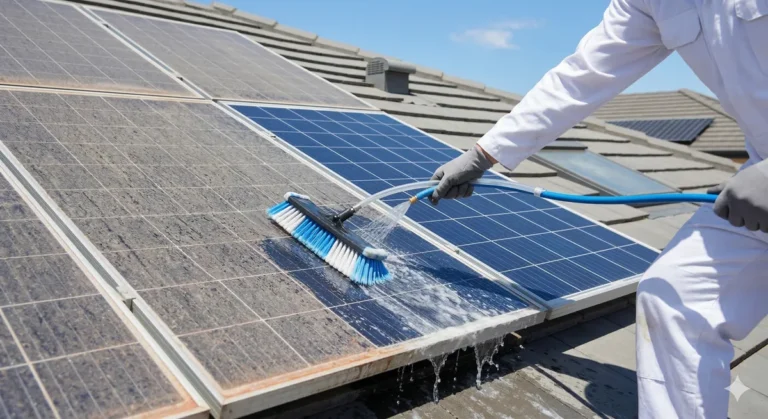
- Sunlight and weather. The Clean Energy Regulator lists hail, wind and sunlight, dust and debris build-up, water and moisture seepage, and vermin as causes of damage to rooftop systems.
- Coastal salt. Salt-laden air can corrode panels and fittings. There is an international standard for it, IEC 61701, which tests a panel’s resistance to salt mist corrosion. If you live close to the ocean, ask whether the panels you are quoted have passed it, and check the manufacturer’s warranty conditions for coastal sites.
The Solar Consumer Guide says solar panels are designed to withstand the Australian climate, but extreme weather events can still damage a system. Regular checks matter more as a system ages, and our solar panel maintenance guide for Perth sets out what to look at and how often.
Signs your solar system is ageing
The clearest sign is lower generation on sunny days than the system used to manage at the same time of year. Check your monitoring app or inverter display before assuming the panels are worn out, because the cause is often the inverter, shade or dirt.
- Generation that is lower than usual on clear days, compared with the same month in earlier years.
- A fault code or warning light on the inverter, or an inverter that shuts down in the heat of the day.
- Visible damage: cracked glass, discoloured or browned cells, moisture inside a panel, or corroded frames and fittings.
- Damaged or deteriorated wiring, or isolator switches that are cracked or faded.
- New shade from trees or neighbouring buildings that was not there when the system went in.
The Solar Consumer Guide notes that a drop in performance does not always mean a part needs replacing. It also says repairs should only be attempted by an accredited electrician, because a solar system stays energised even when the mains are off. Your first call should be the retailer or installer who put the system in. Talk Energy does not service or repair systems installed by other companies.
Repair, replace or upgrade?
If the panels are sound and the inverter has failed, replacing the inverter is usually the smaller job. If the panels are damaged, or the system is too small for how you now use power, a new or larger system is the better question to ask. In Perth, the answer also depends on which connection rules the work falls under.
Western Power’s current technical rules became mandatory on 1 May 2026 and apply to new systems and to upgrades of existing ones. According to Energy Policy WA, a system installed before that date is not affected unless you upgrade it, and replacing a faulty inverter with a similar or exact model under warranty does not trigger the new requirements. Adding panels or a battery counts as an upgrade, and an upgraded site must comply in full. That brings the whole system under the 2026 rules:
- Up to 30 kVA of total inverter capacity on a basic connection.
- A default export limit of 1.5 kW, or up to 5 kW in the Perth metropolitan area with an off-take agreement with your electricity retailer.
- The system must be capable of being managed remotely.
The detail is in our guide to Western Power’s 2026 export limits. An old system on the earlier rules may export under different conditions from an upgraded one, so compare both before you decide. Our guide to upgrading an old solar system in Perth walks through the options, and the solar panels page shows what a new installation involves.
What happens to old solar panels at end of life?
Old panels should be removed by a licensed electrician and recycled where possible. The Solar Consumer Guide says most of the materials in a solar panel can be recycled, that you may have to pay a recycling fee, and that some states and territories have banned solar panels from landfill. The Australian Government is investing $24.7 million over three years in a National Solar Panel Recycling Pilot. For what is available locally, see our guide to solar panel recycling and disposal in WA.
Replacing or upgrading an old system with Talk Energy
Talk Energy Solar & Battery installs solar panels, home batteries, inverters and EV chargers across Perth. We have been in business for 7+ years and have completed 5,000+ installations, all carried out by in-house SAA-accredited electricians under WA electrical contractor licence EC15564. We do not service or repair systems installed by other companies, but we can quote to replace or upgrade an ageing system, designed around Western Power’s current rules.
To talk through a replacement or upgrade, request a free solar quote in Perth or call 08 6255 5914. We are based at 16 Ogilvie Rd, Mount Pleasant WA 6153.
Frequently asked questions
Do solar panels stop working after 25 years?
No. Twenty-five years is the length of the standard performance warranty, not the life of the panel. Panels keep generating after that at a gradually lower output. The Australian Government’s Solar Consumer Guide gives an average panel lifespan of 20 to 30 years.
How much output does a solar panel lose each year?
A US National Renewable Energy Laboratory review of nearly 2,000 field measurements found a median loss of 0.5% a year and a mean of 0.8% a year. At the median rate, a panel would be at about 95% of its original output after 10 years and about 88% after 25 years. Individual panels can do better or worse than that.
Should I replace 10 or 15 year old solar panels?
Usually not on age alone. At typical degradation rates, panels of that age are still producing most of their original output. The part more likely to need attention is the inverter, because the Solar Consumer Guide puts the average string inverter lifespan at 10 to 15 years.
How long does a solar inverter last?
The Solar Consumer Guide lists an average lifespan of 10 to 15 years for string inverters and 20 to 25 years for microinverters. Common product warranties are 5 to 10 years for string and hybrid inverters. Keeping a string inverter out of direct sunlight helps it last longer.
If I upgrade my old system in Perth, do the new Western Power rules apply?
Yes. Western Power’s technical rules that became mandatory on 1 May 2026 apply to upgrades as well as new systems, and an upgraded site must comply in full. Adding panels or a battery counts as an upgrade. Replacing a faulty inverter with a similar or exact model under warranty does not trigger the new requirements.
Can old solar panels be recycled in WA?
Most of the materials in a solar panel can be recycled, although you may have to pay a recycling fee. Panels should be removed by a licensed electrician, not by the homeowner. Recycling options in WA change, so check our solar panel recycling guide before you book a removal.