Upgrading Your Old Solar System in Perth: When to Upgrade, What’s Involved, and What It Costs in 2026
If your solar system is between five and ten years old, you’re in an interesting position. Your system has paid back a good chunk of its cost, but it’s also old enough that the energy landscape around it has changed significantly. Synergy’s feed-in tariff is lower than when you installed. Grid electricity has gone up. Battery technology has come a long way. And the panels themselves may be producing noticeably less than they were on day one.
This guide is for Perth homeowners who want a clear, honest answer to one question: is it worth upgrading, and if so, what exactly should you do?
The short answer: for most households with a 5-10 year old system, the upgrade that makes the most financial sense in 2026 is adding a battery, not replacing your panels. But that depends on your system’s condition, your energy use, and which upgrade path suits your roof and budget. The sections below walk you through each decision point.
Signs Your System Needs Attention
Not every ageing system needs an upgrade. Some 10-year-old systems are running perfectly and will continue to do so for another decade. Others are quietly losing money every day. Here’s how to tell the difference.
Check your generation data
The most reliable indicator is your inverter’s monitoring data. Compare your system’s current monthly output against its rated capacity and what it produced in its first year. Most quality panels degrade at around 0.5% per year, so a 6.6 kW system installed in 2016 should still be producing roughly 95-97% of its original output. If you’re seeing drops of 15% or more, something is wrong beyond normal degradation.
If you don’t have historical data, your installer may have records. Alternatively, Synergy’s online usage portal shows your import and export history, which gives a useful proxy.
Warning signs to watch for
- Higher electricity bills despite similar usage patterns and no major tariff changes
- Inverter error codes or frequent shutdowns (a 5-10 year old string inverter is approaching or past its typical 10-12 year lifespan)
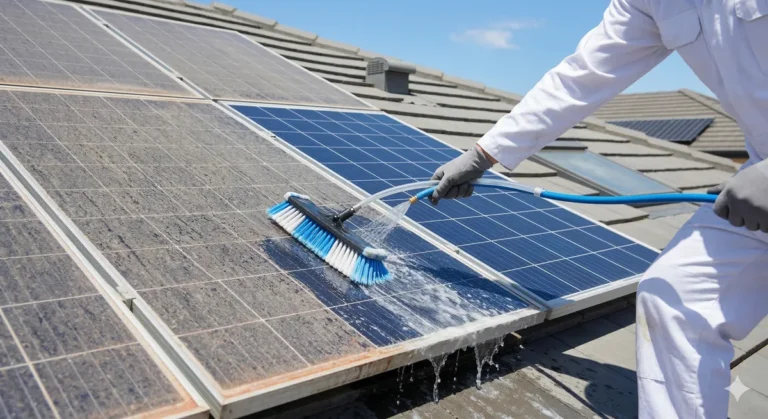
- Visible panel damage such as discolouration, micro-cracks, or delamination on the panel surface
- No monitoring data available because your original inverter’s monitoring system has been discontinued
- Your system is smaller than 5 kW and was installed before 2017, when panel efficiency was considerably lower than today’s standard
Key point: A system producing 20% less than its rated output costs a typical Perth household around $300-$500 per year in lost savings at current Synergy tariffs. Over five years, that’s $1,500-$2,500 in foregone value, which changes the ROI calculation for an upgrade considerably.
How the New Synergy Tariffs Change Your Upgrade ROI
Before deciding what to upgrade, it’s worth understanding how the energy environment has shifted since most of these systems were installed.
Synergy’s Distributed Energy Buyback Scheme (DEBS) now pays 10c/kWh for solar exported between 3pm and 9pm, and just 2c/kWh at all other times. The off-peak rate has fallen from 3c when DEBS launched to 2c (since 1 July 2024), and the direction of travel is clear: export credits will keep declining as more rooftop solar saturates the grid during daylight hours.
At the same time, Synergy’s Home Plan (A1) grid electricity rate is now 33.26c/kWh, plus a 119.24c/day supply charge (Synergy rates from 1 July 2026). The State’s annual electricity credit was not continued in 2025-26; only a $150 Commonwealth credit was paid.
What this means for upgrade decisions:
| Scenario | Value of solar energy |
|---|---|
| Solar used directly in your home | ~33c/kWh (avoided grid cost) |
| Solar exported during peak (3-9pm) | 10c/kWh |
| Solar exported off-peak (all other hours) | 2c/kWh |
The gap between self-consumption and export is now enormous. Every kilowatt-hour your solar panels produce and you use directly is worth 16 times more than exporting it off-peak. This single fact is the most important driver of upgrade decisions in 2026.
The practical implication: if your household is out during the day and exporting most of your solar at 2c/kWh, a battery that captures that energy for evening use transforms your ROI. If you already use most of your solar directly (retirees, work-from-home households, businesses), the battery case is less urgent and a system size upgrade may make more sense.
Your Three Upgrade Options (and What Each Costs)
There are three distinct upgrade paths for an older Perth solar system. They’re not mutually exclusive, but most households will find one path clearly makes more sense than the others.
Option 1: Inverter replacement only
If your panels are in good condition but your inverter is failing, a targeted inverter replacement is often the most cost-effective fix. String inverters typically last 10-12 years, so systems installed in 2014-2016 are entering this zone now.
What drives inverter replacement cost in Perth: the inverter’s size and brand, single-phase versus three-phase, whether you choose a standard replacement or a hybrid (battery-ready) model, and any switchboard or cabling work needed. A hybrid upgrade costs more than a like-for-like swap. Your quote should itemise each of these.
When to choose this: your panels are performing well, the inverter is the only problem, and you’re not planning to add a battery in the near future. If you are planning to add a battery within 2-3 years, it’s worth paying the premium for a hybrid inverter now rather than replacing it again later.
See Talk Energy’s solar inverter page for how we choose the right inverter.
Option 2: Full system replacement
A full system replacement makes sense when your panels have significant degradation, the system is undersized for your current energy use, or you want to take advantage of modern panel efficiency and a larger system size.
Today’s premium 400W+ panels produce significantly more output per square metre than the 250-280W panels common in 2015-2017 installations. A full replacement also lets you right-size for current loads, including EVs, air conditioning upgrades, or pool additions.
As a rough guide, most Perth homes pay around these amounts for a full system replacement in 2026 (after the STC rebate). Your price depends on panel and inverter choice, roof type and any switchboard work:
| System size | Rough estimate after STC rebate |
|---|---|
| 6.6 kW (standard family home) | $5,000 – $7,500 |
| 10 kW (larger home / high usage) | $8,000 – $11,000 |
| 13.3 kW (premium / EV / pool) | $10,000 – $14,000 |
When to choose this: your existing panels are degraded beyond 15-20% of rated output, your system is 5 kW or smaller and your energy use has grown, or you want to significantly increase system capacity.
Option 3: Add a battery to your existing system
For most Perth households with a functioning solar system, adding a battery is the highest-ROI upgrade available right now. With Synergy’s off-peak export rate at just 2c/kWh, storing that energy and using it at night instead of buying grid power at about 33c/kWh is a straightforward financial win.
The WA Residential Battery Scheme provides up to $1,300 for Synergy customers, stacking with the federal Cheaper Home Batteries Program for combined rebates of roughly $3,900–$4,000 on a 10 kWh system.
As a rough guide, most Perth homes pay around these amounts for a battery retrofit in 2026. Your price depends on battery brand and size, inverter compatibility and switchboard work:
| Battery size | Before rebates | After combined rebates (Synergy) |
|---|---|---|
| 5-7 kWh | Quoted individually | Quoted individually |
| 10 kWh | $9,500 – $13,000 | $5,500 – $9,000 |
| 13-16 kWh | $13,000 – $18,000 | $8,000 – $12,500 |
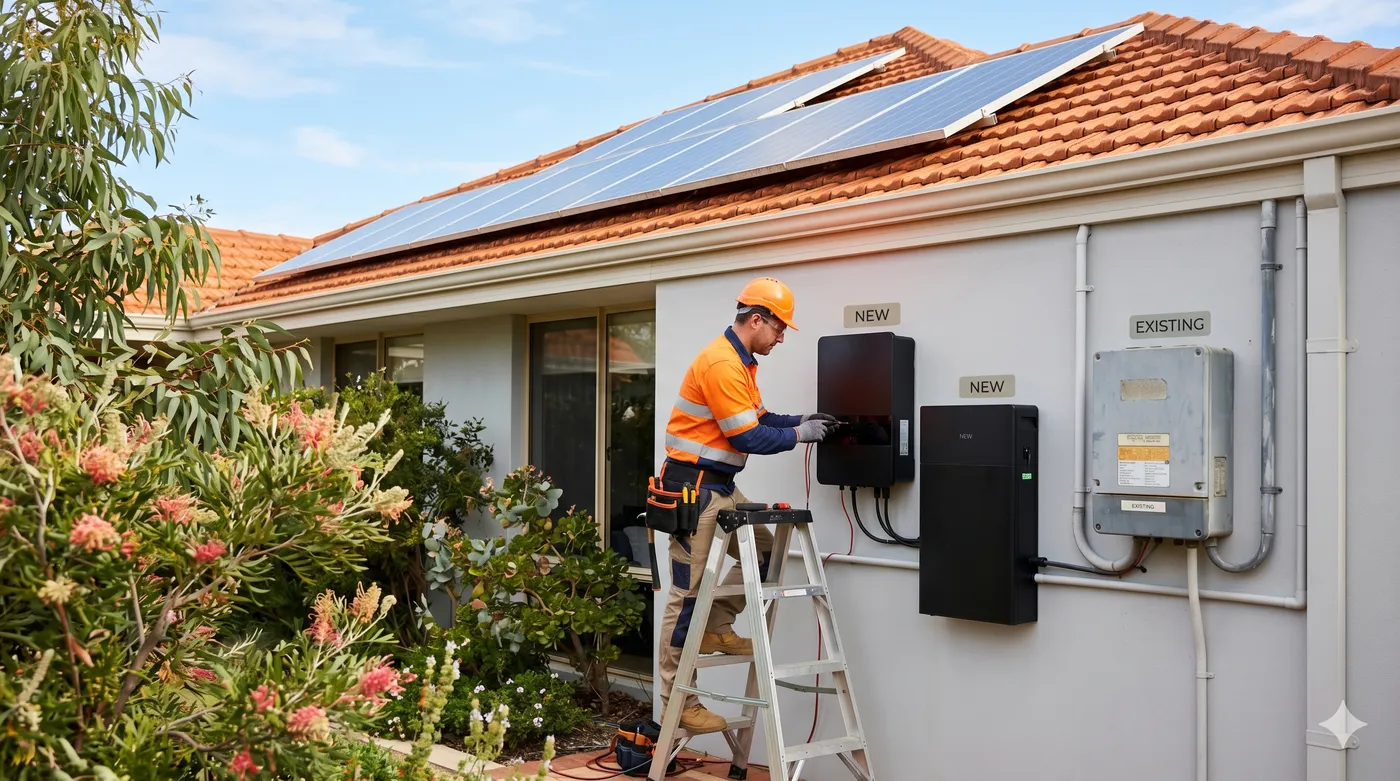
Important: to add a battery to an existing system, your inverter must be on Synergy’s Supported Solutions List. If your current inverter is not compatible, you’ll need a hybrid inverter upgrade alongside the battery, which adds to the project cost. Talk Energy’s upgrade assessment includes a compatibility check as the first step.
For a detailed breakdown, see our guide on adding a battery to your existing solar system in Perth.
Upgrade Decision Matrix
Use this matrix to identify the most likely upgrade path for your situation. It’s a starting point, not a substitute for a proper system assessment, but it should give you a clear direction before you call anyone.
| Your situation | Recommended action |
|---|---|
| Inverter showing errors, panels still producing well | Inverter replacement (consider hybrid if battery is in your future) |
| System output down 15%+ vs original, panels 8+ years old | Full system replacement |
| System working fine, household out during the day, high export | Add battery (check inverter compatibility first) |
| System working fine, already high self-consumption | Review system size; may benefit from capacity expansion |
| System under 5 kW, installed pre-2017 | Full replacement likely cost-effective given efficiency gains |
| Inverter failed, planning to add battery soon | Replace with hybrid inverter now, add battery separately |
| Panels with visible damage (cracks, delamination) | Full replacement; damaged panels are a safety and performance risk |
| On old REBS tariff (grandfathered flat rate) | Careful assessment needed; battery ROI is different under REBS |
Note on REBS customers: if you’re still on Synergy’s grandfathered Renewable Energy Buyback Scheme (REBS) at 7.135c/kWh flat rate, the economics of adding a battery are different from DEBS customers. The flat rate is higher than DEBS off-peak, which changes the payback calculation. Talk Energy can model both scenarios for you.
What Talk Energy’s Upgrade Assessment Involves
A solar upgrade is not a one-size-fits-all exercise. The right path depends on your specific system, your roof, your energy use, and your goals. Talk Energy’s upgrade assessment is designed to give you a clear, unbiased picture before you commit to anything.
What the assessment covers
- System performance review using your inverter data and Synergy usage history to establish actual vs expected output
- Inverter compatibility check to determine whether your current inverter can support a battery, or whether a hybrid upgrade is needed
- Roof and panel condition inspection to identify any physical degradation, shading issues, or safety concerns
- Energy use analysis to right-size any upgrade to your actual consumption patterns, including time-of-use behaviour
- Financial modelling showing payback periods for each upgrade option under current Synergy tariffs
The assessment is free and carries no obligation. Talk Energy uses in-house SAA-accredited electricians for all assessments and installations, with no subcontractors, which means the person assessing your system is the same team that would do the work.
What happens after
If an upgrade makes sense, you’ll receive a written quote with itemised costs, the applicable STC rebate, and any WA Battery Scheme rebate you’re eligible for. Talk Energy also offers solar financing options including interest-free loans through the WA Battery Scheme (up to $10,000 for eligible households) and Brighte finance for system upgrades.
All Talk Energy installations are covered by a 20-year workmanship warranty with a 48-hour fix or replace guarantee, which applies to upgrades as well as new installations.
To book your free upgrade assessment, visit our solar upgrade page or call (08) 6255 5914.
Frequently Asked Questions
How do I know if my solar panels are degrading faster than normal?
Compare your current monthly generation (from your inverter app or monitoring portal) against the system’s rated output for your location. Perth averages around 4.5-5 peak sun hours per day, so a 6.6 kW system should produce roughly 27-30 kWh on a clear day. If you’re consistently seeing 20% or more below that, and there’s no obvious shading or weather explanation, abnormal degradation is likely. A professional system assessment will confirm this with data.
Can I add more panels to my existing system?
Yes, in most cases, but there are constraints. Your inverter has a maximum input capacity, and an upgraded system must meet Western Power’s 2026 export limits (1.5 kW, or up to 5 kW with a retailer off-take agreement). Adding more panels without upgrading your inverter may mean the extra capacity can’t be fully utilised. Talk Energy’s assessment will identify whether a panel addition makes sense within your existing setup, or whether a full system upgrade is the better path. See our guide to Perth’s solar export limits for more detail.
Will I lose my grandfathered feed-in tariff if I upgrade?
This depends on the type of upgrade. In most cases, adding a battery or replacing a failed inverter with a like-for-like replacement does not affect your existing DEBS or REBS tariff entitlement. However, making significant changes to your system configuration (such as adding panels that require a new network application) can trigger a tariff review. Talk Energy will flag any tariff implications before work begins.
Is the WA Battery Scheme rebate still available?
Yes. As of mid-2026, the WA Residential Battery Scheme is open for applications. Synergy customers are eligible for up to $1,300, and Horizon Power customers up to $3,800. The scheme also includes an interest-free loan of up to $10,000 for households with a combined income under $210,000. The federal Cheaper Home Batteries Program stacks on top for combined savings of around $3,900–$4,000 on a 10 kWh battery for Synergy customers.
How long does a solar upgrade take?
An inverter replacement is typically completed in half a day. A battery retrofit takes one full day. A full system replacement (panels, inverter, and battery) is usually completed in one to two days depending on system size. Talk Energy handles all paperwork, including Western Power applications and Synergy DEBS registration, as part of the installation.
My original installer has closed. Can Talk Energy service my system?
No. Talk Energy services and repairs only the systems we install. If your original installer has closed, your panel and inverter manufacturer warranties still apply, so contact the manufacturer directly. If your system is due for replacement, we can quote a new system, which comes with our 20-year workmanship warranty.