How to Clean Solar Panels Safely in Perth
Quick Answer: Clean solar panels from the ground on a cool morning, using a soft brush on an extension pole and a garden hose at normal pressure. Never climb onto the roof, never use a pressure washer, and never use harsh chemicals or abrasive pads. In Perth, panels usually need a clean after the long dry summer, or sooner if your monitoring app shows output dropping on clear days.
You’ve spent good money on solar, and you’ve noticed the panels look a bit grubby from the backyard. It’s natural to want to get up there and give them a scrub. Before you do, it’s worth knowing that panels have no moving parts, need very little care, and are easy to damage with the wrong cleaning method.
This guide covers when Perth panels actually need cleaning, how to check, how to clean them safely without leaving the ground, and when to leave it to a professional.
Do Perth panels need cleaning?
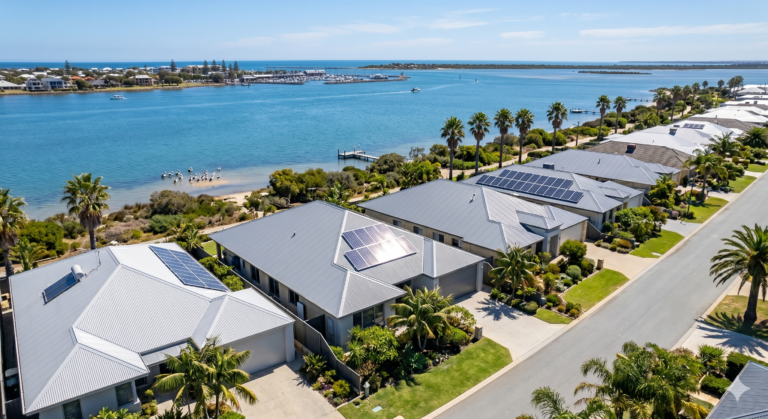
Sometimes, yes. Most of the year, rain does a reasonable job. But Perth gets most of its rain in the cooler months and very little in summer (Bureau of Meteorology), so dust can build up for months at exactly the time your panels should be producing the most.
Some homes collect more grime than others. These are the common causes in Perth:
| Cause | Where it’s worst | What it does |
|---|---|---|
| Dry-season dust | Near main roads, building sites, quarries and open land; Perth Hills and outer suburbs | A thin, even film that slowly lowers output across all panels |
| Coastal salt | Beachside and riverside suburbs, such as Scarborough, Cottesloe and Fremantle | A sticky salt film that rain doesn’t always shift |
| Bushfire smoke and ash | Hills and bushland edges after a fire or a burn-off | A greasy layer that holds dust |
| Bird droppings | Homes near water, bushland or tall trees | Hard patches that shade individual cells and can drag down a whole string |
| Leaves, sap and pollen | Roofs under or beside trees | Patchy shading and sticky residue |
| Low roof pitch | Flat or near-flat roofs | Water pools and dirt settles instead of running off |
REC’s installation manual says the need for cleaning depends on location, rainfall, pollution and tilt, and that panels at a lower angle need more cleaning (REC installation manual). If your roof is steep and your street is quiet, you may rarely need to clean at all.
How to tell from your monitoring app
Your monitoring app is a better guide than how the panels look from the ground. Panels can look dusty and still work well, and a single bird dropping you can’t see can cause a real drop.
- Compare like with like. Pick a clear, cloudless day and compare it with a clear day from the same time last year or a few weeks earlier. Don’t compare a June day with a January day.
- Look for a slow slide. A gradual drop across several weeks of fine weather, with no error codes, usually points to dirt.
- Look for a sudden drop. A sharp fall overnight, or one string producing much less than the others, usually points to a fault or new shading, not dirt. Cleaning won’t fix it.
- Check after a good rain. If output bounces back after rain, dirt was the cause. If it doesn’t, something else is going on.
Quick tip: If your app has stopped updating, fix that first. A system can lose its wi-fi connection after a router change and nobody notices for months. Without data, you can’t tell dirt from a fault.
Cleaning safely from the ground
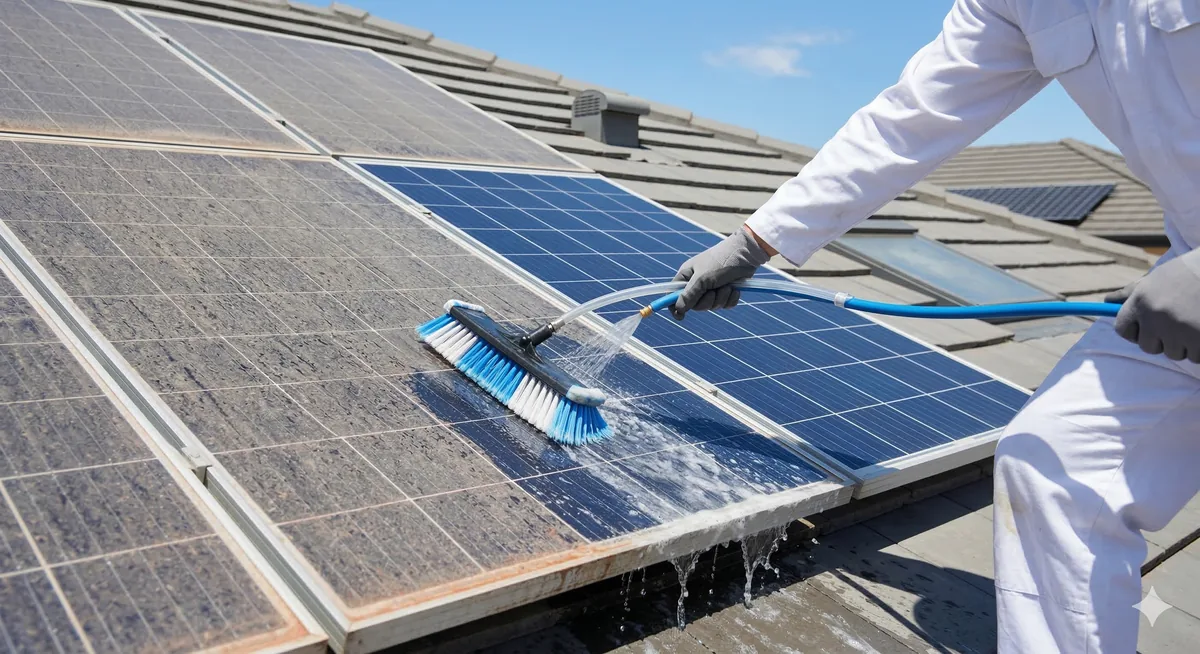
The safe way to clean panels at home is from the ground, with water and a soft brush. Here’s how.
- Pick a cool morning. Clean early, before the glass heats up. REC’s manual says to clean when panels are cool, such as early morning, to avoid breakage from thermal shock. Cold water on hot glass is the risk.
- Stay off the roof. Use a soft-bristled brush on an extension pole. If you can’t reach a panel from the ground, leave it.
- Rinse first. Use a garden hose at normal mains pressure to wet the panels and loosen dust. Spray from above where you can, so water runs down the glass and not up under the frame.
- Brush gently. Work from the top down with light strokes. Let the water do most of the work.
- Rinse again. Wash off the loosened dirt with plenty of clean water.
- Let it dry. Panels can air-dry. Tap water may leave light spots; these have far less effect than the dirt you’ve removed.
Important: Never climb onto the roof to clean panels. Roof falls cause serious injuries, and walking on panels can crack cells you can’t see. Solar panels also produce electricity whenever light hits them, and they can’t be switched off at the roof.
For stubborn spots such as dried bird droppings, REC allows a mild, biodegradable washing-up liquid, followed by a thorough rinse. Soak the spot first rather than scrubbing harder.
What never to use
Never use a pressure washer, harsh chemicals or anything abrasive on solar panels. These can damage the glass coating, seals or cells, and may void your panel warranty.
| Don’t use | Why |
|---|---|
| Pressure washer or high-pressure nozzle | Can force water past seals and damage the laminate or cells. REC does not permit high-pressure hoses or cleaners. |
| Steam cleaner | Sudden heat can stress the glass. Trina’s manual rules out steam cleaners. |
| Acid or alkaline cleaners, solvents, bleach | Can damage the anti-reflective coating and frame. Both REC and Trina rule these out. |
| Scourers, steel wool, hard-bristle brooms, blades | Scratch the glass, which permanently lowers output. |
| Bore water | Perth bore water often carries iron and minerals that can stain glass. |
| Your feet or a ladder leaning on the array | Cracks cells and risks a fall. |
When to call a professional
Call a professional if you can’t reach the panels from the ground, or if the problem isn’t dirt. Specifically:
- Your roof is two storeys, steep, or the panels can’t be seen from the ground.
- Output stays low after rain or after you’ve cleaned.
- Your inverter shows an error code that doesn’t clear.
- You can see cracked glass, scorch marks, bent frames or loose cables.
- Birds are nesting under the panels.
- You notice water stains on the ceiling under the array, or a burning smell near the inverter or switchboard. Treat these as urgent.
What affects solar panel cleaning cost? If you’re comparing professional cleaners, prices vary with the number of panels, roof height and pitch, how easy the roof is to access, how dirty the panels are, and whether an electrical inspection is included. A clean on a two-storey roof with fall protection takes more time and gear than a single-storey one. Ask what’s included before you compare quotes, and ask whether the cleaner is insured for roof work.
Maintenance plans for Talk Energy customers
If we installed your system, maintenance and servicing are available through us. Cleaning is the visible part, but most costly faults are found by inspection: worn isolators, loose connections, roof seal problems or a string that has quietly gone offline. Our solar system maintenance plans guide explains what a service covers and how often to book one.
Every Talk Energy system is installed by our in-house SAA-accredited electricians and backed by a 20-year workmanship warranty and a 48-hour fix-or-replace guarantee. Our maintenance and servicing cover systems we installed only.
Cleaning and your warranty
Gentle cleaning with water and a soft brush is in line with major panel makers’ guidance. The wrong method can void your panel warranty. Each manufacturer sets its own rules, so check the installation manual for your exact panel model. Two examples:
- REC recommends clean water with a sponge, microfibre cloth or soft brush, allows mild biodegradable washing-up liquid, rules out acid or alkali detergents and high-pressure hoses or cleaners, and says failure to follow the manual’s procedures will invalidate the warranty (REC installation manual).
- Trina Solar says brushes must be non-conductive and non-abrasive, rules out steam cleaners and strong acidic or alkaline solvents, gives a maximum recommended water pressure, and says damage from inappropriate cleaning voids its warranty (Trina Solar Vertex user manual).
Your installer’s workmanship warranty is separate from the panel warranty. Damage caused by climbing on the roof or using the wrong cleaning method isn’t a workmanship fault. If you’re unsure which panels you have, the brand and model are on your installation paperwork. You can also learn more about the panels we install on our solar panels page.
Talk Energy Solar & Battery is rated 4.8 stars from 300+ Google reviews. Planning a new system? Get a free quote, call (08) 6255 5914, or visit our contact page.
Frequently asked questions
How often should Perth panels be cleaned?
Many Perth homes only need a clean after the long dry summer, and some rarely need one at all. Homes near the coast, main roads, bushland or trees, or with low-pitch roofs, may need cleaning more often. Let your monitoring app guide you: if output on clear days slides over several weeks and recovers after rain, it’s time to clean.
Does rain clean them enough?
For most of the year, rain does a reasonable job on panels with a decent tilt. It’s less effective in Perth’s dry summer, on flat or low-pitch roofs, and on sticky grime like salt, ash and bird droppings. If output stays low after a good rain, the problem may be stubborn dirt or a fault.
Can I use a pressure washer?
No. High pressure can force water past the seals and damage the laminate or cells. REC does not permit high-pressure hoses or cleaners on its panels. Use a garden hose at normal pressure and a soft brush instead.
Does cleaning affect my warranty?
Gentle cleaning with water and a soft brush is in line with major panel makers’ guidance. The wrong method can void your panel warranty: REC says not following its manual invalidates the warranty, and Trina says damage from inappropriate cleaning voids its warranty. Check the manual for your panel model.
Do you clean panels another company installed?
No. Our service covers systems we install. If another company installed your system, contact that installer, or follow the cleaning guidance in your panel manufacturer’s manual.