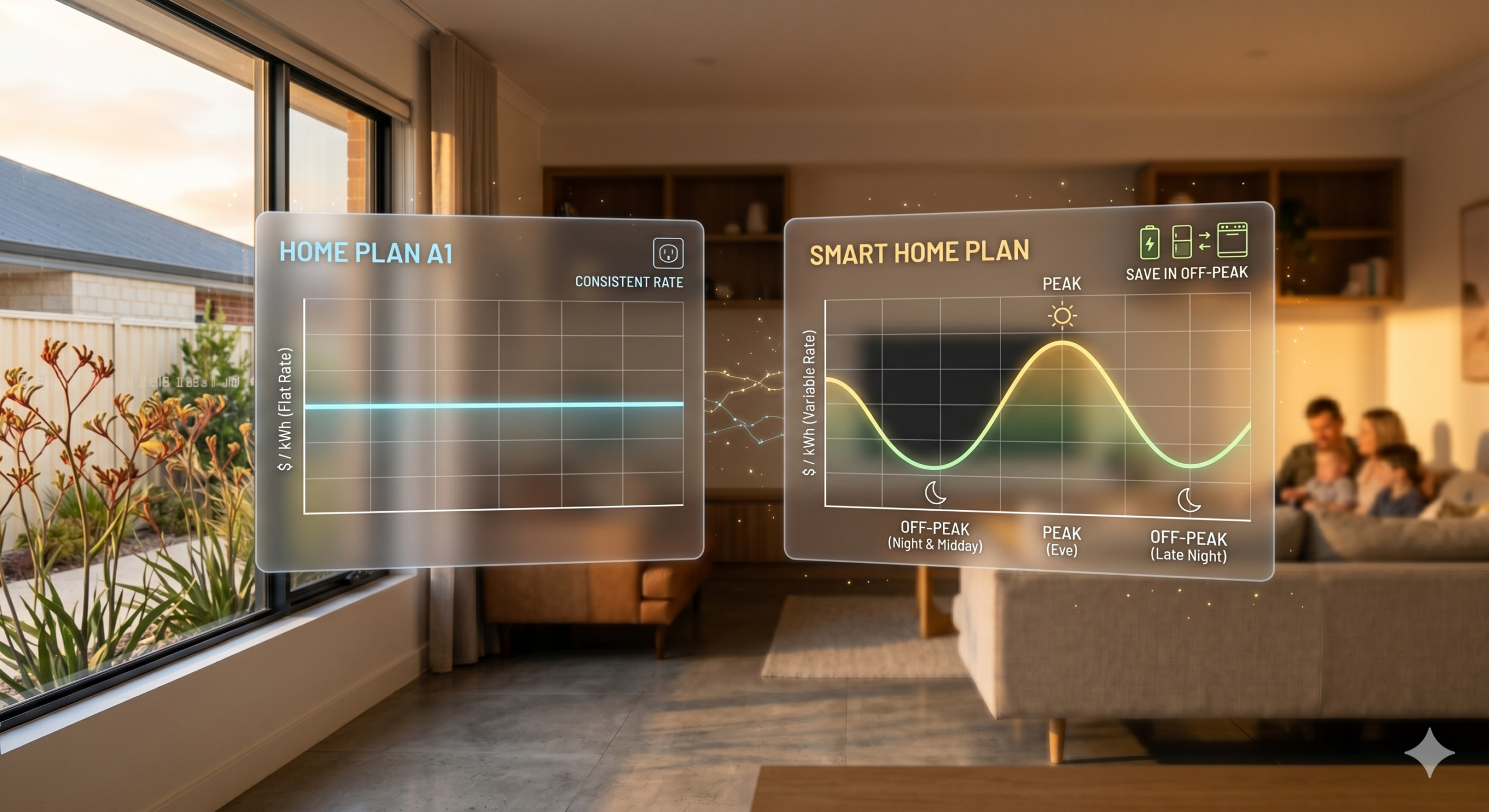
Synergy Smart Home Plan vs Home Plan A1 (2026): What’s Changed and What to Choose Now
Quick answer: Synergy’s Smart Home Plan is closed to new customers. If you are already on it, you can stay, at 63.26c/kWh peak (weekdays 3pm–9pm), 33.13c shoulder and 17.43c off-peak from 1 July 2026. If you are not on it, you can’t switch to it. Your real choice in 2026 is Home Plan A1 (a flat 33.26c/kWh any time), Midday Saver (cheap 9am–3pm, expensive 3pm–9pm) or, if you own a plug-in EV, EV Add On. In short: solar-only homes with evening usage usually stay on A1; homes with a battery or EV usually do better on Midday Saver or EV Add On.
All rates below are Synergy’s regulated prices from 1 July 2026, including GST, from Synergy’s Standard Electricity Prices and Charges brochure. Feed-in (DEBS) rates are the same on every plan: 10c/kWh for exports from 3pm to 9pm and 2c/kWh at all other times.
Is the Synergy Smart Home Plan still available in 2026?
No, not for new customers. Synergy’s 2026 price brochure says the plan “is only available to existing Synergy Smart Home Plan customers” and points anyone interested in a time-of-use tariff to Midday Saver instead.
Here are the Smart Home Plan rates that existing customers pay from 1 July 2026:
| Smart Home Plan component | Time window | Rate (1 July 2026, incl. GST) |
|---|---|---|
| Peak | Weekdays 3pm–9pm | 63.26c/kWh |
| Shoulder | Weekdays 7am–3pm; weekends 7am–9pm | 33.13c/kWh |
| Off-peak | Every day 9pm–7am | 17.43c/kWh |
| Supply charge | Per day | $1.19/day (119.24c) |
Synergy counts public holidays as weekdays, so a Monday public holiday still has a 3pm–9pm peak. On weekends there is no peak at all: 3pm–9pm is charged at the shoulder rate.
Compared with Midday Saver, it has a higher peak but a cheaper overnight rate, no weekend peak and a lower supply charge. It has no cheap daytime window: shoulder (33.13c) is about the same as A1.
Already on the Smart Home Plan? What happens if you stay, move or switch
You can stay on it. Synergy still publishes current rates for existing customers, and nothing in the 2026 brochure says existing customers will be moved off. Before you change anything, though, check these points.
- Leaving is probably one-way. The plan is “only available to existing” customers. If you move to A1 or Midday Saver, expect that you won’t be able to come back. Check with Synergy (13 13 53) before you switch.
- Moving house: Synergy doesn’t publish whether the plan can follow you to a new address. Assume you may need to choose an open plan at the new home, and check with Synergy before you move.
- Your meter: if advanced (AMI) meters are available in your suburb, you must have one to stay on the plan. If you opt out of an advanced meter, Synergy moves you back to Home Plan A1.
- Adding a battery with the WA rebate: the WA Residential Battery Scheme requires Synergy customers to join a virtual power plant. Synergy’s Battery Rewards program is only open to customers on A1, K1, Midday Saver or EV Add On. The Smart Home Plan is not on that list. In practice, claiming the Synergy rebate is likely to mean leaving the Smart Home Plan. Confirm with Synergy before you sign up.
- Your feed-in tariff doesn’t change. DEBS pays the same 10c/2c on every plan, so your plan choice only affects what you pay for imports.
Is it worth staying? Often, yes. Its 17.43c overnight rate beats A1 (33.26c), Midday Saver (24.34c) and EV Add On (19.92c), and weekends have no peak. Battery homes that cover the weekday 3pm–9pm peak can do well on it. Homes without a battery that use lots of power on weekday evenings pay 63.26c for it.
What is Synergy Home Plan A1 and what does it cost in 2026?
Home Plan A1 is Synergy’s standard flat-rate residential tariff. From 1 July 2026 it costs 33.26c per kWh at any time of day plus a supply charge of $1.19 a day (119.24c), all including GST. That supply charge alone comes to about $435 a year.
| Home Plan A1 | 1 July 2025 | 1 July 2026 |
|---|---|---|
| Electricity charge (any time) | 32.37c/kWh | 33.26c/kWh |
| Supply charge | $1.16/day | $1.19/day |
Both lines rose about 2.75% on 1 July 2026. Key points about A1:
- Residential use only. If you run a business from home, Synergy’s Home Business Plan (K1) applies instead.
- No special meter needed. A1 works with any meter, and it’s the plan Synergy moves you to if you opt out of an advanced meter on a time-of-use plan.
- Eligible for Battery Rewards, so you can stay on A1 and still claim the WA battery rebate.
- Exports are paid under DEBS: 10c/kWh from 3pm to 9pm and 2c/kWh at other times, the same as on any other plan.
Home Plan A1 vs Midday Saver vs EV Add On: the Synergy plans you can choose now
New Synergy home customers can choose between three main plans: A1 (flat rate), Midday Saver (time of use) and EV Add On (time of use plus a cheap overnight EV window). Here they are side by side, with the closed Smart Home Plan included for comparison.
| Rate (1 July 2026, incl. GST) | Home Plan A1 | Midday Saver | EV Add On | Smart Home Plan (closed) |
|---|---|---|---|---|
| 9am–3pm | 33.26c | 8.85c | 8.85c | 33.13c (shoulder) |
| 3pm–9pm | 33.26c | 55.33c (every day) | 55.33c (every day) | 63.26c weekdays; 33.13c weekends |
| Overnight | 33.26c | 24.34c (9pm–9am) | 19.92c (11pm–6am); 24.34c (9pm–11pm, 6am–9am) | 17.43c (9pm–7am) |
| Supply charge | $1.19/day | $1.33/day | $1.33/day | $1.19/day |
| Who can join | Any residential customer | Residential, compatible/advanced meter | Residential, plug-in EV registered in WA, advanced meter | Existing customers only |
| Battery Rewards (VPP) | Yes | Yes | Yes | No |
Midday Saver rewards you for using power between 9am and 3pm and charges heavily from 3pm to 9pm, every day of the week. You don’t need solar, a battery or an EV to join, but you do need a compatible meter. The supply charge is about 14c a day (around $50 a year) higher than A1. Read our Midday Saver plan explained guide for the full detail.
EV Add On is not an extra charge on top of your plan. It is a whole-of-home tariff you choose instead of A1 or Midday Saver. It uses the same rates as Midday Saver, plus an overnight band from 11pm to 6am at 19.92c for charging. You need a plug-in EV (battery electric or plug-in hybrid) registered with the WA Department of Transport at your address. See our EV Add On plan guide.
For a wider look at every Synergy option, including the legacy and invitation-only plans, see our Synergy electricity plans compared hub.
Worked examples: which Synergy plan costs less?
The answer depends on when you import power from the grid, not how much solar you have. These three examples are illustrative estimates using 1 July 2026 rates. They include grid imports and supply charges only. Solar exports are left out because DEBS pays the same on every plan. Smart Home Plan figures blend five weekdays and two weekend days. Your own bill will differ.
Example 1: solar-only home, no battery (estimate)
A family with a 6.6 kW system imports 10 kWh a day: 4 kWh between 3pm and 9pm (cooking, air-con, TV), 5 kWh overnight (4 kWh between 9pm and 7am, 1 kWh between 7am and 9am) and 1 kWh between 9am and 3pm.
- Home Plan A1: 10 kWh × 33.26c + $1.19 supply = about $4.52/day, or about $1,650 a year.
- Midday Saver: (4 × 55.33c) + (5 × 24.34c) + (1 × 8.85c) + $1.33 supply = about $4.85/day, or about $1,770 a year.
- Smart Home Plan (existing customers): about $5.08 on a weekday and $3.88 on a weekend day, or about $1,730 a year.
Result: A1 is cheapest, by roughly $120 a year compared with Midday Saver. Evening imports at 55c or 63c cancel out the cheap daytime and overnight rates. This is the classic profile that should stay on A1.
Example 2: solar + battery home (estimate)
The same home adds a battery of around 13 kWh. The battery charges from midday solar and covers most of the evening. Grid imports drop to 5 kWh a day: 0.5 kWh between 3pm and 9pm, 3.5 kWh between 9pm and 7am, 0.5 kWh between 7am and 9am, and 0.5 kWh between 9am and 3pm.
- Home Plan A1: 5 kWh × 33.26c + $1.19 supply = about $2.86/day, or about $1,040 a year.
- Midday Saver: (0.5 × 55.33c) + (4 × 24.34c) + (0.5 × 8.85c) + $1.33 supply = about $2.62/day, or about $960 a year.
- Smart Home Plan (existing customers): about $2.45 on a weekday and $2.30 on a weekend day, or about $880 a year.
Result: Midday Saver beats A1 by roughly $85 a year. An existing Smart Home Plan customer with a battery does even better, because their overnight power costs 17.43c. That is why existing customers should think carefully before leaving the plan. Remember, though, that the Synergy WA battery rebate (up to $1,300) requires a VPP, and Battery Rewards isn’t open to Smart Home Plan customers. In winter, Midday Saver also lets you top up the battery from the grid at 8.85c between 9am and 3pm when solar is weak, which this example doesn’t count.
Example 3: solar-only home with an EV (estimate)
Take the Example 1 household and add a plug-in EV that uses 10 kWh a night (roughly 60–70 km of daily driving), charged between 11pm and 6am. Of the home’s 5 kWh of overnight use, assume 3 kWh falls between 11pm and 6am.
- Home Plan A1: 20 kWh × 33.26c + $1.19 supply = about $7.84/day, or about $2,860 a year.
- Midday Saver (EV charged overnight at 24.34c): about $7.28/day, or about $2,660 a year.
- EV Add On (EV charged 11pm–6am at 19.92c): about $6.71/day, or about $2,450 a year.
- Midday Saver with the EV charged at home 9am–3pm (8.85c, before any free solar): about $5.73/day, or about $2,090 a year.
Result: EV Add On saves roughly $415 a year over A1 for an EV that charges overnight. If the car is at home during the day, charging between 9am and 3pm on Midday Saver is cheaper again, and even more so when spare solar does the charging.
Which Synergy plan is best for your home?
There is no single best Synergy plan. The right one depends on when you use grid power. Use this as a starting point:
- Stay on (or choose) Home Plan A1 if you have no solar, or solar without a battery, and you use a lot of power between 3pm and 9pm. A1 also suits households that can’t shift load, such as shift workers, families with babies and homes running medical equipment.
- Choose Midday Saver if you have a battery that covers most of the 3pm–9pm peak, or you’re home during the day and can run big loads (pool pump, hot water, dishwasher, washing) between 9am and 3pm.
- Choose EV Add On if you own a plug-in EV registered in WA and charge it overnight. You keep Midday Saver’s cheap daytime rate as well.
- Already on the Smart Home Plan? Compare your last 12 months of bills against A1 and Midday Saver before you leave, because you probably can’t come back. If you’re adding a battery and want the Synergy rebate, ask Synergy how that affects your plan.
What about “Synergy solar plans”? Synergy doesn’t sell a separate solar plan. Solar owners choose one of the plans above, and Synergy pays for exports under DEBS: 10c/kWh from 3pm to 9pm and 2c/kWh at other times, on up to 50 kWh of exports a day. Because daytime exports earn only 2c, using your own solar (or storing it in a battery) is worth far more than exporting it. Our DEBS feed-in tariff guide explains the buyback rules.
If a battery would tip you onto Midday Saver, the numbers above show why it’s worth modelling first. As a rough guide, most Perth homes pay around $9,500–$13,000 for a ~10 kWh battery before rebates in 2026, or about $5,500–$9,000 after the federal and WA rebates. Your price depends on battery size, your switchboard and how the system is installed. Talk Energy’s in-house SAA-accredited electricians can look at your Synergy usage data and show you which plan suits the system you’re considering. Get a free, fixed quote.
How to switch Synergy plans in 2026
Switching between A1, Midday Saver and EV Add On is done through Synergy (online or on 13 13 53). Here’s what to expect:
- Check your meter. Midday Saver and EV Add On need a compatible meter. Where advanced (AMI) meters are available in your suburb, you must have one. Synergy lists a meter upgrade fee of $108.84, a reprogram fee of $111.60 and a remote reprogram fee of $42.22, if a change is needed.
- Check eligibility. All three are for residential use only. For EV Add On, the EV registration name and address must match the account.
- Ask Synergy to change your plan. Midday Saver has no fixed term, and Synergy lets you move back to a Home Plan with 5 days’ notice.
Frequently asked questions
Can I still switch to the Synergy Smart Home Plan?
No. Synergy says the Smart Home Plan is only available to existing Smart Home Plan customers. If you want a time-of-use tariff, Synergy points new customers to Midday Saver, or EV Add On if you own a plug-in EV.
What are the Synergy Smart Home Plan rates in 2026?
From 1 July 2026, including GST: peak 63.26c/kWh on weekdays from 3pm to 9pm, shoulder 33.13c/kWh on weekdays from 7am to 3pm and weekends from 7am to 9pm, off-peak 17.43c/kWh every day from 9pm to 7am, and a supply charge of 119.24c a day.
What is the Synergy A1 tariff rate in 2026?
Synergy Home Plan A1 costs 33.26c per kWh at any time of day plus a supply charge of $1.19 a day (119.24c), including GST, from 1 July 2026. That is up about 2.75% from 32.37c and $1.16 a day in 2025-26.
If I leave the Smart Home Plan, can I go back?
Probably not. The plan is closed to anyone who isn’t already on it, so once you move to A1, Midday Saver or EV Add On you should expect to lose access. Synergy doesn’t publish the exact rules, so check with Synergy on 13 13 53 before you switch or move house.
Is Midday Saver or A1 better with solar panels?
With solar and no battery, A1 is usually cheaper because most of your grid power is used in the evening, when Midday Saver charges 55.33c/kWh. With a battery that covers the 3pm to 9pm peak, or if you can run big loads between 9am and 3pm at 8.85c/kWh, Midday Saver usually comes out ahead.
Which Synergy plan is best for an EV owner?
If you charge overnight, EV Add On is usually best: it charges 19.92c/kWh from 11pm to 6am, compared with 33.26c on A1, and keeps Midday Saver’s 8.85c daytime rate. If the car is home during the day, charging from solar or at 8.85c between 9am and 3pm is cheaper still.
Not sure which plan suits a solar or battery upgrade? Talk Energy has completed 5,000+ installations over 7+ years and holds 4.8 stars from 300+ Google reviews. Get a free quote or call (08) 6255 5914.