Synergy EV Add On Plan (2026): Rates, Times and Who It Suits
Quick answer: The Synergy EV Add On is a time-of-use electricity plan for Perth households that own a WA-registered plug-in electric vehicle. From 1 July 2026 it charges 19.92c/kWh overnight (11pm–6am) and 8.85c/kWh in the middle of the day (9am–3pm), but 55.33c/kWh from 3pm to 9pm. It replaces your whole-of-home tariff, so it suits households that can charge the car overnight or from solar and keep evening use down.
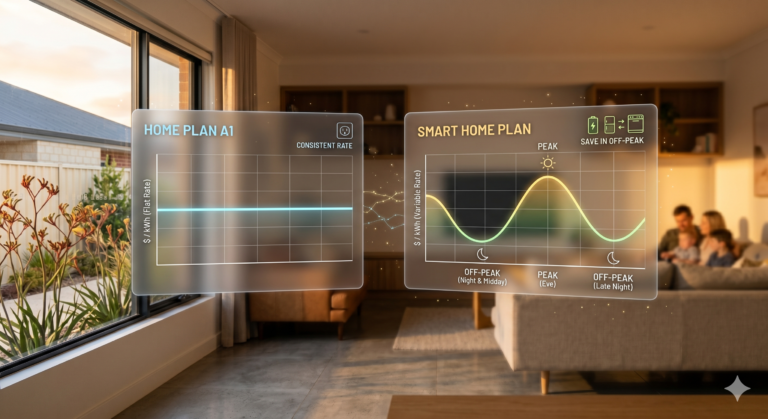
You’ve bought an EV, and now you’re wondering what it will do to your power bill. On the standard Synergy Home Plan (A1), every kilowatt-hour costs the same 33.26c, whenever you plug in. The EV Add On gives you cheaper hours for charging. The catch is a much dearer evening window for everything else in the house.
What is the Synergy EV Add On?
The EV Add On is Synergy’s electricity plan for homes with a plug-in electric vehicle. It is the Midday Saver time-of-use plan with one extra band: a cheaper overnight rate from 11pm to 6am for charging the car.
Despite the name, it isn’t a separate meter or an extra charge on top of your current plan. It has its own supply charge and its own rate for every hour of the day. In practice, you choose it instead of the Home Plan (A1) or Midday Saver, and it covers all the electricity your home uses, not just the car.
Key points:
- Who can get it: residential Synergy customers who own a battery electric vehicle (BEV) or plug-in hybrid (PHEV) registered with the WA Department of Transport to their home address.
- Meter: you need an advanced (AMI) meter where one is available in your suburb. If AMI isn’t available in your suburb yet, you can’t join.
- Contract: no fixed term. You can switch to another Synergy plan you’re eligible for with 5 days’ notice.
Worth knowing: Synergy’s older EV Home Plan is closed to new customers. If you’re still on it, it charges 23.21c/kWh from 11pm to 4am and 33.26c/kWh at all other times, with a 119.24c daily supply charge. New EV owners are pointed to the EV Add On instead.
EV Add On rates and time windows (from 1 July 2026)
The EV Add On has five daily time periods and four different prices. The same windows apply every day, including weekends.
| Period | Time (every day) | Rate inc. GST |
|---|---|---|
| Super Off Peak | 9am–3pm | 8.85c/kWh |
| Peak | 3pm–9pm | 55.33c/kWh |
| Off Peak | 6am–9am and 9pm–11pm | 24.34c/kWh |
| Overnight | 11pm–6am | 19.92c/kWh |
| Supply charge | Daily | 132.78c/day (about $1.33) |
For comparison, here’s how it lines up against the other two plans open to new Synergy customers:
| Plan | 9am–3pm | 3pm–9pm | 9pm–11pm | 11pm–6am | 6am–9am | Supply/day |
|---|---|---|---|---|---|---|
| Home Plan (A1) | 33.26c | 33.26c | 33.26c | 33.26c | 33.26c | 119.24c |
| Midday Saver | 8.85c | 55.33c | 24.34c | 24.34c | 24.34c | 132.78c |
| EV Add On | 8.85c | 55.33c | 24.34c | 19.92c | 24.34c | 132.78c |
So the only difference between Midday Saver and the EV Add On is that overnight band: 19.92c instead of 24.34c between 11pm and 6am. For a full walk-through of the time-of-use plan underneath, see our Synergy Midday Saver guide. To compare every Synergy plan side by side, see Synergy electricity plans compared.
Is the EV Add On cheaper than A1? A worked example
For most EV owners who charge overnight and don’t run the house hard between 3pm and 9pm, yes. In our example below, a household charging about 10 kWh a night saves roughly $340 a year compared with A1. The overnight saving on the car is large, but the dearer evening rate claws some of it back.
Important: this is an estimate built on assumed usage, not a quote or a guarantee. Your result depends on when your household actually uses power. Your Synergy bill or online account shows your real daily use.
Assumptions (no solar, no battery):
- The EV is charged with about 10 kWh a night, between 11pm and 6am.
- The rest of the house uses 16 kWh a day: 3 kWh between 9am and 3pm, 7 kWh between 3pm and 9pm, and 6 kWh between 9pm and 9am (charged at the 24.34c off-peak rate to keep it simple).
Step 1: the car alone.
- A1: 10 kWh × 33.26c = $3.33 a night, or about $1,214 a year.
- EV Add On overnight: 10 kWh × 19.92c = $1.99 a night, or about $727 a year.
- Saving on charging: about $487 a year.
Step 2: the whole home, per day.
| Usage | Home Plan (A1) | EV Add On |
|---|---|---|
| 3 kWh, 9am–3pm | 3 × 33.26c = $1.00 | 3 × 8.85c = $0.27 |
| 7 kWh, 3pm–9pm | 7 × 33.26c = $2.33 | 7 × 55.33c = $3.87 |
| 6 kWh, 9pm–9am (house) | 6 × 33.26c = $2.00 | 6 × 24.34c = $1.46 |
| 10 kWh, 11pm–6am (EV) | 10 × 33.26c = $3.33 | 10 × 19.92c = $1.99 |
| Supply charge | $1.19 | $1.33 |
| Total per day | $9.84 | $8.92 |
| Total per year (× 365) | about $3,592 | about $3,255 |
Result: about $337 a year cheaper on the EV Add On in this example. That’s lower than the $487 saving on charging alone, because the evening 7 kWh costs about $1.54 a day more and the supply charge is about 14c a day higher.
Where the maths flips. Every kilowatt-hour you use between 3pm and 9pm costs about 22c more on the EV Add On than on A1. In this example, the overnight charging advantage (about $1.20 a day after the higher supply charge, plus savings on midday and night use) would be wiped out if evening use climbed from 7 kWh to roughly 11 kWh a day, with everything else unchanged. Homes that run air conditioning, cooking, a pool pump and a dryer through the evening can get there quickly, especially in a Perth summer.
Quick tip: charging the car at midday instead (9am–3pm at 8.85c) would cost about $0.89 for the same 10 kWh. That’s the cheapest grid rate on the plan, if the car is home during the day.
Charging your EV from solar in the 9am–3pm window
If you have rooftop solar and the car is home during the day, midday charging is the cheapest way to run an EV on this plan. Your panels supply most of the power, and any shortfall from the grid costs 8.85c/kWh between 9am and 3pm.
Here’s why it works so well in Perth:
- Exported solar earns very little at midday. Under Synergy’s Distributed Energy Buyback Scheme (DEBS), exports earn 2c/kWh outside 3pm–9pm. Putting 10 kWh of your own solar into the car instead gives up only about 20c of export credit.
- The grid top-up is cheap too. On a cloudy day, the Super Off Peak rate of 8.85c means a 10 kWh top-up costs well under a dollar.
- It frees up the overnight band. Midday charging means you rely less on the 19.92c overnight rate, and much less on anything after 3pm.
Quick tip: set your charger or the car’s app to charge 9am–3pm when you’re home and 11pm–6am when you’re not. Avoid plugging in at 5pm when you get home from work. That’s the 55.33c peak window, which costs more than twice the overnight rate.
Charger choice, circuit sizing and solar-aware charging are covered in our EV charger installation guide for Perth. For how an EV, panels and a battery work together as one system, see EV, solar and battery for Perth homes.
Who the EV Add On suits (and who it doesn’t)
The EV Add On suits plug-in EV owners who can keep most of their household use out of 3pm–9pm. It doesn’t suit homes that are busiest in the evening and have no solar or battery to cover it.
It’s usually a good fit if you:
- own a BEV or plug-in hybrid registered in WA to your home address
- charge the car on a timer, overnight or at midday
- have rooftop solar covering daytime use, so the 8.85c window works in your favour
- have a home battery, or plan to get one, to cover the 3pm–9pm peak
- can run the dishwasher, washing machine and pool pump during the day
It’s usually a poor fit if you:
- use a lot of power between 3pm and 9pm and have no battery. Think evening air conditioning, electric cooking and a household that’s home from mid-afternoon.
- rarely drive, so the overnight saving on charging is small
- own a regular (non-plug-in) hybrid. It isn’t eligible.
- live in a suburb where an advanced meter isn’t available yet. You can’t join until one is.
- have the car registered to a different address or name from the electricity account
Worth knowing: if your evening use is high and you have no battery, the flat A1 rate can still come out cheaper. Our Synergy plans comparison walks through each option.
How to switch to the EV Add On
You apply to Synergy directly. Synergy arranges any meter work, and there’s no lock-in contract. The steps are simple:
- Check the rego. The EV must be a BEV or PHEV registered with the WA Department of Transport. The name and address need to match the account holder, an authorised person at the same address, or a business name at the same residential address.
- Check your meter. If advanced metering (AMI) is available in your suburb, you must have an advanced meter. Synergy organises the installation or reprogramming if it’s needed.
- Apply through Synergy’s EV Add On page.
- Expect a meter fee if work is needed. It is charged in full on your next bill: $108.84 for a meter upgrade, $111.60 for reprogramming, or $42.22 if it can be reprogrammed remotely.
- Set your charging schedule from day one, so the car charges 11pm–6am or 9am–3pm.
If it doesn’t work out, you can move to another Synergy plan you’re eligible for with 5 days’ notice. One thing to know: if you opt out of an advanced meter, or your meter is no longer compatible, Synergy moves you back to the Home Plan (A1).
Quick tip: before you switch, look at a few months of interval data in your Synergy account. If more than about a third of your household use falls between 3pm and 9pm, model it carefully or plan a battery first.
How a home battery fits with the EV Add On
A home battery is the piece that removes the plan’s main downside. It stores solar during the day and runs the house through the 55.33c peak from 3pm to 9pm. That leaves the cheap 8.85c and 19.92c windows for the car.
A typical daily rhythm for a Perth home with solar, a battery and an EV on this plan:
- 9am–3pm: solar runs the house and fills the battery. The car charges if it’s home. Any grid top-up costs 8.85c.
- 3pm–9pm: the battery powers the house, so you buy little or nothing at 55.33c.
- 11pm–6am: the car charges at 19.92c if it wasn’t home during the day.
Keep the car charging off the battery overnight. A 10 kWh battery drained into an EV at night leaves nothing for the next evening’s peak, and the overnight grid rate is already low.
As a rough guide, most Perth homes pay around $9,500–$13,000 for a ~10 kWh battery before rebates in 2026, or about $5,500–$9,000 after the federal Cheaper Home Batteries program and the WA Residential Battery Scheme. Your price depends on battery size, your switchboard and whether you’re adding to existing solar. See our solar battery installation page for more.
Battery Rewards: is the EV Add On eligible?
Yes. The EV Add On is one of four Synergy tariffs eligible for Synergy Battery Rewards, the virtual power plant (VPP) linked to the WA Residential Battery Scheme. The others are the Home Plan (A1), Home Business Plan (K1) and Midday Saver.
- Credit: 70c/kWh for energy your battery exports during Battery Rewards events.
- Events: up to 30 a year, with a 2-year initial term.
- Who can join: customers installing a battery under the WA Residential Battery Scheme. The scheme rebate is up to $1,300 for Synergy customers, and VPP participation is required.
- Exclusion: not available where life-support equipment is registered at the address.
Each event uses battery energy you might otherwise have used to cover your own evening peak. We explain that trade-off in Synergy VPP vs a standalone battery.
Getting solar and a battery set up for an EV
The EV Add On rewards homes that can avoid the 3pm–9pm peak. For most households, that means enough solar to cover daytime use and charging, plus a battery sized for the evening.
Talk Energy Solar & Battery is a Perth installer based in Mount Pleasant, with 7+ years in business and 5,000+ installations. Our in-house SAA-accredited electricians install solar, Sigenergy SigenStor batteries and EV chargers, and we hold 4.8 stars from 300+ Google reviews. Every install comes with a 20-year workmanship warranty.
We can look at your Synergy usage, your driving and your roof, then size a system that suits the plan you’re on. Get a free, fixed quote or call (08) 6255 5914.
Frequently asked questions
What are the Synergy EV Add On rates in 2026?
From 1 July 2026, the Synergy EV Add On charges 8.85c/kWh from 9am to 3pm, 55.33c/kWh from 3pm to 9pm, 24.34c/kWh from 6am to 9am and 9pm to 11pm, and 19.92c/kWh overnight from 11pm to 6am. The supply charge is 132.78c a day. All rates include GST and apply every day, including weekends.
Who is eligible for the Synergy EV Add On?
Residential Synergy customers who own a battery electric vehicle or plug-in hybrid registered with the WA Department of Transport to their home address are eligible. Regular non-plug-in hybrids are not. You also need an advanced meter where one is available in your suburb. If advanced metering isn’t available in your suburb yet, you can’t join the plan.
Is the EV Add On charged on top of my current Synergy plan?
No. The EV Add On is a full time-of-use plan with its own supply charge and rates for every hour of the day. You take it instead of the Home Plan (A1) or Midday Saver, and it applies to all the electricity your home uses, not just the car. There is no separate EV meter.
Is the EV Add On cheaper than the Synergy Home Plan (A1)?
It is often cheaper for EV owners who charge overnight or at midday and keep evening use low. In our estimate, a home charging 10 kWh a night with 7 kWh of 3pm–9pm use saves about $337 a year compared with A1. Every kilowatt-hour used between 3pm and 9pm costs about 22c more than on A1, so homes with heavy evening use and no battery can end up paying more.
Can I join Synergy Battery Rewards on the EV Add On?
Yes. The EV Add On is one of the tariffs eligible for Synergy Battery Rewards, along with A1, K1 and Midday Saver. It is open to customers installing a battery under the WA Residential Battery Scheme. Battery Rewards pays a 70c/kWh activation credit for energy exported during events, with up to 30 events a year.