Virtual Power Plants (VPP) in Perth Explained: How Synergy Battery Rewards Works
Quick answer: A virtual power plant (VPP) is a network of home batteries that a retailer can call on, remotely and briefly, when the grid is under pressure. In WA, joining one is mandatory if you want the WA Residential Battery Scheme rebate. For Synergy customers that VPP is Synergy Battery Rewards: a 2-year agreement, up to 30 events a year, and a 70c/kWh credit for energy your battery exports during each event.
If you have priced a home battery in Perth this year, you have probably hit the VPP condition and paused. Letting Synergy control your battery sounds like a big ask. In practice it is a fairly narrow arrangement, and it comes with both rules and payments. This guide explains what a VPP is, how events work in WA, what you can realistically earn, and what you keep control of.
What is a virtual power plant?
A virtual power plant is a group of home batteries, linked over the internet, that can be told to charge or discharge at the same time. Each battery is small. Thousands of them together act like one large power station, without a building.
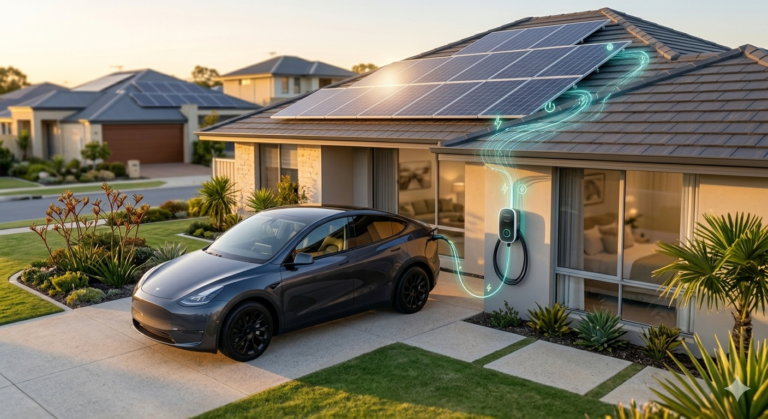
The operator (in WA, usually your electricity retailer) sends a signal through your inverter’s cloud software. Your battery then exports some of its stored energy to the grid for a few hours. You are paid for that energy. The rest of the time, the battery works for your home as normal: it stores your rooftop solar during the day and runs the house in the evening.
Why bother? Perth’s grid, the South West Interconnected System, is under the most strain between 3pm and 9pm on very hot or very cold days. Solar output is falling, air conditioners and heaters are running, and everyone is cooking dinner. Drawing a little energy from thousands of household batteries at those moments is cheaper than building and running extra generators that sit idle most of the year.
What “VPP-ready” or “VPP-capable” means
A VPP-ready battery is one whose inverter can connect to the internet, receive remote signals and respond to them. This matters for two reasons:
- Federal rebate: under the Cheaper Home Batteries Program, an on-grid battery and the inverter it connects to must be VPP-capable when installed. You do not have to actually join a VPP to get the federal discount.
- WA rebate: under the WA Residential Battery Scheme you must join a VPP, and the battery and inverter must be on Synergy’s (or Horizon Power’s) Supported Solutions List. For the Synergy rebate, the equipment has to be listed under “DER-Storage”.
Worth knowing: “VPP-capable” and “on Synergy’s list” are not the same thing. A battery can be VPP-capable for the federal program but still not qualify for the Synergy rebate. Always check the current Supported Solutions List before you sign a quote.
Do you have to join a VPP in WA?
Only if you want the WA battery rebate. Joining a VPP is a condition of the WA Residential Battery Scheme, which pays up to $1,300 for Synergy customers and up to $3,800 for Horizon Power customers. If you buy a battery without the WA rebate, you don’t have to join anything.
- Synergy customers (Perth and the South West) join a Synergy VPP product, which is Synergy Battery Rewards, or an eligible alternative listed by the WA Government.
- Horizon Power customers (regional towns) join a Horizon Power VPP product instead.
- No WA rebate? Your battery still has to be VPP-capable for the federal discount, but you are not required to enrol.
For most Perth homes, skipping the WA rebate does not make sense. Combined with the federal discount, the rebates are worth roughly $3,900–$4,000 on a 10 kWh battery for a Synergy customer. If you are weighing up the trade-off in detail, our guide to Synergy VPP vs a standalone battery runs the numbers both ways. To check the rest of the scheme’s conditions, see the WA Battery Scheme eligibility checklist.
Important: Synergy says Battery Rewards is not compatible with any other VPP program. You can be in one VPP at a time.
How Synergy Battery Rewards works
Synergy Battery Rewards is a 2-year agreement. During that time Synergy can call up to 30 activation events a year. In each one your battery exports energy to the grid, and you get a bill credit of 70c for every kWh exported.
| Feature | Synergy Battery Rewards (as at October 2026) |
|---|---|
| Activation credit | 70c per kWh exported during an event, capped at your battery’s maximum capacity per event |
| Energy offset credits | Credits for grid energy used while your battery is held and charged before an event |
| Events per year | Up to 30 activation events (test events are separate) |
| Initial term | 2 years |
| Typical timing | 3pm–9pm on very hot or very cold days, mostly summer and winter |
| Event length | Typically two to four hours of discharge, after a standby window of about two hours |
| Eligible tariffs | Home Plan (A1), Home Business Plan (K1), Midday Saver, EV Add On |
| Who can join | Synergy residential customers who installed a battery under the WA Residential Battery Scheme, with reliable internet |
| Not eligible | Homes with registered life support equipment; homes already in another VPP |
What happens during an event
- Standby window (about two hours). Synergy holds your battery and charges it to full, from solar or the grid. Energy offset credits cover grid energy used during this window.
- Activation. Your battery discharges for roughly two to four hours. Your home’s own use comes first; the excess is exported.
- Back to normal. Your battery returns to its usual settings. Each event is one charge and discharge cycle.
You won’t get a warning before activation events, and you can’t pick and choose which ones to join. It all runs automatically through your inverter’s cloud connection, so you don’t need to do anything. If your internet drops out, your battery goes offline from the VPP until it reconnects, and you miss out on credits for that event.
Your tariff: Battery Rewards works on A1, K1, Midday Saver and EV Add On. It is not listed for the closed Smart Home Plan. If you are unsure which plan suits a battery, our Synergy electricity plans comparison walks through each one.
How much can you earn from a VPP in Perth?
Expect tens of dollars to a couple of hundred dollars a year in bill credits, not thousands. The ceiling with a 10 kWh battery is about $210 a year: 30 events × 10 kWh × 70c. Most homes will earn less, because Synergy does not have to call all 30 events, and your home uses some of the battery’s energy during each event.
| Scenario (10 kWh usable battery) | Exported per event | Events in the year | Activation credits |
|---|---|---|---|
| Quiet year | 7 kWh | 10 | ~$49 |
| Busier year | 7 kWh | 20 | ~$98 |
| Theoretical maximum | 10 kWh | 30 | ~$210 |
Is 70c a good deal compared with using the energy yourself?
Yes. Per kWh, 70c is more than your stored energy is worth in any everyday use on a Synergy plan. Compare what one kWh from your battery is worth in each case (Synergy rates from 1 July 2026):
- Exported during a VPP event: 70c
- Used at home instead of buying peak power on Midday Saver (3pm–9pm): about 55c
- Used at home instead of buying power on Home Plan A1: about 33c
- Exported under DEBS in the 3pm–9pm peak window: 10c
So on event days you come out ahead of normal self-use, and well ahead of exporting under DEBS. The catch is that events are rare, so VPP credits are a bonus on top of a battery’s main job, which is cutting your evening grid use every day. Our guide to Synergy’s DEBS feed-in tariff explains the everyday export rates.
Quick tip: The biggest money in the VPP decision is the upfront rebate, not the credits. Up to $1,300 off for Synergy customers is worth more than six years of maximum Battery Rewards credits.
What you keep control of (and what you don’t)
You still own the battery, and your home’s use comes first, even during events. What you hand over is the right for Synergy to run up to 30 events a year without asking you first.
| You keep | You give up |
|---|---|
| Ownership of the battery and inverter | The choice of which events to join |
| Priority for your own household use during events | Advance notice of activation events |
| A reserved minimum you set in your battery app, which Synergy cannot use | Your normal battery settings during the standby window and event |
| Normal everyday operation outside events | Joining any other VPP during the agreement |
Your reserve setting and blackouts
Synergy says you can set a reserved minimum in your battery’s own app, and that this reserve is not available to Synergy during events. Setting it higher keeps more charge in hand for your evening or for an outage, but it also cuts the energy you export and so your credits.
Whether your battery keeps the lights on in a blackout depends on your installation, not on the VPP. Some systems are installed with backup capability and a backup circuit; others are not. If backup matters to you, ask for it at the quote stage and agree on a reserve level with your installer.
Pros and cons of joining a VPP
For most Perth homes getting a battery, the pros outweigh the cons, mainly because joining unlocks the WA rebate.
| Pros | Cons |
|---|---|
| Unlocks the WA rebate (up to $1,300 Synergy / $3,800 Horizon Power) | 2-year agreement with limited early exit |
| 70c/kWh credits on event days | No warning before events; you can’t opt out of single events |
| Battery is charged to full before each event | Less stored energy for your own evening use on event days |
| Helps keep the grid stable on peak days | Needs a reliable home internet connection |
| Fully automatic, no action needed | Limits your battery and inverter choice to the Supported Solutions List |
What about battery wear? Synergy says event cycling affects the battery the same way as normal self-consumption, which already cycles it most days. Up to 30 extra cycles a year is small next to the roughly 365 a typical Perth solar battery does anyway. Check your battery’s warranty for its cycle or throughput limits.
Can you leave Synergy Battery Rewards?
Yes, but only on set terms. During the first two years, Synergy’s FAQs say you can opt out if you no longer live at the property, or if you come to need life support equipment. After the initial term, you can leave at any time by giving at least 20 business days’ notice (call Synergy on 13 13 53 or write to them).
- Moving house: tell Synergy so they can cancel the agreement at your old address. If your new home has a compatible battery and you still meet the rules, you can sign up again there.
- Leaving early for other reasons: Synergy’s FAQs don’t spell this out. Read the Battery Rewards terms and conditions, and the WA scheme conditions, before you sign, so you know what applies to your rebate.
Getting a VPP-ready battery installed in Perth
The VPP side works smoothly when three things are right from day one: the battery and inverter are on Synergy’s Supported Solutions List under DER-Storage, the system has a reliable internet connection, and your reserve and backup settings are agreed before it is switched on.
Talk Energy installs Sigenergy SigenStor batteries, which have DER-Storage listings on Synergy’s Supported Solutions List (checked against the 1 October 2026 list). Our in-house SAA-accredited electricians set up the battery, its monitoring and its connection, and we explain your reserve and backup options before you sign. We have completed 5,000+ installations over 7+ years, and we’re rated 4.8 stars from 300+ Google reviews. See our solar battery installation service for how it works.
As a rough guide, most Perth homes pay around $9,500–$13,000 for a ~10 kWh battery before rebates in 2026, or about $5,500–$9,000 after the federal and WA rebates. Your price depends on battery size, your switchboard and whether you want backup. Get a free, fixed quote or call (08) 6255 5914.
Frequently asked questions
Do I have to join a VPP to get a battery rebate in WA?
Only for the WA rebate. Joining a VPP is a condition of the WA Residential Battery Scheme, which pays up to $1,300 for Synergy customers and up to $3,800 for Horizon Power customers. The federal Cheaper Home Batteries discount only needs the battery to be VPP-capable; joining a VPP is optional for that program.
Will a VPP drain my battery before a blackout?
It can lower your charge on an event day, but you can protect a reserve. Synergy charges your battery to full in the standby window, then discharges it for about two to four hours, usually between 3pm and 9pm. You can set a reserved minimum in your battery app that Synergy cannot use. Backup during a blackout also depends on your system being installed with backup capability.
Can I leave Synergy Battery Rewards?
Yes, on set terms. During the 2-year initial term, Synergy lets you opt out if you no longer live at the property or need life support equipment. After that, you can leave at any time with at least 20 business days’ notice. Check the terms and conditions for anything else that applies to you.
How much does the Synergy VPP pay?
Synergy Battery Rewards pays a 70c bill credit for every kWh your battery exports during an activation event, plus energy offset credits during the standby window. With up to 30 events a year, a 10 kWh battery could earn at most about $210 a year in activation credits. Most homes will earn less, as not every event is called and your home uses some energy during each one.
Who runs virtual power plants in WA?
For WA rebate purposes, Synergy customers join Synergy Battery Rewards or an eligible alternative listed by the WA Government. Horizon Power customers join a Horizon Power VPP product. You can only be in one VPP at a time, so compare the terms before you choose.
What is a VPP-ready battery?
A VPP-ready battery has an inverter that can connect to the internet and respond to remote signals from a VPP operator. All on-grid batteries claiming the federal discount must be VPP-capable. For the Synergy rebate, the battery and inverter must also be on Synergy’s Supported Solutions List under DER-Storage.