Solar EV Charging in Perth: How Much Solar, Which Charger and When to Charge
Quick answer: Most Perth EVs use about 15–20 kWh per 100 km. If you drive 40 km a day, that is roughly 7.5 kWh a day at the wall, which is about 2 kW of extra solar panels (around five panels) on an average Perth day. To charge from solar you need the car at home in daylight and a solar-aware charger that follows your surplus. If the car is away all day, Synergy’s EV Add On overnight rate (19.92c/kWh, 11pm–6am) is usually a better choice than draining your home battery.
Filling your EV with your own sunshine works well in many Perth homes. But it only pays off when the car, charger, tariff and battery work together. Here is the maths, so you can check it against your own driving.
How much solar do you need to charge an EV in Perth?
Allow about 1 kW of extra solar for every 20 km you drive each day. Here is the working.
- Work out your daily energy. Multiply your daily kilometres by your car’s consumption. Most EVs use around 15–20 kWh per 100 km. We use 17 kWh/100 km below. Example: 40 km × 0.17 = 6.8 kWh.
- Add charging losses. Some energy is lost as heat in the charger and the car. Allow about 10%. Example: 6.8 × 1.1 ≈ 7.5 kWh a day from your wall.
- Divide by what 1 kW of solar makes in Perth. Perth metro is in the Clean Energy Regulator’s solar Zone 3, with a zone rating of 1.382 MWh per kW per year. That is about 3.8 kWh per kW per day, averaged over the year. Example: 7.5 ÷ 3.8 ≈ 2 kW.
- Convert to panels. With typical 440 W panels, 2 kW is about five panels.
Worth knowing: 3.8 kWh per kW per day is an annual average, not a promise. Winter output is noticeably lower, and roof direction, tilt and shade all matter. Use these figures for planning only.
| Daily driving | EV energy at the wall (estimate) | Extra solar needed (estimate) | Approx. extra panels (440 W) |
|---|---|---|---|
| 20 km | 3.7 kWh/day | about 1 kW | 2–3 |
| 40 km | 7.5 kWh/day | about 2 kW | 5 |
| 60 km | 11.2 kWh/day | about 3 kW | 7 |
| 80 km | 15.0 kWh/day | about 4 kW | 9 |
| 100 km | 18.7 kWh/day | about 5 kW | 11–12 |
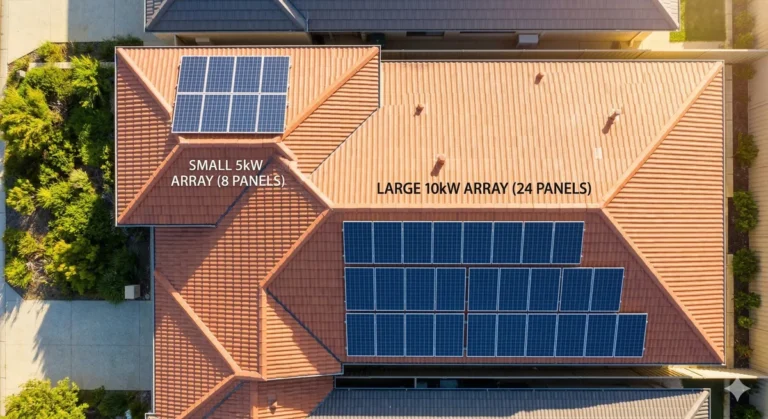
Those panels sit on top of what your home already needs. As a rough guide, most Perth homes pay around $8,000–$11,000 for a 10 kW solar system after the STC discount in 2026. Your price depends on your roof, your switchboard and the panels and inverter you choose.
The bigger catch is timing. Panels only help if the car is plugged in while the sun is up. A car that leaves Rockingham at 7am and returns at 6pm sees little of it on weekdays. Weekends, work-from-home days and a second car that stays home change the picture.
What makes a charger a “solar EV charger”?
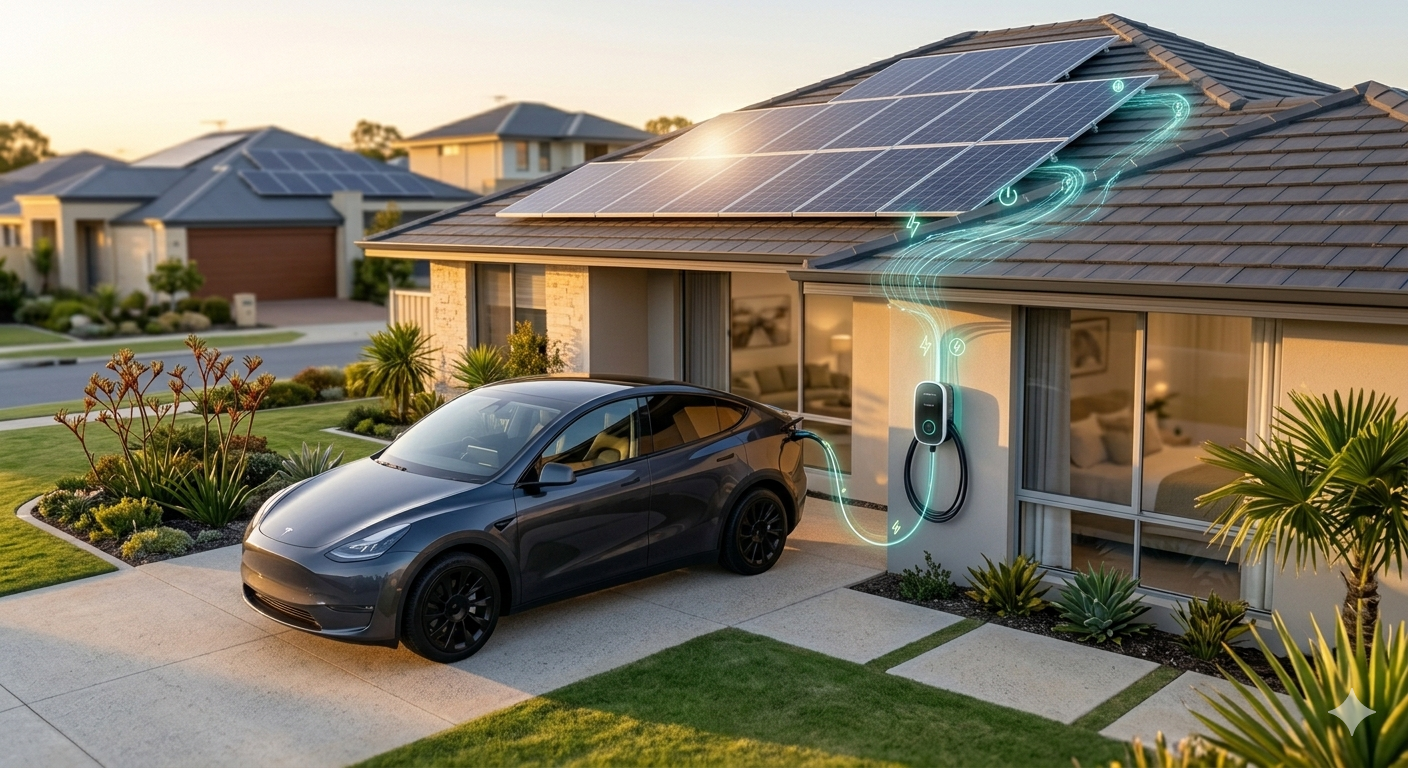
A solar EV charger watches how much solar you are exporting and adjusts the charging rate to soak up that surplus. A basic charger just draws full power whenever the car is plugged in, whether the energy comes from your roof or the grid. Some people call the solar-following feature a “solar diverter” mode, borrowing the name from hot water diverters that do the same job.
Features vary by model, so check the spec sheet rather than the box. The ones that matter most are:
- Solar-only (surplus) mode. The charger only runs on excess solar and speeds up or slows down as clouds pass and household loads change.
- Mixed or “eco plus grid” mode. It uses all available surplus, then tops up from the grid to keep a minimum rate. Useful on part-cloudy days.
- A meter sensor or inverter link. The charger needs to know your export in real time. That is usually a current clamp at the meter box or a direct link to your inverter or battery system.
- Scheduled charging. Lets you charge only in cheap tariff windows, such as 9am–3pm or 11pm–6am on Synergy plans.
- Load management. Holds total household draw within your supply limit, which matters on single-phase homes.
Important: EV charging has a minimum current, usually around 6 amps, or about 1.4 kW on single-phase. Below that surplus, solar-only mode pauses. A three-phase charger may need roughly three times that before it starts, unless it can switch to single-phase.
A 7 kW charger can draw more than many systems produce at noon; solar-aware software simply throttles it to match. Choosing between single-phase and three-phase, and what it takes to wire a charger into your switchboard, is covered in our EV charger installation guide for Perth.
Daytime solar vs overnight off-peak: which is cheaper?
Your own solar surplus is the cheapest energy you can put in an EV, and Synergy’s 9am–3pm rate is a close second. Overnight charging on EV Add On is a solid fallback for cars that are away all day. Charging between 3pm and 9pm on a time-of-use plan is the expensive mistake.
Solar charging is not quite free: every kWh in the car is a kWh you no longer export, and Synergy’s DEBS buyback pays 2c/kWh for exports outside 3pm–9pm. That 2c is your real cost.
| Where the energy comes from | Rate (from 1 July 2026) | Cost per 100 km (estimate) | Per year at 40 km/day (estimate) |
|---|---|---|---|
| Your surplus solar (lost DEBS credit) | 2c/kWh | about $0.37 | about $55 |
| Grid, Midday Saver or EV Add On, 9am–3pm | 8.85c/kWh | about $1.65 | about $240 |
| Grid, EV Add On overnight, 11pm–6am | 19.92c/kWh | about $3.72 | about $545 |
| Grid, Home Plan A1 (any time) | 33.26c/kWh | about $6.22 | about $910 |
| Grid, Midday Saver or EV Add On, 3pm–9pm | 55.33c/kWh | about $10.35 | about $1,510 |
Note that EV Add On is a whole-of-home plan, not an extra line on your bill. It has a higher daily supply charge than A1 (132.78c vs 119.24c a day), and everything else in your home pays 55.33c/kWh between 3pm and 9pm. To join, you need a plug-in EV registered in WA and an advanced meter. We compare it with A1 and Midday Saver in our Synergy EV Add On guide.
In short: a car home by day suits solar first, then 9am–3pm grid top-ups. A commuter car suits solar on weekends and EV Add On overnight on weeknights.
Should you charge your EV from your home battery?
Usually not. In most Perth homes, energy in a home battery is worth more running the house in the evening than filling the car overnight. There are a few cases where it makes sense, covered below.
There are three reasons it rarely pays:
- Round-trip losses. Every time energy is stored and released, some is lost. A typical lithium home battery returns roughly 90% of what goes in. Then the EV charger and car lose about another 10%. So solar routed through the battery into the car delivers around 80% of what the panels made. Charging the car directly from solar skips one of those steps.
- Value. On Midday Saver or EV Add On, each kWh your battery supplies between 3pm and 9pm saves 55.33c. Using the same kWh to charge the car at midnight saves only 19.92c, because that is what the grid charges on EV Add On overnight. You give up about 35c of value for every kWh you move.
- Size. A 10 kWh battery holds roughly 50 km of driving. One top-up can empty it.
Charging from the battery can make sense when:
- The battery is still well charged late at night and will refill from solar tomorrow, as often happens in spring and summer.
- You are not eligible for EV Add On, or you stay on A1, so overnight grid power costs 33.26c.
- Your system is designed for it. Some integrated systems can charge the car straight from DC solar and battery power, which avoids part of the conversion losses.
Worth knowing: Batteries installed under the WA Residential Battery Scheme must join a virtual power plant, such as Synergy Battery Rewards, which can call on them up to 30 times a year. Set a battery reserve so the car cannot drain it.
The simple rule: let solar charge the car during the day, let the battery run the house in the evening, and let the cheap overnight rate do the rest. A good energy management system can do this for you automatically. See how batteries fit Perth homes on our solar battery page.
Can your EV power your home? Vehicle-to-home in Australia
Yes in principle, but in Perth it is still early days. Vehicle-to-home (V2H) and vehicle-to-grid (V2G) use a bidirectional charger to send energy from the car back to your home or the grid.
Where things stand in October 2026:
- Standards. Australia’s inverter standard, AS/NZS 4777.2, was amended so bidirectional chargers can be certified like solar and battery inverters. A small number of bidirectional chargers have been listed by the Clean Energy Council since late 2025.
- Western Power rules. In Perth, a bidirectional charger counts as embedded generation. Western Power says it must meet its Basic Embedded Generator Connection Technical Requirements, be registered with the Clean Energy Council, and get written approval through an Embedded Generation Connection application before it is connected.
- Buyback. Synergy’s DEBS rules allow V2G-capable EVs to export, alongside home batteries.
- The car. This is the biggest limit. Only some EV models support bidirectional charging, and the car maker has to allow it. Check your owner’s manual and warranty terms before you plan around it.
If V2H matters to you, choose equipment that is ready for it, but do not pay a big premium today for a feature your car may not support.
Example setups for Perth EV households
The right setup depends more on when your car is home than on how far you drive. These examples show how the pieces fit.
| Household | Driving pattern | Solar (example) | Battery role | Charging plan |
|---|---|---|---|---|
| Retired couple, Applecross | ~30 km/day, car home most days | Existing 6.6 kW may cover it; add ~1.5 kW if the house already uses most of it | Optional; covers evening house load | Solar-only mode, grid top-up 9am–3pm |
| Commuter, Joondalup | ~50 km/day, away 7am–6pm weekdays | 10 kW so weekends can refill the car | Runs the house 3pm–9pm; not the car | Solar on weekends, EV Add On 11pm–6am on weeknights |
| Family with two EVs, Willetton | ~80 km/day combined, one car home by day | 10–13 kW | Runs the house in the evening; reserve set for VPP events | Home car on solar; commuter car overnight |
| Long commute, Mandurah to Perth | 100+ km/day, away all day | Solar sized for the house first | House only | Mostly EV Add On overnight; solar on weekends |
Two patterns stand out. More solar is usually the most useful upgrade, because it helps both the car and the house. And the battery is best sized for your evening household load, not your car.
Solar, battery and EV charging with Talk Energy
Talk Energy designs and installs solar, home batteries and EV chargers as one system, so the three work together from day one. We are a Perth company based at 16 Ogilvie Rd, Mount Pleasant, with in-house SAA-accredited electricians and no subcontractors. Over 7+ years we have completed more than 5,000 installations, and we hold 4.8 stars from 300+ Google reviews.
For batteries we install Sigenergy’s SigenStor. Sigenergy describes SigenStor as an all-in-one solar inverter, battery and energy manager, with an optional DC EV charging module that draws power directly from solar and the battery. It says vehicle-to-home and vehicle-to-grid features depend on the car and future model support. Read more in our SigenStor guide for Perth, and ask us whether an integrated EV option suits your home.
Installs come with our 20-year workmanship warranty and 48-hour fix-or-replace guarantee (WA electrical contractor licence EC15564). We look at your bills, roof and driving, then show you the numbers in writing.
Get a free, fixed solar and EV charging quote or call (08) 6255 5914.
Frequently asked questions
How many solar panels do I need to charge an EV in Perth?
As a rough estimate, about five extra 440 W panels (around 2 kW) for 40 km of driving a day. That assumes the car uses about 17 kWh per 100 km, around 10% charging losses, and Perth’s average output of about 3.8 kWh per kW of solar per day. Double the driving and you roughly double the panels. Output is lower in winter, so expect some grid top-ups between June and August.
Is it cheaper to charge my EV from solar or on Synergy’s EV Add On overnight rate?
Solar is cheaper. Charging from surplus solar costs you only the 2c/kWh DEBS credit you would have earned by exporting it, about $0.37 per 100 km. EV Add On overnight costs 19.92c/kWh from 11pm to 6am, about $3.72 per 100 km. Overnight charging is still a good option for cars that are away during the day.
Should I charge my EV from my home battery?
Usually not. Storing energy in a battery and then moving it into a car loses roughly 20% along the way. Battery energy is also worth more covering your home between 3pm and 9pm, when time-of-use grid power costs 55.33c/kWh. It can make sense when the battery has spare charge late at night and will refill from solar the next day.
Do I need a special charger to charge my EV from solar?
You need a solar-aware charger, or a charger linked to your inverter or battery system. It measures your solar export and adjusts the charging rate to match the surplus. A basic charger draws full power from wherever it can, including the grid. Check the charger can communicate with the equipment you already have.
Can my EV power my house in Perth?
Possibly, but it is still early days. You need a car that supports bidirectional charging, a bidirectional charger registered with the Clean Energy Council, and written approval from Western Power through its embedded generation connection process. Only some EV models support it, so check with your car maker first.
Will solar EV charging work in winter?
Yes, but you will get less from it. Perth’s solar output drops in the shorter, cloudier days of June to August, so a solar-only mode will add less range each day. Set your charger to top up from the grid in cheap windows, such as 9am to 3pm on Midday Saver or EV Add On, or 11pm to 6am on EV Add On.