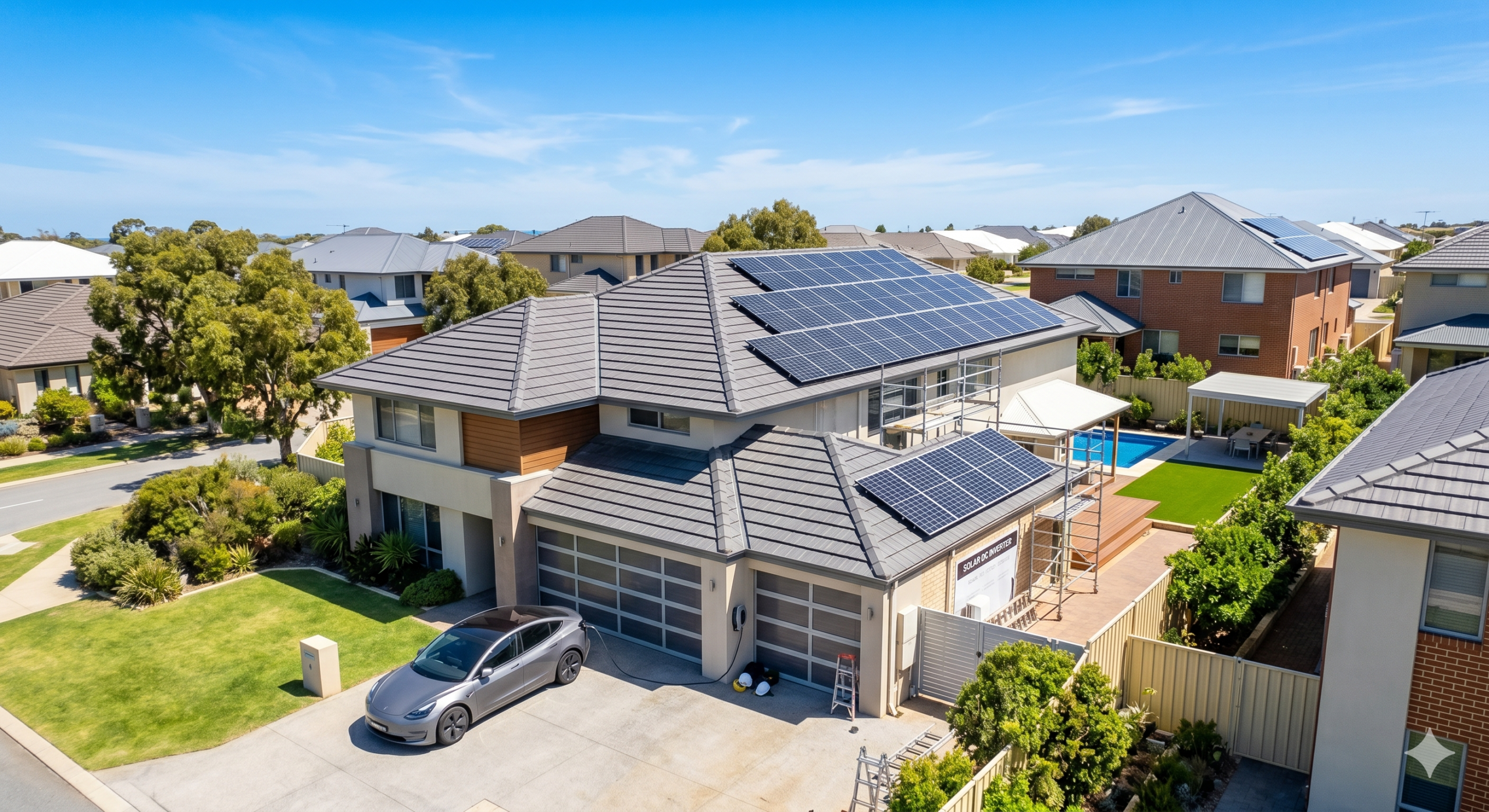
Solar for Double-Storey Perth Homes: Roof Layout, Panel Placement and Costs in 2026
TL;DR: Solar installation on Perth double-storey homes costs a little more than single-storey for the same kW capacity, due to scaffolding and edge-protection safety requirements. As a rough guide, most Perth homes pay around $8,000–$11,000 for a 10 kW system after STC rebates in 2026, plus roughly $8,000–$12,500 for a 13.5 kWh battery after rebates, with the double-storey safety cost on top. The advantage: double-storey homes usually have larger roof areas, multiple roof aspects, and clear sightlines to the north — meaning generation per kW is typically 3–6% higher than equivalent single-storey homes.
Why double-storey solar is different
Double-storey homes — common in Canning Vale, Harrisdale, Piara Waters, Iluka, and most newer Perth subdivisions — bring three things to a solar install that single-storey homes don’t:
- Working-at-heights safety requirements: scaffolding or rooftop edge protection mandatory under WA work safety regulations
- More complex roof geometry: often hip roofs with 4–6 aspects rather than simple gable
- Less obstruction: upper roofs sit above tree lines and neighbouring fences, getting full sun unobstructed
The safety component adds 1–2 hours of setup and its cost depends on roof access, roof height and house orientation. Talk Energy quotes this as a transparent line item up front.
Roof layout strategies for double-storey Perth homes
Hip roofs (most common)
Hip roofs have four sloped aspects. Talk Energy typically uses 2–3 aspects, prioritising:
- North aspect: best generation, fits 12–16 panels typically
- West aspect: 15–20% less generation than north but valuable for late-afternoon peak (3pm–6pm DEBS rate is highest then)
- East aspect: 15–20% less generation than north, useful for morning consumption
A typical Perth double-storey hip roof accommodates 8.8–13.2 kW of solar across 2–3 aspects.
Gable roofs (less common)
Gable roofs have two large aspects, usually north and south. North-facing gable double-storey is the easiest install — large unobstructed roof, simple panel array, fits 10–16 kW comfortably. South-facing gable is the worst-case orientation; generation is 25–35% lower than north and the install is rarely cost-effective without supplementary east/west panels.
Complex modern rooflines
Newer Perth subdivisions often have multiple roof levels — main upper roof plus lower porch/extension roofs. Talk Energy uses these creatively, placing 4–8 panels on the upper roof for best generation, and adding panels on lower roofs for east-west spread without scaffolding overhead.
Cost breakdown for double-storey Perth homes
| System | Single-storey cost (after rebates) | Double-storey cost (after rebates) | Difference |
|---|---|---|---|
| 6.6 kW solar only | ~$5,000–$7,500 | Single-storey estimate + safety setup | Scaffolding and edge protection |
| 10 kW solar only | ~$8,000–$11,000 | Single-storey estimate + safety setup | Scaffolding and edge protection |
| 10 kW + 13.5 kWh battery | 10 kW estimate (~$8,000–$11,000) + ~$8,000–$12,500 battery | Single-storey estimate + safety setup | Scaffolding and edge protection |
| 13.2 kW + 13.5 kWh battery | 13 kW estimate (~$10,000–$14,000) + ~$8,000–$12,500 battery | Single-storey estimate + safety setup | Scaffolding and edge protection |
The cost difference shrinks proportionally on larger systems — at 13.2 kW, the safety overhead is just 3–4% of the total project cost.
Generation advantage of double-storey roofs
Double-storey roofs in Perth typically generate 3–6% more per kW than equivalent single-storey homes. Reasons:
- Above tree shading: upper roofs sit above fence and tree lines that often clip single-storey panels in the morning or late afternoon.
- Better airflow / cooling: panel temperature drops by 2–4°C on upper roofs compared with lower roofs surrounded by other structures. Cooler panels are more efficient.
- Less debris and bird issue: harder for leaves and bird droppings to settle on steeper, higher roofs.
For a 10 kW system, 3–6% generation uplift translates to ~450–900 kWh/year extra — worth $135–$270/year of self-consumption value.
Install day for a Perth double-storey home
- Day 1, 7:30am: Scaffolding crew arrives. Sets up edge protection or scaffolding (1–2 hours).
- 9:30am: Solar electricians begin roof work. Rail/racking installed across selected aspects.
- 12:00pm: Panels lifted to roof, mounted, wired in strings.
- 3:00pm: Inverter and (if applicable) battery installed at ground level.
- 4:30pm: System energised, commissioning tests, scaffolding removed.
- 5:30pm: Final paperwork, app pairing, walkthrough.
Solar-only double-storey installs typically finish in one day. Solar + battery double-storey installs occasionally need a second day depending on switchboard work, but most Talk Energy installs complete in one day.
Frequently asked questions
Does solar cost more on a double-storey Perth home?
Yes, but only marginally — a modest extra cost for the same kW capacity, due to scaffolding and rooftop edge-protection requirements under WA work safety regulations. Talk Energy quotes this as a line item.
How many panels fit on a typical Perth double-storey roof?
Most Perth double-storey homes have 200–300 sqm of usable roof area across 2–4 aspects, accommodating 25–40 panels (10–16 kW solar). Talk Energy assesses your specific layout at the site visit.
Are double-storey solar installs more dangerous?
No — they’re managed safely with proper scaffolding and rooftop edge-protection. Talk Energy’s WA-licensed install teams are certified for working at heights and use compliant safety systems on every double-storey install.
Do double-storey panels generate more electricity than single-storey?
Slightly — typically 3–6% more per kW due to less shading and better airflow cooling. For a 10 kW system, that’s an extra 450–900 kWh/year of generation.
Can battery storage be installed in a double-storey garage?
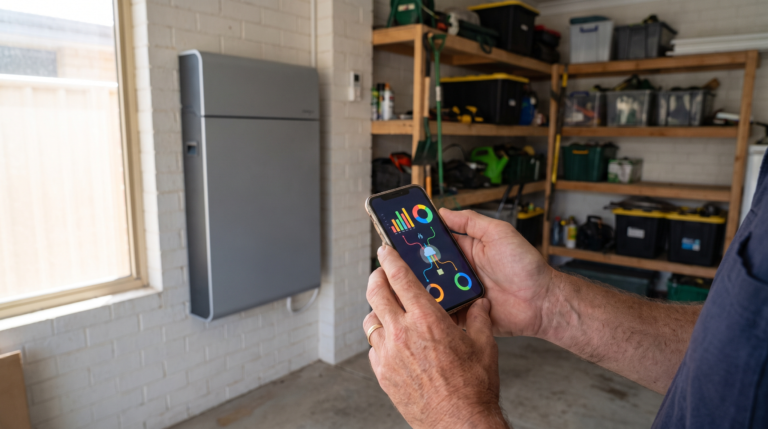
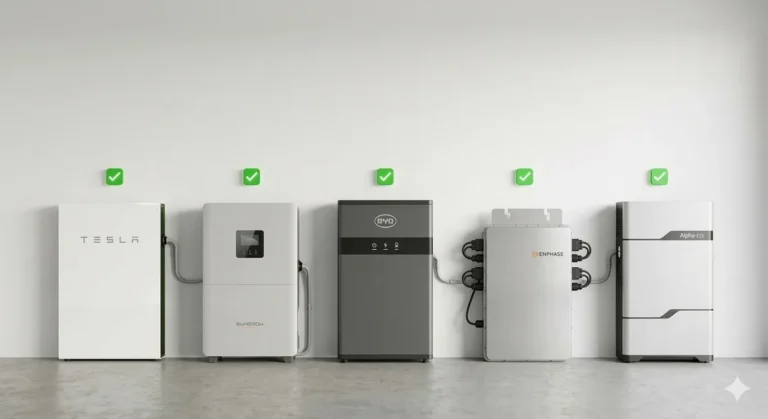
Yes. Batteries (Tesla Powerwall 3, Sungrow SBR, BYD HVM) are always installed at ground level — typically in the garage, ground-floor utility room, or external south-facing wall. The double-storey aspect only affects the rooftop solar install, not the battery placement.
Got a double-storey Perth home? Talk Energy installs across Canning Vale, Harrisdale, Piara Waters, Iluka, and all Perth double-storey suburbs — scaffolding included, all rebates applied at quote. Get a free quote or call (08) 6255 5914.