Solar for Perth Homes with Pool, AC and EV: 2026 Sizing Guide for High-Energy Households
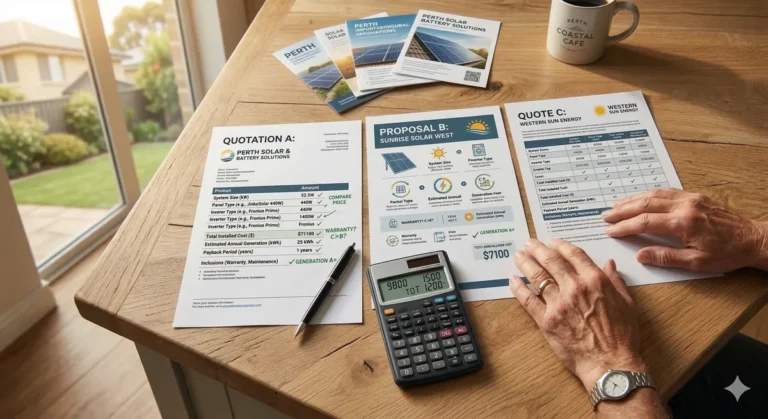
TL;DR: A typical Perth home with pool, ducted AC, and one EV uses 40–55 kWh per day, and the right system is 13.2 kW solar + 13.5–20 kWh battery. As a rough guide, most Perth homes pay around $10,000–$14,000 for 13 kW of solar after the STC rebate, plus around $8,000–$12,500 for a 13–16 kWh battery after federal and WA rebates; your total depends on battery size, phase, switchboard work and the EV charger. With smart load-scheduling (pool pump and EV charged during solar generation) annual electricity bill savings can reach around $5,600 at Synergy’s A1 rate (Synergy rates from 1 July 2026).
The big three: what each appliance actually uses
Pool pump (and pool heat pump if fitted)
A standard variable-speed pool pump in Perth runs 6 hours daily and uses 6–10 kWh/day. If the pool has a heat pump (common in Perth for year-round swimming), add another 10–18 kWh/day in cooler months. Annual pool energy: 2,500–9,000 kWh.
Ducted reverse-cycle AC
Perth’s hot summers and increasingly common heating in winter mean ducted AC is a major load. A 14 kW system used 6 hours daily uses 14–20 kWh/day in summer peak and 4–8 kWh/day in shoulder seasons. Annual AC energy: 4,000–7,000 kWh.
EV (electric vehicle) charging
A typical Perth driver covering 40–60 km/day uses 8–12 kWh/day for EV charging. For two EVs or longer commutes, double this. Annual EV energy: 3,000–8,000 kWh per car.
Base household load
Standard household consumption — fridge, lighting, cooking, hot water, electronics — adds 10–14 kWh/day.
Total consumption profile (high-energy Perth household)
| Load | Summer kWh/day | Winter kWh/day |
|---|---|---|
| Pool pump | 8 | 6 |
| Pool heat pump (if fitted) | 0 | 15 |
| Ducted AC | 18 | 6 |
| EV charging (one car) | 10 | 10 |
| Base household | 12 | 12 |
| Total | 48 kWh/day | 49 kWh/day |
The pattern is unusual: a high-energy Perth home consumes roughly the same amount year-round. Summer AC use is offset by winter pool heating; EV use is constant. This makes solar sizing easier than for typical homes whose loads swing seasonally.
Sizing solar for this profile
To meet 48 kWh/day consumption with solar in Perth (5.6 peak sun hours), the required system size is roughly 48 ÷ 5.6 = 8.6 kW DC as a starting point. But this assumes 100% self-consumption, which isn’t realistic. To allow for daily winter shortfalls, generation losses, and some export buffer:
- Solar size: 13.2 kW (32 panels of 415W). Generates ~55 kWh/day summer, ~28 kWh/day winter average.
- Battery size: 13.5–20 kWh usable. Covers evening AC + EV charging gap.
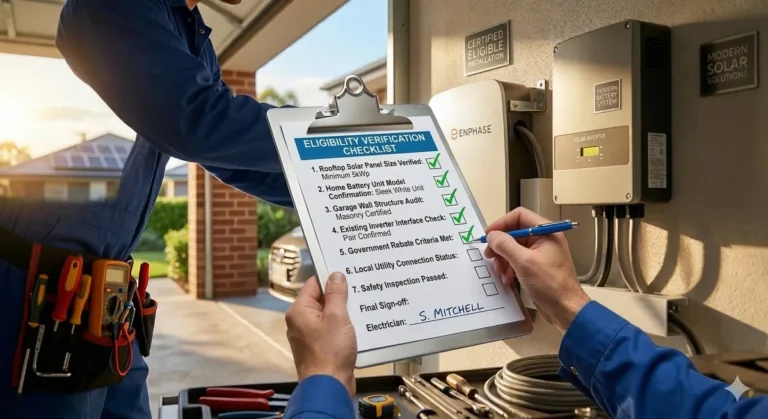
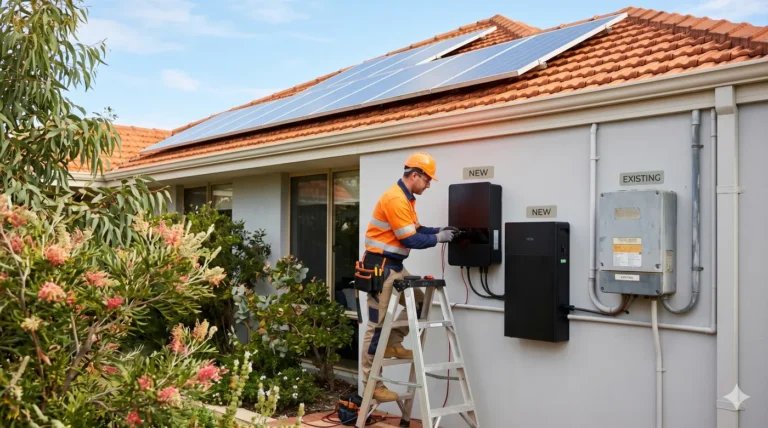
- Inverter: 10 kW hybrid, three-phase preferred.
- EV charger: 7 kW or 11 kW depending on phase, scheduled to charge during solar generation hours.
Export is limited to 1.5 kW, or up to 5 kW with a retailer off-take agreement, but installing 13.2 kW of panels remains viable because most generation is self-consumed by AC + pool + EV during the day.
Total cost in Perth after rebates (2026)
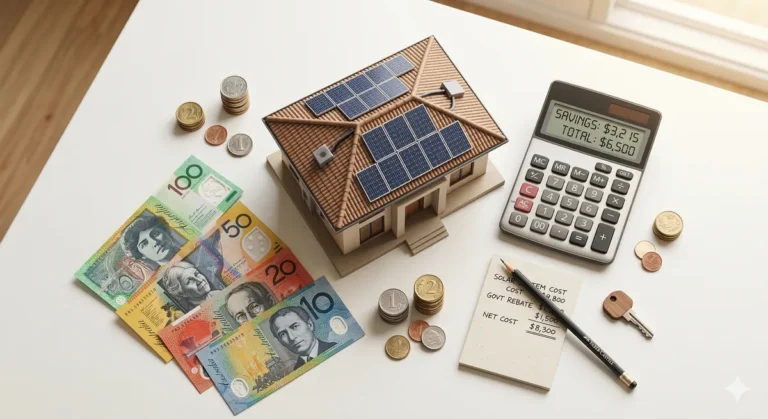
- 13.2 kW solar: as a rough guide, around $10,000–$14,000 installed (after STC)
- 13.5 kWh battery: around $8,000–$12,500 after federal + WA rebates (rough guide for a 13–16 kWh battery; rebate eligibility depends on the model)
- 7 kW EV charger: depends on the charger model, phase and cable run
- Switchboard upgrade (if needed): adds to the cost
- Total turnkey: quoted as one project after a site assessment
Annual savings and payback
Before solar, a high-energy Perth home using 48 kWh/day on Home Plan A1 spends approximately $5,830/year on electricity at 33.26c/kWh (48 kWh × 33.26c × 365, excluding the supply charge). With the system above:
- Daytime solar self-consumption: covers AC + pool pump + EV charging (if scheduled to midday). ~32 kWh/day at 33.26c = $10.64/day saved.
- Battery evening cover: 13.5 kWh discharge replaces evening grid imports. ~$4.50/day saved.
- Overnight top-up: small remaining grid imports at 33.26c on A1 (or 19.92c from 11pm to 6am on EV Add On). ~$0.80/day cost.
- DEBS exports: minimal — system is well-matched to consumption. ~$0.20/day earned.
Net annual saving: around $5,600 (about $15.30/day × 365). Simple payback: your quoted system price divided by that saving. The pool pump + EV + AC make this one of the highest-ROI solar profiles in Perth.
Scheduling tips for high-energy Perth homes
- Pool pump 11am–5pm: matches solar generation peak.
- Pool heat pump 11am–3pm (winter): shortest, hottest solar window.
- EV charging set to “solar mode” via Tesla/Sungrow/Wallbox app: only draws when solar surplus exists.
- AC pre-cool 2pm–4pm: house thermal mass coasts through evening peak.
- Battery charging from solar in midday, discharge 3pm–9pm: handled automatically by the inverter on Midday Saver or EV Add On settings (the Smart Home Plan is closed to new customers).
Frequently asked questions
What size solar do I need for a Perth home with pool, AC and EV?
A 13.2 kW solar system with 13.5–20 kWh battery is the standard for high-energy Perth homes using 40–55 kWh/day. Smaller systems leave significant grid import; larger systems hit export limits without enough self-consumption uplift to be worthwhile.
Can a Perth solar system run my pool, AC, and EV?
Yes, with correct sizing and scheduling. A 13.2 kW system with 13.5 kWh battery covers approximately 85% of typical pool+AC+EV consumption when loads are scheduled to midday solar generation. The remaining 15% is overnight grid import, at 33.26c/kWh on the A1 Home Plan or 19.92c/kWh (11pm–6am) on EV Add On (Synergy rates from 1 July 2026; the Smart Home Plan is closed to new customers).
What’s the payback period for a high-energy Perth home with solar?
Simple payback is your quoted system price divided by your annual bill saving, which can be around $5,600 a year for a well-scheduled 48 kWh/day home. The high baseline consumption makes payback faster than typical homes despite the larger upfront cost.
Should I install solar and battery before or after getting an EV?
Before. Solar+battery installed in advance immediately turns EV charging into near-free fuel. Installing solar after the EV means paying full grid rates for the months in between. Talk Energy regularly sizes systems with “EV-ready” wiring even when the EV arrives 6–18 months later.
Do I need three-phase power for a pool + AC + EV solar setup?
Not strictly. Single-phase Perth homes can run 13.2 kW solar + 13.5 kWh battery + EV charger with proper export limiting. However, three-phase enables 11 kW EV charging (twice as fast) and a higher generation limit (8 kVA per phase), so it’s preferred for homes planning long-term high consumption.
Got a Perth home with pool, AC and EV planned? Talk Energy designs solar + battery + EV-ready setups around your full consumption profile, not just panel count. Get a free Perth quote or call (08) 6255 5914.