How Much Does a Solar Battery Cost in Perth in 2026?
Quick answer: As a rough guide, most Perth homes pay around $9,500–$13,000 for a ~10 kWh battery before rebates in 2026, or about $5,500–$9,000 after the federal Cheaper Home Batteries rebate and the WA Residential Battery Scheme. Larger 13–16 kWh batteries sit around $13,000–$18,000 before rebates. Your price depends on battery size, whether you need a new hybrid inverter, and how complex the install is.
Battery quotes in Perth can look wildly different. Two quotes for a “10 kWh battery” can be thousands of dollars apart, and it is not always clear which rebates have been taken off. This guide sets out rough 2026 estimates before and after rebates, explains how the federal and WA rebates stack, and shows what actually moves the price up or down.
Key Takeaways
- A ~10 kWh battery is roughly $9,500–$13,000 before rebates, or ~$5,500–$9,000 after federal and WA rebates (2026 estimate)
- The federal Cheaper Home Batteries rebate is worth about $2,600–$2,700 on a 10 kWh battery, and it falls on 1 January 2027
- The WA Residential Battery Scheme adds up to $1,300 for Synergy customers or up to $3,800 for Horizon Power customers
- The WA rebate requires Virtual Power Plant (VPP) participation and a battery on your retailer’s Supported Solutions List
- An optional WA no-interest loan of $2,001–$10,000 can spread the cost
How Much Does a Solar Battery Cost in Perth in 2026?
Most Perth homes pay roughly $9,500–$13,000 for a ~10 kWh battery before rebates, and around $5,500–$9,000 once the federal and WA rebates come off. These are indicative market estimates for 2026, installed and including GST. They are not a quote.
| Battery size | Rough estimate before rebates | Rough estimate after federal + WA rebates |
|---|---|---|
| ~10 kWh | $9,500–$13,000 | ~$5,500–$9,000 |
| ~13–16 kWh | $13,000–$18,000 | ~$8,000–$12,500 |
| ~20–25 kWh | $18,000–$26,000 | ~$12,000–$19,000 |
The estimates cover the battery, a compatible hybrid inverter where one is needed, installation labour and connection paperwork. Smaller batteries in the 5–7 kWh range vary too much by brand and inverter setup to give a useful range, so ask for a quote.
Why such wide ranges? The same capacity can be sold as a standalone retrofit, as part of a new solar system, or with backup wiring for blackouts. Each changes the labour and parts involved. The sections below explain the main drivers.
Which Rebates Reduce the Cost of a Battery in WA?
Two rebates stack for Perth homes: the federal Cheaper Home Batteries program and the WA Residential Battery Scheme. Together they take roughly $3,900–$4,000 off a 10 kWh battery for a Synergy customer. Both are usually applied by your installer at the point of sale, so you see the saving on the invoice.
Federal Cheaper Home Batteries program
The federal rebate is paid through small-scale technology certificates (STCs). In 2026 a battery earns 6.8 STCs per kWh for the first 14 kWh of capacity. On a 10 kWh battery that works out at about $2,600–$2,700, depending on the certificate price on the day.
The rate drops to 5.7 STCs per kWh on 1 January 2027. That means the same battery is likely to attract a smaller federal rebate if it is installed next year.
WA Residential Battery Scheme
- Synergy customers (Perth metro): up to $1,300
- Horizon Power customers (regional WA): up to $3,800
- Minimum battery size: 5 kWh, with no maximum
- One rebate per property
- Who can apply: owner-occupiers, renters (with the landlord’s written consent) and investment properties (with the tenant’s consent)
- Not means-tested: the rebate has no income limit
These amounts have not changed since the scheme opened on 1 July 2025. You may see “$5,000” or “$7,500” quoted online. Those figures are the federal and state rebates combined, not the WA rebate on its own.
The conditions that affect your price
To get the WA rebate you must join a Virtual Power Plant (VPP). Your battery and inverter must also be on Synergy’s or Horizon Power’s Supported Solutions List. The seller must be an approved seller under the scheme, and the installer needs SAA battery accreditation.
If a quote uses a battery that is not on the list, the WA rebate does not apply and your after-rebate cost rises. Check the full rules in our WA Battery Scheme eligibility checklist and application guide.
What Does a 10 kWh Battery Cost After Rebates in Perth?
For a typical Synergy customer, a ~10 kWh battery comes out at roughly $5,500–$9,000 after both rebates in 2026. Here is how the estimate builds up.
| Step | Rough 2026 estimate |
|---|---|
| Installed cost before rebates (~10 kWh) | $9,500–$13,000 |
| Federal Cheaper Home Batteries rebate | − ~$2,600–$2,700 |
| WA Residential Battery Scheme (Synergy) | − $1,300 |
| Estimated cost after rebates | ~$5,500–$9,000 |
Horizon Power customers in regional WA can receive up to $3,800 from the state scheme instead of $1,300. That is up to $2,500 more off the price than a Synergy customer gets for the same battery.
Worth knowing: When comparing quotes, check whether each price is shown before or after rebates. A quote that looks $4,000 cheaper may simply have both rebates already deducted while the other does not.
What about 13–16 kWh and larger batteries?
A ~13–16 kWh battery is roughly $13,000–$18,000 before rebates and ~$8,000–$12,500 after. A ~20–25 kWh battery is roughly $18,000–$26,000 before rebates and ~$12,000–$19,000 after. The WA rebate is the same flat amount whatever the size, while the federal rebate grows with capacity. So the dollar saving grows with size, but more slowly than the price does.
How Much Does a Solar and Battery Package Cost in Perth?
A solar and battery package is priced as two parts: the solar system (after the STC discount) and the battery (before or after its own rebates). As a rough guide, a 6.6 kW solar system costs around $5,000–$7,500 after STCs in 2026, and a ~10 kWh battery adds roughly $5,500–$9,000 after rebates.
| Solar system size | Rough 2026 estimate (after STC discount) | Typical fit |
|---|---|---|
| 6.6 kW | $5,000–$7,500 | Smaller households with moderate daytime use |
| 10 kW | $8,000–$11,000 | Larger families, ducted air-conditioning, pools |
| 13 kW | $10,000–$14,000 | High-use homes, EV charging, bigger batteries |
A combined quote is often not simply the two numbers added together. A new hybrid inverter can serve both the panels and the battery, which can remove a separate inverter from the bill. On the other hand, a retrofit onto an older system may need extra parts. That is why a site-specific quote matters more for packages than for either part alone.
Matching solar size to battery size
- 6.6 kW solar: the most common Perth size. It can charge a ~10 kWh battery on most days but leaves less spare generation in winter.
- 10 kW solar: suits homes that want a ~10–16 kWh battery and still cover daytime use. Check whether your home has single-phase or three-phase power.
- 13 kW solar: suits larger batteries and EV charging. Extra generation can go into the battery instead of being limited at the grid export cap.
For more on battery-ready systems, see our solar battery installation page.
What Drives Battery Price Differences Between Installers?
Two quotes for the same battery size can differ by several thousand dollars and both be accurate. The gap usually comes from five things: the equipment, the inverter setup, who does the installation, the warranty behind it, and the site itself.
1. Battery and inverter equipment
Battery brands differ in usable capacity, power output, warranty terms and local support. A battery that is modular can be expanded later, which may cost more up front but avoids a full replacement. Whether the battery is on your retailer’s Supported Solutions List also matters, because that decides whether the WA rebate applies.
2. Retrofit or new hybrid system
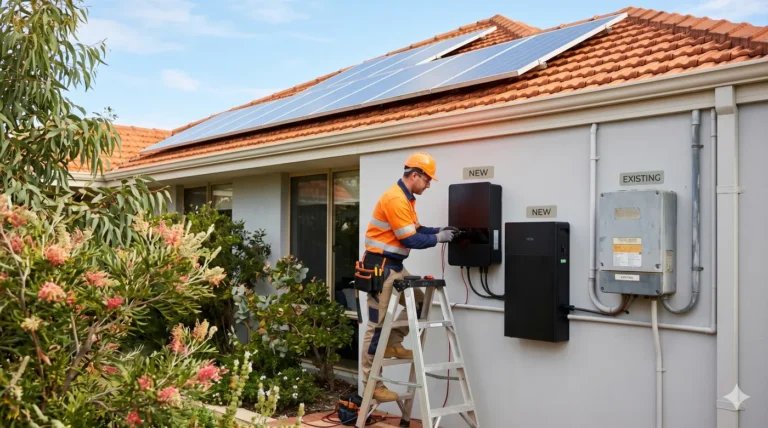
Adding a battery to existing solar may need a new hybrid inverter or a separate battery inverter. Installing solar and battery together lets one hybrid inverter do both jobs. This one factor can move a quote by thousands.
3. In-house or subcontracted electricians
Some retailers sell the system and then pass the install to a subcontracted team paid per job. Others employ their own electricians. Employed teams cost more in wages and overheads, but they give you one point of accountability if something needs fixing. Ask every installer who will physically do the work.
4. Workmanship warranty and aftercare
Equipment warranties come from the manufacturer. The workmanship warranty covers the installation itself, and its length varies a lot between installers. A longer warranty is only useful if the business is still around and staffed to honour it. Aftercare costs money, and a very low quote may not include it.
5. Site conditions
Switchboard upgrades, long cable runs, the battery’s mounting position, and adding blackout backup circuits all add labour and parts. A good quote lists these items so you can see what you are paying for.
Quick tip: Ask each installer to show the price before rebates, each rebate separately, and the final amount you pay. It is the easiest way to compare quotes like for like.
Does the Battery Brand Change the Cost?
Yes. The brand affects the upfront price and, just as importantly, whether you can claim the WA rebate. A battery that is not on Synergy’s Supported Solutions List for storage cannot get the $1,300 Synergy rebate, so its after-rebate cost is higher.
One example: as of 1 October 2026, the Tesla Powerwall 3 is not on Synergy’s Supported Solutions List for battery storage. A Synergy customer choosing it would miss out on the WA rebate. Lists change, so check the current list before you sign.
Talk Energy installs Sigenergy SigenStor batteries. You can read how that system works, and how its sizing and expansion options compare, in our Sigenergy SigenStor guide for Perth. For a neutral side-by-side look at popular brands, see solar batteries in Perth compared.
What Size Battery Does a Perth Home Need?
Most Perth homes are well served by a battery that covers their evening and overnight use, which is often around 10 kWh. Going bigger raises the price, so size it to your usage, not to the largest rebate.
- ~10 kWh: a common choice for households that use most of their power in the evening
- ~13–16 kWh: larger families, ducted air-conditioning at night, or homes planning an EV
- ~20–25 kWh: high-use homes or those wanting longer blackout backup
Your tariff matters too. On Synergy’s Midday Saver plan (from 1 July 2026), power costs 8.85c/kWh from 9am to 3pm but 55.33c/kWh from 3pm to 9pm. A battery that stores cheap daytime solar and covers that 3pm–9pm window avoids the most expensive power. By comparison, the DEBS buyback pays 10c/kWh for exports from 3pm to 9pm and 2c/kWh at other times, so storing solar is usually worth more than exporting it.
Your last 12 months of power bills are the best starting point for sizing. An installer should look at your usage pattern before recommending a size.
How Can You Pay for a Battery in WA?
You can pay up front, or use the WA Government’s optional no-interest loan to spread the cost. The loan sits alongside the WA rebate and is arranged through Plenti.
| WA no-interest loan | Details |
|---|---|
| Loan amount | $2,001–$10,000 |
| Interest | 0% |
| Lender | Plenti |
| Income limit | Household income under $210,000 |
| Scheme | Part of the WA Residential Battery Scheme |
Note the difference: the rebate itself has no income test, but the loan does. If your household earns more than $210,000 you can still claim the rebate. You just cannot use the no-interest loan. Lending checks apply, and the loan cannot exceed what the system costs.
Will Battery Prices Go Up in 2027?
The upfront cost after rebates is likely to rise for many buyers in 2027, because the federal rebate gets smaller. On 1 January 2027 the federal rate drops from 6.8 to 5.7 STCs per kWh. For a 10 kWh battery, that means fewer certificates and a smaller discount.
Equipment prices may move either way, and nobody can promise where they will land. What is known is the rebate step-down. If you are already planning a battery, getting a quote before the end of 2026 lets you see the current rebate figure on paper.
That said, do not rush into the wrong system to beat a date. A battery that is the wrong size, or not on the Supported Solutions List, can cost more over its life than the rebate difference.
How to Get an Accurate Battery Price for Your Home
The estimates in this guide are a starting point. Your real price depends on your usage, your switchboard, your existing solar and the battery you choose. A site-specific quote is the only way to know the number with rebates applied.
Talk Energy Solar & Battery is based in Mount Pleasant and has completed 5,000+ installations over 7+ years. Installs are done by in-house SAA-accredited electricians, with no subcontractors, and are backed by a 20-year workmanship warranty and a 48-hour fix-or-replace guarantee. The business holds a 4.8-star rating from 300+ Google reviews.
Get a free, fixed quote: request your quote online or call (08) 6255 5914. We will show the price before rebates, each rebate, and what you pay.
Frequently Asked Questions
How much does a solar battery cost in Perth in 2026?
As a rough guide, most Perth homes pay around $9,500–$13,000 for a ~10 kWh battery before rebates in 2026. After the federal Cheaper Home Batteries rebate and the WA Residential Battery Scheme, that drops to roughly $5,500–$9,000 for a Synergy customer. A ~13–16 kWh battery is roughly $13,000–$18,000 before rebates. Your price depends on battery size, inverter needs and site conditions.
How much is the battery rebate in WA?
The WA Residential Battery Scheme pays up to $1,300 for Synergy customers and up to $3,800 for Horizon Power customers. It stacks with the federal Cheaper Home Batteries rebate, which is worth about $2,600–$2,700 on a 10 kWh battery in 2026. Together, a Synergy customer gets roughly $3,900–$4,000 off a 10 kWh battery. VPP participation is required for the WA rebate.
How much does a 10kW solar system with a battery cost in Perth?
As a rough guide, a 10 kW solar system costs around $8,000–$11,000 after the STC discount in 2026, and a ~10 kWh battery adds roughly $5,500–$9,000 after federal and WA rebates. A combined quote is often different from the two figures added together, because one hybrid inverter can serve both. Your price depends on your roof, switchboard and the equipment chosen.
Is the federal battery rebate going down?
Yes. On 1 January 2027 the federal Cheaper Home Batteries rate falls from 6.8 to 5.7 STCs per kWh. That means a smaller federal discount on the same battery. The WA rebate amounts of $1,300 (Synergy) and $3,800 (Horizon Power) are not part of that change.
Can I get the WA battery rebate with a Tesla Powerwall 3?
Not as a Synergy customer, as of 1 October 2026. The Tesla Powerwall 3 is not on Synergy’s Supported Solutions List for battery storage, so it does not qualify for the $1,300 Synergy rebate. The federal rebate is a separate program. Lists change, so check the current list before you buy.
Is there an income limit for the WA battery rebate?
No. The WA battery rebate is not means-tested. Only the optional no-interest loan of $2,001–$10,000, arranged through Plenti, has a household income limit of $210,000. Owner-occupiers, renters with the landlord’s written consent and investment properties with the tenant’s consent can all apply.