Solar for Perth Warehouses and Industrial Properties: What to Expect from a Commercial Installation
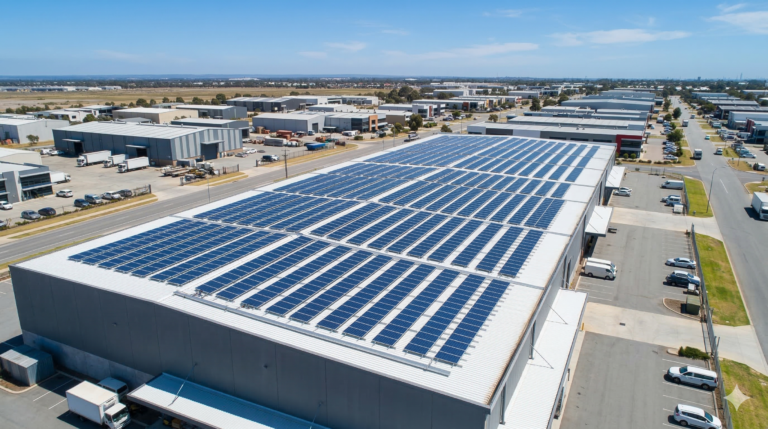
Perth warehouses and industrial properties sit in a category of their own when it comes to solar. The roof space is enormous, the electricity bills are substantial, and the daytime operating profile is almost perfectly aligned with peak solar generation. A well-designed commercial system can slash energy costs by 40 to 70 percent and return the investment in three to five years.
The problem is that most of what gets written about solar is aimed at homeowners. A 6.6kW residential system and a 150kW warehouse installation are entirely different projects, governed by different grid connection rules, requiring different electrical infrastructure, and demanding a different standard of installer. This guide covers everything a Perth warehouse or industrial property owner needs to understand before committing to a commercial solar installation.
The core opportunity: WA commercial electricity rates sit at approximately 32 to 35 cents per kWh (Synergy Business tariff, effective 1 July 2025). Every kilowatt-hour your solar system generates during business hours is a kilowatt-hour you no longer buy from the grid. At those rates, the savings accumulate fast.
Is Your Warehouse Roof Suitable for Solar?
Not every large roof is a good solar roof. Before a system can be sized or quoted, four factors need to be assessed by a qualified commercial installer.
Orientation and Pitch
North-facing roof planes deliver the highest annual output in Perth. West-facing arrays generate slightly less overall but shift production into the afternoon, which can align well with late-shift operations. East-facing panels capture morning generation. Most commercial warehouses have low-pitch or near-flat corrugated iron roofs, which are well suited to tilt-frame mounting that can be angled to maximise north-facing output regardless of the building’s orientation.
Structural Load Capacity
This is the issue that catches many warehouse owners off guard. Solar panels, mounting frames, and ballast weight add a distributed load to the roof structure. A structural engineer must assess whether the existing purlins, rafters, and cladding can support the additional weight, particularly on older industrial buildings. Some roofs require reinforcement before installation can proceed. Budget for a structural report as part of your pre-installation costs.
Shading
Even partial shading on a commercial system has an outsized impact on output. Rooftop plant rooms, HVAC units, skylights, neighbouring buildings, and overhead lines all need to be mapped. A quality installer will produce a shading analysis using satellite data and on-site measurement, not just a visual inspection.
Roof Condition
A solar system has a design life of 25 years. If the roof cladding is already 15 years old and showing corrosion, it makes no sense to install solar panels over it now. Plan to replace deteriorating roof sections before or during the solar installation. Retrofitting later means removing and reinstalling panels at significant cost.
Load Analysis: Matching System Output to Daytime Operations
The single most important design principle for commercial solar is self-consumption. Every kilowatt-hour exported to the grid earns a fraction of what it would save if consumed on-site. For large commercial systems on Western Power’s network, export limitations make this even more critical (more on that below).
A proper load analysis involves pulling 12 months of interval data from your electricity meter, usually available from Synergy or your energy retailer. This data reveals:
- Peak demand periods: When is your site drawing the most power?
- Daytime consumption profile: How much energy is used between 7am and 5pm?
- Seasonal variation: Do operations ramp up in summer or winter?
- Demand charges: Large commercial accounts often pay a separate demand tariff based on peak 30-minute intervals. Solar can reduce these charges, but only if the system is sized and timed correctly.
The practical goal: Size the solar system so that its peak output does not significantly exceed your site’s daytime base load. A warehouse running 100kW of equipment during business hours can absorb a 100kW solar system almost entirely on-site. The same system on a site with only 30kW of daytime load will push most of its generation into the grid, where it earns little or nothing under current WA rules.
For most Perth warehouses operating standard business hours, a well-sized system achieves 70 to 90 percent self-consumption. That is the target to design towards.
Western Power Grid Rules for Large Commercial Systems
This is where commercial solar diverges sharply from residential installations, and where an inexperienced installer can create serious problems.
Export Limitations
Under Western Power’s current connection requirements, commercial systems above 30kW require a formal connection study before approval. This process assesses the local network’s capacity to accept the additional generation and determines what export limit, if any, will apply to the site.
The practical reality for most Perth warehouse installations:
- Systems designed to operate within site load (self-consumption only) can often be approved with a zero-export or low-export configuration, avoiding lengthy connection studies.
- Sites in network-constrained areas may be required to install export limiting controls regardless of system size.
- Systems seeking unrestricted export will face a more complex approval process and may be subject to export caps set by Western Power based on available network headroom.
From May 2026, new rules under Western Power’s WEM Procedure introduced updated requirements for inverter systems. For standard small user facilities (connections below 1,000V with aggregate DER capacity of 30kVA or less), the rules now permit up to 30kVA of total inverter capacity. Commercial systems above this threshold fall under a separate, more involved connection pathway. See Energy Policy WA’s guidance for installers for the current technical requirements.
The takeaway: For a 50kW to 250kW warehouse system, expect a connection application and likely a formal network assessment. A commercial installer who has done this before will manage this process efficiently. One who hasn’t will cause costly delays.
Three-Phase Inverter Requirements
Almost every warehouse and industrial property in Perth is connected to a three-phase power supply. Commercial solar systems in this range require three-phase inverters, which distribute generation evenly across all three phases and comply with Western Power’s requirements for larger embedded generator connections.
For a detailed breakdown of how three-phase connections affect system design, see Talk Energy’s guide to 3-phase power and solar systems.
Commercial systems in the 50kW to 250kW range typically use multiple string inverters or a central inverter configuration. The choice depends on roof layout, shading complexity, and budget. String inverters with module-level power electronics offer better performance monitoring and partial shading tolerance; central inverters can be more cost-effective on large, unshaded roof planes.
Realistic System Sizes and Payback Periods for Perth Warehouses
Warehouse solar systems in Perth typically fall into three broad tiers based on roof space, load profile, and budget.
| System Size | Roof Area Required | Annual Generation (Perth) | Main Cost Drivers | Annual Savings at 33c/kWh |
|---|---|---|---|---|
| 50kW | ~350m² | ~72,500 kWh | Roof structure, switchboard capacity | ~$24,000 |
| 100kW | ~650m² | ~145,000 kWh | Roof structure, network approval | ~$47,850 |
| 150kW | ~950m² | ~217,500 kWh | Structural assessment, network approval | ~$71,775 |
| 250kW | ~1,600m² | ~362,500 kWh | Network approval, protection equipment | ~$119,625 |
Savings figures assume 80% self-consumption at 33c/kWh avoided cost. Perth average: ~1,450 kWh per installed kW per year.
What Drives the Payback Period?
At current WA commercial electricity rates of 32 to 35 cents per kWh, the payback arithmetic is compelling. A 100kW system generating 145,000 kWh annually and achieving 80 percent self-consumption delivers roughly $47,850 in avoided electricity costs per year. Set against a system cost that depends mainly on roof structure, switchboard capacity and network approval requirements, that typically means a simple payback of only a few years, with 20-plus years of low-cost generation to follow.
The variables that most affect payback:
- Self-consumption rate: Higher is always better. A site consuming 90% of its solar output pays back faster than one consuming 60%.
- Tariff type: Businesses on time-of-use tariffs with peak rates above 40c/kWh during business hours see even stronger returns.
- Demand charge reduction: If solar reduces your peak demand interval, the savings on the demand component of your bill compound the overall return.
- STCs (Small-scale Technology Certificates): Systems up to 100kW are eligible for STCs, which provide an upfront discount on the system cost. From 1 October 2026, new systems from 100kW to 1MW can also create STCs (with a fixed 5-year deeming period), while systems above 1MW create Large-scale Generation Certificates (LGCs), which work differently and are claimed over time rather than upfront.
For a detailed look at how commercial solar ROI varies by business type across Perth, see the guide to commercial solar ROI by business type.
Case Study: A Hypothetical 100kW Perth Warehouse Installation
To make the numbers concrete, consider a distribution warehouse in Perth’s southern industrial corridor. The business operates Monday to Friday, 7am to 5pm, with a base load of approximately 80 to 120kW during operating hours.
Site profile:
- Building footprint: 2,500m² with north and west-facing roof sections
- Connection: Three-phase, 200A supply
- Current electricity bill: $5,500/month ($66,000/year)
- Synergy Business tariff: 33c/kWh flat rate
System design:
- System size: 100kW DC (approximately 220 x 455W panels)
- Inverter configuration: Two 50kW three-phase string inverters
- Mounting: Tilt-frame on low-pitch metal roof, north-facing orientation
- Export configuration: Zero-export via export limiting relay (avoids network connection study delays)
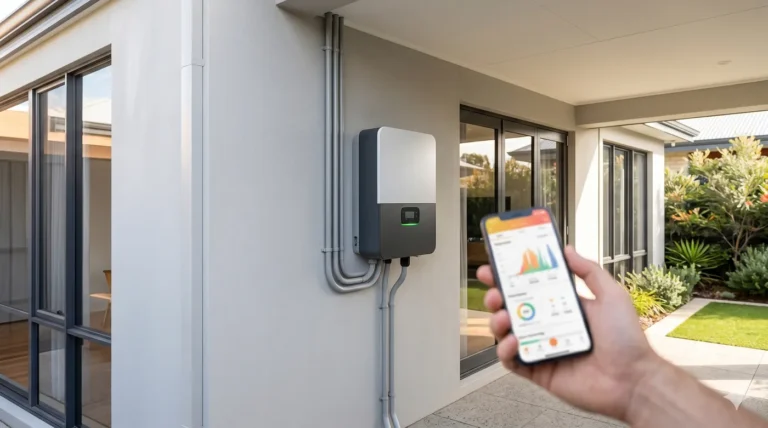
- Monitoring: Cloud-based performance monitoring with real-time alerts
Financial modelling:
| Metric | Value |
|---|---|
| Annual solar generation | ~145,000 kWh |
| Self-consumption rate | 85% (~123,250 kWh) |
| Avoided electricity cost | ~$40,670/year (at 33c/kWh) |
| System cost (after STCs) | Site-specific (quote-based) |
| Simple payback period | A few years (depends on final system cost) |
| 10-year cumulative savings | ~$406,700 |
| 25-year cumulative savings | ~$1,016,750 |
Note: Figures are illustrative. Actual savings depend on tariff structure, consumption profile, system performance, and future electricity price movements. WA electricity prices have increased an average of 4 to 5 percent annually over the past decade.
What the STC rebate looks like at 100kW:
A 100kW system installed in Perth in 2026 creates roughly 690 STCs (100 kW × Perth’s Zone 3 rating of 1.382 × 5 remaining deeming years to 2030). At a market price of around $38 to $40 per STC, that is a point-of-sale discount of roughly $26,000 to $27,500. From 1 October 2026, systems between 100 kW and 1 MW can also create STCs instead of large-scale generation certificates (LGCs), with Clean Energy Regulator applications opening from mid-to-late November 2026. This is why the net system cost after STCs is substantially lower than the gross installation price.
The battery question:
This warehouse operates during daylight hours only. For this profile, battery storage adds cost without proportionate benefit. The solar system already achieves 85 percent self-consumption during operating hours. If the business were to expand to evening shifts or wanted resilience against grid outages, a battery would change the equation entirely.
Battery Integration for Overnight and After-Hours Operations
Not every warehouse operates on a clean 9-to-5 schedule. Cold storage facilities, manufacturing plants, and logistics operations running evening or overnight shifts have a fundamentally different energy profile, and battery storage changes the calculus significantly.
When Battery Storage Makes Sense for Industrial Properties
Battery storage earns its keep in commercial settings when one or more of the following apply:
- After-hours operations: Any significant load running after solar generation has ceased (typically from 6pm onwards in Perth) benefits from stored solar energy rather than drawing from the grid at full tariff rates.
- Demand charge reduction: A well-programmed commercial battery can discharge during the 30-minute peak demand interval that sets your demand tariff for the billing period. Shaving even one or two peak intervals per month can deliver meaningful bill reductions.
- Zero-export configurations: If Western Power has imposed a zero-export limit on the site, a battery absorbs excess solar that would otherwise be curtailed, dramatically improving self-consumption from 60 to 70 percent up to 90 percent or more.
- Backup power requirements: Cold chain operations, data rooms, and medical manufacturing cannot afford unplanned outages. A commercial battery with backup capability provides resilience without the ongoing cost of a diesel generator.
Sizing Commercial Battery Storage
For a 100kW solar system on a site with four hours of after-hours load at 50kW, a 200kWh battery system would cover that load entirely from stored solar. At current commercial battery pricing, a 200kWh commercial system represents a significant additional investment, but the payback improves substantially when demand charge reduction is factored in.
The right battery size depends entirely on the load profile. This is why interval meter data is essential before any commercial battery recommendation is made.
Commercial EPC Installer vs. a Residential Installer Doing Commercial Work
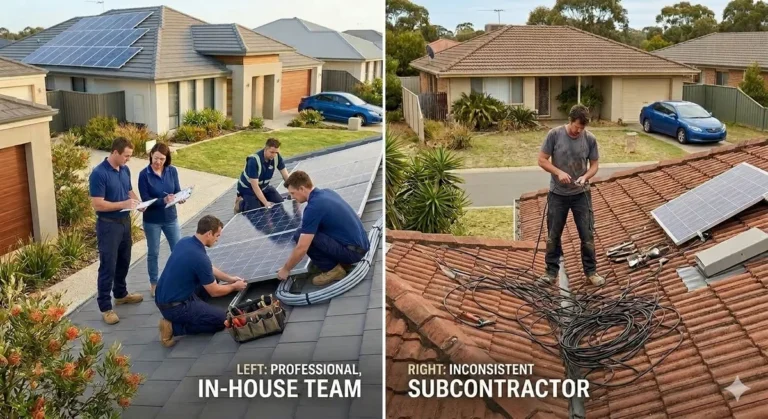
This distinction matters more than most business owners realise. The commercial solar market attracts residential installers looking to scale up, and the gap in capability is significant.
A genuine commercial EPC (Engineering, Procurement, and Construction) installer operates differently in every dimension:
| Capability | Commercial EPC Installer | Residential Installer |
|---|---|---|
| Design process | Full engineering design with load analysis, structural assessment, shading study | Basic string sizing from a software tool |
| Western Power connection | In-house experience with commercial connection applications and network studies | Unfamiliar with commercial connection pathways |
| Electrical capacity | In-house licensed electricians with commercial LV experience | Subcontracted residential electricians |
| Project management | Dedicated project manager, coordinated trades, milestone reporting | Owner-operator juggling multiple small jobs |
| Compliance documentation | AS/NZS 3000 wiring rules, commercial switchboard upgrades, metering compliance | Residential compliance documentation |
| Warranty backing | Company with commercial insurance, long-term service capability | May not exist in five years |
The Red Flags to Watch For
When evaluating commercial solar quotes for a warehouse project, these are the warning signs that a residential installer is out of their depth:
- No request for interval meter data before quoting
- No mention of a structural assessment
- No clear process for the Western Power connection application
- Quote produced without a site visit
- No reference commercial projects of comparable scale
- Warranty backed only by the manufacturer, with no workmanship component from the installer
A poorly designed or incorrectly installed commercial system does not just underperform. It can create grid compliance issues, void equipment warranties, and in the worst cases, create electrical hazards in a workplace environment. The CEC (Clean Energy Council) accreditation framework applies to commercial systems, but accreditation alone does not distinguish a genuinely capable commercial installer from one who has completed the minimum requirements.
For guidance on what to look for when choosing a commercial installer in Perth, see how to choose a commercial solar installer.
Getting the Process Right from Day One
A commercial solar installation on a Perth warehouse is one of the highest-returning capital investments available to a business owner right now. WA’s commercial electricity rates, Perth’s solar resource, and the current STC incentive structure combine to produce payback periods that are difficult to match with any other capital expenditure.
The difference between a system that delivers on that promise and one that disappoints almost always comes down to the quality of the design process and the capability of the installer. Getting interval meter data, commissioning a structural assessment, understanding the Western Power connection pathway, and choosing an installer with genuine commercial experience are not optional steps. They are the foundation of a project that performs for 25 years.
Ready to assess your warehouse for solar? Talk Energy’s commercial team works with Perth industrial and warehouse operators across metro and regional WA. We carry out full site assessments, manage the Western Power connection process, and back every installation with a 20-year workmanship warranty. Get a commercial solar assessment or explore our full commercial solar guide for Perth businesses.