How Much Does Solar and Battery Cost in Perth in 2026? An Honest Breakdown by Talk Energy
Solar pricing in Perth is genuinely confusing. You can get three quotes for the same system size and find prices that differ by $3,000 or more. Some of that gap reflects real differences in quality. Some of it is margin. And some of it is corners being cut in ways you won’t notice until something goes wrong three years from now.
This guide gives you actual cost ranges for the most common system sizes in Perth in 2026, explains what government rebates reduce your upfront cost, and breaks down exactly why prices vary between installers. We’ll also answer the question we hear most often from homeowners who’ve compared our quotes: “Why is Talk Energy more expensive than that other company?”
The short answer: In most cases, we’re not more expensive once you factor in what’s included. But when we are, we’ll tell you exactly why.
Quick numbers: A 6.6kW solar system in Perth costs $4,200–$7,500 after the federal STC rebate in 2026. Add a battery and combined rebates can cut another $3,750–$6,250 from the upfront cost. Payback periods sit at 3–5 years for solar-only, 7–8 years for solar plus battery.
Solar System Cost in Perth: 2026 Price Ranges
All prices below are after the federal Small-scale Technology Certificate (STC) rebate is applied at the point of sale. You do not need to claim this separately; your installer deducts it from the invoice. These ranges reflect what Perth homeowners are actually paying for quality systems with Tier 1 panels, a reputable inverter, and full installation by licensed electricians.
Cost Calculator: Solar System Sizes
| System Size | Typical Household | Before STC Rebate | STC Rebate (approx.) | After STC Rebate | Est. Annual Savings | Payback Period |
|---|---|---|---|---|---|---|
| 6.6kW | 2–4 people, average usage | $6,000–$9,500 | $1,700–$2,500 | $4,200–$7,500 | $1,500–$2,300/yr | 3–5 years |
| 10kW | 4–5 people, high usage | $9,000–$13,000 | $2,500–$3,500 | $6,500–$10,000 | $2,300–$3,000/yr | 3–5 years |
| 13kW | Large homes, pools, EVs | $11,500–$16,000 | $3,500–$5,000 | $8,500–$12,500 | $2,800–$3,800/yr | 4–5 years |
Prices include panels, inverter, mounting hardware, wiring, and full installation. GST included. STC rebate amounts are approximate and based on Perth’s STC zone. Annual savings are based on Synergy’s standard tariff of 32.37c/kWh and typical Perth self-consumption rates.
Which System Size Is Right for You?
Choosing the right system size is the most important financial decision in the process. Oversizing wastes money on capacity you can’t use; undersizing leaves bill savings on the table.
- 6.6kW: The most popular size for Perth homes. Covers typical daytime usage for a family of 3–4 and fits comfortably within Western Power’s 5kW single-phase export limit when paired with a hybrid inverter.
- 10kW: Suits larger families, homes with ducted air conditioning running through summer, or anyone planning to add an EV charger. Requires checking whether your property has single-phase or three-phase power.
- 13kW: Built for high-consumption households. Increasingly common as battery storage becomes standard, since the extra generation feeds the battery rather than being capped at the grid export limit.
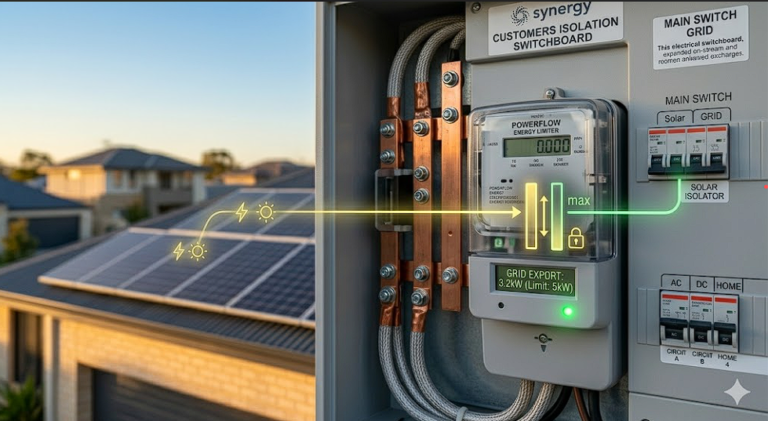
Important note on the 5kW export cap: Western Power limits grid export to 5kW on single-phase connections. A 10kW or 13kW system will still generate and self-consume beyond that limit; the cap only affects what you send back to the grid. Pairing a larger system with a battery is the most effective way to capture that excess generation.
Battery Add-On Costs: BYD HVM and Tesla Powerwall 3
Adding a battery to your solar system changes the financial equation significantly. The upfront cost is higher, but Perth’s rebate stacking makes it more accessible than most homeowners expect, and self-consumption rates above 80% are achievable with the right battery size.
Battery Price Comparison (Perth, 2026)
| Battery | Capacity | Installed Before Rebates | Federal CHBP Rebate | WA State Rebate (Synergy) | Net Cost After Rebates |
|---|---|---|---|---|---|
| BYD Battery-Box HVM 10.24kWh | 10.24 kWh | $11,500–$14,000 | ~$2,500 | $1,300 | $7,700–$10,200 |
| BYD Battery-Box HVM 13.8kWh | 13.8 kWh | $13,000–$16,000 | ~$3,400 | $1,300 | $8,300–$11,300 |
| Tesla Powerwall 3 | 13.5 kWh | $14,500–$17,000 | ~$3,300 | $1,300 | $9,900–$12,400 |
Federal Cheaper Home Batteries Program (CHBP) rebate amounts reflect post-May 2026 rates. WA state rebate of $1,300 applies to Synergy customers; Horizon Power customers in regional WA receive up to $3,800. Battery prices include supply, installation, and GST.
BYD HVM vs Tesla Powerwall 3: What the Price Difference Reflects
The BYD Battery-Box HVM is typically around $1,000 to $1,500 cheaper than the Powerwall 3 after rebates. That gap is real, but so are the differences between them.
BYD HVM advantages:
- Modular design: add capacity later without replacing the whole unit
- Strong 80% capacity retention warranty over 10 years
- Compatible with a wider range of existing inverters, making it the better retrofit option
Tesla Powerwall 3 advantages:
- Integrated 11.5kW inverter means fewer components and a cleaner install for new systems
- Higher continuous power output (11.5kW vs BYD’s 5kW)
- Well-suited to homes prioritising blackout backup and whole-home coverage
For most Perth homeowners adding a battery to an existing solar system, the BYD HVM delivers strong value at a lower net cost. For new installations where the integrated inverter simplifies the design, the Powerwall 3 is worth the premium.
A word on timing: The federal CHBP rebate steps down at six-monthly intervals. The next reduction is scheduled for January 2027. Installing before that date locks in the current rebate rate. The WA Residential Battery Scheme runs until its budget is exhausted, so earlier applications carry less risk of missing out.
Government Rebates That Reduce Your Upfront Cost
Perth homeowners in 2026 have access to two separate rebate programs that can be stacked. Your installer handles both applications on your behalf; you see the combined saving reflected in your final invoice.
Federal STC Rebate (Solar Panels)
The federal government’s Small-scale Technology Certificate (STC) scheme provides an upfront discount on solar panel installations. Perth sits in STC Zone 3, which generates a strong number of certificates per kilowatt installed. In practical terms:
- 6.6kW system: $1,700–$2,500 off
- 10kW system: $2,500–$3,500 off
- 13kW system: $3,500–$5,000 off
The STC rebate reduces in value each year as the scheme steps down toward its 2030 end date. Installers deduct this at the point of sale, so there is no separate claim process for homeowners.
Federal Cheaper Home Batteries Program (CHBP)
The federal government’s Cheaper Home Batteries Program provides approximately 30% off eligible battery systems. As of mid-2026, a 10kWh battery attracts roughly $2,450 in federal rebate. This rebate is also applied at point of sale by your accredited installer.
Note: The CHBP rebate reduces at six-monthly intervals. The next step-down occurs in January 2027.
WA Residential Battery Scheme (State Rebate)
The WA Residential Battery Scheme launched in July 2025 and stacks on top of the federal rebate:
- Synergy customers (Perth metro): Up to $1,300 rebate ($130/kWh, capped at 10kWh)
- Horizon Power customers (regional WA): Up to $3,800 rebate ($380/kWh, capped at 10kWh)
- No-interest loan: Up to $10,000 for households with income under $210,000 (repaid over up to 10 years through Plenti)
VPP (Virtual Power Plant) participation is required to access the WA state rebate. This means Synergy can draw on your battery during grid stress events, typically for short windows. In exchange, you receive the rebate and may earn additional credits through Synergy’s Battery Rewards program.
Total Rebate Stack: What Perth Homeowners Can Access
| Scenario | Federal Solar STC | Federal Battery CHBP | WA State Battery | Total Saving |
|---|---|---|---|---|
| 6.6kW solar only | $1,700–$2,500 | — | — | $1,700–$2,500 |
| 10kW solar only | $2,500–$3,500 | — | — | $2,500–$3,500 |
| 6.6kW + 10kWh battery (Synergy) | $1,700–$2,500 | ~$2,450 | $1,300 | $5,450–$6,250 |
| 10kW + 10kWh battery (Synergy) | $2,500–$3,500 | ~$2,450 | $1,300 | $6,250–$7,250 |
| 10kW + 10kWh battery (Horizon Power) | $2,500–$3,500 | ~$2,450 | $3,800 | $8,750–$9,750 |
What Drives Price Differences Between Installers
Two quotes for a “6.6kW system” can differ by $3,000 and both be technically accurate. Here is what actually creates that gap.
Equipment Tier
Not all solar panels are equal. The industry uses the term “Tier 1” to describe manufacturers who meet Bloomberg NEF’s bankability criteria, covering financial stability, manufacturing scale, and quality controls. Tier 1 panels typically carry stronger performance warranties (25 years at 80%+ output) and are more likely to still be serviced by the manufacturer a decade from now.
Budget installers often use panels from manufacturers outside this tier. The panels may perform adequately in the short term, but warranty claims become difficult if the manufacturer exits the market.
The same applies to inverters. A Fronius, SMA, or SolarEdge inverter costs more than a lesser-known brand. The difference shows up in reliability data and in whether the company has local service support when something fails.
Labour Model: In-House vs Subcontracted
This is the single biggest structural cost difference in the Perth solar market, and most homeowners don’t know to ask about it.
Many solar retailers in Perth act as sales organisations. They take your deposit, book a date, and then send a subcontracted electrical team they’ve never worked with before. That team is paid per job, which creates an incentive to install fast rather than install well. When something goes wrong, the retailer and the subcontractor point at each other.
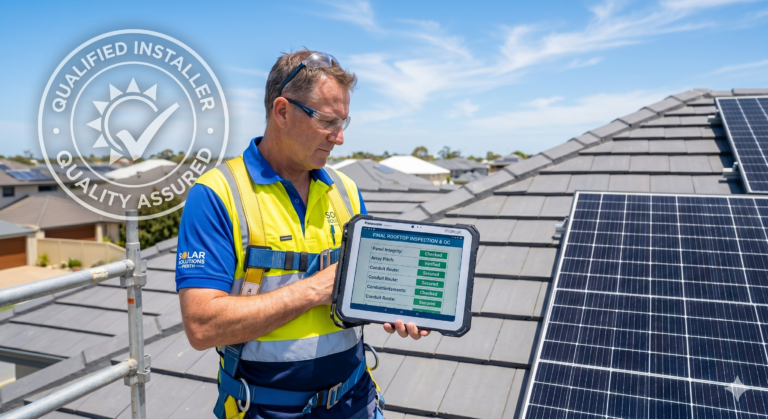
Talk Energy uses in-house electricians on every installation. Our team is employed by us, trained by us, and accountable to us. This costs more in wages and overheads than a subcontracted model. It also means:
- One point of accountability if anything needs fixing
- Consistent installation quality across every job
- Our 20-year workmanship warranty is backed by the same team who installed the system
Warranty Depth
A standard workmanship warranty in Perth is 5–7 years. Talk Energy offers 20 years, with a 48-hour fix or replace guarantee. That is not a marketing claim; it is a financial commitment that requires maintaining an employed team capable of honouring it. Installers who subcontract cannot credibly offer this, because they have no control over whether that subcontractor will still be operating in five years, let alone twenty.
Post-Installation Support
Some installers are difficult to reach after the job is done. Monitoring issues, inverter faults, and panel underperformance are common over a 25-year system lifespan. The cost of aftercare is built into Talk Energy’s pricing. It is not built into a $3,500 “bargain” quote.
Why Is Talk Energy More Expensive? An Honest Answer
We hear this question regularly. Here is a direct, factual answer.
In many cases, we are not more expensive. Talk Energy offers price matching on comparable quotes, meaning if another SAA-accredited installer provides a written quote for genuinely equivalent equipment and warranty terms, we will match it. The key word is “equivalent.” A quote using a Tier 2 panel, a 5-year workmanship warranty, and subcontracted labour is not equivalent to a Talk Energy quote.
When we are more expensive, here is what you are paying for:
| What costs more | Why it matters |
|---|---|
| In-house licensed electricians | Single point of accountability; no subcontractor finger-pointing |
| Tier 1 panels (REC, Jinko, QCells) | Stronger performance over 25 years; manufacturer still trading |
| Premium inverters (Fronius, SMA, SolarEdge) | Higher reliability; local service support |
| 20-year workmanship warranty | Backed by an employed team, not a third-party contractor |
| 48-hour fix or replace guarantee | Requires real operational capacity to honour |
| 250+ verified 5-star reviews | Track record, not promises |
The honest reality is this: solar is a 25-year asset. The cheapest quote today often becomes the most expensive outcome over the life of the system, once you factor in underperforming equipment, voided warranties, and installers who are no longer contactable. We are not claiming every budget installer delivers a bad outcome. We are saying that the risk profile is materially different, and homeowners deserve to understand that before signing.
Our price matching commitment: Bring us any written quote from a SAA-accredited Perth installer using comparable Tier 1 equipment and warranty terms, and we will match the price. If we cannot match it, we will tell you why the comparison is not apples-to-apples.
For a detailed comparison of how Talk Energy’s terms stack up against other Perth installers, see our honest installer comparison guide.