Best Solar Batteries in Perth 2026: BYD Battery-Box HVM vs Tesla Powerwall 3 vs Sungrow SBR
If you’re shopping for a home battery in Perth right now, three products keep coming up on every installer’s shortlist: the BYD Battery-Box HVM, the Tesla Powerwall 3, and the Sungrow SBR. Together they account for the majority of new residential battery installations across Australia in 2026, and for good reason. All three use lithium iron phosphate (LFP) chemistry, carry 10-year warranties, and are built for daily solar self-consumption.
But they are not interchangeable. The right battery for your home depends on your existing inverter, how much you care about backup power, your household’s daily energy use, and how much you’re willing to spend per usable kilowatt-hour. This guide cuts through the marketing and gives you the data you need to make the right call.
Key takeaway: The Sungrow SBR wins on efficiency and cost per kWh. The BYD HVM wins on inverter flexibility. The Tesla Powerwall 3 wins on backup power output and weather resistance. None of them is universally “best” for every Perth home.
Side-by-Side Specs: The Numbers That Matter
Before diving into the detail, here is the full comparison across every spec that affects real-world performance and value in Perth.
| Spec | BYD Battery-Box HVM | Tesla Powerwall 3 | Sungrow SBR |
|---|---|---|---|
| Usable capacity | 8.3-22.1 kWh | 13.5 kWh | 6.4-25.6 kWh |
| Chemistry | LFP (cobalt-free) | LFP | LFP (cobalt-free) |
| Round-trip efficiency | ~96% | ~89% | ~97% |
| Continuous power output | 8 kW | 11.5 kW | 9.6 kW |
| Peak power output | 12 kW | 22 kW | – |
| Coupling type | DC (hybrid inverter required) | AC (built-in inverter) | DC (Sungrow SH inverter only) |
| Compatible inverters | Fronius, SMA, SolarEdge, GoodWe, Sungrow + more | Tesla Solar only (built-in) | Sungrow SH series only |
| Scalable to | 66 kWh | 54 kWh | 25.6 kWh |
| IP rating | IP55 | IP67 | IP55 |
| Warranty | 10 years / 60% capacity retention | 10 years / 70% capacity retention | 10 years / 70% capacity retention |
| Cycle life | 6,000+ | Unlimited | 6,000+ |
| Installed price (Perth) | ~$9,000-$13,000 | ~$12,000-$15,000 | ~$8,000-$11,000 |
| Cost per kWh | ~$770-$1,050/kWh | ~$890-$1,110/kWh | ~$660-$940/kWh |
| WA Battery Scheme eligible | Yes (CEC approved) | Check Synergy SSL | Yes (CEC approved) |
A note on the Powerwall 3 efficiency figure: Its 89% round-trip efficiency is lower than the other two partly because the integrated inverter’s conversion losses are counted in the overall figure. Over a year of daily cycling, that gap costs roughly 100-150 kWh compared to the Sungrow or BYD, worth about $30-$45 at Perth’s current electricity rates. It matters, but it is not a deal-breaker.
How Each Battery Performs in Perth’s Climate
Perth averages over 3,200 hours of sunshine annually, which is excellent for solar generation but also means high ambient temperatures, particularly from November through March. Battery performance in heat is a legitimate concern.
The good news is that all three batteries use LFP chemistry, which handles high temperatures significantly better than the older NMC (nickel manganese cobalt) batteries that dominated the market a few years ago. LFP cells are more thermally stable, degrade more slowly in heat, and carry a lower fire risk.
Where the differences show up
Installation location matters more than chemistry in Perth. The Powerwall 3 carries an IP67 rating, meaning it is dust-tight and can withstand temporary water immersion. The BYD HVM and Sungrow SBR are both rated IP55, which is adequate for outdoor installation in a sheltered or shaded location but less suited to fully exposed mounting on a north-facing wall in direct afternoon sun.
For most Perth homes, this means:
- All three batteries can be installed outdoors with proper placement
- Avoid direct western sun exposure for IP55-rated units
- A shaded garage wall or under-eave location is ideal for BYD and Sungrow
- The Powerwall 3 has the most flexibility for exposed outdoor locations
Perth’s feed-in tariff context also shapes the value equation. With Synergy’s Distributed Energy Buyback Scheme (DEBS) currently paying around 2 cents per kWh for most daytime export, rising to about 10 cents during the 3-9pm peak, the efficiency gap between batteries has a direct dollar value. A battery that returns 97 kWh per 100 kWh stored (Sungrow) versus one returning 89 kWh (Powerwall 3) means fewer kilowatt-hours are lost to heat and conversion, and more are available for evening use rather than exported at the lower off-peak rate.
Perth-specific insight: In a climate with 8+ peak sun hours in summer, the self-consumption benefit of a battery is maximised. A higher-efficiency battery captures more of that solar generation for evening use, which is where the real bill savings come from.
WA Battery Scheme Compatibility: What You Need to Know
The WA Residential Battery Scheme launched on 1 July 2025 and offers meaningful financial assistance for eligible Perth households. Understanding how each battery interacts with the scheme is critical before committing to a purchase.
What the scheme offers
- Synergy customers: Rebate of up to $1,300 (capped at 10 kWh usable capacity)
- Horizon Power customers: Rebate of up to $3,800
- No-interest loan: Up to $10,000 for households with gross annual income under $210,000, repayable over up to 10 years
- Federal stacking: The WA rebate stacks with the Federal Government’s Cheaper Home Batteries Program, meaning a 10 kWh battery could attract up to around $3,750 in combined rebates for Synergy customers
The VPP requirement is the most important condition most buyers overlook. To access the rebate or loan, your battery must be enrolled in a Virtual Power Plant (VPP). Synergy customers can use Synergy’s own VPP product or an approved alternative supplier. This means your battery needs to be remotely accessible and grid-responsive, which all three batteries support in principle, but your inverter must also appear on Synergy’s Supported Solutions List.
Scheme eligibility by battery
| Battery | CEC Approved | Synergy SSL Status | VPP Compatible | Notes |
|---|---|---|---|---|
| Sungrow SBR | Yes | Yes (Sungrow SH inverters listed) | Yes | Strong scheme fit; Sungrow SH inverters are on Synergy’s list |
| BYD Battery-Box HVM | Yes | Depends on paired inverter | Yes | Inverter must be on Synergy SSL; BYD modules themselves are CEC approved |
| Tesla Powerwall 3 | Yes | Verify current listing | Tesla Energy Plan only | Tesla operates its own VPP product; confirm current Synergy SSL status before purchasing |
The practical implication: For BYD, your eligibility hinges on the hybrid inverter you pair it with. Fronius, GoodWe, and SMA inverters are commonly listed on Synergy’s SSL, but always verify the specific model before signing a contract. For the Powerwall 3, Tesla’s VPP product is separate from Synergy’s ecosystem, so confirm current scheme compatibility with your installer.
The WA Government’s eligibility requirements are clear that battery modules do not need to be on the Supported Solutions List independently, but the overall system (inverter plus battery) must comply with Western Power’s technical requirements.
Which Battery Suits Your Household Size?
Battery sizing is where most Perth buyers go wrong. Too small and you exhaust the battery before morning. Too large and you are paying for capacity that never gets used. The right size depends on your daily consumption, not your solar panel output.
Sizing guide by household type
| Household | Daily usage | Recommended capacity | Best-fit battery |
|---|---|---|---|
| 1-2 people, small home | 10-15 kWh/day | 6-10 kWh | Sungrow SBR (2-3 modules) |
| 3-4 people, average home | 15-25 kWh/day | 10-14 kWh | Sungrow SBR (4 modules) or BYD HVM (13.8 kWh) |
| 4-5 people, larger home | 25-35 kWh/day | 14-22 kWh | BYD HVM (scalable to 22.1 kWh) or Tesla Powerwall 3 x2 |
| Large home, EV, pool | 35+ kWh/day | 20+ kWh | BYD HVM (maximum scalability to 66 kWh) |
| Backup power priority | Any | 13.5 kWh+ | Tesla Powerwall 3 (11.5 kW continuous output) |
The modular advantage
The Sungrow SBR’s modular design (3.2 kWh per module) is particularly well-suited to Perth households that want to start with a smaller investment and expand later. A 9.6 kWh system (3 modules) is enough for a typical 3-person household, and adding a fourth module to reach 12.8 kWh is a straightforward upgrade.
The BYD HVM uses 2.76 kWh modules and scales to an impressive 66 kWh ceiling, making it the right choice for households planning to add an EV, a pool heat pump, or additional loads over time.
The Powerwall 3 is a fixed 13.5 kWh unit. Scaling requires adding a second complete unit, which is a larger cost jump. For households whose needs fit within 13.5 kWh, this is no issue. For those who might want incremental expansion, the modular alternatives are more flexible.
A Perth-specific consideration: Many Perth homes run ducted reverse-cycle air conditioning, which can draw 3-5 kW on a hot summer evening. If you are sizing a battery to cover overnight use including air conditioning from December through February, you will want at least 10-13 kWh of usable capacity to avoid grid top-up before sunrise.
Talk Energy’s Recommendation Framework
After installing hundreds of battery systems across Perth metro and regional WA, the Talk Energy team has developed a straightforward framework for matching households to the right battery. The answer almost always comes down to four questions.
Question 1: What inverter do you already have?
This is the single most important factor for a battery retrofit.
- Sungrow SH hybrid inverter already installed: The Sungrow SBR is the clear choice. It pairs natively, qualifies for the WA Battery Scheme, and delivers the best efficiency of the three.
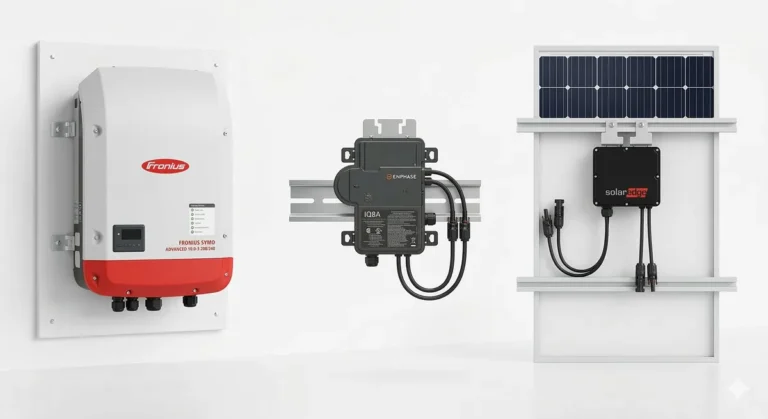
- Fronius, GoodWe, SMA, SolarEdge, or Kostal hybrid inverter: The BYD HVM is the best fit. It offers the widest compatibility of any battery on the market and avoids the cost of replacing your inverter.
- No existing inverter (new system): You have full flexibility. If backup power is a priority, consider the Powerwall 3. If value per kWh is the priority, the Sungrow SBR with a Sungrow SH inverter is the most cost-effective combination.
- String inverter only (no hybrid): You will need to add a hybrid inverter regardless of which battery you choose, or go with the Powerwall 3’s all-in-one approach.
Question 2: How important is blackout protection?
The Powerwall 3’s 11.5 kW continuous output is decisive here. It can run ducted air conditioning, a refrigerator, lighting, and an induction cooktop simultaneously during a power outage. The BYD HVM (8 kW continuous) and Sungrow SBR (up to 9.6 kW via the SH inverter) are capable for most loads but require more management during high-demand blackout scenarios.
If you are in an area with frequent outages, or if whole-home backup across all loads is non-negotiable, the Powerwall 3 justifies its premium price.
Question 3: Are you planning to add an EV or expand capacity later?
- Yes, within the next 3-5 years: BYD HVM. Its 66 kWh ceiling and modular expansion give you the most headroom.
- No, or unlikely: Sungrow SBR or Powerwall 3 depending on your other priorities.
Question 4: What is your budget?
| Priority | Recommended battery | Indicative installed cost |
|---|---|---|
| Best value per kWh | Sungrow SBR | $8,000-$11,000 |
| Balanced value and flexibility | BYD Battery-Box HVM | $9,000-$13,000 |
| Premium performance and backup | Tesla Powerwall 3 | $12,000-$15,000 |
Talk Energy’s overall recommendation for most Perth households: The Sungrow SBR paired with a Sungrow SH hybrid inverter represents the best combination of efficiency, cost, and WA Battery Scheme compatibility for the majority of new installations. For retrofits onto existing compatible inverters, the BYD HVM is the most practical choice. The Powerwall 3 is the right answer when backup power is a genuine priority, not just a nice-to-have.
Frequently Asked Questions
Which of these three batteries has the best warranty?
The Sungrow SBR and Tesla Powerwall 3 both guarantee 70% capacity retention at the end of 10 years. The BYD Battery-Box HVM guarantees 60% retention over the same period. All three cover 10 years of ownership. The 10-percentage-point difference in capacity retention means the BYD may hold slightly less charge by year 10, though real-world degradation rates for LFP batteries often outperform warranted minimums.
Is the Tesla Powerwall 3 eligible for the WA Battery Scheme?
The Powerwall 3 is on the Clean Energy Council’s approved battery list, which is a prerequisite for the scheme. However, eligibility also requires your inverter to appear on Synergy’s Supported Solutions List, and the Powerwall 3 uses its own integrated inverter rather than a third-party hybrid inverter. Tesla also operates its own VPP product (the Tesla Energy Plan) rather than Synergy’s VPP. Always confirm current scheme eligibility with your installer before purchasing, as the Supported Solutions List is updated regularly.
Can I add a battery to my existing solar system?
Yes, in most cases. If you have a compatible hybrid inverter already installed (Fronius, GoodWe, SMA, SolarEdge, Sungrow SH), adding a BYD HVM or Sungrow SBR respectively is straightforward. If you have a string inverter without hybrid capability, you will need to replace or add an inverter, or consider the Powerwall 3’s AC-coupled approach which can work alongside an existing string inverter in some configurations. Talk Energy’s team can assess your existing system and advise on the most cost-effective upgrade path.
How much can I save with a battery in Perth?
Savings depend on your consumption pattern, tariff structure, and battery size. A typical Perth household on Synergy’s A1 tariff (around 30 cents per kWh) with a 10-13 kWh battery can expect to reduce grid imports by 60-80% in summer, and 40-60% in winter. At current electricity prices, that translates to annual savings of $1,200-$2,000 for an average household, though individual results vary. The WA Battery Scheme rebate and federal incentives reduce the payback period significantly.
Do these batteries work during a blackout?
All three support backup power, but with important differences. The Powerwall 3 has the highest continuous output (11.5 kW) and switches to backup mode automatically. The BYD HVM and Sungrow SBR require a compatible hybrid inverter with backup functionality enabled; the output available during a blackout depends on the inverter model. Confirm backup capability with your installer when specifying the system.
What happens to my battery at the end of the warranty period?
LFP batteries typically retain 75-85% of their original capacity after 10 years of daily cycling, often exceeding the warranted minimums. At end of life, batteries can be recycled through manufacturer take-back programs. Both BYD and Sungrow have established recycling pathways in Australia. The batteries do not simply stop working at 10 years; they continue to function, just with reduced capacity.
Ready to Choose? Get a Quote from Talk Energy
The data in this guide gives you a solid foundation, but the right battery for your home depends on specifics that only a site assessment can confirm: your existing inverter model, your roof orientation, your consumption profile, and your connection to Synergy or Horizon Power.
Talk Energy is a Perth-based solar and battery retailer with in-house electricians, a 20-year workmanship warranty, and over 250 five-star reviews from Perth homeowners. The team supplies and installs all three batteries covered in this guide and can assess your WA Battery Scheme eligibility as part of the quoting process.
Get a free quote from Talk Energy and find out which battery delivers the best return for your specific home, budget, and energy goals.