What Size Solar System Do I Need? Perth Sizing Guide for 2026
Quick answer: Divide your daily electricity use (kWh) by 3.8 to find the solar system size (kW) that would cover it across a year in Perth. Most Perth families land on 6.6 kW. Bigger homes with ducted air-con, a pool or an EV usually suit 10–13 kW. For the panel count, divide the system size by the panel wattage: a 6.6 kW system is about 15 panels of 440 W.
You’ve got your Synergy bill and three quotes that each recommend a different size. This guide shows you how to check the numbers yourself, using official Perth solar data and the 2026 WA rules.
How do I work out what size solar system I need?
Take your average daily usage in kWh and divide it by 3.8. That gives the system size in kW that would generate about as much power as you use over a year. Then adjust for when you use power, your roof and your plans.
- Find your daily usage. Your Synergy bill shows “average daily usage”. If it doesn’t, divide the total kWh by the days in the billing period. For example, 1,800 kWh over 90 days is 20 kWh a day.
- Divide by Perth’s output per kW. Each kW of panels in Perth produces around 3.8 kWh a day on average. 20 kWh ÷ 3.8 = 5.3 kW.
- Round up to a standard size. 5.3 kW rounds up to 6.6 kW, the most common size on a 5 kW inverter.
- Adjust for your situation. Go bigger if you plan a battery, an EV or a switch from gas. Stay nearer the minimum if your roof is small or nobody is home in the day.
Use a full year of bills if you can, because Perth summer and winter bills can differ a lot. If you have a smart meter, download your interval data from My Synergy. It shows when you use power, and solar only covers what you use while the sun is up.
How much power does a solar system produce in Perth?
Each kW of solar panels in Perth produces about 1,382 kWh a year, or around 3.8 kWh a day on average. The Clean Energy Regulator puts almost every Perth metro postcode in solar Zone 3, with a rating of 1.382 MWh per kW per year. It’s the same rating used to work out your STC rebate.
| System size | Average daily output | Yearly output |
|---|---|---|
| 5 kW | ~19 kWh | ~6,900 kWh |
| 6.6 kW | ~25 kWh | ~9,100 kWh |
| 10 kW | ~38 kWh | ~13,800 kWh |
| 13.3 kW | ~50 kWh | ~18,400 kWh |
That’s a yearly average. Output runs well above it on long summer days and well below it in June and July. So a system that covers your usage “on average” will still leave you buying some winter power from Synergy.
Direction matters too. North-facing panels produce the most. West-facing panels produce a little less but more in the late afternoon, when many homes use the most power.
Worth knowing: Adelaide, Sydney and Brisbane are also in Zone 3, so the 3.8 kWh per kW rule of thumb works there too. Melbourne and Hobart sit in the lower-rated Zone 4.
What size solar system suits my type of house?
Most Perth family homes suit a 6.6 kW system. Smaller households can do well with 5–6.6 kW. Larger homes with ducted air-con, a pool or an EV usually need 10–13 kW. Use this table as a starting point, then check it against your own bill.
| Household type | Typical daily use | Suggested system size |
|---|---|---|
| 1–2 people, gas cooking or hot water, no pool | 8–14 kWh | 5–6.6 kW |
| Family of 3–4, split-system air-con | 15–22 kWh | 6.6 kW |
| Family of 4–5, ducted air-con | 22–30 kWh | 8–10 kW |
| Large home with pool and ducted air-con | 30–40 kWh | 10–13 kW |
| Any of the above plus an EV or all-electric home | Add 5–10 kWh | Step up one size |
Is a 6.6 kW system the right size for my home?
It is if you use roughly 15–25 kWh a day. A 6.6 kW system produces about 25 kWh a day on average in Perth. Industry design rules generally allow up to a third more panel capacity than the inverter rating, so 6.6 kW of panels pairs neatly with a 5 kW inverter. That’s also why you see “6.66 kW systems”: 5 kW × 1.33 ≈ 6.65 kW. The extra panels keep the inverter near full output for more of the day.
When do 10 kW or 13.3 kW systems make sense?
Go bigger when you use more than about 25 kWh a day, plan a battery or EV, or run a pool pump and ducted air-con through the day. A 10 kW system averages about 38 kWh a day in Perth and a 13.3 kW system about 50 kWh. Our 10 kW solar cost guide goes deeper on that size.
Should I size up now for a battery or an EV?
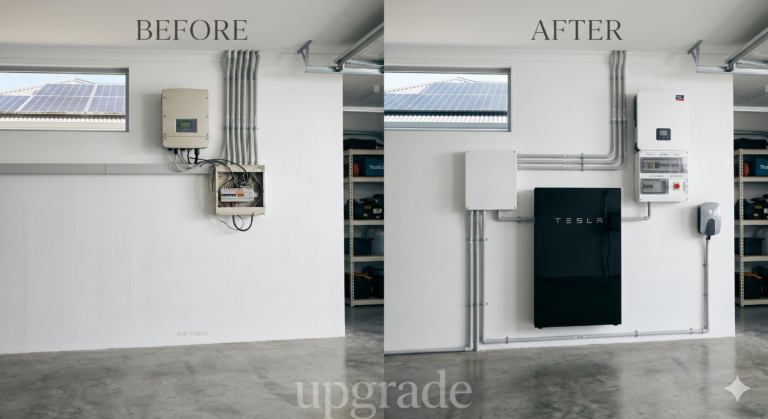
Usually, yes. Adding panels later can mean a second install, a new connection application and sometimes a new inverter. For a battery, your panels must cover daytime use and still have spare power to charge it. As a rough check, add about 1 kW of panels for every 3.8 kWh of battery you want to fill each day. Our battery sizing guide covers choosing the battery itself. For an EV, multiply your daily kilometres by the car’s energy use (kWh per 100 km) to see what it adds.
Should I size solar to cover my usage or to export more?
Size it around the power you’ll use, not the power you’ll export. In Perth, solar you use yourself is worth far more than solar you send to the grid. Here’s why, using Synergy’s rates from 1 July 2026:
| What happens to 1 kWh of solar | Value to you |
|---|---|
| Used at home instead of buying it (Home Plan A1) | 33.26c saved |
| Exported 3pm–9pm under DEBS | 10c earned |
| Exported at any other time under DEBS (including midday) | 2c earned |
Most solar is generated around the middle of the day, so most exports earn 2c. Export 10 kWh at midday and you earn about 20c. Use that same 10 kWh to run the pool pump, dishwasher and air-con and you save about $3.33.
Bigger isn’t always a mistake. Extra capacity helps in winter and on cloudy days. But once your system makes far more than you use in daylight, each extra kW adds less to your savings. Shift loads into the day with timers to lift the share you use yourself. On Synergy’s Midday Saver plan, 9am–3pm power costs 8.85c and 3pm–9pm costs 55.33c, so evening use matters even more. Our solar payback guide shows how self-consumption changes your payback.
How many solar panels do I need, and will they fit on my roof?
Divide the system size in watts by the wattage of one panel. A 6.6 kW system (6,600 W) built from 440 W panels needs 15 panels. Most modern home panels are rated around 430–480 W, so the count shifts a little with the panel you choose.
| System size | Panels at 440 W | Approx. roof area |
|---|---|---|
| 5 kW | 11–12 | ~22–24 m² |
| 6.6 kW | 15 | ~30 m² |
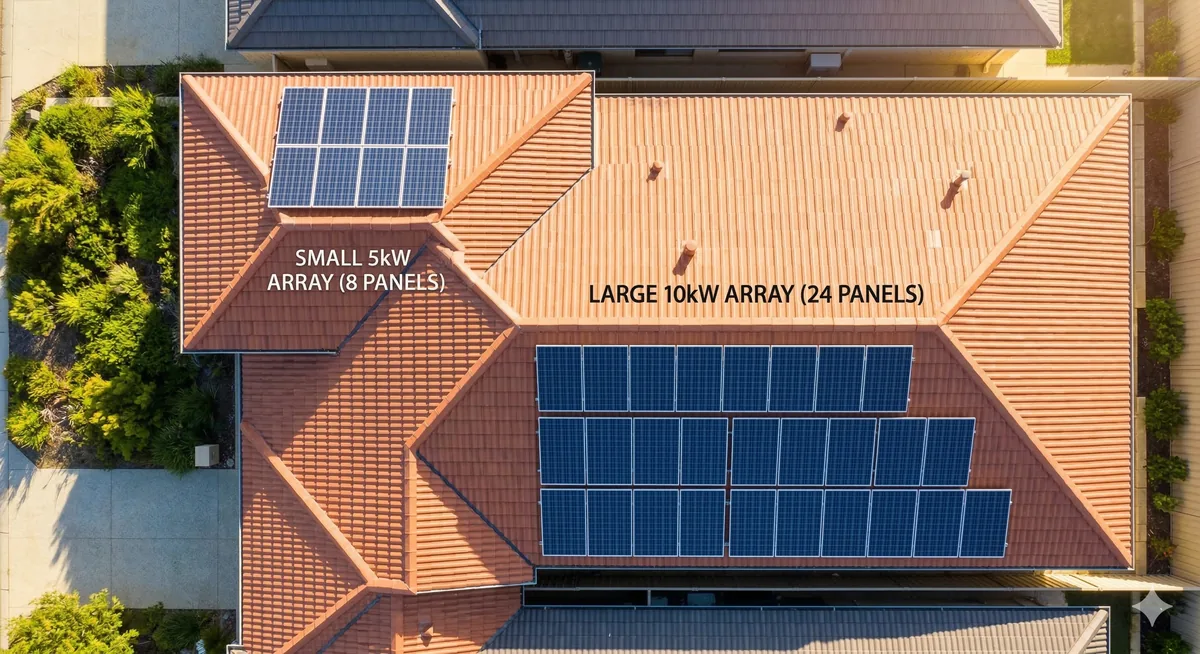
| 10 kW | 23 | ~46 m² |
| 13.3 kW | 30 | ~60 m² |
| 20 kW | 45 | ~90 m² |
Roof space is often the real limit. A two-storey home in Scarborough with a complex tiled roof may fit fewer panels than a single-storey new build in Baldivis with long, simple roof planes. If north-facing space is short, a split array (some panels north, some west or east) spreads generation across the day.
Quick tip: Shade from a tree or a neighbour’s roof can drag down a whole string of panels. On shaded roofs, microinverters or optimisers can limit the loss. On clear roofs, a standard string inverter is usually simpler and cheaper.
What is the maximum solar system size in WA, and how do export limits work?
From 1 May 2026, most Perth homes on a standard connection can install up to 30 kVA of total inverter capacity, counting solar and battery inverters together. But however big the system, you can export at most 5 kW, and only 1.5 kW unless you have a buyback (off-take) agreement with your retailer.
| Connection | Max total inverter capacity | Generation limit | Export limit |
|---|---|---|---|
| Single-phase | 30 kVA | 15 kVA | 1.5 kW standard; up to 5 kW with a retailer agreement |
| Three-phase | 30 kVA | 8 kVA per phase | 1.5 kW standard; up to 5 kW with a retailer agreement (net across all phases) |
Two points catch people out. First, the 5 kW export limit on three-phase is a total for the site, not 5 kW per phase. Second, new and upgraded systems must be able to be managed remotely during grid emergencies. Synergy uses a standard called CSIP-AUS for this. If you opt out of staying connected, your export is capped at 1.5 kW.
So a larger system is now allowed on single-phase power, but panels beyond your daytime use mostly export at low rates or hit the export cap. Bigger pays off when you can use the power: a battery, an EV, a pool or heavy daytime air-con. Our solar export limits guide explains how the cap affects your bill.
What about 19.9 kW, 26.6 kW and 39.9 kW systems?
These follow the same one-third oversizing pattern as 6.6 kW: roughly 1.33 times a 15 kW, 20 kW or 30 kW inverter. A 19.9 kW array on a 15 kW inverter sits inside the standard residential limits and usually suits a three-phase home with a big roof. The 26.6 kW and 39.9 kW sizes press against the 30 kVA cap and per-phase generation limits, especially once a battery is added, so they need careful design. Anything over 30 kVA goes through a separate Western Power application.
Single-phase or three-phase: which do I have?
Check your meter box. One main switch usually means single-phase. Three linked main switches usually mean three-phase. Most older Perth homes are single-phase, and under the 2026 rules you don’t need three-phase for a 10 kW system. Read more in our three-phase power and solar guide.
How much does each size cost, and how do I check a quote?
As a rough guide, most Perth homes pay around these amounts in 2026, after the federal STC discount, installed and including GST:
| System size | Rough 2026 estimate (after STC) | Average daily output |
|---|---|---|
| 6.6 kW | $5,000–$7,500 | ~25 kWh |
| 10 kW | $8,000–$11,000 | ~38 kWh |
| 13 kW | $10,000–$14,000 | ~49 kWh |
Your price depends on the panels and inverter, your roof type and height, and whether your switchboard needs work. See our solar panel cost guide for Perth for a full breakdown. Before you sign, check that the installer has:
- Used your Synergy bills or interval data, not a guess
- Checked your roof, shade, switchboard and phase
- Asked about batteries, EVs, pools and gas appliances you may change
- Explained your export limit under the 2026 Western Power rules
How Talk Energy sizes a system
Talk Energy Solar & Battery has been installing solar across Perth for 7+ years, with 5,000+ installations. Our in-house SAA-accredited electricians (no subcontractors) review your bills, check your roof and switchboard, and size the system around how your household uses power. Every install is backed by a 20-year workmanship warranty and a 48-hour fix-or-replace guarantee, and we hold 4.8 stars from 300+ Google reviews. If a battery is part of the plan, we install Sigenergy SigenStor systems.
Get a free, fixed solar quote or call (08) 6255 5914. We’re at 16 Ogilvie Rd, Mount Pleasant WA 6153 (licence EC15564).
Frequently asked questions
How many solar panels do I need?
Divide your system size in watts by the wattage of one panel. A 6.6 kW system uses about 15 panels of 440 W, a 10 kW system about 23, and a 13.3 kW system about 30. To find the system size first, divide your daily usage in kWh by 3.8, which is Perth’s average daily output per kW of panels. Each panel needs roughly 2 square metres of roof.
What size solar system does the average Perth home need?
Most Perth family homes suit a 6.6 kW system. It produces about 25 kWh a day on average, which covers a household using around 15–25 kWh a day. Larger homes with ducted air-con, a pool or an EV often need 10–13 kW. Always size from your own Synergy bill rather than an average.
Is a 6.6 kW solar system the right size for my home?
A 6.6 kW system is right for most homes using 15–25 kWh a day. It pairs with a 5 kW inverter, because industry design rules generally allow about a third more panel capacity than inverter capacity. If you use more than about 25 kWh a day, or plan a battery or EV, a larger system is worth comparing.
What is the maximum solar system size for a home in WA?
From 1 May 2026, homes on a standard Western Power connection can install up to 30 kVA of total inverter capacity, including battery inverters. Generation is limited to 15 kVA on single-phase and 8 kVA per phase on three-phase in the Perth metro network. Export is limited to 1.5 kW, or up to 5 kW with a retailer buyback agreement. Larger systems need a separate Western Power application.
Can I install a 10 kW solar system on single-phase power in Perth?
Yes, under the Western Power rules that apply from 1 May 2026, a single-phase home in the Perth metro network can have up to 15 kVA of generation. Your export is still capped at 1.5 kW, or up to 5 kW with a retailer buyback agreement. A 10 kW system on single-phase makes most sense when you use most of the power yourself, for example with a battery or EV.
Is it better to get a bigger solar system than I need?
It is if you expect your usage to grow with a battery, EV or electric appliances. Adding panels later can mean a second install and a new connection application. If your usage won’t grow, extra panels mostly export power at 2c per kWh outside 3pm–9pm, so the last few kW add little to your savings.