6.6kW Solar System in Perth: Output, Sizing and Who It Suits
A 6.6kW system is the most common size on Perth roofs, and the most commonly misunderstood. The number describes the panels, not the inverter, and what you actually save depends far more on when you use power than on the size printed on the quote.
What “6.6kW” actually means
A 6.6kW system is 6.6 kilowatts of panels paired with a 5kW inverter. That mismatch is deliberate and it is allowed: Australian rules let installers oversize the panel array up to 133% of the inverter’s capacity, and 6.6kW sits exactly at that limit for a 5kW inverter.
The reason is that panels almost never produce their rated output. Rated figures come from laboratory conditions — a specific light intensity at 25°C. A Perth roof in February is a long way from 25°C, and panel output falls as the panels get hotter. Oversizing the array keeps the inverter working closer to its capacity for more of the day, particularly in the morning and late afternoon when the sun is weaker.
The practical effect is a flatter, longer production curve rather than a tall spike at midday. That matters, because the morning and evening shoulders are when most households are actually home using power.
What a 6.6kW system produces in Perth
Perth is one of the sunniest capital cities in Australia, which is why the same system produces noticeably more here than in Melbourne or Hobart. A well-positioned 6.6kW system in the Perth metro area typically generates somewhere around 26 to 28 kilowatt-hours a day averaged across the year.
The average hides a large seasonal swing. Expect something closer to 35 kWh on a long clear day in December, and roughly half that in the middle of a grey July. Any installer quoting you a single flat number for all twelve months is simplifying to the point of being misleading.
Three things move that figure on a real roof:
- Orientation. North-facing gives the highest total output. West-facing gives less overall but produces more late in the afternoon, which suits households that are out during the day and home after five.
- Pitch and shading. A single tree branch across one panel can drag down a whole string, depending on how the system is wired.
- Dust. Perth’s long dry summers mean months without meaningful rain. Panels lose a few percent to accumulated dust before anyone notices.
Who a 6.6kW system suits
As a rule of thumb, a 6.6kW system fits a household using somewhere between 20 and 30 kWh a day — which describes a large share of Perth family homes with air conditioning, a couple of adults and school-age children.
It tends to be undersized if you have ducted air conditioning running most of summer, a pool pump, an electric vehicle, or you are about to add a battery. It tends to be oversized for a single-person household or a unit, where the roof space and the money are usually better spent elsewhere.
The honest test is not the size of your house. It is your bill: look at your daily average consumption in kWh on your Synergy statement, then look at when that power is being used.
Why self-consumption matters more than system size
This is the part most size comparisons skip. Every kilowatt-hour your system produces either gets used in your home or gets exported to the grid. Power you use yourself avoids the full retail rate. Power you export earns a feed-in payment that is considerably lower than the retail rate, and lower again outside the afternoon peak window.
So two identical 6.6kW systems on two identical roofs can deliver very different savings. The household that runs the dishwasher, washing machine and pool pump during daylight hours will do substantially better than the one that runs everything after dark, even with exactly the same hardware.
Before you spend money on a bigger system, it is usually worth shifting what you can into daylight hours. That costs nothing and it changes the maths on what size you actually need. Our guide to how the DEBS feed-in tariff works explains how exports are paid in WA.
Roof space and what gets installed
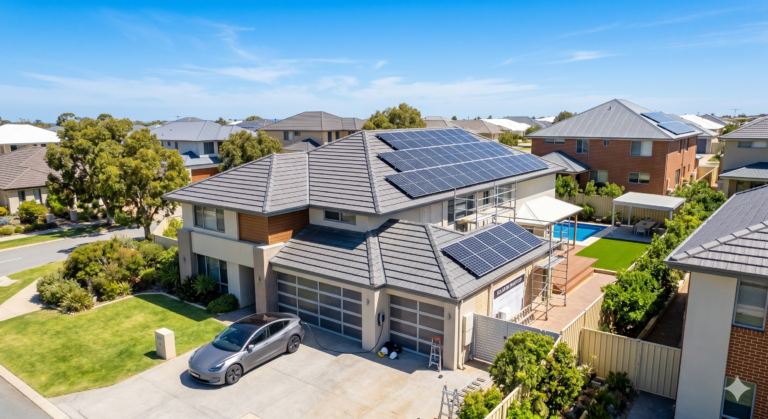
At today’s panel sizes, 6.6kW is typically fifteen or sixteen panels. That needs roughly 30 square metres of usable roof — usable meaning clear of vents, skylights, aerials and shading, and on faces that point somewhere sensible.
Plenty of Perth roofs cannot fit all sixteen panels on one face, which is fine. Splitting an array across two orientations is normal, and it often produces a more useful daily shape than cramming everything onto one aspect.
6.6kW or 10kW?
A 10kW system is the next common step up, usually on a three-phase supply or with a larger single-phase inverter. It makes sense when consumption is genuinely higher, when you are planning an electric vehicle, or when you intend to add a battery and want enough surplus to charge it.
What it does not do is automatically save more money. If your household cannot use the extra production, the additional output is exported at a lower rate, and the payback stretches rather than shortens. Our guide to 10kW systems in Perth covers where that line sits.
Adding a battery later
A 6.6kW system is a reasonable base for adding storage later, provided the installer has left you room to do it. Two things are worth settling at installation rather than afterwards: whether the inverter is battery-ready or will need replacing, and whether there is physical space near the switchboard for a battery.
If a battery is likely within a couple of years, say so at quote stage. It is one of the few decisions that is much cheaper to plan for than to retrofit. The WA Battery Scheme eligibility checklist sets out what qualifies.
Common questions
Will a 6.6kW system cover my whole bill?
Usually not all of it. It will typically cover a large share of daytime usage, with the remainder coming from the grid at night. Households that shift usage into the day and keep a close eye on standby loads get closest.
Can I add panels to a 6.6kW system later?
Sometimes, but it is constrained by the inverter. A 5kW inverter is already running a 133% array, so adding panels usually means a larger or additional inverter. This is why it is worth sizing for where you will be in five years, not where you are today.
Does a 6.6kW system still qualify for the federal incentive?
Yes. Small-scale technology certificates apply to systems of this size and are normally handled as a discount at the point of sale rather than something you claim back. The value steps down each year until the scheme ends.
How long does installation take?
Most residential systems of this size are installed in a single day, with grid connection and meter configuration following separately.
Getting it sized properly
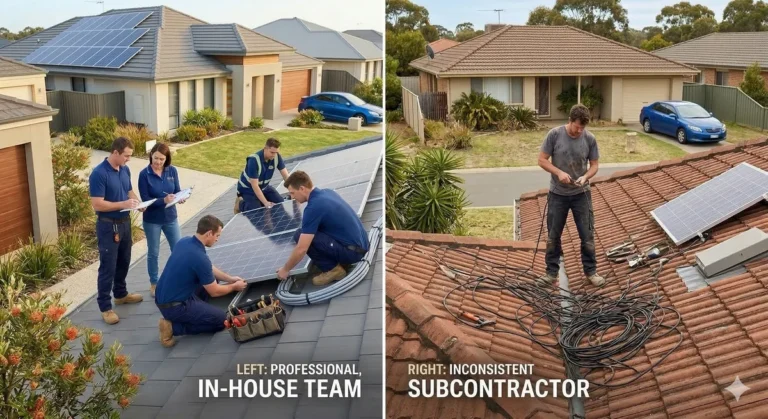
The right way to size a system is to start with twelve months of your own consumption data and your daily usage pattern, not a package on a website. Talk Energy designs every system from your actual bills and roof, and every installation is carried out by our own in-house SAA-accredited electricians, backed by a 20-year workmanship warranty and a 48-hour fix or replace guarantee.
For a free assessment sized to your household, call 08 6255 5914.