10kW Solar System Cost in Perth 2026: What You Actually Pay
Quick answer: As a rough guide, most Perth homes pay around $8,000–$11,000 for a 10kW solar system in 2026, fully installed with GST, after the federal STC rebate. Your price depends on the panels and inverter, your roof and access, and whether you need switchboard or three-phase work. Get a free, fixed quote.
A 10kW system is a common size for larger Perth homes. It suits households with ducted air conditioning, a pool, an electric vehicle or a home office. It is also big enough for the federal rebate to take a real bite out of the upfront cost.
Quotes for “a 10kW system” can still differ by thousands of dollars. This guide explains why. It covers the price range, the STC maths for Perth, what a fair quote includes, what the system produces, how payback works, and what adding a battery costs.
How Much Does a 10kW Solar System Cost in Perth in 2026?
Most Perth homes pay roughly $8,000–$11,000 for a 10kW solar system in 2026, after the STC rebate. That is an estimate for a Perth metro install, including GST. It is not a fixed price. Where you land in the range comes down to the parts you choose and how hard your roof is to work on.
Here is how a 10kW system compares with the sizes either side of it:
| System size | Rough 2026 Perth estimate (after STC) | Typical fit |
|---|---|---|
| 6.6kW | $5,000–$7,500 | Smaller homes, lower daytime use |
| 10kW | $8,000–$11,000 | Families of four or more, pools, ducted air, EVs |
| 13kW | $10,000–$14,000 | Very high use, usually three-phase homes |
Within the 10kW range, quotes tend to fall into three broad tiers:
- Lower end of the range: entry-level Tier 1 panels, a standard string inverter and a simple single-storey roof.
- Middle of the range: well-known Tier 1 panels and a hybrid-ready inverter, so a battery can be added later without swapping the inverter.
- Top of the range: premium panels, optimisers or a premium inverter, or a complex roof. Three-phase work and switchboard upgrades can push a quote higher.
People searching for a 10kW solar system price in Melbourne, Sydney or Brisbane will see different figures. Market prices vary between cities, and the solar zone changes the size of the rebate (see the next section). Use Perth figures for a Perth home.
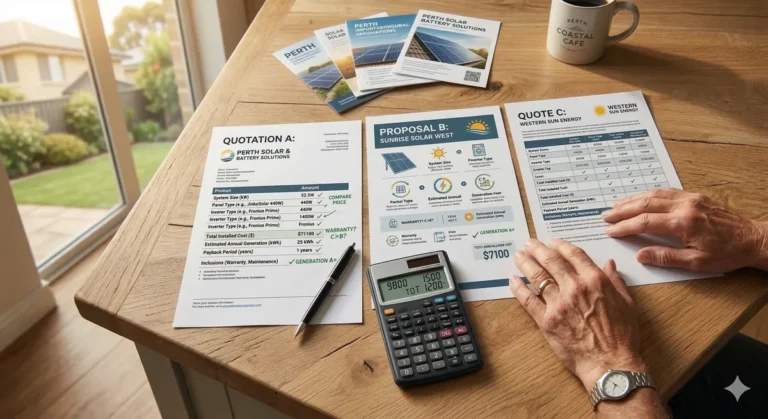
Treat a 10kW quote well below $8,000 with care. Very cheap quotes often leave out brand names, use subcontracted labour or add costs later. For a wider look at prices across all system sizes, see our solar panel cost guide for Perth.
How Much Is the STC Rebate on a 10kW System in Perth?
A 10kW system installed in Perth in 2026 earns about 69 STCs, worth roughly $2,600–$2,800. The estimates above already have this taken off. You do not claim it yourself. You assign the certificates to your installer, who deducts the value from your invoice.
STCs (small-scale technology certificates) come from the federal Small-scale Renewable Energy Scheme. The number you get depends on three things: system size, your solar zone, and the deeming period (the years left until the scheme ends in 2030).
The maths for a 10kW system in Perth
- Zone: Most Perth metro postcodes are in Zone 3, which has a zone rating of 1.382. Check your own postcode in the Clean Energy Regulator’s postcode zone table.
- Deeming period: 5 years for systems installed in 2026.
- Calculation: 10kW × 1.382 × 5 years = 69 STCs (rounded down).
- Value: 69 STCs × about $38–$40 each = roughly $2,600–$2,800.
Arrays are often a little over 10kW because of panel sizes. A 10.4kW array earns a few more certificates. The STC price also moves with the market, so check the rebate line on each quote.
Why the rebate shrinks each year
The deeming period drops by one year every 1 January. A 10kW system installed in 2027 uses a 4-year period, which works out to about 55 STCs instead of 69. At today’s STC prices, that is roughly $530–$560 less rebate on the same system.
This also explains why prices for other cities look different. Zones further south have lower ratings, so the same 10kW system earns fewer STCs there. A Perth quote and a Melbourne quote for the same parts will not net out the same.
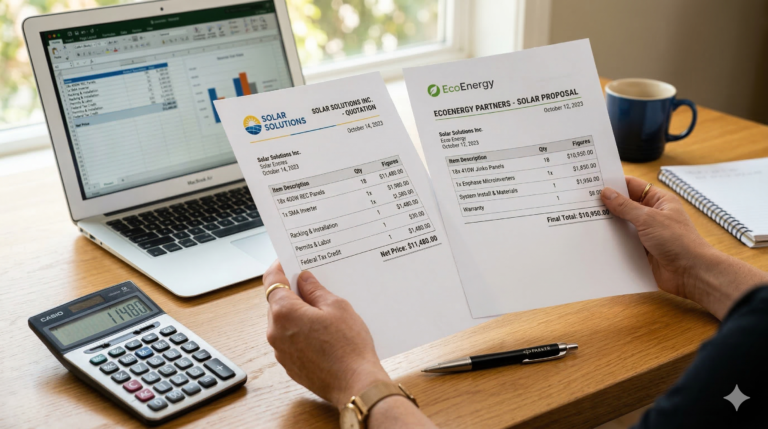
Every quote should show three numbers: the price before the rebate, the STC amount and the net price you pay. If the rebate is not itemised, ask for it.
What Should a 10kW Solar Quote Include?
A complete 10kW quote covers the parts, the labour and the paperwork needed for a working, grid-connected system. If any of the items below are missing, the “cheap” quote may not be cheap once extras are added.
| Item | What it does | What to look for |
|---|---|---|
| Solar panels (about 22–25) | Turn sunlight into DC power | Named brand and model, 25-year performance warranty |
| Inverter | Converts DC to AC for your home | Named brand, warranty length, hybrid-ready if you may add a battery |
| Mounting and racking | Holds the panels on your roof | Rated for your roof type and Australian Standards |
| Cabling and isolators | Connects the system safely | UV-rated and correctly sized |
| Monitoring | Shows what the system produces | App or portal set up at handover |
| Grid connection | Approval to connect and export | Application to Western Power handled for you |
The panel count comes from simple maths. With 400–460W panels, a 10kW array needs about 22–25 panels. Most Perth roofs can fit that, but a site check confirms space, shading and orientation.
The price should also cover:
- Installation by SAA-accredited electricians
- Commissioning and handover documents
- Meter changes needed for solar export
- STC rebate processing, deducted upfront
- GST
Costs that are sometimes left out
- Switchboard upgrades if your board cannot take the new system
- Scaffolding for double-storey or steep roofs
- Tile roof work, which takes more labour than tin
- Split arrays across several roof faces
- Extended inverter warranties beyond the factory term
Ask every installer one question: “Does this price include everything needed for a fully working, grid-connected system?” Get any conditions in writing. A quote given without a site assessment is a guess.
What Makes One 10kW Quote Cost More Than Another?
Four things explain most of the gap between 10kW quotes: panel quality, the inverter, your power supply (single- or three-phase) and your roof. Compare these line by line before you compare totals.
Panels
Panels differ in heat performance, degradation and warranty. Perth summers are hot, and panels lose some output as they heat up, so the temperature rating matters here. Look for a named Tier 1 brand with a long product warranty and a 25-year performance warranty.
Inverter
The inverter is the part most likely to need replacing during the system’s life. A longer warranty and good local support are worth paying for. If you may add a battery later, a hybrid-ready inverter can save you buying a second inverter down the track.
Single-phase or three-phase power
Most Perth homes are single-phase. Western Power sets limits on how much inverter capacity a single-phase home can connect and how much it can export. A 10kW array can still make sense on single-phase if you use a lot of power during the day, because more of it is used in the home. Three-phase homes have more room. Your installer should confirm your supply and the limits that apply before quoting.
Roof and access
A single-storey, north-facing tin roof is the simplest job. Tiles, double storeys, steep pitches and roofs facing several directions all add time and cost.
Why Is Price Alone the Wrong Way to Compare 10kW Quotes?
Because a solar system runs for 25 years or more, and the upfront price is only part of what you pay over that time. Who stands behind the work matters as much as the parts.
Here is what can make a cheaper quote cost more later:
- Short workmanship warranty. If a roof penetration leaks or a connection fails after the warranty ends, you pay for the repair.
- Slow fault response. At Synergy’s Home Plan (A1) rate of 33.26c/kWh, a 10kW system can produce more than $10 worth of power on a sunny day. Every day it sits idle is money lost.
- No monitoring. Without it, a fault can go unnoticed for weeks.
- Subcontracted installs. When the seller and the installer are different businesses, it can be harder to get problems fixed.
- Installers who leave the market. A long warranty is only useful if the business is still around to honour it.
Questions to ask every installer: Are your electricians employed by you? How long is your workmanship warranty? How fast do you respond to faults? Is the rebate itemised on the quote?
How Much Power Does a 10kW System Produce in Perth?
A 10kW system in Perth produces roughly 13,800kWh a year, or about 38kWh a day on average. That figure comes from the Clean Energy Regulator’s Zone 3 rating of 1.382MWh per kW per year. Real output is higher in summer and lower in winter, and depends on shading, orientation and panel heat.
That is enough to cover a large share of a big household’s daytime use, including:
- Ducted reverse-cycle air conditioning on summer afternoons
- Pool pumps and filtration
- Home office equipment
- Daytime EV charging
Is 10kW the right size for your home?
A 10kW system usually suits homes using about 25–40kWh a day. That often means four or more people, ducted air, a pool, an EV or someone home during the day. Homes that use less are often better served by a 6.6kW system. Bigger is not always better: unused solar earns only a small export credit, so oversizing can slow payback.
How Much Can a 10kW Solar System Save in Perth?
Savings depend mostly on how much solar you use yourself. Each kWh you use instead of buying from the grid saves 33.26c on Synergy’s Home Plan (A1). Each kWh you export earns only 2c–10c under DEBS. So self-consumption drives savings.
| Synergy rate (from 1 July 2026) | Rate |
|---|---|
| Home Plan (A1) grid power | 33.26c/kWh |
| DEBS export, peak (3pm–9pm) | 10c/kWh |
| DEBS export, off-peak (all other times) | 2c/kWh |
DEBS export payments are capped at 50kWh a day. Most solar exports happen in the middle of the day, so most are paid at the 2c rate.
A worked example
This is an illustration, not a promise. Take a 10kW system producing 38kWh a day:
- Half used in the home: 19kWh × 33.26c × 365 = about $2,300 a year
- Half exported, mostly at 2c: 19kWh × 2c × 365 = about $140 a year
- Total: roughly $2,450 a year
At an estimated system cost of $8,000–$11,000, that points to a simple payback of about 3.3–4.5 years. Use more of your solar and payback is faster. Use less and it is slower. For a full breakdown by household type, see our solar payback period guide for Perth.
How Much Is a 10kW Solar System With a Battery?
As a rough guide, a 10kW solar system plus a battery of about 10kWh comes to around $13,500–$20,000 in 2026, after the STC rebate on the solar and the federal and WA rebates on the battery. That is the two estimates added together. Your quote depends on battery size, your inverter and your switchboard.
| Battery size | Rough estimate before rebates | Rough estimate after federal + WA rebates |
|---|---|---|
| About 10kWh | $9,500–$13,000 | $5,500–$9,000 |
| About 13–16kWh | $13,000–$18,000 | $8,000–$12,500 |
Two rebates bring the battery price down:
- Federal Cheaper Home Batteries program: about $2,600–$2,700 on a 10kWh battery. It is based on 6.8 STCs per kWh for the first 14kWh, which falls to 5.7 STCs per kWh on 1 January 2027.
- WA Residential Battery Scheme: up to $1,300 for Synergy customers or up to $3,800 for Horizon Power customers. You must join a virtual power plant (VPP), and the battery and inverter must be on your retailer’s approved list. See our WA Battery Scheme guide.
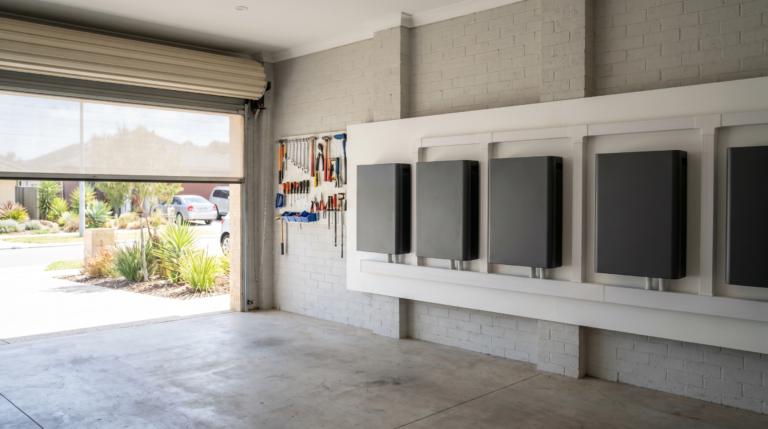
A battery makes the most sense with a 10kW array because a large system often has spare daytime output. Stored solar can cover the 3pm–9pm evening peak instead of being exported at 2c. Talk Energy installs Sigenergy SigenStor batteries. For detail on battery sizes and costs, read our solar battery system cost guide for Perth.
Can You Finance a 10kW Solar System?
Yes. Many Perth households use a payment plan or green loan rather than paying cash. Compare the total cost of any plan, including fees and interest, against your expected yearly savings.
- Cash: no fees or interest, so you keep the full saving from day one.
- Payment plans and green loans: offered through finance partners. Rates, fees and terms vary, so read the fine print.
- WA no-interest battery loan: if you add a battery under the WA scheme, an optional no-interest loan of $2,001–$10,000 is available through Plenti. It has a household income limit of $210,000. The battery rebate itself is not means-tested.
What Do You Get With a Talk Energy 10kW Installation?
Every Talk Energy 10kW quote starts with a site assessment and ends with a fixed, itemised price, with the STC rebate shown. Here is what backs each install:
- In-house SAA-accredited electricians, with no subcontractors
- A 20-year workmanship warranty
- A 48-hour fix-or-replace guarantee
- Monitoring set up at handover
- Western Power grid connection paperwork handled for you
- STC rebate deducted upfront, so there is nothing to claim
Talk Energy has completed more than 5,000 installations over 7+ years and holds 4.8 stars from 300+ Google reviews. Learn more about our solar installations in Perth.
The Bottom Line on 10kW Solar Prices in Perth
- Price: most Perth homes pay roughly $8,000–$11,000 after the STC rebate in 2026.
- Rebate: about 69 STCs, worth roughly $2,600–$2,800, already deducted.
- Output: about 13,800kWh a year, or 38kWh a day on average.
- Payback: around 3.3–4.5 years in our worked example, faster with high self-consumption.
- With a battery: roughly $13,500–$20,000 for 10kW plus about 10kWh, after rebates.
- Timing: the solar rebate steps down on 1 January 2027, and so does the federal battery rebate.
Want a price for your home? Get a free, fixed quote or call (08) 6255 5914.
Frequently Asked Questions
How much is a 10kW solar system in Perth?
As a rough guide, most Perth homes pay around $8,000–$11,000 for a 10kW solar system in 2026, fully installed with GST, after the STC rebate. Your price depends on the panels and inverter, your roof and any switchboard or three-phase work.
How many solar panels are in a 10kW system?
About 22–25 panels, using the 400–460W panels common in 2026. Higher-wattage panels mean fewer panels on the roof.
How much is the STC rebate on a 10kW system in Perth?
Roughly $2,600–$2,800 in 2026. Perth metro is mostly in Zone 3 (rating 1.382), so a 10kW system earns about 69 STCs over a 5-year deeming period, at about $38–$40 each. The rebate falls on 1 January 2027.
How much is a 10kW solar system with a battery?
As a rough guide, a 10kW system plus a battery of about 10kWh comes to around $13,500–$20,000 in 2026 after the solar STC rebate and the federal and WA battery rebates. Larger batteries cost more.
What is the payback period for a 10kW system in Perth?
In a worked example where half the solar is used at home and half is exported at 2c, a 10kW system saves about $2,450 a year, which points to a payback of around 3.3–4.5 years. Using more of your solar shortens it.
Is a 10kW system worth it on single-phase power?
It can be, if you use a lot of power during the day. Western Power limits how much a single-phase home can connect and export, so the value comes from using the solar in your home. Your installer should check your supply before quoting.