Commercial Solar in Perth 2026: What Size System Does Your Business Need and What Will It Cost?
Perth businesses are paying some of the highest commercial electricity rates in Australia, with Synergy tariffs running at 24–34 cents per kilowatt-hour depending on your usage profile. At those rates, a well-sized commercial solar system doesn’t just reduce your bills; it fundamentally changes your operating cost structure.
The problem most business owners face isn’t a lack of interest in solar. It’s a lack of reliable, WA-specific information. How large a system do you actually need? What will it cost after government incentives? What does Western Power require before you can connect? This guide answers all of it, specifically for Perth businesses considering systems between 10kW and 100kW.
Key insight: Perth sits in STC Zone 3 (rating 1.382 MWh per kW per year), the same zone as Sydney and Brisbane. That means WA businesses receive the strongest federal solar rebate in the country, yet most commercial solar guides are written for the eastern states and miss this advantage entirely.
How to Size a Commercial Solar System
The single biggest mistake businesses make is sizing a commercial system based on total electricity consumption rather than daytime consumption. Commercial solar only offsets power you use while the sun is shining. Electricity consumed at night comes from the grid regardless.
Step 1: Identify Your Daytime Load
Pull three months of electricity bills and look at your interval data (available from Synergy’s online portal). You want to know how much energy your business consumes between roughly 8am and 4pm on weekdays. For most offices, this is 60–80% of total consumption. For warehouses with refrigeration or machinery running around the clock, it may be closer to 40–50%.
The rule of thumb: Size your system to cover 80–90% of your daytime load. Going larger than this risks exporting excess generation for very little return. WA’s Distributed Energy Buyback Scheme (DEBS) pays eligible exporters (households, schools and not-for-profits) just 2c/kWh off-peak and 10c/kWh from 3pm to 9pm (Synergy rates from 1 July 2026), and most standard businesses are not eligible for DEBS at all. That is a poor return compared to the 24–34c/kWh you save by self-consuming.
Step 2: Check Your Available Roof Space
Each kilowatt of solar requires roughly 4–5 square metres of usable roof space (accounting for panel size, row spacing, and setbacks). A 30kW system needs approximately 150 square metres; a 100kW system needs around 450–500 square metres. North-facing roof area is ideal in Perth, though east and west-facing installations still perform well given the city’s 5.4 average peak sun hours per day.
Quick Sizing Reference by Business Type
| Business Type | Typical Daily Consumption | Daytime Usage | Recommended System Size |
|---|---|---|---|
| Small office (10–20 staff) | 50–100 kWh/day | 70–80% | 15–25kW |
| Medium office (20–50 staff) | 100–200 kWh/day | 70–80% | 25–50kW |
| Retail shop or café | 60–150 kWh/day | 80–90% | 20–40kW |
| Small warehouse | 150–300 kWh/day | 40–60% | 30–60kW |
| Large warehouse / light manufacturing | 300–600 kWh/day | 40–55% | 50–100kW |
If you’re unsure of your interval data, an SAA-accredited commercial installer will pull this directly from your Synergy account as part of a site assessment.
Commercial Solar System Costs in Perth: 2026 Price Guide
Perth commercial solar pricing has become more competitive over the past two years as panel costs continue to fall. Commercial pricing varies too much from site to site to quote a reliable range here, so the table below shows typical system sizes and annual generation. Your installed cost after the federal Small-scale Technology Certificate (STC) rebate depends on the factors listed below the table.
| System Size | Installed Cost (After STCs) | Annual Generation | Typical Business |
|---|---|---|---|
| 10kW | Quote-dependent | 15,000 kWh | Small office, café |
| 20kW | Quote-dependent | 30,000 kWh | Medium office, retail |
| 30kW | Quote-dependent | 45,000 kWh | Large office, small warehouse |
| 50kW | Quote-dependent | 75,000 kWh | Warehouse, factory |
| 100kW | Quote-dependent | 150,000 kWh | Large warehouse, manufacturing |
Prices vary based on panel and inverter brand, roof type and complexity, whether switchboard upgrades are required, and the installer’s experience with commercial systems. Allow extra budget if your switchboard needs upgrading, which is common in older commercial buildings.
The STC Rebate: Why Perth Businesses Are in the Best Position Nationally
The federal Small-scale Renewable Energy Scheme (SRES) provides an upfront discount through STCs, which your installer claims on your behalf and passes on as a point-of-sale reduction. Zone 3 sits between the sunnier northern zones and southern zones such as Melbourne.
In practical terms, a 30kW system installed in Perth in 2026 creates about 207 STCs (30 × 1.382 × 5), worth roughly $7,900–$8,300 at $38–$40 per STC. A 99kW system creates about 684 STCs, worth roughly $26,000–$27,400. This is the single largest upfront cost reduction available to Perth businesses and it expires in 2030, with the rebate value stepping down each year. Installing in 2026 earns more certificates than waiting until 2027 or 2028.
Systems above 100kW: From 1 October 2026, solar systems from 100kW to 1MW installed from that date can also create STCs, with a fixed 5-year deeming period and Clean Energy Regulator applications opening from mid-to-late November 2026. Systems above 1MW create Large-scale Generation Certificates (LGCs) under the national Large-scale Renewable Energy Target, which WA systems can access.
Tax Incentives That Stack on Top
Beyond STCs, Perth businesses can access:
- Instant Asset Write-Off: Claim the full system cost as a tax deduction in the same financial year, reducing the effective cost by 25–30% for businesses on the standard company tax rate.
- CEFC Financing: The Clean Energy Finance Corporation offers low-interest loans from $50,000 for qualifying commercial solar projects, reducing the upfront capital requirement.
- Made in WA Energy Affordability Investment Program (MEAIP): The WA Government’s $153 million program offering low-interest loans of up to $15 million for manufacturers, with applications opening July 2026 through the Department of Energy and Economic Diversification.
Payback Period Calculations by Business Type
Payback period is the metric that actually matters for a business investment decision. The figures below assume a Synergy commercial tariff of 30c/kWh and a self-consumption rate of 75–85%, which is realistic for businesses that operate standard weekday hours.
Office (30kW System)
A medium-sized Perth office running a 30kW system will generate approximately 45,000 kWh per year. At 80% self-consumption, that’s 36,000 kWh displacing grid power at 30c/kWh, saving roughly $10,800 annually. Depending on the installed cost after STCs, the payback period is typically 2.5–3 years.
After payback, the system runs for a further 20+ years with minimal maintenance costs. The economics are straightforward: the same electricity that costs $10,800 per year from the grid costs effectively nothing once the system is paid off.
Warehouse (50kW System)
Warehouses present a different profile. Higher total consumption but lower daytime usage percentage, since refrigeration, security systems, and some equipment run continuously. A 50kW system generating 75,000 kWh annually, with 60% self-consumption, saves approximately $13,500 per year. Depending on the installed cost after STCs, payback typically lands at 3–3.5 years.
Retail (20kW System)
Retail businesses operate almost entirely during daylight hours, making them one of the best candidates for commercial solar. A 20kW system generating 30,000 kWh annually with 85% self-consumption saves around $7,650 per year. Depending on the installed cost after STCs, payback is typically 2.5–3 years.
The real insight: The businesses with the fastest payback are those with the highest daytime electricity consumption and the highest Synergy tariff rates. If your business pays over 28c/kWh and operates primarily during the day, commercial solar is one of the highest-returning capital investments available to you right now.
For a detailed breakdown of ROI by business type, Talk Energy’s commercial solar ROI guide for Perth businesses covers additional scenarios including medical centres, hospitality, and light manufacturing.
Grid Connection Requirements for Commercial Properties in WA
Grid connection is where commercial solar projects get delayed, and it’s the area most installers underexplain to their clients. Here’s what Perth business owners need to know.
Systems Up to 30kVA (Approx. 25kW Solar)
Systems with a total inverter capacity at or below 30kVA connect under a standard Basic Embedded Generation application with Western Power. This is the simplest pathway, typically adding 2–4 weeks to the project timeline. Your installer handles the application on your behalf.
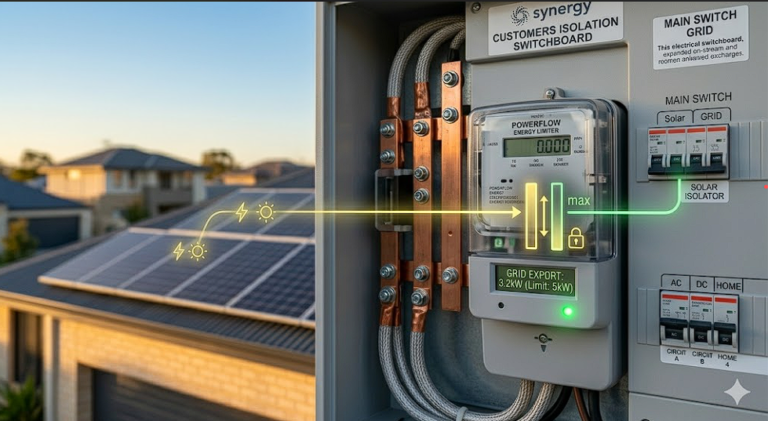
From 1 May 2026, new connection rules apply to all installations on the South West Interconnected System (SWIS). Every new system must be commissioned under one of two export arrangements:
- Future-ready pathway: Full access to DEBS feed-in tariffs and future VPP programs. Requires a communications-capable inverter and Wi-Fi at the inverter location. This is the right choice for most businesses.
- Standard export (1.5kW cap): No ongoing communications required after installation testing, but export is capped at 1.5kW. Not recommended for commercial systems where excess generation is likely.
For most commercial installations, the future-ready pathway is the correct choice. A knowledgeable installer will configure this from day one rather than leaving you to retrofit it later.
Systems Above 30kVA (Approx. 25kW+ Solar)
Commercial systems above 30kVA require a separate Embedded Generation Connection application with Western Power. This involves:
- An engineering study of your site
- A formal network capacity assessment
- Potential switchboard upgrades to handle three-phase connection
- Longer approval timelines: typically 6–12 weeks
Western Power has introduced a Conditional Exemption for commercial systems between 30kVA and 200kVA, allowing them to be exempt from interface protection requirements if they use an AS/NZS 4777.1:2020 compliant inverter. This has meaningfully reduced the cost and complexity for 30–100kW systems compared to previous years.
The practical implication: A business installing a 50kW or 100kW system should factor in 8–12 weeks for grid connection approval on top of the installation timeline. Experienced commercial installers will lodge the network application at the same time as your system design is being finalised, running both processes in parallel to minimise delays.
For a comprehensive breakdown of what to look for in an installer who understands this process, see Talk Energy’s guide to choosing a commercial solar installer in Perth.
Why Your Installer Choice Matters More Than Your Panel Brand
Most businesses spend considerable time comparing panel brands and inverter models. The installer question gets far less attention, and that’s backwards.
A commercial solar installation involves electrical work, structural assessment, network applications, compliance documentation, and ongoing monitoring. The panel brand is largely irrelevant if the system is poorly designed, incorrectly sized, or connected to the grid in a way that limits your export earnings.
What to Require From Any Commercial Installer
- SAA accreditation (mandatory): Solar installer accreditation in Australia is administered by Solar Accreditation Australia (SAA), which took over from the Clean Energy Council. Accreditation is held by individual electricians, not by companies, so the question to ask is whether the people actually on your roof are accredited. Systems must be installed by an SAA-accredited installer to qualify for the STC rebate. Verify this before signing anything.
- In-house licensed electricians: Commercial installations require licensed electrical work. Installers who subcontract this out introduce coordination risk and accountability gaps. In-house electricians mean a single point of responsibility.
- Commercial-specific experience: Residential installers are not the same as commercial installers. Commercial systems involve three-phase connections, larger inverter configurations, switchboard work, and network applications that require specific experience.
- Workmanship warranty: A minimum 10-year workmanship warranty is the industry standard for quality commercial installers. Some Perth installers offer 20 years. This covers the installation itself, not just the equipment.
- Post-installation monitoring: System performance monitoring should be included. If your system underperforms due to shading, soiling, or inverter faults, you want this identified quickly, not discovered at your next annual electricity review.
Talk Energy’s commercial solar team is made up of our own in-house SAA-accredited electricians, and backs every installation with a 20-year workmanship warranty, one of the longest in Perth.
What the Commercial Solar Installation Process Looks Like
A well-managed commercial solar project follows a predictable sequence. Understanding it upfront helps you plan around it and hold your installer accountable.
Typical Timeline for a 20–100kW Perth Commercial Installation
| Stage | What Happens | Timeframe |
|---|---|---|
| Site assessment | Load analysis, roof inspection, shading assessment, switchboard review | 1–2 days |
| System design & proposal | Sizing, equipment selection, financial modelling | 3–7 days |
| Retailer application (Synergy) | Retailer Reference Number obtained | 1–2 weeks |
| Western Power application | Network connection approval (concurrent with design) | 2–8 weeks (size dependent) |
| Installation | Panel mounting, inverter installation, electrical connections | 1–3 days |
| Commissioning & inspection | System tested, export pathway configured, notice of completion lodged | 1 day |
| Monitoring setup | Remote monitoring activated, performance baseline established | Same day |
For systems above 30kVA, the Western Power application stage is the primary timeline driver. The most experienced commercial installers lodge this application as early as possible, often before the final design is locked in, to avoid it becoming the critical path item.
Total project timeline: For a 20–30kW system, expect 6–10 weeks from signed contract to operational system. For a 50–100kW system, allow 10–16 weeks, primarily due to the network connection process.
After Installation: What to Expect
A quality commercial system requires minimal intervention once operational. Annual cleaning (or more frequent in dusty industrial environments), inverter firmware updates, and annual performance reviews are the primary maintenance requirements. Most modern inverters include remote monitoring that flags faults automatically.
The WA Government’s energy policy guidance notes that systems commissioned under the future-ready pathway from May 2026 onwards will be eligible for emerging grid services and VPP participation as these products become available in WA, providing additional revenue streams beyond electricity bill savings.
Ready to Get a Commercial Solar Assessment?
The numbers for Perth commercial solar in 2026 are compelling: 2.5–4 year payback, 20+ years of reduced electricity costs, and the strongest federal rebate in the country available right now. The STC value steps down each year through to 2030, so the financial case for acting in 2026 is stronger than it will be in 2027.
Talk Energy specialises in commercial solar installations for Perth small to medium businesses, from 10kW offices to 100kW warehouses. With our own in-house SAA-accredited electricians, a 4.8-star rating from 300+ Google reviews, and a 20-year workmanship warranty, Talk Energy manages the entire process, from load analysis and system design through to Western Power connection and ongoing monitoring.
Get a free commercial solar assessment tailored to your business’s actual energy data, roof space, and financial goals. Talk Energy’s team will provide a detailed proposal including system sizing, installed cost after STCs, projected annual savings, and payback period, at no cost and no obligation.
Contact Talk Energy at talkenergy.com.au or call to speak with a commercial solar specialist. For more detail on what to expect from the process, see the complete commercial solar installation guide for Perth businesses.