Commercial Solar Perth: A 2026 Installation Guide for Businesses
Quick answer: Commercial solar in Perth is a rooftop (or ground-mount) system sized to a business’s daytime electricity use, usually on three-phase power. Systems up to 100 kW earn an upfront federal STC discount, worth about 6.91 STCs per kW for a Perth install in 2026. Your price depends on system size, roof, switchboard work and Western Power approval, so the right first step is a site assessment based on 12 months of your bills.
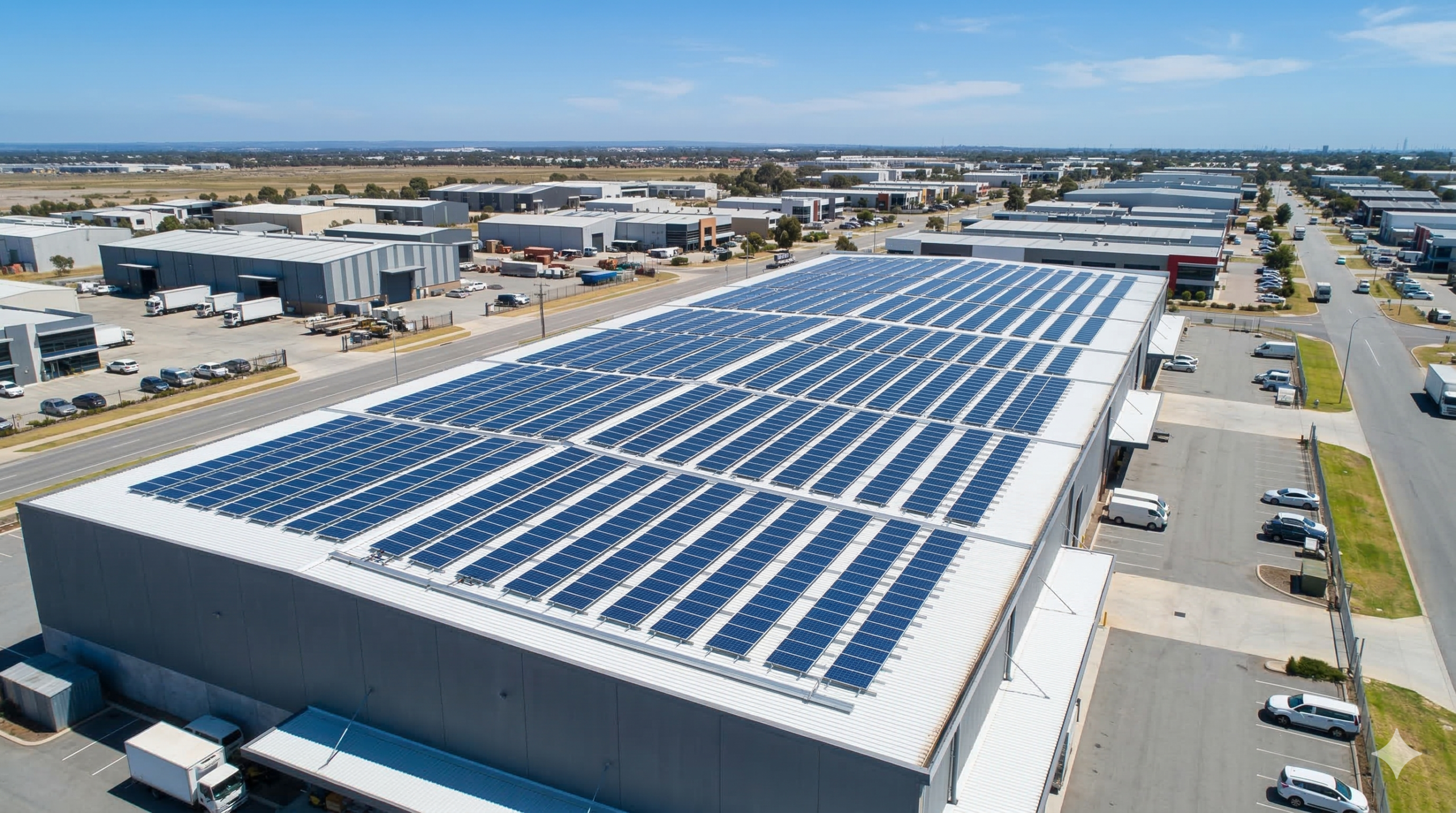
Power is one of the biggest running costs a Perth business can actually control. Offices, warehouses, workshops, clinics and retail stores all use most of their electricity in daylight hours, which is exactly when Perth’s sun is doing its work. That match is why commercial solar so often makes financial sense.
But a commercial installation is a different job from a house. The systems are larger, the network approvals are more involved, and the incentive rules changed again in October 2026. This guide covers what Perth business owners need to know before signing: how to size a system, what drives cost, which incentives apply, how the installation process runs and how to compare installers.
How is commercial solar different from residential solar?
Commercial solar uses the same panels and inverter technology as a home system, but almost everything around it is bigger and more regulated. The main differences are system size, three-phase power, network approval, roof engineering and the incentive rules that apply once a system passes 100 kW.
| Factor | Typical Perth home | Typical Perth business |
|---|---|---|
| System size | 6.6 kW to 13 kW | 20 kW to 100 kW, and larger for industrial sites |
| Power supply | Usually single-phase | Usually three-phase |
| Grid connection | Standard Western Power application | More detailed Western Power assessment; export limits are common |
| Roof check | Visual inspection | Structural load assessment often needed |
| Federal incentive | STCs | STCs up to 100 kW; mid-scale STCs or certificates above that |
| Feed-in credit | DEBS buyback for eligible homes | Standard businesses generally not eligible for DEBS |
Three-phase power
Most commercial premises in Perth run on three-phase power, which spreads load across three separate phases. A commercial system needs inverters and cabling set up to balance generation across all three. If the design gets this wrong, the system can underperform or trip network protection. If your site is single-phase, a supply upgrade may be needed before a larger system can go in.
Grid connection and export limits
Larger systems need a more detailed Western Power connection application than a home system. Western Power may set an export limit, or in some areas allow no export at all. That means the system has to be designed around what your business uses on site, not around how much power the roof could produce.
Important: Network approval is one of the most common causes of delay. Build it into your timeline from the first conversation, especially if you need the system running before a lease change or the end of the financial year.
Roof structure and engineering
Warehouse and factory roofs cover a lot of area, but that does not mean they can carry any load. Older buildings, long roof spans and some roof materials may need a structural assessment before panels are mounted. Tin, concrete tile and membrane roofs each need different racking, and an ageing roof may need repairs before installation.
What size commercial solar system does a Perth business need?
Size the system to your daytime electricity use, not to your roof. A good commercial design starts with 12 months of bills or interval meter data, works out how much power you use while the sun is up, and then picks the size that lets you use most of what the panels produce.
A quick rule of thumb
For a rough starting figure, divide the energy your business uses during daylight hours each day (in kWh) by about 4.5 to 5. Perth averages roughly that many peak sun hours a day across the year. A business using about 250 kWh during the day would land somewhere around a 50 kW system. Treat this as a starting point only. Seasonal swings, shift work, refrigeration cycles, air conditioning peaks and export limits all shift the right answer.
What your installer needs to see
- 12 months of electricity bills so seasonal changes are captured
- Your tariff type, including any demand charge or time-of-use pricing
- Your operating hours, including weekends and shift work
- Your switchboard and meter details, including whether you are on three-phase supply
- Planned changes such as new equipment, an EV fleet, expansion or a lease end date
Which Perth businesses suit solar best?
Businesses that use most of their power between about 8am and 4pm get the most from solar, because they use what they generate instead of sending it to the grid. The table below is a qualitative guide only. Your own bills decide the numbers.
| Business type | Typical load pattern | Solar fit | What to check |
|---|---|---|---|
| Warehouse, logistics, cold storage | Large roof, steady daytime load, refrigeration | Strong | Roof structure, export limit, overnight refrigeration load |
| Office building | Air conditioning, lighting and IT in business hours | Strong | Roof space per tenant, weekend use, metering for tenancies |
| Workshop, trade, light manufacturing | Machinery and compressors during the day | Strong | Three-phase balance, demand peaks at start-up |
| Medical and dental clinics | Daytime air conditioning and equipment | Good | Critical loads, whether backup power matters |
| Retail and showrooms | Lighting and cooling across trading hours | Good | Late trading, shared roofs in shopping centres |
| Restaurants and cafés | Peaks at lunch and in the evening | Moderate | Evening load share; a battery may be worth modelling |
Worth knowing: Because standard businesses generally don’t get the DEBS buyback rate, power you export earns little or nothing. An oversized system can look impressive on paper and still pay back more slowly than a smaller one sized to your load.
How much does commercial solar cost in Perth?
There is no honest single price for commercial solar, because two businesses with the same system size can need very different work. The installed cost depends mainly on system size, roof type, switchboard and metering upgrades, network requirements, equipment choice and whether a battery is included. A fixed quote after a site assessment is the only reliable number.
What drives the price
- System size. Larger systems usually cost less per kW, because design, access and labour costs are spread over more panels.
- Switchboard and metering. Older premises often need switchboard work or a meter change before solar can be connected safely.
- Roof type and access. Tin, tile and membrane roofs need different racking. High roofs, long cable runs and safety access add cost.
- Western Power requirements. Export limiting devices, protection settings or network studies can be required for larger systems.
- Equipment. Panel and inverter choice affects both price and how the system performs over 25 years.
- Battery storage. A commercial battery adds cost but can help with evening use and demand charges.
- Monitoring. Make sure system monitoring is included, not an extra left out of a budget quote.
How STCs reduce the upfront cost
For systems up to 100 kW, the federal Small-scale Renewable Energy Scheme creates small-scale technology certificates (STCs). Your installer normally applies their value as a discount on your invoice. In Perth (Zone 3, rating 1.382) a system installed in 2026 has a 5-year deeming period, so it earns about 6.91 STCs per kW.
| System size (Perth, 2026) | Approximate STCs |
|---|---|
| 30 kW | About 207 |
| 50 kW | About 345 |
| 99 kW | About 684 |
The dollar value depends on the STC market price when your certificates are traded, so check that each quote shows the STC discount clearly. The deeming period drops by one year each year until the scheme ends in 2030, which means the same system earns fewer certificates every year it waits.
Quick tip: Compare quotes like for like: the same system size, panel and inverter brands, warranty terms and what is included (switchboard work, monitoring, network application). A cheaper quote often leaves one of these out.
If you would rather not pay upfront, our guide to commercial solar financing in WA compares PPAs, loans, leases and grants.
What incentives can Perth businesses claim for solar in 2026?
The main incentive is the federal STC discount for systems up to 100 kW. From 1 October 2026, eligible systems between 100 kW and 1 MW can also create STCs under the Clean Energy Regulator’s new mid-scale rules. Some businesses can also bring forward the tax deduction for the system, depending on current ATO rules.
Systems up to 100 kW: STCs
Small-scale systems must be no more than 100 kW and produce less than 250 MWh a year. They create STCs once, at installation, based on the 5-year deeming period that applies in 2026. To be eligible, the system must be designed and installed by SAA-accredited people and use approved panels and inverters.
Systems from 100 kW to 1 MW: the new mid-scale rules
According to the Clean Energy Regulator (page updated 7 October 2026), eligible solar systems from 100 kW to 1 MW installed from 1 October 2026 can create STCs using a 5-year deeming period. Applications are expected to open in mid to late November 2026. These systems must choose between STCs and renewable electricity certificates. Choosing STCs means you can’t create those certificates for the deeming period. Because the rules are new, ask any installer to model both options for your site.
Worth knowing: Older guides say systems over 100 kW can only earn ongoing large-scale certificates. That changed for mid-scale systems installed from 1 October 2026. Check the Clean Energy Regulator site for the latest rules before you sign.
Tax treatment
A solar system is a business asset. Depending on your turnover and the ATO rules in force when the system is installed, you may be able to deduct the cost faster under instant asset write-off or small business depreciation rules. Thresholds change often, so confirm with your accountant before you build it into your payback numbers.
Feed-in credits and WA rules
WA’s main grid, the South West Interconnected System, has its own rules. The Distributed Energy Buyback Scheme (DEBS) pays eligible households, schools and not-for-profits 10c/kWh from 3pm to 9pm and 2c/kWh at other times (Synergy rates from 1 July 2026). Standard businesses are generally not eligible, so exported solar earns little or nothing. The WA Residential Battery Scheme is also for homes only. For a business, the value of solar comes from the power you use on site.
How long does commercial solar take to pay back?
Payback depends on three things: the net cost after incentives, how much of the solar power you use on site, and what you pay per kWh. Businesses that run most of their load in daylight hours usually see the fastest payback, because nearly every kWh the panels produce replaces power they would otherwise buy from the grid.
The basic calculation is simple:
Simple payback (years) = net system cost after incentives ÷ yearly savings on your power bill
What pushes payback up or down
- Self-consumption. The share of solar you use on site matters more than any other factor, because exports earn little for most businesses.
- Your tariff. Business tariffs differ in their energy rate, daily charge and demand charge. Solar cuts the energy part of the bill most directly.
- Demand charges. If your bill includes a charge based on peak demand, solar alone may not reduce it. A battery or load management may be needed to capture that saving.
- Equipment quality. Panels that degrade faster lose output every year of a 25-year life.
- Workmanship. Shading mistakes, poor string design or loose connections cut output from day one.
A proper commercial proposal should show projected generation, the share you will use on site, the saving at your actual tariff and the resulting payback. If a quote only quotes a payback figure without showing how it was worked out, ask for the numbers behind it.
Should a business add a battery?
For most daytime businesses, solar on its own pays back faster. A battery is worth modelling if you have a large evening load (hospitality, for example), a significant demand charge, time-of-use pricing, or equipment that needs backup power. Ask for the system to be quoted with and without a battery so you can compare.
How does a commercial solar installation work, step by step?
A commercial solar project in Perth usually runs through five stages, from the first bill review to monitoring after switch-on. The network approval stage is normally the longest, so it should start as early as possible.
- Consultation and site assessment. Your electricity bills, usage pattern, switchboard, supply and roof or ground space are reviewed on site.
- System design and proposal. The system is designed around your load, roof, tariff and operating hours, with projected generation, savings and payback shown in writing.
- Approvals and paperwork. The Western Power connection application, any export limit requirements and compliance documents are lodged and managed for you.
- Installation. Licensed electricians install the system to Australian Standards, with the work scheduled to keep disruption to your business low.
- Commissioning and aftercare. The system is tested and switched on, monitoring is set up, and ongoing support and warranties begin.
Ask any installer who will handle each stage. On a commercial job, having one company responsible from design to aftercare avoids finger-pointing if something goes wrong later.
How do you choose a commercial solar installer in Perth?
Choose an installer whose own electricians are SAA-accredited, who can show commercial experience at a similar size to your project, and who backs the installation with a long workmanship warranty. Residential and commercial solar are different disciplines, and the installer’s design work will affect your system’s output for the next 25 years.
Accreditation
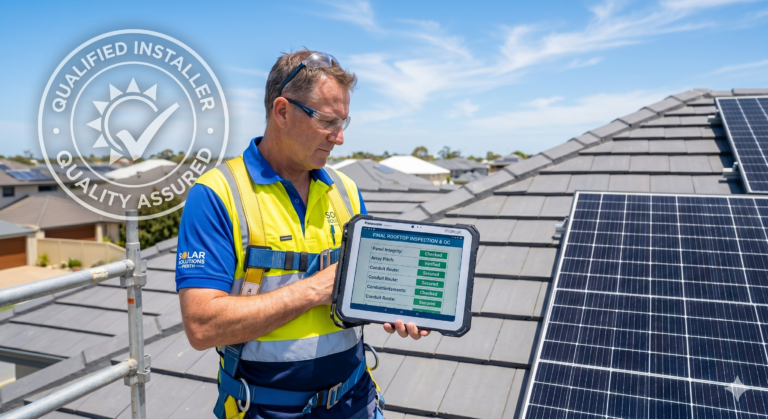
Installer accreditation in Australia is run by Solar Accreditation Australia (SAA), which took over from the Clean Energy Council. Accreditation is held by individual electricians and designers, not by companies. So the right question is whether the people designing and installing your system are SAA-accredited. It is a baseline requirement for claiming STCs.
Questions to ask every installer
- Are your electricians in-house, or do you use subcontractors?
- Can you show commercial projects of a similar size and refer us to business clients?
- Who prepares and manages the Western Power application?
- Has the system been sized from our interval data or bills, or from roof area?
- Is switchboard work, monitoring and the network application included in the price?
- How long is your workmanship warranty, and how quickly do you respond to faults?
Warranties
A solar system has three warranty layers. The panel product warranty covers manufacturing defects. The panel performance warranty (often 25 years) covers output loss over time. The workmanship warranty covers the installation itself: wiring, mounting and weatherproofing. Installation faults are a common cause of early underperformance, so the workmanship warranty, and the company standing behind it, matter as much as the panel warranty.
What mistakes do Perth businesses make with commercial solar?
Most commercial solar regrets come from the same five errors. All of them are avoidable at the planning stage.
- Sizing to the roof, not the load. Filling every square metre of roof leads to large exports that earn little. Size to your daytime use first.
- Choosing on price alone. Quotes that differ widely for the same size usually differ in panel and inverter quality, what is included or warranty terms.
- Underestimating approval time. Western Power assessment for larger systems takes time. Start early if you have a deadline.
- Ignoring the tariff structure. If your bill has a demand charge, solar alone may not reduce it. Model it before you commit.
- Not planning for growth. New equipment, EV charging or expansion in the next few years should be built into the design now. Adding capacity later usually costs more.
Commercial solar in Perth with Talk Energy
Talk Energy Solar & Battery designs and installs commercial solar for businesses across Perth and regional Western Australia. Every system is installed by our in-house SAA-accredited electricians, with no subcontractors, so one team is accountable from design to aftercare. Installations are backed by a 20-year workmanship warranty and a 48-hour fix-or-replace guarantee.
We have been installing for more than seven years, have completed over 5,000 installations, and hold a 4.8-star rating from 300+ Google reviews. Our office is at 16 Ogilvie Rd, Mount Pleasant, and we work with businesses from Joondalup to Rockingham and out to the Perth Hills. You can see more about our solar installations in Perth.
Ready to see the numbers for your premises? Get a free commercial solar quote, call us on (08) 6255 5914, or contact our team. Bring 12 months of electricity bills and we will size a system to your load, not your roof.
Commercial solar Perth: frequently asked questions
How much does commercial solar cost in Perth?
Commercial solar in Perth is priced per project, because cost depends on system size, roof type, switchboard and metering work, Western Power requirements, equipment choice and whether a battery is included. Larger systems usually cost less per kW than smaller ones. Systems up to 100 kW receive an upfront STC discount of about 6.91 STCs per kW in 2026. A fixed quote after a site assessment is the only reliable price.
What size solar system does my business need?
Your system should be sized to the electricity your business uses during daylight hours, not to your roof area. As a rough guide, divide your daytime daily use in kWh by about 4.5 to 5 to get a starting size in kW. An installer should confirm the size using 12 months of bills or interval meter data, your tariff and your operating hours.
Can a system over 100 kW get STCs?
Yes, under new Clean Energy Regulator rules. Eligible solar systems from 100 kW to 1 MW installed from 1 October 2026 can create STCs using a 5-year deeming period, with applications expected to open in mid to late November 2026. These systems must choose between STCs and renewable electricity certificates, so ask your installer to model both options.
Do businesses get paid for exported solar in WA?
Generally not much. The Distributed Energy Buyback Scheme covers eligible households, schools and not-for-profits, and standard businesses are generally not eligible. That is why commercial systems in Perth are sized so the business uses most of its solar power on site.
Does Talk Energy use subcontractors for commercial installs?
No. Every Talk Energy installation, residential and commercial, is completed by our own in-house SAA-accredited electricians. That gives your business one point of accountability for design, installation and warranty, backed by a 20-year workmanship warranty and a 48-hour fix-or-replace guarantee.
How do I get a commercial solar quote in Perth?
Request a free quote online or call Talk Energy on (08) 6255 5914. Have 12 months of electricity bills ready, along with your operating hours and any plans to expand. We will assess your site and provide a written proposal with projected generation, savings and payback.