Sigenergy SigenStor Review for Perth Homes (2026): Specs, Price, Rebates and the Recall
Quick answer: The Sigenergy SigenStor is a modular home battery that combines a solar inverter, battery inverter, battery pack, energy management system and an optional DC EV charger in one stack. Modules come in four sizes, and one controller takes up to six of them. As a rough guide, most Perth homes pay around $9,500–$13,000 for a ~10 kWh battery before rebates in 2026. The 2025 recall covered certain single-phase energy controllers, not the battery modules.
Sigenergy installation in Perth: Talk Energy installs Sigenergy SigenStor batteries across Perth with our own in-house SAA-accredited electricians. It is the battery brand we supply, for new solar-and-battery systems and for adding a battery to existing solar. Every install carries our 20-year workmanship warranty and 48-hour fix-or-replace guarantee. Get a free, fixed quote or call (08) 6255 5914.
If you’re researching Sigenergy, you’ve probably seen three things already: glowing reviews of the design, a lot of talk about EV charging, and headlines about a recall. It’s hard to know what matters for a Perth home.
This review sets out what the SigenStor actually is, what it costs, how it fits the WA Battery Scheme, what happened with the recall, and who it suits. Specifications are taken from Sigenergy’s Australian product page and its Australian warranty document, checked in October 2026. Confirm current details when you get your quote.
What is the Sigenergy SigenStor?
The SigenStor is a stackable “5-in-1” energy storage system. Sigenergy lists the five parts as a solar inverter, an EV DC charger, a battery PCS (the battery’s power converter), the battery pack, and an energy management system (EMS). They sit in one stack instead of being separate boxes on your wall.
Most home battery set-ups are built from parts. You have a solar inverter, a battery with its own inverter or a hybrid inverter, and often a separate EV charger. Each has its own app and its own warranty. The SigenStor rolls these into one product with one app (mySigen).
The stack has two main pieces:
- The Energy Controller. This is the inverter at the top of the stack. It handles your solar panels and the battery, and comes in single-phase and three-phase versions.
- Battery modules. These stack underneath. Each module has its own DC-DC optimiser, so you can add a module years later without it being dragged down by the older ones.
An EV DC charging module is optional. It charges a compatible electric car straight from solar and battery DC power, at 12.5 kW or 25 kW, using a CCS2 plug. That skips the double conversion of a normal AC wall charger.
Sigenergy also describes the system as V2H (vehicle-to-home) and V2G (vehicle-to-grid) ready. Its own fine print says this depends on your car, and the feature will be turned on by software update once the relevant standards are published. Treat it as a future option, not something you’ll use on day one.
Worth knowing: Blackout backup needs the separate Sigen Home Energy Gateway. It isn’t one of the five built-in parts. The Gateway detects a grid outage and switches your home to solar and battery power. Sigenergy quotes “0 ms load-side disruption”, and its HomePro single-phase model supports 100 A whole-home backup.
SigenStor specs at a glance
SigenStor batteries come in four module sizes, and one Energy Controller takes one to six modules. With the largest module, that’s about 54 kWh of total capacity on one controller.
| Specification | SigenStor (Australian models) |
|---|---|
| Battery modules | BAT 5.0, 6.0, 8.0 and 10.0 (usable energy 5.2, 6.0, 7.8 and 9.0 kWh under Sigenergy’s warranty test) |
| Modules per controller | 1 to 6 |
| Battery chemistry | Lithium iron phosphate (LiFePO4) |
| Single-phase inverter | Models up to 12 kW |
| Three-phase inverter | 5 kW to 30 kW |
| Max. inverter efficiency | 97.6–98.0% (single-phase), 98.1–98.4% (three-phase) |
| Optional DC EV charger | 12.5 kW or 25 kW, CCS2 plug |
| Weather rating | IP66, floor-standing or wall-mounted |
| Operating temperature | -20 °C to 55 °C ambient (10–30 °C recommended for battery life) |
| Warranty | Battery 10 years, Energy Controller 10 years, EV DC module 3 years |
What the key numbers mean:
- 98.4% is inverter efficiency, not round-trip efficiency. Round-trip losses (energy in versus energy out of the battery) are always higher than an inverter’s peak efficiency figure.
- The battery warranty has a throughput limit. Sigenergy warrants 70% of usable energy at 10 years, or a set amount of energy cycled through the battery, whichever comes first. For a BAT 10.0 module that is 33.29 MWh.
- It needs to stay online. Sigenergy’s Australian warranty requires an internet connection for firmware updates. If the system is offline for more than a year, cover drops to five years from activation.
- Perth heat matters. It can run up to 55 °C, but battery life is best at 10–30 °C. A shaded south- or east-facing wall or a garage beats a west wall in full afternoon sun.
How much does a Sigenergy battery cost in Perth?
As a rough guide, most Perth homes pay around $9,500–$13,000 for a ~10 kWh battery before rebates in 2026, or about $5,500–$9,000 after the federal and WA rebates. Larger systems cost more, but the rebates stop growing past a certain size.
These are general Perth market estimates for an installed battery, including GST. They aren’t a Talk Energy price list, and they aren’t specific to one brand.
| Battery size (installed, Perth) | Rough guide before rebates | Rough guide after federal + WA rebates |
|---|---|---|
| ~10 kWh | $9,500–$13,000 | ~$5,500–$9,000 |
| ~13–16 kWh | $13,000–$18,000 | ~$8,000–$12,500 |
| ~20–25 kWh | $18,000–$26,000 | ~$12,000–$19,000 |
Your SigenStor price depends on a few things:
- How many modules you stack, and which sizes.
- Single-phase or three-phase, and the inverter size you need.
- Extras, such as the Home Energy Gateway for blackout backup or the DC EV charging module.
- Your switchboard and site. An older switchboard or a long cable run adds cost.
Rebates: Two discounts usually come off the price at the point of sale.
- Federal Cheaper Home Batteries program. This is worth roughly $2,600–$2,700 on a 10 kWh battery in 2026. It’s based on 6.8 STCs per kWh for the first 14 kWh and is reduced above that. The rate falls to 5.7 STCs per kWh on 1 January 2027.
- WA Residential Battery Scheme. Up to $1,300 for Synergy customers, or up to $3,800 for Horizon Power customers. It’s capped at 10 kWh, and you must join a virtual power plant (VPP).
Quick tip: Because both rebates level off (WA at 10 kWh, federal reduced above 14 kWh), a very large stack costs more per kWh after rebates. Size the battery to your evening and overnight use, not to the biggest number available. Our solar battery cost guide for Perth breaks this down further.
Does the SigenStor qualify for the WA Battery Scheme?
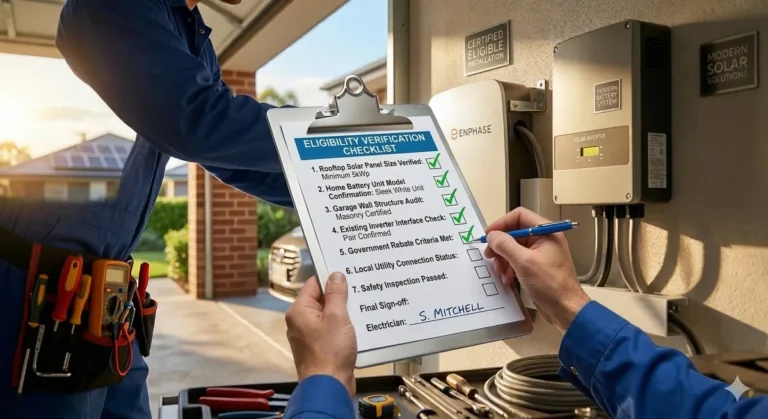
Yes, in general. Sigenergy has storage listings on Synergy’s Supported Solutions List, which is what the Synergy rebate requires. But eligibility is checked by exact model and configuration, so we confirm yours at quote.
For the WA rebate, the battery and inverter must be:
- New and VPP-capable
- At least 5 kWh usable (there’s no maximum)
- On the Clean Energy Council approved products list
- On your retailer’s Supported Solutions List. For Synergy customers, it must be listed under “DER-Storage”
Synergy’s list was last updated on 1 October 2026. Sigenergy, Sungrow, GoodWe, Fronius, SolaX, SolarEdge and several other brands have DER-Storage listings on it. Tesla Powerwall 3 is currently listed only under DER-Generator, so it doesn’t attract the Synergy rebate. Lists change, which is why every system gets checked against the current version.
If you’re a Horizon Power customer in regional WA, the same idea applies against Horizon Power’s own list. Check eligibility at quote.
VPP is part of the deal. Joining a virtual power plant is mandatory if you take the WA rebate. Synergy customers join a Synergy VPP product. Sigenergy designs the SigenStor for VPP dispatch, and the Synergy listing is what lets it take part. Our VPP guide for Perth explains what that means day to day.
Other conditions apply too: one rebate per property, owner-occupiers and renters (with the landlord’s written consent) can both apply, and the rebate is not means-tested. Our WA Battery Scheme eligibility checklist covers the full list.
The 2025 Sigenergy recall: what happened
On 19 November 2025, a voluntary electrical safety recall of some Sigenergy energy controllers was published on the ACCC’s Product Safety Australia site (recall number PRA 2025/20703). It covered the inverter part of the system, not the battery modules.
- Affected products: SigenStor single-phase 8 kW, 10 kW and 12 kW energy controllers with quick-connect AC plugs that need ferrules and crimping.
- Sale period: 4 March 2025 to 18 November 2025.
- The hazard: the AC plugs could overheat and be damaged, creating a fire risk.
- Harm reported: the notice said no property damage, injuries or deaths had been reported.
What Sigenergy did:
- Sent a firmware update to all affected units that were online. It lets Sigenergy monitor each system and briefly reduce AC output during sustained full load, so the plug doesn’t overheat.
- Offered a free replacement inverter with an updated AC plug, arranged through the retailer, installer or a Sigenergy Australia service partner.
- Added two years of warranty on the replacement inverter, on top of the standard 10 years.
Sigenergy’s own statement says the failures it inspected were on systems “not installed as per Sigenergy installation instructions”. The ACCC notice describes the plug design as the hazard. Both points are worth knowing. The crimped plug made installation quality critical, and the fix replaces that plug.
Important: If you own a single-phase 8, 10 or 12 kW SigenStor bought in that window, check the mySigen app and contact your installer or Sigenergy Australia (sigenservice.au@sigenergy.com). If you’re buying now, ask your installer which energy controller model you’re getting.
Our view: no recall is good news. But this one was narrow, it didn’t involve the battery cells, and the remedy was free. It’s a fair reason to ask questions, and to care about who installs your system. It isn’t, on its own, a reason to rule the product out.
Sigenergy battery review: pros, cons and who it suits
The SigenStor suits Perth homes that want one integrated system they can grow over time, especially if an EV is in the picture. It’s a weaker fit if you want the longest Australian track record or the simplest possible set-up.
Strengths
- One system, one app. Solar inverter, battery and optional EV charging come from one maker, under one warranty document.
- Easy to expand. Start with one module and add more later. The per-module optimisers let new and old modules work together.
- DC EV charging. Up to 25 kW straight from solar and battery, which few home systems offer.
- Wide size range. From about 5 kWh to about 54 kWh on one controller, single- or three-phase.
- Outdoor-rated. IP66, with a -20 °C to 55 °C operating range.
- Rebate-ready. Listed for Synergy’s storage rebate and designed for VPP participation.
Things to weigh up
- Shorter track record. Sigenergy is a newer brand than some long-standing names. There isn’t a decade of Australian field data yet.
- The 2025 recall. It was limited and remedied, but some buyers will want to factor it in.
- The EV DC module has a 3-year warranty, not 10.
- It must stay online to keep the full 10-year warranty.
- Backup isn’t automatic. You need the Gateway for blackout protection, which adds cost.
Who it suits: EV owners or homes planning one, families who expect their usage to grow, three-phase homes with big loads (pool, ducted air, two cars), and anyone who wants solar, battery and charging managed in one place.
Who might look elsewhere: small households with low evening use, people who want a single fixed-size unit with no add-ons, and buyers for whom brand history outweighs features.
How does it compare with other batteries?
Every major battery has trade-offs, and the right one depends on your home. Tesla’s Powerwall 3 is a single all-in-one unit with a built-in solar inverter. It isn’t currently on Synergy’s storage list, so Synergy customers miss the WA rebate with it. Modular stacks from other brands work in a similar way to the SigenStor but usually pair with a separate hybrid inverter and charger.
For a side-by-side look, see our Perth solar battery comparison and our Tesla Powerwall 3 guide.
Getting a SigenStor installed in Perth
Installation quality matters with any battery, and the recall showed why it matters with this one. Before you sign, ask any installer these questions:
- Are your electricians SAA-accredited for grid-connected battery systems (needed for the WA rebate)?
- Which Energy Controller model, how many modules, and is the Gateway included for backup?
- Have you checked my exact configuration against the current Supported Solutions List?
- Where will it be mounted, and how will it be kept out of the afternoon sun?
- Who do I call if something goes wrong, and how fast do you respond?
Talk Energy installs Sigenergy. It’s the battery brand we work with. Every system is installed by our in-house SAA-accredited electricians, never subcontractors. On top of Sigenergy’s manufacturer warranty, our installs come with a 20-year workmanship warranty and a 48-hour fix-or-replace guarantee.
We’re based at 16 Ogilvie Rd, Mount Pleasant, and install across Perth, from Joondalup and Wanneroo to Rockingham, Mandurah and the Perth Hills. We’ve been doing this for 7+ years, with 5,000+ installations and 4.8 stars from 300+ Google reviews.
We’ll size the SigenStor to your actual usage, check rebate eligibility for your exact set-up, and give you a fixed quote. See our solar battery installation page for how it works.
Get a free, fixed quote or call us on (08) 6255 5914.
Frequently asked questions
Is Sigenergy a good battery?
Sigenergy’s SigenStor is a well-specified modular battery with strong features for its price range. It uses LiFePO4 cells, is rated IP66, has a 10-year warranty on the battery and inverter, and can add DC EV charging. Its main drawbacks are a shorter track record than older brands and the limited 2025 recall of some single-phase energy controllers. Whether it’s right for you depends on your usage, your plans for an EV and your budget.
How much is a Sigenergy battery in Perth?
As a rough guide, most Perth homes pay around $9,500–$13,000 for a ~10 kWh battery before rebates in 2026, or about $5,500–$9,000 after federal and WA rebates. A ~13–16 kWh system is roughly $13,000–$18,000 before rebates. Your price depends on the number of modules, single- or three-phase supply, and extras like the Gateway or EV charger. A fixed quote is the only way to know your exact cost.
What sizes does the SigenStor come in?
SigenStor battery modules come in four sizes: BAT 5.0, 6.0, 8.0 and 10.0. Under Sigenergy’s Australian warranty, their usable energy is 5.2, 6.0, 7.8 and 9.0 kWh. One Energy Controller takes one to six modules, so a single stack ranges from about 5 kWh to about 54 kWh. Single-phase controllers go up to 12 kW and three-phase controllers range from 5 kW to 30 kW.
Was the Sigenergy battery recalled?
No, the battery modules weren’t recalled. The November 2025 recall covered SigenStor single-phase 8, 10 and 12 kW energy controllers with quick-connect AC plugs, sold between 4 March and 18 November 2025. The plugs could overheat and create a fire risk, and no property damage, injuries or deaths were reported. Sigenergy pushed a firmware update, offered free replacements with an updated plug, and added two years of warranty on the replacement inverter.
Does the SigenStor work in a blackout?
Yes, when it’s installed with the Sigen Home Energy Gateway. The Gateway detects a grid outage and switches your home to solar and battery power, and Sigenergy quotes 0 ms load-side disruption. Its HomePro single-phase model supports 100 A whole-home backup. Backup only works if it’s part of the install, so ask your installer to include it.
Can I get the WA battery rebate with a Sigenergy battery?
Generally yes. Sigenergy has storage listings on Synergy’s Supported Solutions List, which the Synergy rebate of up to $1,300 requires. You also need at least 5 kWh usable capacity, and you must join a virtual power plant. Eligibility is confirmed by exact model and configuration, and Horizon Power customers are checked against Horizon Power’s list, so check eligibility at quote.