GoodWe and SolaX in Perth 2026: The Value Tier, Honestly Compared
Every solar quote comparison eventually arrives at the same question: is the cheaper inverter actually worse, or am I just paying for a badge?
It is a fair question and it deserves a straight answer rather than a sales one. GoodWe and SolaX are two of the main value-tier inverter brands in Australia, and both are legitimate products — but "legitimate" is not the same as "right for you".
Specifications in this guide were checked against GoodWe and SolaX Australia data on 26 August 2026. Both brands revise their line-ups regularly — confirm current details at the time of your quote.
What the value tier actually is
GoodWe and SolaX are both large, established manufacturers with substantial global installed bases and Australian distribution. They are not obscure brands, and they are not the no-name equipment that gives cheap solar its reputation.
What separates them from Fronius or SolarEdge is generally:
- Passive rather than active cooling — relevant in Perth heat, see below
- Shorter standard warranty terms in some cases
- Smaller Australian support footprint
- Less field-serviceability — more likely to be a whole-unit replacement than a component repair
- Shorter track record at the 10–15 year mark in Australian conditions
What is not generally different: conversion efficiency at the headline level is broadly comparable across tiers in 2026. GoodWe quotes peak efficiency up to 98.6%, with its three-phase dual-MPPT string inverter at 98.3% max. For comparison, the premium-tier Fronius Primo GEN24 5.0 Plus peaks at 97.6%.
Read that again, because it is the single most useful fact in this article: on paper, the value-tier inverter is not less efficient. The gap is in longevity, thermal management and support depth — not in how much of your solar reaches your switchboard.
The Perth-specific consideration
This is the part that matters most locally and gets left out of national comparisons.
Inverter lifespan is driven substantially by operating temperature, and Perth summers are hard on wall-mounted electronics. A passively-cooled inverter on a west-facing wall in Mount Pleasant is operating in a materially harsher environment than the same unit in Melbourne.
This does not disqualify the value tier. It does mean installation location matters more when you choose it. A GoodWe or SolaX mounted in a shaded, well-ventilated position will likely outlast a premium unit mounted badly.
On a value-tier inverter, getting the mounting position right is close to essential — ask where your installer intends to put it, and push back if the answer is an unshaded west-facing wall.
GoodWe
GoodWe produces a broad range covering single-phase, three-phase and hybrid applications, with a substantial global installed base.
The current Australian range:
- DNS G3 series — single-phase string, roughly 3–6 kW. The common residential choice for a standard Perth home.
- SDT G2 series — three-phase string, roughly 5–20 kW. Residential three-phase and light commercial.
- ES, EM, SBP, EH and ET series — storage and hybrid inverters for battery systems and backup.
Efficiency: up to 98.6% peak across the range.
Warranty — check which series you are being quoted. All CEC-approved GoodWe inverters carry a 5-year standard manufacturer warranty. The DNS, MS and G3 series add a further 5 years on a parts-only basis: in years 6–10 GoodWe supplies replacement parts free, but you pay delivery, labour and any taxes or duties.
That is a real difference from a full parts-and-labour warranty, and it is exactly the kind of clause worth understanding before you compare two quotes on headline warranty length. A "10-year warranty" that bills you for the electrician in year eight is not the same product as one that does not.
Suits: budget-conscious installations, straightforward roofs, homes where the priority is maximising array size for a fixed total spend.
Consider carefully if: the only viable mounting location is hot and unshaded, or the system is going onto a complex multi-orientation roof.
SolaX
SolaX covers both hybrid inverters and modular battery storage. (This is neutral comparison information: Talk Energy installs Sigenergy SigenStor batteries.)
The battery side is the more interesting proposition. SolaX offers modular storage at a lower entry point than Sungrow or Tesla, which makes battery ownership accessible to households where a Powerwall is simply out of budget.
The numbers. The Triple Power T-BAT range builds from 5.1 kWh modules (a 3.6 kWh module is also available), starting at 5.1 kWh usable and expanding with additional slave units to around 20.7 kWh usable. Chemistry is LFP, with a design life of up to 6,000 cycles. The range is CEC-approved.
Warranty: 10 years, with a minimum 70% capacity retention at end of term and a throughput allowance of 3.46 MWh per usable kWh.
That throughput figure is worth understanding, because it is a second limit running alongside the 10 years — whichever you hit first ends the warranty. For a normal household cycling once a day it is generous. If you are enrolled in a VPP, you are adding cycles beyond your own use, and throughput becomes the binding constraint sooner. Since VPP participation is mandatory under the WA Battery Scheme, that is worth doing the arithmetic on. See our guide to virtual power plants in Perth.
Suits: homes that want storage and would otherwise not get any, staged capacity builds on a constrained budget.
Consider carefully if: you need high continuous output for backup loads, or you want the longest available warranty term.
Where we genuinely recommend the value tier
This is not a section most installers write, because the margin is better on premium equipment. But the honest answer is that value-tier equipment is the right call more often than the industry admits.
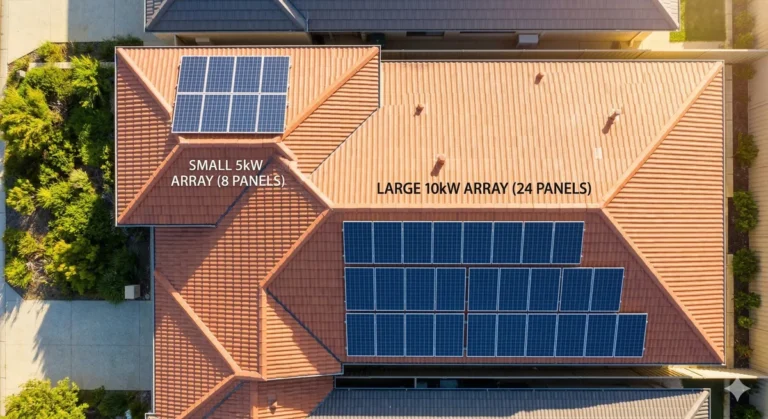
When the budget is fixed and the array could be bigger. A 10kW array with a GoodWe inverter will generate substantially more over its life than a 6.6kW array with a Fronius at similar total cost. More panels beat a better inverter for total generation, almost every time. If the choice is between a bigger system with a value inverter and a smaller system with a premium one, take the bigger system.
When storage is otherwise unaffordable. A SolaX battery that gets installed is worth infinitely more than a Powerwall that does not.
When the mounting location is genuinely good. Shaded, ventilated, not west-facing — the main structural disadvantage largely disappears.
On a rental or a property you will sell within a decade. Paying a premium for years 15–25 of inverter life makes little sense if you will not be there.
Where we would steer you to premium instead
Hot, unavoidable mounting location. If the only option is a west-facing wall in full sun, spend the money on active cooling. It is the single clearest case for Fronius in Perth.
Complex or shaded roof. Neither brand solves shading better than panel-level electronics. SolarEdge or microinverters will out-generate any string inverter on a difficult roof, and the difference is large enough to dominate the price gap.
You want maximum time before the first replacement. If the plan is to install once and not think about it for twenty years, buy the longer-lived product.
Backup power is a primary requirement. Check continuous output figures carefully against the loads you actually want to run.
Comparison
| GoodWe | SolaX | Sungrow | Fronius | |
|---|---|---|---|---|
| Tier | Value | Value | Upper-mid | Premium |
| Cooling | Passive | Passive | Passive | Active |
| Peak efficiency | up to 98.6% | — | ~97.5–98% | 97.6% |
| Battery option | Yes | Yes, 5.1 kWh modules → ~20.7 kWh | Yes, 3.2 kWh modules → 25.6 kWh | Via GEN24 |
| Battery warranty | — | 10 yr, 70%, 3.46 MWh/kWh throughput | 10 yr, 70% | — |
| Inverter warranty | 5 yr (+5 parts-only on DNS/MS/G3) | Check current | 10 yr parts & labour | 5 yr (+5 free on registration) |
| Best for | Max array per dollar | Affordable storage | Balanced value | Longevity, hot mounting |
For the full picture on the two brands above the value tier, see our guides to Fronius inverters and Sungrow batteries and inverters.
Warranty
Every Talk Energy installation — value tier or premium — carries the same 20-year workmanship warranty and 48-hour fix-or-replace guarantee. The installation quality does not vary with equipment price.
Manufacturer warranties do vary, and that is a real part of the value equation. The summary:
- GoodWe: 5 years standard; DNS/MS/G3 series add 5 years parts-only (you pay labour and freight in years 6–10)
- SolaX battery: 10 years, 70% capacity retention, 3.46 MWh/kWh throughput cap
See our guide to solar warranties in Perth for how manufacturer and workmanship warranties interact, and why the workmanship term is usually the one that matters most.
The short version
GoodWe and SolaX are honest products at honest prices. The main thing you give up against premium brands is thermal headroom and long-term support depth — both of which matter in Perth, and both of which can be substantially mitigated by mounting the inverter somewhere sensible.
If a bigger array or a battery you can actually afford is on the other side of choosing the value tier, choose the value tier. If the mounting location is hot or the roof is complex, spend the extra.
Talk to our team about what fits your budget and your roof: (08) 6255 5914.