EV Charger Installation in Perth
Quick answer: In Western Australia a home EV charger must be installed by a licensed electrician working for a licensed electrical contractor. Most Perth homes suit a 7 kW single-phase wall charger, which can refill most EVs overnight. A 22 kW charger needs three-phase power and a car whose onboard charger accepts 22 kW, which few do. Installation cost depends on your switchboard, the cable run, your phase and whether you need load management. As of October 2026 there is no WA government rebate for household EV chargers.
EV charger installation in Perth: Talk Energy installs home EV chargers across Perth with our own in-house electricians, including chargers set up to run from your solar panels and Sigenergy battery. Get a free, fixed quote or call (08) 6255 5914.
You have the car. Now you have a slow cable in the boot and a question about what to put on the garage wall. The good news: for most Perth homes the answer is simple. The details that change the job, and the price, are mostly in your switchboard.
Who can install an EV charger in WA
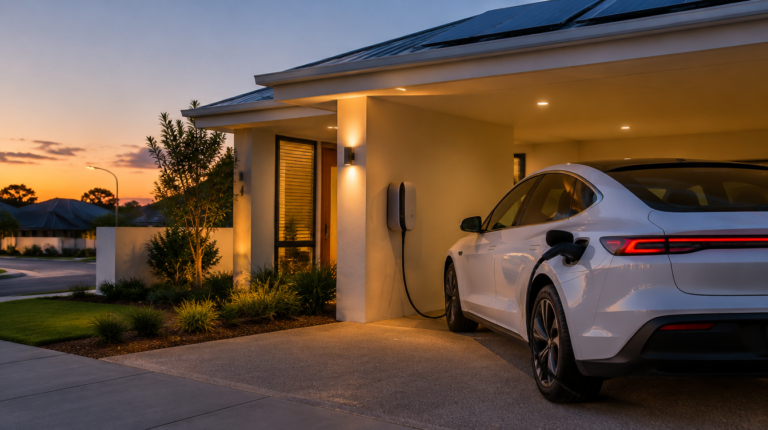
Only a licensed electrician can install a wall-mounted EV charger in WA. WA law requires all electrical work to be done by a licensed person, and the work must be carried out for a licensed electrical contractor. A wall charger is fixed wiring. It needs its own circuit from the switchboard, its own protection, and a check that your home’s total load stays within its supply.
Western Power’s rules for EV charging connections add two points your electrician must handle:
- Your main switch must be a circuit breaker. Western Power requires the main switch to be upgraded to a circuit breaker for EV charging connections. Older homes may need this changed.
- Your total load must fit your connection. A standard metro connection is 63 A on single-phase or 32 A per phase on three-phase. The charger cannot push your home past that limit.
You can check any electrician’s or contractor’s licence on the Building and Energy licence search before you sign anything.
Worth knowing: A portable charger that plugs into an existing powerpoint is not an installation. But if it will run for hours most nights, ask an electrician to check that circuit first.
Portable vs wall-mounted chargers
A wall-mounted charger is about three times faster than the portable cable that came with your car. For most households that is the difference between a full charge overnight and a partial one.
| Charger type | Typical power | Supply needed | Approx. range added per hour | Best suited to |
|---|---|---|---|---|
| Portable, 10 A powerpoint | About 2.3 kW | Any home | Roughly 10–15 km | Plug-in hybrids, short commutes |
| Portable, 15 A outlet | About 3.6 kW | Dedicated 15 A outlet | Roughly 15–25 km | Small EVs, moderate driving |
| Wall-mounted, single-phase | Up to about 7 kW (32 A) | Single or three-phase | Roughly 35–50 km | Most Perth homes |
| Wall-mounted, three-phase | Up to 22 kW (32 A per phase) | Three-phase only | Limited by the car | Two-EV homes, high daily distances |
Range figures are approximate. They vary with the car, the weather and how you drive.
The real limit on 22 kW
A 22 kW charger only delivers 22 kW if your car can accept it. On AC charging, the car’s onboard charger sets the ceiling. Many EVs sold in Australia accept 11 kW or less on AC, and some single-phase-only cars take around 7 kW no matter what charger you use. Plug an 11 kW car into a 22 kW charger and you charge at 11 kW.
A 22 kW charger also draws 32 A on every phase. That is the full limit of a standard three-phase connection, so it usually needs load management to share power with the rest of the house.
Single or three-phase: what your Perth home has
Most older Perth homes are single-phase. Many newer and larger homes are three-phase. Either can run a 7 kW charger: Western Power permits a 7 kW single-phase charger on single or three-phase sites.
To check, open your switchboard and look at the main switch. A single main switch usually means single-phase. A main switch three poles wide, or three linked switches, usually means three-phase. Your electrician will confirm it at the quote visit.
- Single-phase home: a 7 kW wall charger is the practical maximum, and for most drivers it is plenty.
- Three-phase home: you can choose a three-phase charger (11 kW or 22 kW), but only pay for the speed your car can use. Three-phase sites also need the load balanced across phases.
- Upgrading to three-phase: possible, but it means an application to Western Power for an upgraded connection, with extra cost and waiting time. It is rarely worth it for charging alone.
What affects EV charger installation cost
The charger is only part of the price. The rest depends on your switchboard and how far the cable has to travel. Two homes buying the same charger can get very different quotes. These are the factors that move the number:
- Distance from the switchboard. A charger on the garage wall behind the board is a short job. A carport on the other side of the house needs a long cable run, and a long run may need thicker cable to limit voltage drop.
- Switchboard capacity and condition. The board needs space for a new circuit breaker and RCD protection. Old boards with ceramic fuses, or a main switch that is not a circuit breaker, may need an upgrade first.
- Phase. Three-phase chargers need larger multi-core cable and three-pole protection, which costs more than a single-phase circuit.
- Load management. If your home is already near its supply limit, a charger with load management (it slows charging when the oven and air conditioner are running) can avoid a supply upgrade. A separate current sensor may be needed.
- The cable route. Running through a roof space is simpler than chasing brick walls. A detached garage may need trenching.
- Supply upgrade. If your connection cannot carry the extra load, an upgrade through Western Power adds cost and time.
Your quote depends on the factors above, which is why an electrician needs to see your switchboard and parking spot first. Talk Energy gives you a written quote after a free site assessment.
Important: As of October 2026 there is no WA government rebate for household EV chargers. The state’s Charge Up grants were for businesses, not-for-profits and local governments, and Round 3 has closed. The $3,500 zero-emission vehicle rebate was for buying a car, not a charger, and it closed in May 2025. Source: WA Government EV policies, rebates and grant programs.
Charging from your solar and battery
Your own solar is usually the lowest-cost energy for your car, if the car is home while the sun is up. Solar you export to the grid under Synergy’s buyback scheme earns little. Solar you put into your own car saves you buying that energy back later.
A solar-aware charger watches what your panels are exporting and charges the car from the surplus. When a cloud passes, it slows down or pauses. It suits people who work from home, have a second car that stays parked, or charge on weekends.
There is a catch. Most EVs need a minimum charging current, roughly 1.4 kW on single-phase or around 4.1 kW on three-phase. If your surplus is below that, solar-only charging stops. A larger solar system, or a single-phase charger on a three-phase home, makes solar charging easier.
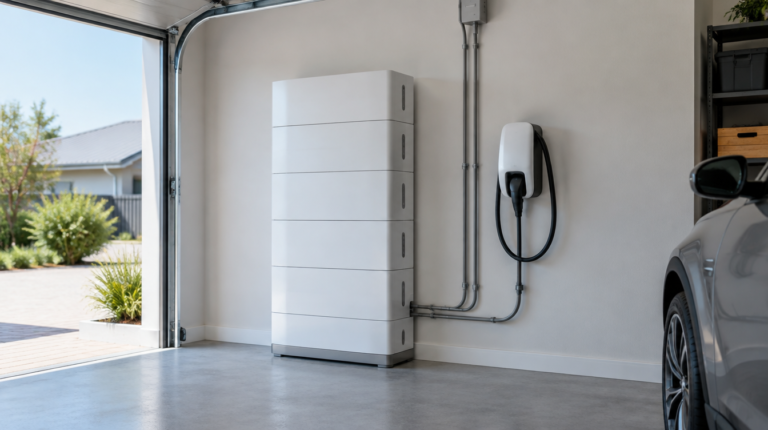
What about a home battery? A battery stores midday solar for the evening, but an EV can drain it fast. Many households charge the car from solar during the day, keep the battery for the house at night, and use cheaper off-peak grid power for the car when needed. Our solar battery page covers sizing, and our EV, solar and battery guide shows how the three fit together.
Quick tip: If an EV is in your plans within a few years, mention it when you get a solar or battery quote. It changes how the system should be sized, even if the charger comes later.
The Synergy EV plan
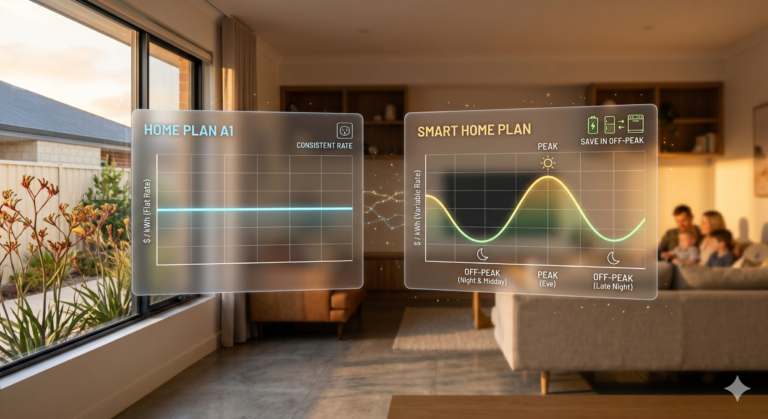
Synergy offers an EV-specific option for households that charge at home. It uses time-of-use pricing, so when you charge matters as much as how much. A charger with scheduling lets you lock charging into the cheapest window automatically.
From 1 July 2026, Synergy’s EV Add On charges 19.92c/kWh overnight (11pm–6am), 8.85c/kWh in the middle of the day (9am–3pm), 55.33c/kWh in the evening peak (3pm–9pm) and 24.34c/kWh at other times, plus a daily supply charge of 132.78c (all GST inclusive). It is open to households with a WA-registered plug-in EV and an advanced meter. Check current rates and eligibility on Synergy’s EV Add On page. For a worked cost comparison with Home Plan A1, read our Synergy EV Add On plan guide.
What happens on install day
Most single-phase installs are done in a single visit, often within half a day. Switchboard work, long cable runs or trenching add time. Here is the usual order:
- Confirm the location. The electrician checks where the car parks and which side the charge port is on, so the cable reaches without crossing a walkway.
- Power off. Your power is switched off for part of the visit while the switchboard work is done.
- Mount and wire. The charger goes on the wall, the cable is run back to the board, and a dedicated circuit with its own protection is installed.
- Test. The circuit and charger are tested before the car is plugged in.
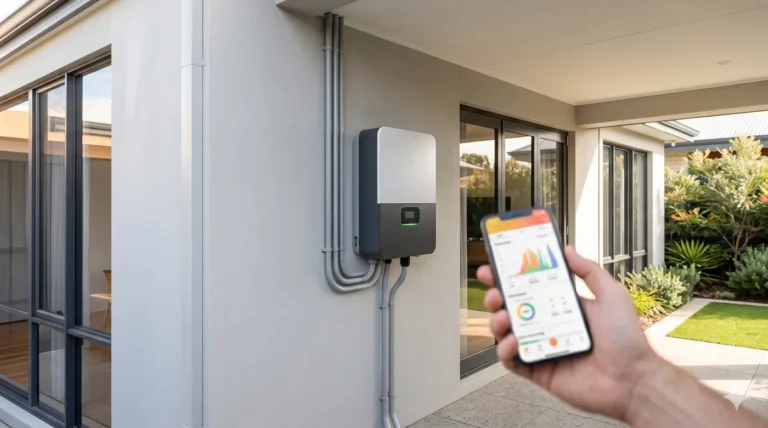
- Set up. The charger is connected to its app, with charging schedules and solar settings configured if your charger supports them.
- Paperwork. The contractor completes the required WA compliance paperwork, including your Electrical Safety Certificate.
Getting a home EV charger installed with Talk Energy
Talk Energy installs home EV chargers across Perth using in-house SAA-accredited electricians, never subcontractors, under WA electrical contractor licence EC15564. The same team designs and installs our solar and battery systems, so a charger can be planned in with new solar or a battery in one visit to your switchboard.
Every installation is backed by our 20-year workmanship warranty and 48-hour fix-or-replace guarantee. We have been doing this for 7+ years and have completed 5,000+ installations.
Get a free quote: request your free quote online, call (08) 6255 5914, or contact our team with a photo of your switchboard and where you park.
Frequently asked questions
Do I need a switchboard upgrade for an EV charger?
Not always. Western Power requires your main switch to be a circuit breaker for EV charging connections, so homes with an older main switch may need that changed. The board also needs space for a new circuit breaker and RCD protection. Older boards with ceramic fuses or no spare space usually need an upgrade first. A charger with load management can sometimes avoid a larger supply upgrade. Your electrician should check this at the quote visit, before you commit.
7 kW or 22 kW: which EV charger do I need?
Most Perth homes need a 7 kW charger. It works on single-phase power and adds roughly 35–50 km of range per hour, enough to refill most EVs overnight. A 22 kW charger needs three-phase power, and it only charges at 22 kW if your car’s onboard charger accepts that much, which few do. Many EVs accept 11 kW or less on AC. Check your car’s AC charging limit before paying for extra speed.
Can my EV charger run on solar only?
Yes, if your charger has a solar-surplus mode and the car is home while the sun is up. The charger uses only the solar you would otherwise export and slows or pauses when output drops. Most EVs need a minimum of roughly 1.4 kW on single-phase to keep charging, so small systems or cloudy days may stop solar-only charging. Most people set a fallback so the car tops up from the grid at off-peak times if solar falls short.
How long does EV charger installation take?
Most single-phase installs are done in a single visit, often within half a day. Your power is switched off for part of that time. A switchboard upgrade, a long cable run, trenching to a detached garage or a three-phase charger can add time. If your home needs a supply upgrade from Western Power, allow extra weeks for that approval before the install.
Can you install an EV charger I bought myself?
Ask us, because it depends on the charger. We need to check that the model suits Australian conditions, your switchboard and your supply before we agree to install it. Send us the make and model when you request a quote and we will confirm whether we can install it.