What Size Battery Do I Need for My Perth Home? 2026 kWh Sizing Calculator and Guide
TL;DR: Most Perth homes need a home battery between 10 and 15 kWh usable capacity in 2026. The right size depends on three numbers: your evening-and-overnight energy use (typically 40–60% of daily total), how much solar surplus you produce in winter (your worst month), and whether you want tariff arbitrage, blackout backup, or both. A 6.6 kW solar system + 13.5 kWh battery suits a typical 3–4 bedroom Perth home.
The 3-step Perth battery sizing method
Step 1: Find your average daily kWh use
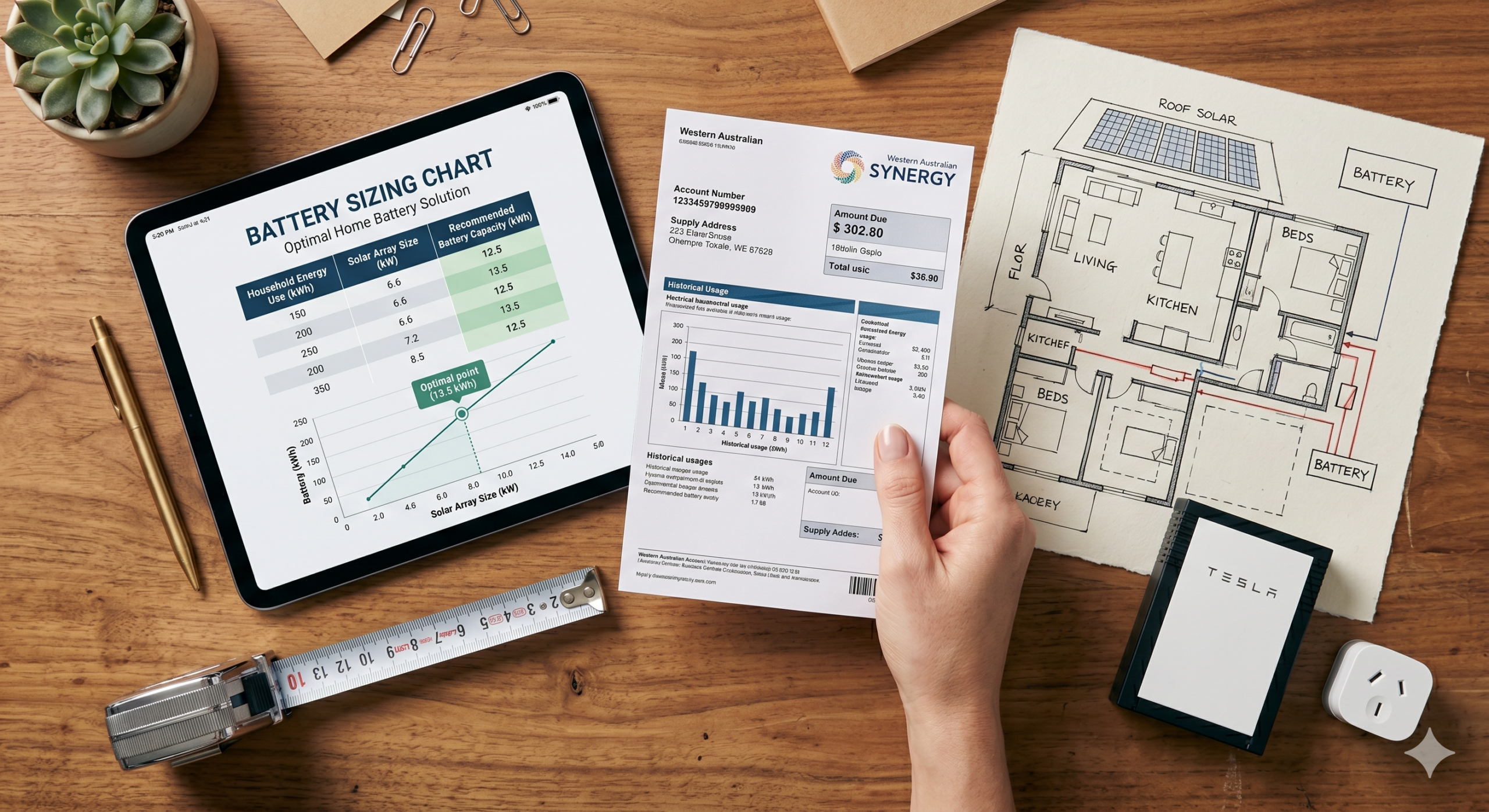
Open a recent Synergy bill. Look for “Average daily usage” — it’ll show a number like 22 kWh/day. If your bill is quarterly, divide total kWh by 90 days. Typical Perth households fall in these bands:
- 1–2 bedroom apartment/villa: 8–14 kWh/day
- 3 bedroom single-storey: 15–22 kWh/day
- 4 bedroom with pool or AC: 22–35 kWh/day
- 5+ bedroom large home, pool, multiple AC zones: 35–55 kWh/day
- Home with EV charging: add 8–15 kWh/day per EV
Step 2: Estimate evening/overnight share
The battery only needs to cover the energy your home uses when solar is not generating — roughly sunset to sunrise. For most Perth households this is 50–60% of daily use. Work-from-home families with daytime AC will be lower (40–45%) because more of their consumption happens while solar is producing. Households with everyone out during the day are higher (60–70%).
Multiply your daily kWh by your evening share. For a 22 kWh/day home with 55% evening use: 22 × 0.55 = 12.1 kWh evening/overnight consumption.
Step 3: Match usable kWh to that evening number
Pick a battery whose usable capacity matches or slightly exceeds your evening kWh. Don’t oversize beyond 1.3x — extra capacity past that point rarely pays back in Perth’s electricity market.
Recommended Perth battery sizes by household
| Household type | Daily use | Recommended battery |
|---|---|---|
| 1–2 bed apartment / unit | 10 kWh | 5–7 kWh (Sungrow SBR064 single module) |
| 2–3 bed villa, no pool | 15 kWh | 9–10 kWh (Sungrow SBR096, Powerwall 3 with light load) |
| 3 bed single-storey, 1 AC | 18–22 kWh | 10–13.5 kWh (Powerwall 3, SBR128) |
| 4 bed family home, ducted AC | 22–30 kWh | 13.5–18 kWh (Powerwall 3, BYD HVM 16.5) |
| 4–5 bed with pool, multiple AC | 30–40 kWh | 20–25 kWh (BYD HVM 22 or dual Powerwall) |
| Large home + EV + workshop | 40–55 kWh | 25–30 kWh (dual Powerwall 3 or stacked BYD HVM) |
Sizing for tariff arbitrage on Synergy Smart Home Plan
If you’re on Synergy’s Smart Home Plan, the battery can charge during off-peak periods (9pm–7am, cheap) and discharge during peak (3pm–9pm, expensive). To benefit from this in Perth in 2026, the battery needs enough capacity to cover the full peak window. That’s typically 4–6 kWh on top of your evening-overnight number.
So a 22 kWh/day household with 12 kWh evening use + 4 kWh peak-shift target = 16 kWh usable capacity for tariff-optimised sizing. This is why most Perth tariff-optimised homes land on a Powerwall 3 (13.5 kWh) or BYD HVM 16.5.
Sizing for solar self-consumption maximisation
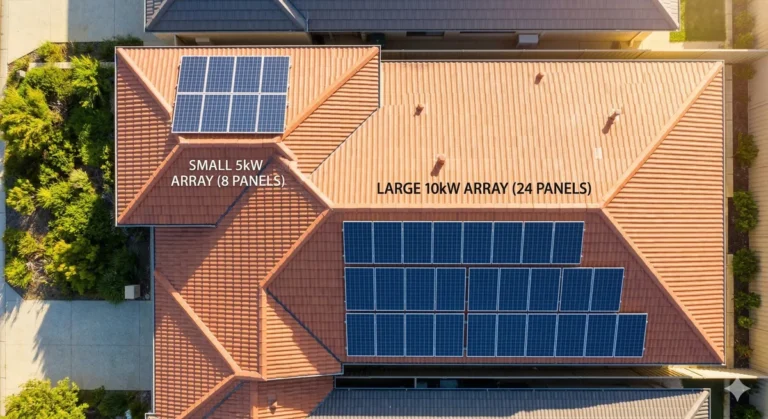
If your goal is to use 80%+ of your solar generation yourself (rather than exporting at low feed-in tariffs), size the battery to soak up your average daily solar surplus. In Perth, a 6.6 kW solar system on a typical 3-bed home produces ~28 kWh/day in summer and ~14 kWh/day in winter. With ~10 kWh used during daylight, evening surplus is 18 kWh summer / 4 kWh winter. A 13.5 kWh battery captures most of the summer surplus and all of the winter surplus.
When bigger is wrong
Oversizing past 1.3x your evening use creates two problems in Perth’s energy market:
- Stranded capacity: A battery that never fully cycles wastes the cost-per-kWh of the extra capacity. A 20 kWh battery in a home with 12 kWh evening use cycles to 60% — you paid for 8 kWh that rarely earns its keep.
- Solar mismatch: If your 6.6 kW solar system can’t refill the battery during a Perth winter day, it sits partly empty, defeating the purpose.
The exceptions: planning for an EV in the next 2 years, planning for a home extension, or living in a regional area where blackouts are common.
When smaller is wrong
Under-sizing is the more common Perth mistake. The temptation is to start with a 5 or 7 kWh battery to keep cost down. The trap is that these batteries cycle to 100% every evening and provide almost no blackout backup, no tariff arbitrage, and only marginal self-consumption uplift. The Federal Cheaper Home Batteries Program rebate scales with battery size, so the cost-per-kWh of a properly-sized 10–13.5 kWh battery is often lower than a small one once rebates are applied.
Sizing the inverter alongside the battery
Your battery is only as powerful as the inverter feeding it. A 13.5 kWh battery on a 5 kW hybrid inverter can only discharge at 5 kW maximum — useless for backing up ducted AC. The Tesla Powerwall 3 sidesteps this with an integrated 11.5 kW inverter. For Sungrow and BYD setups, pair with a 10 kW SH-HV or SMA Tripower hybrid inverter for full benefit. Talk Energy’s standard quotes always include inverter capacity alongside the battery to avoid this trap.
Frequently asked questions
What size battery do I need for a 3-bedroom Perth home?
A typical 3-bedroom Perth home using 18–22 kWh/day suits a 10–13.5 kWh usable battery — the Tesla Powerwall 3 (13.5 kWh) and Sungrow SBR128 are the most common picks at this size.
Is a 10 kWh battery enough for Perth?
For a 1–2 bedroom unit or a small home with ~12 kWh daily use, yes. For a 3+ bedroom family home with AC, 10 kWh is below the sweet spot and you’ll see the battery drain to empty most evenings, losing tariff arbitrage opportunity.
Can I add more battery capacity later?
Yes with modular systems. Sungrow SBR and BYD HVM are both designed for adding modules later. Tesla Powerwall 3 supports adding one expansion battery (without inverter) per master unit. Plan for expansion at the original install — the cabling and inverter sizing should accommodate the future module.
Should I size the battery for my future EV?
If you’re getting an EV within 2 years, yes — add roughly 5–8 kWh of battery for night-time EV charging from stored solar, or plan for daytime smart charging from live solar generation. Talk Energy’s EV+solar designs typically combine 13.5 kWh battery with a Wallbox or Tesla Wall Connector for optimal cost.
Does battery sizing change in winter?
Yes. Perth solar generation drops ~50% in June–July compared with summer. A correctly sized battery for summer can sit at 30–50% charge through winter evenings. This is normal and expected — the right size is the one that fully cycles through October–April when solar is strongest.
Want a sizing recommendation based on your actual Synergy usage and roof? Talk Energy reviews 12 months of your bills and your roof orientation to size the battery exactly right — no oversell. Get a sizing quote or call (08) 6255 5914.