Battery Backup During Perth Blackouts: How Long Will Your Home Battery Actually Run Your House?
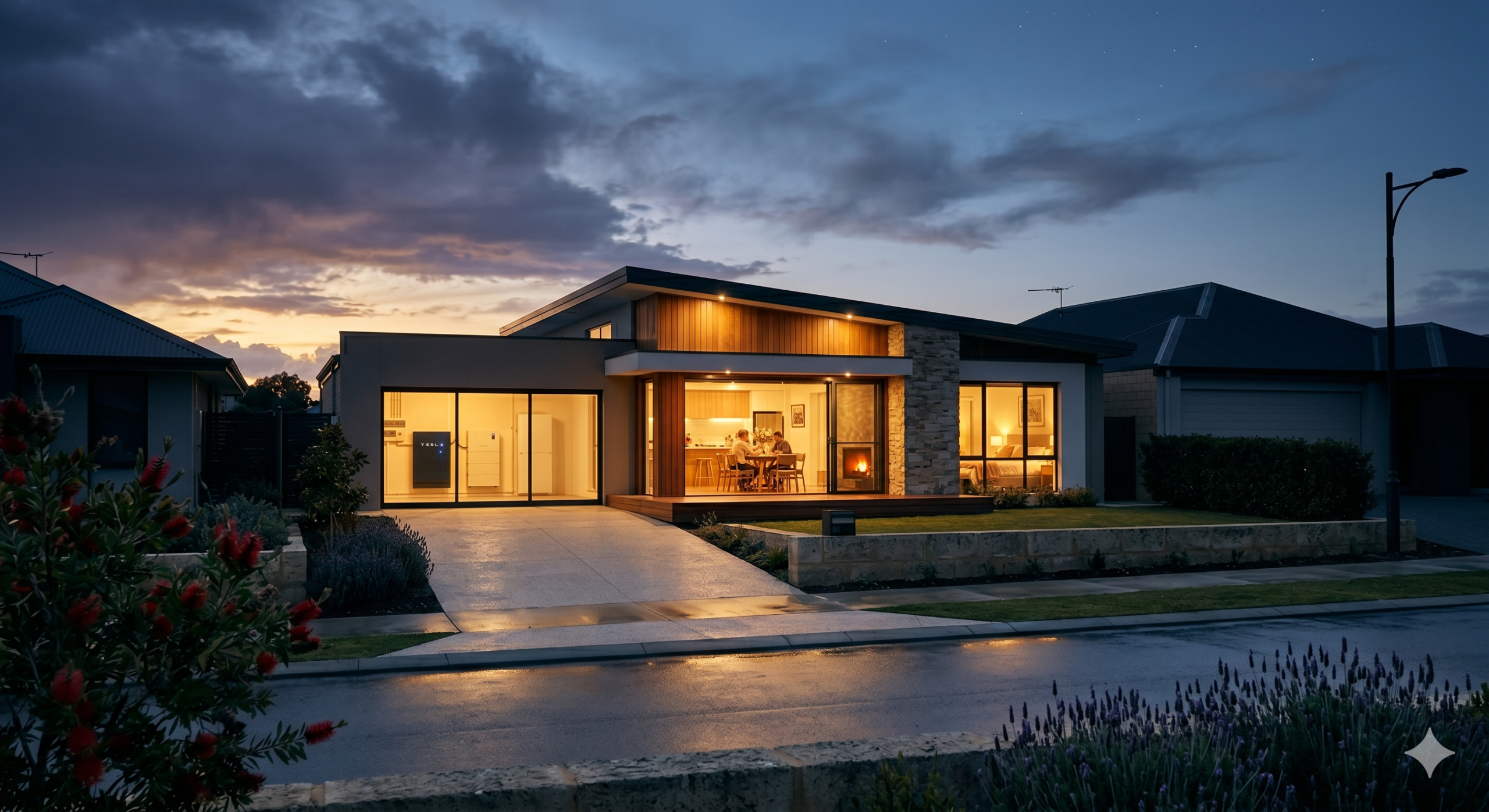
TL;DR: A typical 13.5 kWh home battery like the Tesla Powerwall 3 will run an average Perth home for 8 to 12 hours during a blackout with normal evening loads (fridge, lights, TV, internet, fans). Add a 5 kW reverse-cycle air-conditioner and that drops to 3 to 4 hours. The two numbers that determine your real backup time are usable kWh capacity and the battery’s continuous power output in kW — and most Perth homeowners underestimate the second one.
The two numbers that matter
Battery runtime is not a single number on a spec sheet. It is the result of two distinct capabilities working together:
- Usable energy capacity (kWh) — how much electricity is stored. Sets the total “tank size”.
- Continuous power output (kW) — how fast that energy can be delivered. Sets which appliances can run simultaneously.
Imagine a 13.5 kWh battery with 5 kW continuous output. If you draw 1 kW (fridge + lights + a few small loads), it lasts 13.5 hours mathematically. If you draw 5 kW (full house including AC), it lasts 2.7 hours. If you try to draw 6 kW, the inverter trips and your backup fails. This is why Perth homes with pools, ducted AC, or induction cooktops often need a battery with 8+ kW continuous output to be useful during outages.
Typical Perth home loads (what each appliance actually draws)
| Appliance | Running watts | Notes |
|---|---|---|
| Fridge / freezer combo | 150 W avg (700 W peak on compressor start) | Cycles on/off — averages 3.6 kWh/day |
| LED lights (whole house) | 80–150 W | 1.5 kWh/day if used heavily |
| TV + internet + Wi-Fi | 120 W | 0.6 kWh for a 5-hour evening |
| Reverse-cycle 7 kW split (cooling) | 1,800–2,400 W | Cycles down once room is cold |
| Ducted reverse-cycle (14 kW) | 3,500–4,800 W | Largest single load in most Perth homes |
| Pool pump (variable-speed) | 250–1,200 W | Skip during blackout |
| Induction cooktop (one zone) | 1,500–2,400 W | Brief but high |
| Electric oven | 2,000–3,500 W | Avoid during backup |
| Washing machine (hot wash) | 2,200 W | Defer until grid returns |
| EV charger (single-phase 7 kW) | 7,000 W | Cannot run on battery backup |
Real-world Perth backup durations by battery
Scenario 1: Essentials only (fridge, lights, internet, fans)
Average draw: ~0.5 kW. A 13.5 kWh Powerwall 3 lasts roughly 24+ hours. A 9.6 kWh Sungrow SBR lasts ~18 hours. A 10 kWh battery lasts ~20 hours. For most Perth grid outages (which last 1–6 hours in 2026), any battery in this list comfortably bridges the gap.
Scenario 2: Comfortable evening (essentials + one split AC + entertainment)
Average draw: ~2.2 kW. A 13.5 kWh Powerwall 3 lasts roughly 6 hours. A 9.6 kWh battery lasts ~4 hours. This is the most common real-world scenario in a Perth summer blackout.
Scenario 3: Full house running (ducted AC, cooking, full lights, pool pump)
Average draw: ~6 kW. Most single-battery setups can’t sustain this load at all — the inverter will trip. A Powerwall 3 (11.5 kW continuous) can technically handle it for ~2.3 hours. A stacked dual-Powerwall or large BYD HVM is needed for genuine “run the whole house” backup capability.
Scenario 4: Multi-day blackout with solar topping up
This is where Perth’s climate becomes the deciding advantage. A 6.6 kW solar system in Perth produces 25–30 kWh on a clear summer day. If your battery is correctly wired into an islanding-capable backup configuration, the solar continues to charge the battery during daylight even when the grid is down. With modest evening loads (~5 kWh used overnight), a 13.5 kWh battery + 6.6 kW solar can run a Perth home indefinitely through a multi-day outage. Most Perth installs don’t enable solar-during-blackout by default — it has to be specified at install. Talk Energy enables it on every install where the inverter supports it.
What can and can’t run on battery backup in Perth
Will run on a single home battery: fridge, freezer, lights, TV, internet/Wi-Fi, fans, computers, microwave (briefly), one small split AC, gas hot water systems with electric ignition, NBN, garage door, security system.
Will not run on a single home battery (too much power draw): EV chargers (7+ kW), ducted reverse-cycle AC (3.5+ kW), electric instantaneous hot water (24+ kW), multi-zone induction cooking, electric pool heating, large workshop equipment.
Should you back up the whole home, or just essentials?
Talk Energy electricians typically install one of two configurations in Perth:
- Whole-home backup (most common with Powerwall 3): the entire main switchboard is backed up. You retain normal use during outages until the battery is depleted. Best for homes where convenience matters more than maximising runtime.
- Essentials sub-circuit backup: a separate small sub-board with selected circuits (fridge, lights, internet, one AC, kitchen). Everything else stays off the battery. Doubles or triples your effective runtime by preventing accidental high-draw appliances.
For Perth homes in areas with longer outages (parts of the hills, regional WA, storm-prone northern suburbs), the essentials sub-circuit option is usually the smarter choice.
How often do Perth homes actually lose power?
According to Western Power’s reliability reports, the average Perth metro home experiences roughly 1.4 outages per year, totalling around 110 minutes. Storm season (November–March) drives most of them. Hills and regional WA see substantially higher numbers — the South West Interconnected System (SWIS) fringe areas can average 3–6 hours of outage per year. A correctly-sized battery covers all of these comfortably.
Frequently asked questions
How long does a 13.5 kWh battery last during a blackout?
A 13.5 kWh battery runs essentials only (fridge, lights, internet) for around 24 hours. With normal evening loads including one split AC and entertainment, expect 6–8 hours. With heavy ducted AC and cooking, 2–3 hours.
Can my air-conditioner run on battery backup?
A single split system (5–7 kW reverse-cycle) can run on most modern home batteries. Ducted reverse-cycle systems with 3.5+ kW running draw require a battery with 8+ kW continuous output, such as a Tesla Powerwall 3 or stacked BYD HVM.
Does solar still work during a blackout in Perth?
Only if your system is configured for islanding/off-grid operation, which requires a hybrid inverter and a battery that supports backup mode. Standard grid-tied solar without a battery automatically shuts down during outages. Talk Energy enables solar-during-blackout on every install where the hardware supports it.
How big a battery do I need for whole-home backup in Perth?
For most Perth homes wanting overnight whole-home backup including AC, 13.5–20 kWh of usable capacity and at least 7 kW of continuous output is the right range. Larger homes with pools, multiple AC zones, or future EVs typically need 20–25 kWh.
Will my battery switch on automatically during a blackout?
Yes. All modern home batteries installed with backup capability switch over in under 1 second when the grid drops. The Tesla Powerwall 3 transitions in ~50 milliseconds — fast enough that most appliances and computers don’t notice the changeover.
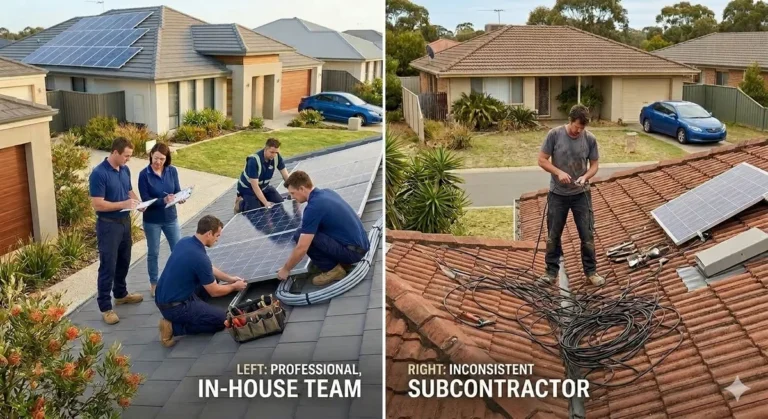
Need a battery sized correctly for your Perth home and your blackout-tolerance preferences? Talk Energy’s in-house electricians design backup configurations matched to your switchboard, your appliances, and your suburb’s outage history. Get a free assessment or call (08) 6255 5914.