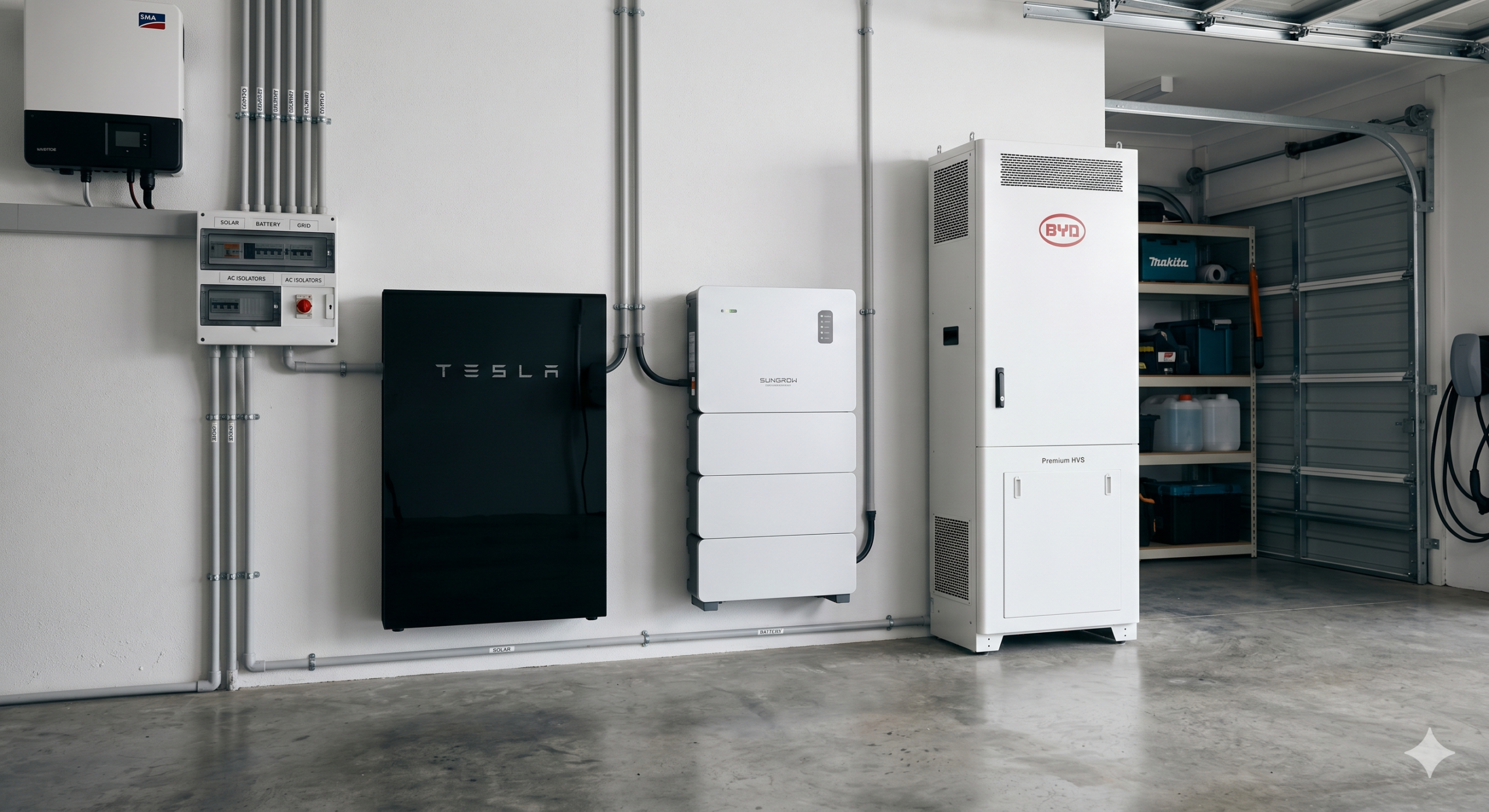
Tesla Powerwall 3 vs Sungrow SBR vs BYD Battery-Box Premium HVM: Which Is Best for Perth Homes in 2026?
TL;DR: For most Perth homes in 2026, the Tesla Powerwall 3 is the best all-rounder thanks to its 11.5 kW continuous backup power, integrated solar inverter, and 13.5 kWh usable capacity. The Sungrow SBR096 wins on modular sizing and value if you already have a Sungrow inverter, and the BYD Battery-Box Premium HVM wins on scalability and high-voltage efficiency for larger or three-phase Perth homes. All three are Cheaper Home Batteries Program and WA Residential Battery Scheme eligible when installed by an approved retailer like Talk Energy.
Why these three batteries dominate the Perth market
Walk into any quote conversation in Perth in 2026 and three battery names come up first: Tesla Powerwall 3, Sungrow SBR, and BYD Battery-Box Premium HVM. They are not the cheapest options on the market, but they are the three batteries that satisfy almost every Perth homeowner’s checklist — adequate capacity for typical 18–28 kWh daily consumption, enough continuous power to run an air-conditioner and pool pump simultaneously during a blackout, reliable warranty terms, full eligibility for both the Federal Cheaper Home Batteries Program and the WA Residential Battery Scheme, and software ecosystems that handle the time-of-use tariff arbitrage that Synergy’s Smart Home Plan unlocks.
That third point is increasingly important. Perth’s grid is shifting toward heavy variable feed-in tariffs and time-of-use plans where battery charge-and-discharge scheduling makes a meaningful difference to annual savings. Older or budget batteries that lack automated tariff optimisation are quietly costing their owners hundreds of dollars a year in 2026.
Head-to-head specifications (2026 models)
| Specification | Tesla Powerwall 3 | Sungrow SBR096 | BYD Battery-Box Premium HVM |
|---|---|---|---|
| Usable capacity | 13.5 kWh | 9.6 kWh (modular 9.6–25.6) | 11.04 kWh (modular 11–22.08) |
| Continuous power output | 11.5 kW | 5.75 kW (single SBR096) | 8 kW (with SMA/Sungrow HV inverter) |
| Peak power (10 sec) | 30 kW | 8 kW | 12 kW |
| Chemistry | LFP (lithium iron phosphate) | LFP | LFP |
| Integrated inverter | Yes (hybrid, 11.5 kW) | No (needs Sungrow hybrid) | No (needs HV-compatible hybrid) |
| Backup capability | Whole-home, automatic | Whole-home with backup box | Whole-home with backup-ready inverter |
| Warranty | 10 years / 70% retention | 10 years / 60% retention | 10 years / 60% retention |
| Round-trip efficiency | 89% (system) | 95% (battery only) | 96% (battery only) |
| Indoor / outdoor rating | IP67 (both) | IP65 (outdoor sheltered) | IP55 (indoor preferred) |
| App / monitoring | Tesla app (best-in-class) | iSolarCloud | BYD Be Connect Plus |
How each battery suits a typical Perth home
Tesla Powerwall 3 — best for most homes
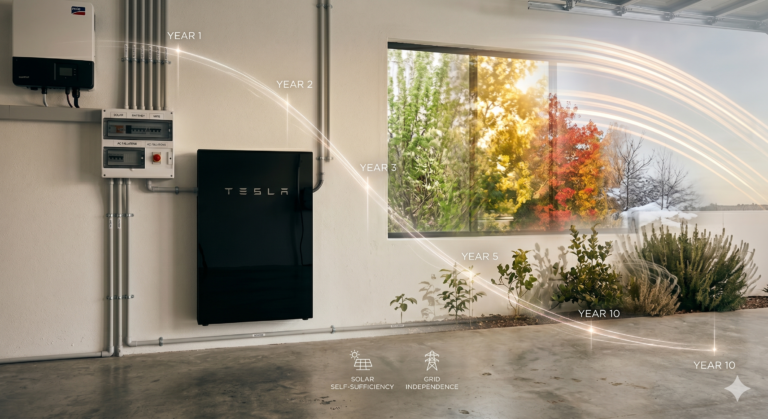
If you are a typical Perth household with reverse-cycle air-conditioning, a pool pump, and one or two EV chargers on the horizon, the Powerwall 3 is the path of least resistance. The integrated 11.5 kW solar inverter means you replace your old string inverter, simplify the install, and gain whole-home backup as part of the package. During a blackout it will hold up an entire single-storey Perth home — including a 5 kW split system — for 8–10 hours of normal evening use, or 4–6 hours with heavy AC running. Tesla’s software is the most polished of the three, with proper Smart Home Plan tariff scheduling out of the box.
The catch: only one Powerwall 3 expansion battery (without inverter) can be added to a single Powerwall 3 unit before you need a second master unit. For larger Perth homes wanting 25+ kWh of storage, stacking BYD or Sungrow modules is more cost-effective.
Sungrow SBR096 — best value if you have a Sungrow inverter
Sungrow is the most common solar inverter on Perth roofs installed in the last three years. If you already have a Sungrow SH-RT hybrid inverter, the SBR is a near-plug-and-play upgrade — no inverter replacement, no rewiring of strings, just a battery cabinet on the wall and a software update. The modular design lets you start at 9.6 kWh and stack up to four modules for 25.6 kWh total without throwing away components.
The continuous power output of 5.75 kW per SBR096 is the weakest in this comparison. For a typical Perth home that wants to run AC, oven, and a pool pump simultaneously during backup, you’ll either need two stacked SBR units or you’ll be load-shedding manually during outages.
BYD Battery-Box Premium HVM — best for large or three-phase Perth homes
The HVM is the high-voltage variant of BYD’s flagship and is paired with SMA Sunny Boy Storage or Sungrow SH-HV inverters for three-phase homes. It is the most modular battery of the three (11 kWh up to 22 kWh in a single tower, with multiple towers possible) and has the highest battery-level round-trip efficiency. It’s the choice for large double-storey Perth homes, regional WA properties on three-phase, and homes planning a future EV charger or workshop.
The trade-off is install complexity. The HVM is not a one-box solution — it needs a compatible hybrid inverter, a backup contactor, and careful commissioning. This is where installer quality matters more than the battery brand itself.
Real-world Perth scenarios
3-bedroom single-storey home in Joondalup, 22 kWh daily use
Tesla Powerwall 3 covers this household completely. 13.5 kWh handles a typical evening (5pm–10pm AC, cooking, lights) and the surplus charges from solar the next day. Sungrow SBR096 alone would leave the household at ~50% charge by morning during summer peak load and is borderline.
4-bedroom double-storey in Canning Vale with pool, AC and 2 EVs incoming
This is BYD HVM territory. You’ll want 22 kWh storage to cover heavy evening AC, a single EV charging cycle, and morning pre-cooling. The three-phase install also supports a future 11 kW EV charger.
2-bedroom villa in Mandurah, existing Sungrow inverter
Sungrow SBR096 at 9.6 kWh, no inverter swap, and a clean install. This is the cheapest path to backup and tariff arbitrage for this household.
Cost in Perth after rebates (2026)
Installed pricing varies by retailer, but as a 2026 reference range from Talk Energy quotes:
- Tesla Powerwall 3 (13.5 kWh): $13,500–$15,200 installed, then minus ~$3,500 Federal rebate and up to $1,300 WA Battery Scheme rebate = $8,700–$10,400 out-of-pocket.
- Sungrow SBR096 (9.6 kWh): $9,800–$11,400 installed, then minus ~$2,500 Federal rebate and up to $1,300 WA rebate = $6,000–$7,600 out-of-pocket.
- BYD Battery-Box Premium HVM (11 kWh): $11,500–$13,200 installed, then minus ~$2,900 Federal rebate and up to $1,300 WA rebate = $7,300–$9,000 out-of-pocket.
For full eligibility detail, read the WA Battery Scheme guide and the application walkthrough.
What Talk Energy recommends in 2026
If you’re building a new solar-plus-battery system from scratch and want the simplest, most reliable install with the best whole-home backup, the Tesla Powerwall 3 is our default recommendation. If you have an existing Sungrow inverter installed in the last 3 years, the SBR is the value play. If your home is large, three-phase, or you want serious future-proof scalability for EVs and workshops, the BYD HVM wins. All three are covered by Talk Energy’s 48-hour fix or replace guarantee and serviced by our in-house electricians.
Frequently asked questions
Which battery is best for Perth blackouts?
The Tesla Powerwall 3 delivers the highest continuous backup power (11.5 kW) of the three, which means it can run an air-conditioner, fridge, and lights simultaneously without load-shedding. For prolonged Perth summer outages caused by storms or grid faults, it is the most capable single-unit option.
Can I add a Tesla Powerwall 3 to my existing Perth solar system?
Yes, but the Powerwall 3 includes its own hybrid solar inverter, so the cleanest install replaces your existing string inverter. Talk Energy handles the changeover in a single day and your existing solar panels and racking stay in place.
Is BYD or Tesla more reliable in Perth heat?
Both use LFP chemistry which handles high temperatures well, and both are rated for Australian conditions. The Tesla Powerwall 3 has a higher IP rating (IP67) and is approved for full outdoor wall mounting in direct Perth sun. The BYD HVM is rated IP55 and is best installed indoors or in a shaded garage in Perth.
Do all three batteries qualify for the WA Battery Scheme?
Yes. All three are on the WA Government’s approved battery list for 2026 and qualify for both the up-to-$1,300 WA rebate and the Federal Cheaper Home Batteries Program (~30% off installed cost) when installed by an approved retailer like Talk Energy.
What happens to my warranty if I change installers later?
The manufacturer warranty stays in place regardless of who installed it, but the workmanship warranty is tied to the original installer. Talk Energy’s 48-hour fix-or-replace guarantee applies to systems we installed and serviced.
Ready to compare which battery is right for your Perth home? Talk Energy is a CEC Approved Retailer with in-house electricians, certified for Tesla, Sungrow, and BYD installations. Get a free no-obligation quote or call (08) 9468 1212.