How Long Do Home Batteries Last in Perth? Lifespan, Degradation and Replacement Costs Explained
TL;DR: A modern lithium iron phosphate (LFP) home battery installed in Perth in 2026 — Tesla Powerwall 3, Sungrow SBR, BYD Battery-Box Premium, Enphase IQ5P — will retain 60–70% of its original capacity after 10 years and typically last 12 to 18 years in real use before replacement makes financial sense. Replacement costs in 2026 dollars sit around $9,500–$18,000 for a 10–16 kWh battery before rebates, based on industry estimates.
What “lifespan” actually means for a home battery
A home battery does not stop working on a single day. Instead, it gradually loses capacity over years — what manufacturers call capacity retention or state of health (SoH). A new Tesla Powerwall 3 stores 13.5 kWh. After 10 years of typical Perth use, it stores around 9.5–9.7 kWh. After 15 years, around 8 kWh. The battery still works — it just stores less.
“End of life” in practical terms is the point where retained capacity is too low to be useful. For most Perth households, this is when the battery can no longer cover the evening load. That tends to happen at 50–55% retention, which puts most LFP home batteries in the 14–18 year practical lifespan range.
The two things that wear down home batteries
1. Cycle aging (how many full charge-discharges)
Each time the battery charges and discharges fully, it experiences one “cycle.” LFP chemistry tolerates 6,000–10,000 cycles before reaching 60% capacity — far more than the NMC chemistry used in older home batteries (2,500–4,000 cycles). For a typical Perth home cycling the battery 1.0–1.3 times per day, that’s 15–25 years of cycle life before cycle aging becomes the limiting factor.
2. Calendar aging (just being there)
Lithium batteries degrade slowly even when sitting idle, due to electrolyte breakdown over time. Heat accelerates this — every 10°C rise roughly doubles calendar aging. This is why Perth installs need to consider where the battery sits. A west-facing garage wall hitting 50°C internally on a January afternoon ages a battery substantially faster than the same battery in a south-facing covered alfresco or indoor utility room.
Real-world degradation rates by battery (Perth conditions)
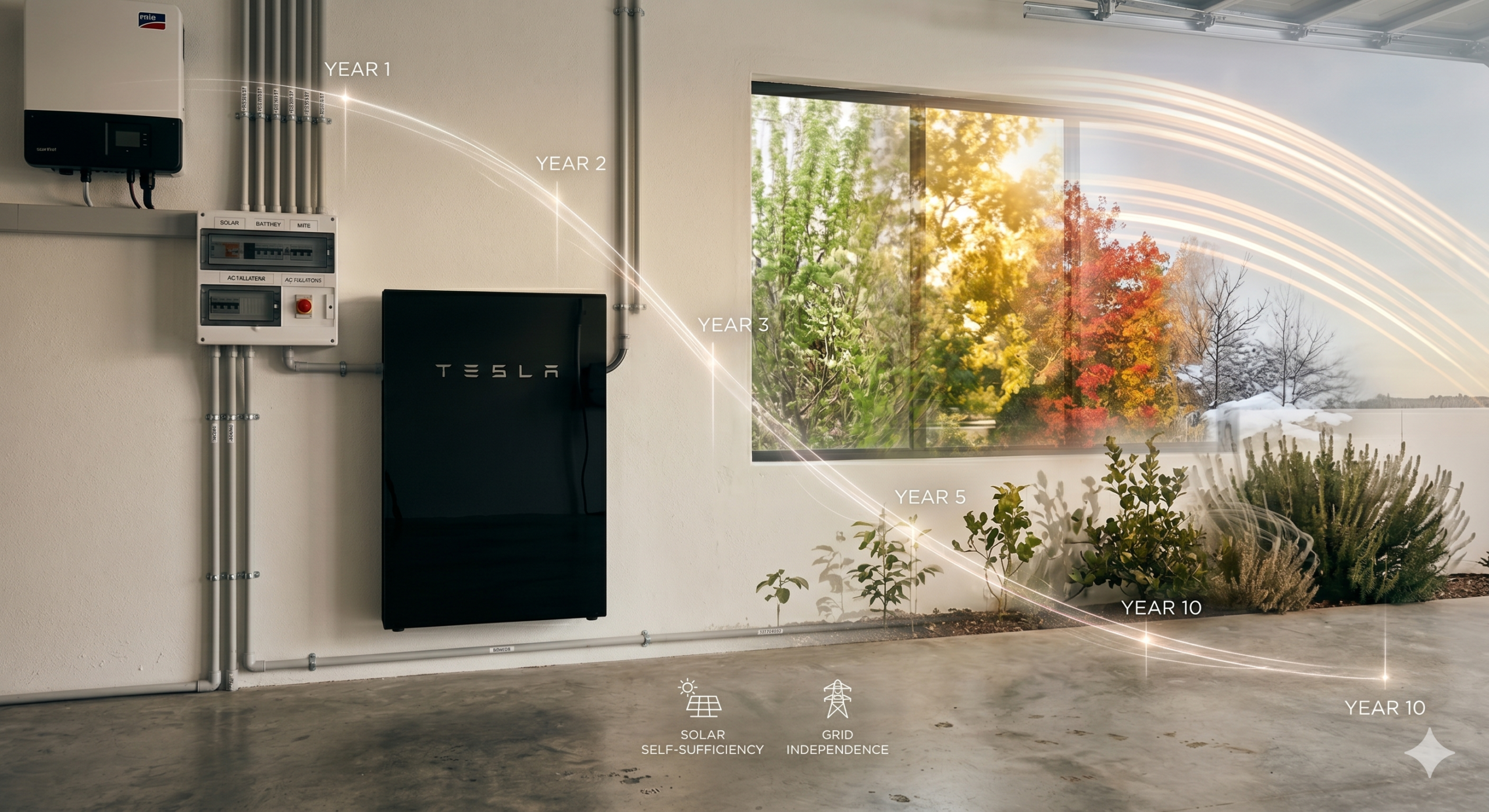
| Battery | Year 1 retention | Year 5 retention | Year 10 retention (warranted) | Practical lifespan |
|---|---|---|---|---|
| Tesla Powerwall 3 | ~98% | ~85% | 70% | 15–18 years |
| Sungrow SBR096/128 | ~97% | ~82% | 60% | 13–16 years |
| BYD Battery-Box Premium HVM | ~97% | ~82% | 60% | 13–16 years |
| Enphase IQ Battery 5P | ~97% | ~83% | 60% | 13–16 years |
Tesla’s 70% capacity warranty at year 10 is the best in this group and reflects Tesla’s preferential cell selection and active thermal management.
How Perth’s climate affects battery lifespan
Perth has hot, dry summers and mild winters — generally favourable for LFP batteries, which tolerate heat better than older lithium chemistries. The catch is install location. The three highest-impact Perth-specific factors:
- Direct afternoon sun: West and north-west exterior walls hit 55–65°C internal surface temperature in summer. Wall-mounted batteries on these aspects age 15–25% faster than the same battery on a south wall or indoors.
- Garage temperature: Uninsulated garages in Perth regularly reach 45–50°C in summer. Batteries here age 10–20% faster than those in air-conditioned indoor utility rooms.
- Salt exposure (coastal suburbs): Cottesloe, Fremantle, Mandurah and other coastal suburbs introduce salt corrosion risk on terminals if the battery is mounted outdoors without proper enclosure. Choose IP67-rated batteries (Tesla Powerwall 3) or install indoors.
How to make a Perth home battery last longer
- Install indoors or south-facing: 25%+ longer lifespan from cooler operating temperature.
- Avoid 100% daily depth-of-discharge: Use the battery’s “reserve” setting to keep 10–15% in the tank — extends cycle life ~20%.
- Don’t oversize: A correctly-sized battery cycles fully, but not deeply repeatedly. Oversized batteries spent partially charged actually degrade faster from calendar aging.
- Keep firmware updated: Manufacturers regularly improve cell-balancing algorithms via software updates. Tesla and Sungrow push these automatically; BYD requires installer intervention every 12–24 months.
- Get annual health checks: Talk Energy includes a free annual SoH check for batteries we installed — catches imbalance issues before they damage cells.
Replacement cost in Perth (2026 dollars)
Battery technology has roughly halved in cost over the last decade and is expected to halve again before most 2026 installs need replacement. As a planning estimate in today’s dollars:
- Tesla Powerwall 3 equivalent (13.5 kWh): roughly $13,000–$18,000 installed in 2026 dollars (industry estimate for a 13–16 kWh battery).
- Sungrow SBR096 equivalent (9.6 kWh): roughly $9,500–$13,000 installed (industry estimate for a ~10 kWh battery).
- BYD HVM equivalent (11 kWh): roughly $9,500–$13,000 installed (industry estimate for a ~10 kWh battery).
If we assume the cost halves over the 15-year practical lifespan (a conservative tech-improvement curve), replacement in real terms is closer to half of today’s estimate — and rebate schemes for replacement are likely to exist by then.
What the warranty actually covers
Most home battery warranties guarantee a minimum retained capacity at year 10 (60–70%) AND a minimum total energy throughput (typically 36–48 MWh for a 10–13.5 kWh battery). If your battery falls below either threshold during the warranty period, the manufacturer will repair or replace it. Talk Energy’s 48-hour fix-or-replace guarantee ensures someone is at your door within 48 hours to action any warranty claim.
When does replacement make financial sense?
Three signs your Perth battery is ready for replacement:
- Retained capacity below 55% (you’ll feel it in shorter evening runtime)
- Frequent inverter faults or BMS errors logged in the app
- Electricity bill creeping up despite same solar production (a sign the battery is no longer covering its share)
If two of these are present, the math usually favours replacement over repair — especially given expected cost drops and rebate continuity.
Frequently asked questions
How long does a Tesla Powerwall 3 last in Perth?
Tesla warrants the Powerwall 3 to retain at least 70% capacity after 10 years. In Perth conditions, practical lifespan is 15–18 years depending on install location and cycle depth.
Does Perth heat shorten home battery life?
Slightly. LFP batteries handle heat better than older lithium types, but install location matters. A battery mounted indoors or on a south-facing wall lasts up to 25% longer than the same battery on a west-facing exterior wall in direct afternoon sun.
What happens to a home battery at end of life?
LFP cells are 95%+ recyclable. The Australian Battery Recycling Initiative and manufacturer take-back schemes handle end-of-life batteries safely. Tesla and Sungrow both run their own recycling programs in Australia.
Can I replace just the battery cells and keep the inverter?
For modular systems like Sungrow SBR and BYD HVM, yes — individual modules can be replaced. The Tesla Powerwall 3 is a sealed unit, so full replacement is the norm.
Will my battery warranty transfer if I sell my Perth home?
Yes — manufacturer warranties for Tesla, Sungrow, BYD, and Enphase transfer to the new homeowner provided the system was installed by an approved retailer and properly registered. This is one reason CEC Approved Retailer status matters at install time.
Thinking about a long-term battery for your Perth home? Talk Energy designs installs around battery longevity — proper location, inverter sizing, and annual health checks included. Get a free quote or call 08 6255 5914.