Solar Financing in Perth: Can You Really Pay $0 Upfront in 2026?
Quick answer: Yes, some Perth households can get a home battery for $0 upfront in 2026. The WA Residential Battery Scheme offers an optional no-interest loan of $2,001 to $10,000 over 3 to 10 years for households earning under $210,000. Rebates are taken off the price at the point of sale, so the loan can cover what is left. For solar panels on their own there is no government loan, so $0 upfront means borrowing from a lender, usually with interest.
The upfront cost is the main reason Perth homeowners put off solar and batteries. That is fair. Even with rebates, a battery is a big purchase, and “$0 upfront” offers can be hard to read. Some are genuinely interest-free. Others hide the cost of finance in a higher system price or a long contract.
This guide explains every way to pay for solar and a battery in Perth, how the government no-interest loan works, what $0 upfront really looks like in dollars, and the warning signs in finance deals.
What are your solar financing options in Perth?
There are five main ways to pay. Here they are at a glance.
| Option | Upfront | Interest | You own it? | Suits |
|---|---|---|---|---|
| Cash | Full price | None | Yes | Households with savings available |
| WA Battery Scheme no-interest loan | Can be $0 if loan and rebates cover the price | 0% | Yes | Eligible households buying a battery |
| Personal or green loan | Usually $0 | Set by the lender | Yes | Solar-only systems, or households not eligible for the scheme loan |
| Interest-free plan or buy now, pay later | Usually $0 | 0% for a period; fees and higher rates may apply later | Yes | Small add-ons repaid within the promotional period |
| Lease or power purchase agreement (PPA) | $0 | Built into fees or per-kWh rate | No | Households that cannot or will not borrow |
How does the WA Battery Scheme no-interest loan work?
It is an optional, government-backed loan for buying and installing a home battery, run by Plenti on behalf of the WA Government. The terms published by the WA Government are:
| Term | Detail |
|---|---|
| Loan amount | $2,001 to $10,000 |
| Interest | None |
| Term | Minimum 3 years, maximum 10 years |
| Income limit | Combined household gross income under $210,000 |
| Administrator | Plenti; approved funds are paid to the accredited vendor |
| Security | No security or guarantee is taken |
| Cap | Loan plus rebate cannot exceed the purchase and installation price of the battery |
| Time limit | Installation within 6 months of approval |
The same rules as the rebate also apply. You must be a Synergy or Horizon Power customer, the battery needs at least 5 kWh of usable capacity, the battery and inverter must be on your retailer’s Supported Solutions List, and you must join a virtual power plant (VPP). Our guide to virtual power plants in Perth explains what joining involves.
Worth knowing: the rebate is not means-tested. Only the loan has the $210,000 income limit. If you earn more, you can still get the rebate and pay the rest another way.
Important: the WA Government describes the loan as being for buying and installing a battery. If you also want new solar panels, ask your installer and Plenti how they can be financed before you sign. Do not assume the panels will fit inside the scheme loan.
How do the battery rebates stack?
The WA rebate and the federal Cheaper Home Batteries discount both come off your invoice. You do not get a cash refund later. On a 10 kWh battery in 2026, that is roughly:
| Customer | WA rebate | Federal discount (approx.) | Combined (approx.) |
|---|---|---|---|
| Synergy (Perth metro) | Up to $1,300 | $2,600–$2,700 | $3,900–$4,000 |
| Horizon Power (regional) | Up to $3,800 | $2,600–$2,700 | $6,400–$6,500 |
The federal discount is set to fall on 1 January 2027, when the rate drops from 6.8 to 5.7 STCs per kWh. The WA scheme runs until 100,000 rebates have been paid out. For eligibility details, see our WA Battery Scheme eligibility checklist.
What does $0 upfront look like in real numbers?
For many battery buyers, the rebates and the $10,000 loan can cover the whole price. Here is how it works for a Synergy customer using 2026 market estimates. These are rough guides, not quotes.
| Battery size | Rough price before rebates | Rough price after federal + WA rebates | Covered by a $10,000 loan? |
|---|---|---|---|
| ~10 kWh | $9,500–$13,000 | ~$5,500–$9,000 | Yes, in most cases: $0 upfront is realistic |
| ~13–16 kWh | $13,000–$18,000 | ~$8,000–$12,500 | Often; at the top of the range you may pay up to ~$2,500 upfront |
| ~20–25 kWh | $18,000–$26,000 | ~$12,000–$19,000 | No; expect to pay part upfront or finance it another way |
Your actual price depends on the battery, your switchboard and how the system is installed. A fixed quote is the only way to know whether the loan covers the full amount. See our battery cost guide for what drives the price.
What would the repayments be?
With no interest, the maths is simple: divide the loan by the number of months.
| Loan | 3 years | 5 years | 10 years |
|---|---|---|---|
| $10,000 at 0% | $277.78/month | $166.67/month | $83.33/month |
| $6,000 at 0% | $166.67/month | $100.00/month | $50.00/month |
Whether the repayments are lower than your bill savings depends on your usage, your tariff and how much solar you already have. Our payback period guide shows how to estimate your savings.
How much more does a personal loan cost?
Interest adds real cost, so a personal loan is best kept for cases the scheme loan does not cover. As an illustration only, a $10,000 loan at 10% a year over 5 years works out at about $212.47 a month, or roughly $2,748 in interest. The same amount through the scheme loan over 5 years is $166.67 a month with no interest.
A personal or green loan still makes sense if:
- you are installing solar panels only, with no battery
- your household income is over the $210,000 limit for the scheme loan
- you need more than $10,000, such as for a large battery with new panels
Compare the comparison rate, not just the headline rate. Check for early repayment fees, too. Many households pay solar loans off faster once their bills drop.
Should you pay cash if you can?
Usually, yes. Cash has no interest, no fees and no contract. The only cost is what that money could have earned elsewhere. If you are eligible for the scheme loan, though, borrowing at 0% costs the same total as cash, and it leaves your savings untouched.
Are solar leases and PPAs worth it?
Rarely, for Perth homeowners who can borrow or pay cash. Under a lease you pay a fixed monthly fee. Under a power purchase agreement (PPA) you pay a set rate for each kWh the panels produce. Either way, the provider owns the system. That means:
- most of the long-term savings go to the provider, not you
- contracts often run for many years and can carry exit fees
- selling your home is more complicated, because the buyer may need to take over the contract
- rebates normally go to whoever buys the system, so check who benefits
Leases and PPAs are more common for businesses. Our commercial solar financing guide covers them in that setting.
How do the options compare over the life of the system?
Ownership wins over the long run, and interest is the main thing that separates the ownership options.
| Method | Total you pay for the system | Who keeps the savings |
|---|---|---|
| Cash | The system price | You |
| WA scheme loan (0%) | The system price (no interest) | You |
| Personal or green loan | The system price plus interest and fees | You, less the interest |
| Interest-free plan | Check whether a fee is built into the price | You, less any built-in fee |
| Lease or PPA | Ongoing fees for the contract term | Mostly the provider |
What are the red flags in a solar finance deal?
- Deferred interest: “interest-free” deals that charge back-dated interest if the balance is not cleared in time.
- A higher price to fund the finance: a merchant fee hidden in the system price. Always ask for the cash price and compare.
- Long contracts with exit fees: common with leases and PPAs. Read the exit clause.
- Only the repayment is shown: you should see the full price, the rebates, the loan amount and the total repayable.
- Pressure to sign today: finance does not change that you are entitled to take your time.
Questions worth asking before you commit:
- Is this the WA scheme loan, or a third-party lender?
- What is the comparison rate over the full term?
- Are there establishment, monthly or early repayment fees?
- What is the cash price for the same system?
- What happens to the loan or contract if I sell the house?
Why should your warranty outlast your loan?
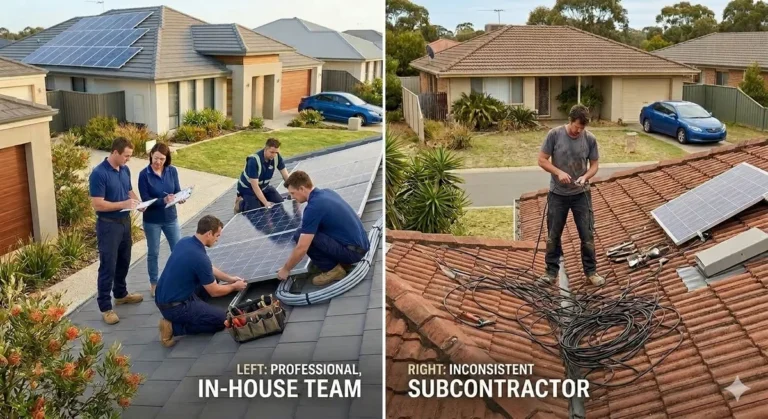
If you are repaying a system over 5 to 10 years, you need the installer to still be fixing it for at least that long. If a fault appears in year six and the installer has closed, or used a subcontractor you cannot reach, you are still repaying a loan on a system that is not working. Before you sign, check the length of the workmanship warranty, who does the repairs, and how quickly they respond. Our guide to the 20-year solar warranty explains what workmanship cover should include.
Which option is right for you?
- You have the cash: paying outright is simplest and cheapest.
- You want a battery and earn under $210,000: look at the WA scheme loan first. It is interest-free and stacks with the rebates.
- You want solar panels only: compare personal and green loans on the comparison rate, and avoid deferred-interest products.
- You cannot borrow: a lease or PPA gets panels on the roof, but go in knowing most of the savings stay with the provider.
If you want solar and a battery together, our guide to solar and battery packages explains how to size them.
How Talk Energy can help
Talk Energy installs solar and Sigenergy batteries across Perth with in-house SAA-accredited electricians, no subcontractors. Every installation is covered by a 20-year workmanship warranty and a 48-hour fix-or-replace guarantee. We are rated 4.8 stars from 300+ Google reviews.
We show the full price, each rebate and any loan amount as separate lines on your quote, and we handle the WA Battery Scheme paperwork for eligible customers. Ask us what payment options are available for your situation. Get a free, fixed quote or call (08) 6255 5914.
Frequently asked questions
Can I get solar with no upfront cost in Perth?
Sometimes. If you are buying a home battery and your household earns under $210,000, the WA Residential Battery Scheme’s no-interest loan of up to $10,000, plus the point-of-sale rebates, can cover the whole price of many batteries. For solar panels on their own, $0 upfront means borrowing from a lender, usually with interest.
Is the WA Battery Scheme loan really interest-free?
Yes. The loan is $2,001 to $10,000 at no interest, repaid over 3 to 10 years. Plenti administers it for the WA Government and pays approved funds to the accredited vendor. No security or guarantee is taken.
Who is eligible for the no-interest loan?
Households with a combined gross income under $210,000 who also qualify for the WA battery rebate. That means being a Synergy or Horizon Power customer, installing a battery of at least 5 kWh usable capacity from your retailer’s Supported Solutions List, and joining a virtual power plant. The rebate itself has no income test.
Does the scheme loan cover solar panels?
The WA Government describes the loan as being for buying and installing a home battery. If you want new panels at the same time, ask your installer and Plenti how they can be financed before you sign. If not, use savings or a personal or green loan for the panels.
Does financing affect my rebates?
No. The STC discount, the federal battery discount and the WA rebate are taken off the price at the point of sale whether you pay cash or borrow. Under the WA scheme, the loan plus the rebate cannot exceed the purchase and installation price of the battery.
What if I earn more than $210,000?
You can still get the WA battery rebate and the federal discount, because neither is means-tested. You just cannot use the scheme’s no-interest loan, so you would pay the remaining amount with cash or another form of finance.