Adding a Battery to Existing Solar in Perth: Is It Worth It? (2026)
Quick answer: Yes. Almost every Perth home with solar can have a battery added. If your inverter is a hybrid, a compatible battery usually connects straight to it. If it is not, the battery either brings its own inverter (AC-coupled) or the old inverter is replaced with a hybrid one. In WA, adding a battery counts as an upgrade: the whole system must meet Western Power’s current rules, customers on the old REBS buyback move to DEBS, and both the WA Residential Battery Scheme rebate and the federal Cheaper Home Batteries discount can apply to a retrofit.
This guide is for Perth and South West households on the Synergy and Western Power network that already have panels on the roof. It covers how to check what you have, how a battery is added, what changes with the network and your feed-in arrangement, how the rebates treat a retrofit, and when a battery makes sense. It does not quote prices, because the cost of a retrofit depends on the system you already own.
Can I add a battery to my existing solar system in Perth?
Yes, in almost all cases. Energy Policy WA, the state government’s energy agency, says there are cost-effective options for customers with all solar system types to add a battery. What varies from home to home is how much of the existing system stays in place.
Its guide to adding batteries or solar panels to an existing system (updated 31 August 2026) sets out three broad situations:
- You have a hybrid inverter. In most cases a compatible battery can be added directly to it. Compatibility is often brand specific.
- You have a non-hybrid inverter or microinverters. The simplest option is usually a battery with its own inverter, connected alongside the existing system.
- Your inverter is older or near the end of its warranty. Replacing it with a hybrid inverter and adding the battery to that is often the better path.
There are limits. The WA Government’s battery scheme Q&A says that, as a general guide, the older your system is, the more likely it is that parts will need upgrading or replacing, and that there will not be a technical solution for every kind of existing inverter.
How to check what solar system you have
Four details decide how a battery can be added: the inverter type, its age, the system size and whether your home has single-phase or three-phase power. You can find most of them before anyone visits.
- Inverter type. Every inverter has a model number on its electrical label, usually on the bottom of the unit. Search the model number to see whether it is a hybrid (“battery ready”) or non-hybrid inverter. Microinverter systems, which have a small inverter at each panel, are treated as non-hybrid. Energy Policy WA notes you can usually check the model against the Clean Energy Council’s approved inverter list, although some older inverters are no longer listed.
- Inverter age. Your original invoice or warranty papers show the install date and the warranty period. An inverter that is close to the end of its warranty is a weaker base to build a battery system around.
- System size. The inverter label shows its rated output and your paperwork shows the panel capacity in kW. Energy Policy WA says most residential systems are around 5 kVA.
- Single-phase or three-phase. Look in the meter box. Three fuse covers and a three-pole main switch (three switches linked so they move together) mean three-phase. One fuse cover usually means single-phase.
It is also worth asking Synergy which buyback scheme your account is on, REBS or DEBS, because that changes when a battery goes in (covered below).
The two ways a battery is added to existing solar
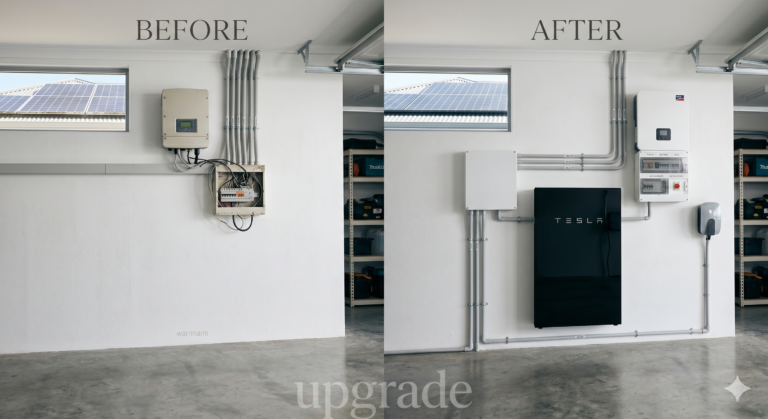
A battery joins an existing system in one of two ways. With AC coupling, the battery has its own inverter and connects to the house wiring, so your current solar inverter stays and keeps running the panels. With DC coupling, the panels and the battery share one hybrid inverter, which means either you already own a compatible hybrid or the old inverter is replaced.
Under WA’s current rules, whichever method is used, all inverters on the property have to work as one managed system. Energy Policy WA calls this whole of site compliance. With two inverters it is usually achieved with a small gateway device, or by a new hybrid inverter controlling the old one. Our guide to AC-coupled vs DC-coupled batteries for existing solar compares the two methods in detail and walks through the common Perth set-ups.
What changes under Western Power’s rules when you add a battery
Adding a battery is treated as an upgrade, so your whole system, old parts included, has to meet the rules that apply today, not the rules from the year your solar went in. Western Power’s Basic Embedded Generator Connection Technical Requirements, mandatory since 1 May 2026, say that where a system is modified or upgraded the complete system must comply, and that an application covering the retained and the new equipment has to be submitted before the work starts.
| Item | Solar-only system left as it is | After a battery is added (Perth metro) |
|---|---|---|
| Which rules apply | No change. Systems installed or upgraded before 1 May 2026 are not affected | The complete system must meet the 2026 requirements |
| Inverter capacity | As originally approved | Solar and battery inverters are added together. Up to 30 kVA in total, with combined output capped at 15 kVA on single-phase or 8 kVA per phase on three-phase |
| Export limit | As originally approved | 1.5 kW static limit, or up to 5 kW with an off-take agreement with your retailer |
| Remote management | As originally installed | The system must be able to be remotely disconnected and reconnected, and all inverters must work as one integrated system |
| Monitoring | Whatever was installed | New or upgraded systems come with a consumption monitor |
| Synergy buyback | REBS or DEBS, as now | REBS customers must apply for DEBS |
Three points from that table matter most for an existing system:
- The export limit can be lower than you are used to. The limit applies to the whole site at the meter. If your present system exports freely on sunny days, that may change once the upgrade is approved. The battery is what soaks up the difference.
- The battery inverter counts. A 5 kVA solar inverter with a 5 kVA battery inverter is 10 kVA of inverter capacity. That fits comfortably inside the single-phase limits, but larger combinations need a control that caps combined output.
- Old wiring may need attention. Western Power requires the main switch to be a circuit breaker before a system is connected, and Energy Policy WA’s fact sheet warns that an older system needing rewiring to meet current electrical standards can be cheaper to replace than to upgrade.
Two exceptions are worth knowing. Energy Policy WA says adding battery modules to an existing battery stack installed before 1 May 2026 does not trigger whole of site compliance, and a like-for-like inverter swap under warranty does not bring the new requirements into play. Limits are lower outside the metro area. Our guide to solar export limits in Perth explains the 1.5 kW and 5 kW limits, off-take agreements and remote management in full.
What happens to your existing feed-in arrangement
If you are on DEBS already, the buyback rates stay the same. If you are still on the older Renewable Energy Buyback Scheme (REBS), adding a battery ends it. Synergy’s DEBS page lists installing a home battery, increasing system size and replacing the inverter with a different model as changes that require a REBS customer to apply for DEBS.
That changes what your exports earn. REBS pays a flat 7.135c per kWh. DEBS pays 10c per kWh for exports between 3pm and 9pm and 2c at all other times, on the first 50 kWh exported each day. A solar-only home exports mostly around midday, so on paper the move looks like a pay cut. With a battery, the midday surplus is stored and used at night instead of being exported, so the export rate matters much less than it did. Our Synergy DEBS guide covers the scheme and the REBS decision in more depth.
Synergy’s pages still describe DEBS eligibility in terms of systems with an inverter capacity of 5 kW or less. If the upgrade takes your total inverter capacity above that, confirm with Synergy which buyback rate and export limit will apply before you commit.
Do the WA and federal battery rebates apply to a retrofit?
Yes, both can apply when a battery is added to solar you already own, and the WA Government confirms its scheme is in addition to the federal program. The conditions differ.
| Question | WA Residential Battery Scheme | Federal Cheaper Home Batteries Program |
|---|---|---|
| Available for a battery added to existing solar? | Yes. The rebate applies to the battery only, and no install date is required for the solar | Yes. Available for batteries connected to new or existing solar. A battery with no solar is not eligible |
| What you get | Up to $1,300 for Synergy customers, up to $3,800 for Horizon Power customers | A discount of around 30% on the upfront cost, set by the battery’s usable capacity and the date it is installed |
| Virtual power plant (VPP) | You must join one | The battery must be VPP-capable, but joining is not required |
| Existing equipment | The existing system must be made compatible with remote management and current electrical standards | The inverter the battery connects to must be VPP-capable and meet Clean Energy Council listing rules. Other solar inverters on site do not need to be VPP-capable |
| How many times | One rebate per property | One battery system per premises, the first time only |
The federal discount is not a fixed dollar amount. The Department of Climate Change, Energy, the Environment and Water explains on its Cheaper Home Batteries Program page that it is delivered through small-scale technology certificates (STCs), with the number set by an STC factor per kWh of usable capacity. The factor is 6.8 for batteries installed from May to December 2026 and falls to 5.7 on 1 January 2027, then steps down every six months to 2030. It applies in full to the first 14 kWh and at a reduced rate above that. You do not apply for it yourself. Your retailer or installer normally passes it on as a reduction in the price.
For the WA rebate, the battery must be new, VPP-capable, at least 5 kWh of usable capacity and on your retailer’s Supported Solutions List, and the accredited vendor submits the application for you. If an older inverter has to be replaced, the WA Government says the rebate still applies only to the battery, but the inverter can be covered by the scheme’s no-interest loan for households that qualify. The full conditions are in our WA Battery Scheme eligibility checklist.
Because federal support is available only once per premises, the Clean Energy Regulator advises choosing the right size the first time. Our guide to what size battery a Perth home needs shows how to work that out from your own bills.
When adding a battery is worth it, and when it is not
A battery is worth adding when you have spare solar in the middle of the day and a use for it after dark. The value comes from the gap between two public rates: under DEBS, surplus solar exported outside 3pm to 9pm earns 2c per kWh, while power bought from the grid on Synergy’s Home Plan (A1) costs 33.26c per kWh (from 1 July 2026). Each kWh you store and use later, instead of exporting and buying back, closes most of that gap, less the small losses in charging and discharging.
A retrofit usually makes sense when:
- your system regularly exports during the day, and your household uses a fair amount of power in the evening and overnight
- your existing inverter is a compatible hybrid, or is new enough to keep and pair with an AC-coupled battery
- your inverter is at the end of its life anyway, so replacing it with a hybrid and adding a battery is one job
- you have roof space to add panels if the current array is too small to fill a battery in winter
- you plan to stay in the home for years.
It is harder to justify when:
- the solar system is small and most of its output is already used in the house during the day, leaving little to store
- evening and overnight use is low
- the roof is full, or shaded, and winter output would rarely charge the battery
- the existing system is old enough to need rewiring to meet current standards, in which case replacing the system may be the better project
- you are likely to sell soon.
The simplest test is your own data. A Synergy bill shows how many units you exported and how many you bought, and an installer can compare the two against a battery size. No one can tell you the outcome without those numbers.
What the installation involves
A battery retrofit is an approval process followed by an electrical installation. In general terms the steps are:
- Site check and design. The installer confirms your inverter model, phases, switchboard and a compliant location for the battery, then designs the system to fit the network limits.
- Applications. Synergy says you or your installer complete its Distributed Energy System application, and Western Power requires the application before work starts. Under the WA scheme, the vendor submits the rebate application.
- Installation. The battery, any new inverter or gateway, the consumption monitor and any switchboard changes are installed. For the federal discount, the installer must be accredited by Solar Accreditation Australia for batteries.
- Commissioning and testing. The system is tested for the remote management capability the 2026 rules require. Energy Policy WA says installers register new systems with Synergy’s platform at installation.
- VPP enrolment. If you are claiming the WA rebate, the battery is enrolled in a virtual power plant product.
Backup power in a blackout is not automatic. It needs backup hardware and wiring to be part of the job, so say at the quote stage if you want it.
Questions to ask an installer before adding a battery
- Will my existing inverter stay, and if so, how will it and the battery be made to work as one system?
- What happens to my existing inverter’s warranty, and who do I call if the old equipment fails later?
- What will my export limit be after the upgrade?
- Am I on REBS now, and what will my buyback rate be afterwards?
- Is the exact battery and inverter combination on Synergy’s Supported Solutions List, and are the WA rebate and federal discount shown as separate lines on the quote?
- Is backup included, and which circuits does it cover?
- Does my switchboard or wiring need work, and is that in the price?
- Can more battery capacity be added later, and would it attract any support?
- Who carries out the installation, and what accreditation do they hold?
Energy Policy WA’s own advice is to get more than one quote, particularly if a quote includes expensive replacement work or says your existing system rules you out.
Adding a battery to existing solar with Talk Energy
Talk Energy Solar & Battery has been installing in Perth for 7+ years and has completed 5,000+ installations. Batteries are installed by in-house SAA-accredited electricians under WA electrical contractor licence EC15564. The battery brand we supply is Sigenergy, and our Sigenergy SigenStor guide explains how its stackable modules and inverter work. We do not service or repair solar systems installed by other companies, so warranty questions about an existing inverter stay with its original installer or manufacturer. More detail is on our solar battery installation page.
To have your existing system checked for the right way to add a battery, request a quote or call 08 6255 5914. We are at 16 Ogilvie Rd, Mount Pleasant WA 6153.
Frequently asked questions
Do I need to replace my solar inverter to add a battery?
Not always. Energy Policy WA says a compatible battery can usually be added to an existing hybrid inverter, and a non-hybrid or microinverter system can usually take a battery that has its own inverter. Replacement is more likely when the inverter is old, near the end of its warranty, or cannot be made to work with the other equipment as one managed system.
Will I lose my REBS feed-in rate if I add a battery?
Yes. Synergy lists installing a home battery as a change that requires an existing REBS customer to apply for DEBS. REBS pays a flat 7.135c per kWh, while DEBS pays 10c per kWh from 3pm to 9pm and 2c at other times. With a battery, more of your solar is used at home, so less depends on the export rate.
Can I get the WA battery rebate if I already have solar panels?
Yes. The WA Government says a solar system installed before a particular date is not a requirement, and the rebate applies to the battery. The battery must be new, VPP-capable and on your retailer’s Supported Solutions List, you must join a virtual power plant, and your existing system has to be made compatible with remote management and current electrical standards. The rebate is up to $1,300 for Synergy customers and up to $3,800 for Horizon Power customers.
Does adding a battery to my solar give me power in a blackout?
Only if backup is part of the installation. Not every battery system provides backup, and Energy Policy WA notes that AC-coupled systems have limitations when used for backup power. Ask which backup hardware is included and which circuits it will run before you sign.
Does my old solar system have to meet the new Western Power rules if I leave it alone?
No. Energy Policy WA says systems installed or upgraded before 1 May 2026 are not affected by the new requirements. They apply when you upgrade, and adding a battery or replacing the inverter with a different model counts as an upgrade. A like-for-like inverter replacement under warranty does not.
Can I add more battery storage later?
Often yes, if the battery is a modular type that accepts more modules, but check the support first. The federal Cheaper Home Batteries discount is available for one battery system per premises, the first time only, and the WA scheme allows one rebate per property. That is why it pays to size the battery properly at the start.