AC Coupled vs DC Coupled Battery: Adding to Existing Solar in Perth
Quick answer: An AC-coupled battery has its own inverter and connects to your home’s AC wiring, so your existing solar inverter stays where it is. A DC-coupled battery connects to the DC side of a hybrid inverter, which usually means replacing your old solar inverter or adding a second, hybrid one. AC coupling is the usual choice when the existing inverter is fairly new or you have microinverters. DC coupling tends to suit an inverter near the end of its life, or a plan to add panels at the same time. In WA, every inverter counts toward Western Power’s limits either way.
This guide is for Perth households that already have solar on the roof and are working out how to add a battery, not whether to. It explains both methods in plain terms, compares them side by side, walks through common Perth situations and shows how the combined inverter capacity is treated on the Western Power network. For the cost and payback side of the decision, see our guide on whether adding a battery to existing solar is worth it in Perth.
What AC coupling and DC coupling mean
The two terms describe where the battery joins your system. Solar panels produce DC electricity, batteries store DC electricity, and your home runs on AC. The question is how many inverters sit in between and who controls the battery.
AC-coupled battery
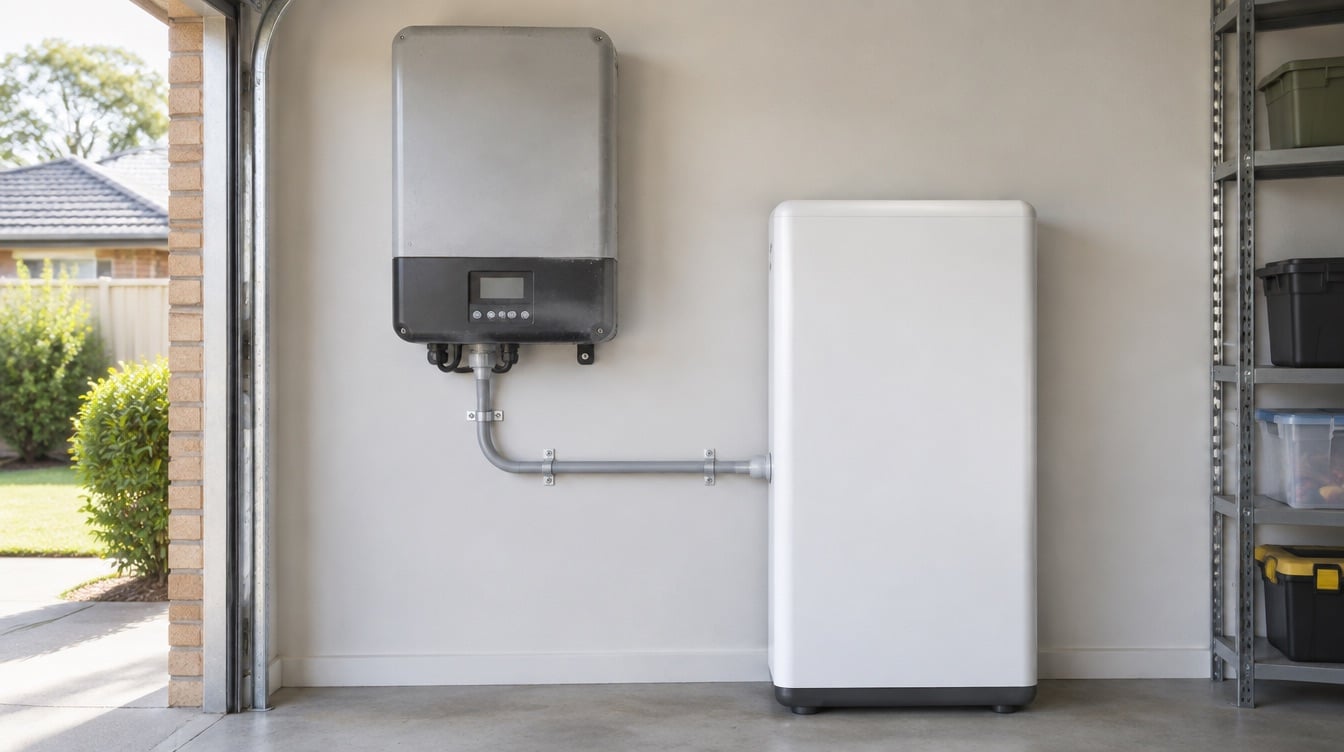
An AC-coupled battery is separate from your solar system. It connects to the house wiring through its own two-way battery inverter, which is often built into the battery unit. Your existing solar inverter keeps turning panel output into AC as it does now. Surplus solar reaches the battery as AC, is converted back to DC for storage, then converted to AC again when you use it.
DC-coupled battery
A DC-coupled battery is part of the solar system. Panels and battery both connect to one hybrid inverter, so solar can charge the battery as DC and is converted to AC once, when the house needs it. If your current inverter is not a hybrid, going DC-coupled means replacing it with a hybrid inverter, or adding a second hybrid inverter alongside it.
AC coupled vs DC coupled battery: side-by-side comparison
Neither method is better in every home. AC coupling changes the least about a system that is working well. DC coupling gives you one newer inverter managing everything.
| Factor | AC-coupled battery | DC-coupled battery |
|---|---|---|
| How it connects | To the home’s AC wiring, through the battery’s own inverter | To the DC side of a hybrid inverter, alongside the solar panels |
| What happens to the existing inverter | It stays and keeps running the panels | It stays only if it is already a compatible hybrid. Otherwise it is replaced, or a second hybrid inverter is added |
| Efficiency in general terms | Stored solar is converted more times (DC to AC, AC to DC, then DC to AC), and each conversion loses a little energy | Solar charges the battery as DC and is converted once on the way out, so fewer conversion losses on stored solar |
| Backup in a blackout | Possible if the battery system includes backup hardware. Whether the old solar inverter keeps charging the battery during an outage depends on the products | Possible if backup hardware is installed. Panels on the hybrid inverter can keep charging the battery when the system is set up for it |
| Western Power inverter capacity (WA) | Solar inverter plus battery inverter are added together | One hybrid inverter counts once. If the old inverter is kept as well, both are added together |
| WA whole of site compliance | Needs a gateway or parent-child set-up so both inverters work as one managed system | Built in when a single hybrid inverter runs everything |
| Typically suits | Newer inverters, microinverter systems, systems that are not being expanded | Inverters near end of life, adding panels at the same time, homes wanting one integrated system |
The efficiency difference is real but depends on the specific products, so compare the round-trip figures on the datasheets you are quoted instead of relying on a general rule. An inverter’s peak efficiency figure is not the same as round-trip efficiency through the battery.
On backup, the Clean Energy Council’s consumer battery guide is blunt: not all battery storage systems provide backup power. That is true of both coupling methods. If blackout protection matters to you, ask what hardware is included and which circuits it covers. Our guide to battery backup during Perth blackouts covers run times.
How combined inverter capacity counts toward WA network limits
Western Power counts every inverter on your property, solar and battery, AC-coupled or DC-coupled, toward one total. Under its Basic Embedded Generator Connection Technical Requirements, mandatory from 1 May 2026, a Perth metro home can have up to 30 kVA of total inverter capacity. The combined output is then capped by a generation limit of 15 kVA on single-phase, or 8 kVA per phase on three-phase.
- AC coupling adds a second inverter to the total. A 5 kVA solar inverter plus a 5 kVA battery inverter is 10 kVA of inverter capacity. That sits inside both the 30 kVA total and the 15 kVA single-phase generation limit.
- Larger combinations need a generation limit control. Where the nameplate total is above the generation limit, for example a 10 kVA solar inverter plus a 10 kVA battery inverter on single-phase, a site generation limit control must hold the combined output to 15 kVA. This applies to any mix of AC-coupled and DC-coupled inverters.
- DC coupling with one hybrid counts once. If a single hybrid inverter replaces the old one, the total is just that inverter’s rating.
- Export is capped separately. The site export limit is 1.5 kW, or up to 5 kW with an off-take agreement with your retailer. Clause 4.3.1.4 says an existing system with an added AC-coupled battery must stay within the table limits as a whole, and a system with a DC-coupled battery added to an existing inverter’s battery port must be export limited to them.
Adding a battery is treated as an upgrade. Western Power requires the complete system, old parts included, to comply with the current requirements, and an application has to be submitted before the work starts. On a three-phase connection, phase balancing rules also apply. Our guide to solar export limits in Perth explains the limits, off-take agreements and remote management in detail.
Energy Policy WA adds a practical rule it calls whole of site compliance. If you add or replace an inverter, all inverters on the premises must communicate as one integrated system that can control each inverter’s output. Simple on/off limits are not accepted. From 1 May 2026, new or upgraded systems must also include a consumption monitor.
When to use AC or DC coupling?
Use AC coupling when the existing solar inverter is worth keeping, and DC coupling when it is not, or when you are changing the solar side anyway. The common Perth situations below follow the options Energy Policy WA sets out for existing systems.
Older string inverter that is still under warranty
AC coupling usually fits. The inverter keeps doing its job and the battery brings its own. To meet whole of site compliance, the two are linked either by a gateway (a small device that lets the inverter and battery communicate as one system) or by parent-child mode, where a new hybrid inverter controls the existing one. Energy Policy WA notes parent-child mode usually requires the same manufacturer, and not every manufacturer supports it. Ask how the existing inverter’s warranty is affected before agreeing to any changes around it.
Old inverter near the end of its life
Replacing it with a hybrid inverter and a DC-coupled battery is usually the tidier path. You avoid building a new battery system around hardware that may fail soon, and you end up with one inverter managing solar and storage. If the replacement inverter is a different size from the old one, Western Power requires a new application that meets all current requirements. Our guide to upgrading an old solar system in Perth covers what else to check on an ageing system.
Microinverters
AC coupling is the answer. Microinverters convert to AC at each panel, so there is no shared DC connection for a battery to join. Energy Policy WA’s guidance for microinverter systems is to add an AC-coupled battery and discuss gateway options with your installer. If you are unsure what you have, our comparison of string inverters, microinverters and optimisers explains the differences.
Wanting more panels at the same time
DC coupling is usually the better fit, in one of two ways:
- Keep the existing inverter and add a second hybrid inverter with the new panels and a DC-coupled battery, linked by a gateway or parent-child mode. This suits a relatively new system.
- Replace the inverter with one larger hybrid inverter and a DC-coupled battery. This suits a system where the panels perform well but the inverter is old.
Either way, the new total has to sit within the 30 kVA and generation limits above. Each roof face generally needs its own input (MPPT) on the inverter, which is often what decides whether the old inverter can take more panels.
Already have a hybrid inverter
In most cases you add a compatible DC-coupled battery to it. Compatibility is often brand-specific, so the battery choice is narrower.
Which type of battery is best for a solar system?
There is no single best type. The right battery is the one that matches your existing inverter, your evening energy use, your backup needs and the rules that apply to your connection. A few checks matter more than the AC or DC label:
- Compatibility. Whether it can work with, or sensibly replace, the inverter you have.
- Backup. Whether backup hardware is included, and for which circuits.
- Power as well as capacity. The inverter’s kW rating decides what can run at once. The battery’s kWh decides for how long.
- Rebate eligibility. The WA Residential Battery Scheme requires a new, VPP-capable battery and inverter on your retailer’s Supported Solutions List, whichever way it is coupled. Our WA Battery Scheme eligibility checklist has the full list.
As one example of how products differ, Sigenergy’s SigenStor is built around a DC-coupled design, with the solar inverter, battery converter and battery modules in one stack. Sigenergy also publishes a retrofit method for adding a SigenStor beside existing inverters from other brands. Whether an existing inverter can stay under WA’s whole of site rules is checked for each home.
Adding a battery to existing solar with Talk Energy
Talk Energy Solar & Battery supplies and installs Sigenergy batteries, including for homes that already have solar. Installations are carried out by in-house SAA-accredited electricians under WA electrical contractor licence EC15564, and the business has completed 5,000+ installations over 7+ years. We do not service or repair solar systems installed by other companies, so questions about an existing inverter’s warranty stay with its original installer or manufacturer. More detail is on our solar battery installation page.
To have your existing system assessed for the right way to add a battery, request a quote or call 08 6255 5914. We are at 16 Ogilvie Rd, Mount Pleasant WA 6153.
Frequently asked questions
Can I keep my existing solar inverter when I add a battery?
Often, yes. With an AC-coupled battery the existing solar inverter stays and the battery uses its own inverter. In WA the two then have to work as one managed system, usually through a gateway or parent-child mode, to meet whole of site compliance. If the inverter is old or near the end of its warranty, replacing it with a hybrid inverter is often the more practical choice.
Is a DC-coupled battery more efficient than an AC-coupled one?
In general, yes for solar that goes through the battery, because the energy is converted fewer times. An AC-coupled battery converts stored solar from DC to AC, back to DC and then to AC again. The size of the difference depends on the products, so compare round-trip efficiency figures on the datasheets you are quoted.
Does adding a battery change my solar export limit in Perth?
It can. Western Power treats adding a battery as an upgrade, and the complete system must then meet the requirements that became mandatory on 1 May 2026. In Perth metro that means a 1.5 kW export limit, or up to 5 kW with an off-take agreement with your retailer. Ask how this applies to your existing system before you commit.
Does a battery inverter count toward the Western Power inverter limit?
Yes. Western Power’s maximum of 30 kVA of total inverter capacity includes solar inverters and battery inverters, whether the battery is AC-coupled or DC-coupled. If the combined nameplate capacity is above the generation limit (15 kVA on single-phase in Perth metro), a site generation limit control must cap the combined output.
What kind of battery works with microinverters?
An AC-coupled battery. Microinverters convert solar to AC at each panel, so there is no shared DC connection for a battery to join. Energy Policy WA’s guidance for microinverter systems is to add an AC-coupled battery and talk to your installer about gateway options.
Do I need Western Power approval to add a battery to existing solar?
Yes. Western Power requires an application covering the existing and new equipment to be submitted before a system is modified or upgraded. The complete system then has to comply with its current Basic Embedded Generator Connection Technical Requirements.