Three-Phase Home Battery in Perth: Do You Need a 3 Phase Battery?
Quick answer: You do not need a three-phase battery just because your Perth home has three-phase power. A single-phase battery can be installed on one of the three phases, but under Western Power’s connection rules (mandatory from 1 May 2026) a single-phase system with a battery is held to a 5 kVA imbalance between phases, and battery inverter capacity above 5 kVA has to be balanced across all three. A three-phase battery system is the better fit if you want more than about 5 kVA of battery power, backup on every phase, or to keep three-phase appliances running in a blackout.
This guide is for Perth homeowners who already have a three-phase supply and are choosing a battery. It covers how to check your supply, what a three-phase battery actually does, where a single-phase battery falls short, how backup works, and the Western Power limits that apply. If you are still working out what three-phase means for the solar panels themselves, start with our guide to three-phase power and solar systems.
How to tell if your home has three-phase power
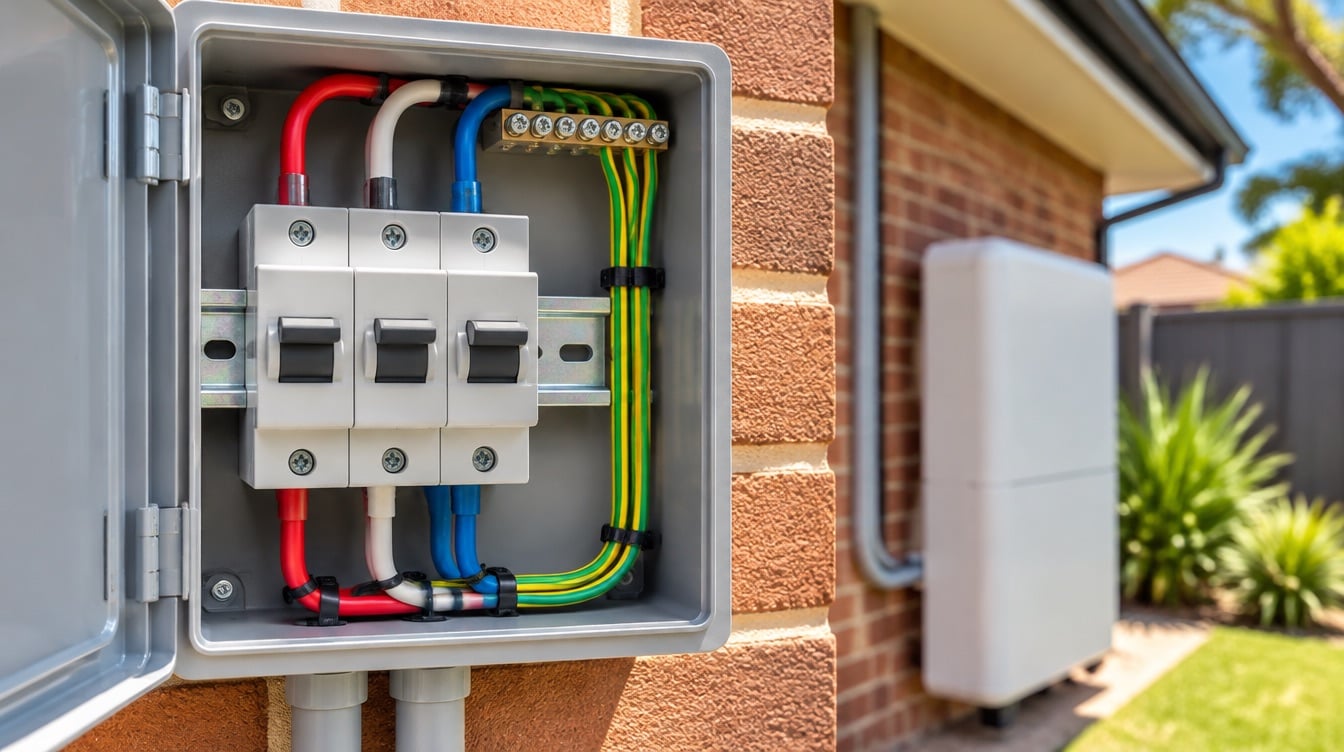
The meter box tells you. Most single-phase homes have a single fuse cover in the meter box. A three-phase home has three fuse covers and a three-pole main switch, where three switches are linked so they move together.
- Count the fuses and poles. Three fuse covers and a linked three-pole main switch mean three-phase supply.
- Check the meter. Western Power’s guide to one of its three-phase smart meters shows phase indicators marked A, B and C on the display.
- Know the standard sizes. Western Power lists its standard connection services as 63 amps at 240 volts for single-phase and 32 amps at 415 volts for three-phase, where three-phase is available.
Look, but do not open or touch anything behind the covers. If the layout is unclear, a licensed electrician can confirm your supply type in a few minutes.
What a three-phase battery does differently
A three-phase battery charges and discharges across all three phases at once, while a single-phase battery works on one phase only. The battery modules themselves store DC electricity either way. The difference is the inverter that sits between the battery and your switchboard.
With a three-phase hybrid inverter, your solar panels and battery feed all three phases, so every circuit in the house can draw on stored energy. Household loads are rarely spread evenly, so it also matters whether the inverter can deliver different amounts of power on each phase. Sigenergy, for example, lists “unbalanced 3-phase power output” as a feature of its three-phase Energy Controller.
| Question | Single-phase battery on a three-phase home | Three-phase battery system |
|---|---|---|
| Which phases it serves | The one phase it is connected to | All three phases |
| Western Power balance rule | Imbalance between phases limited to 5 kVA for a system with a battery | Output is balanced across phases, within 8 kVA per phase |
| Battery inverter size | Up to 5 kVA before it must be balanced across phases | Larger sizes possible, within the site limits |
| Backup in a blackout | Only backed-up circuits on that phase | Circuits on all three phases, if three-phase backup hardware is installed |
| Three-phase appliances in a blackout | Will not run | Can run if the inverter and battery are large enough |
Can a single-phase battery work on a three-phase home?
Yes, within limits set by Western Power. Its Basic Embedded Generator Connection Technical Requirements say the inverter output on a three-phase connection must be balanced across the phases. Where single-phase inverters are used, the generation imbalance between any two phases must not exceed 3 kVA for a solar-only system, or 5 kVA for a system with a battery.
Three points follow from clause 4.2.2 of that document:
- 5 kVA is the practical ceiling. Where a three-phase home has a battery, the battery must be balanced across all phases once its inverter capacity is greater than 5 kVA.
- The phase is chosen for the loads. A single-phase battery system on a three-phase connection must be on the same phase as the load it is intended to supply, while keeping the site’s loads balanced when it charges and discharges.
- The wiring has to cope. Uneven generation and load across phases puts more current through the neutral conductor, which is why Western Power limits imbalance in the first place.
Electrically, a single-phase battery only feeds the circuits on its own phase. Loads on the other two phases keep drawing from the grid. Whether energy the battery pushes out on one phase is counted against what you import on the others depends on how the meter adds the phases together. Western Power’s rules describe the export limit on a balanced three-phase system as a net limit across all phases, and say its metering is used to monitor net exports. How that netting shows up on a Synergy bill for a single-phase battery is not spelled out in those rules, so treat it as something that can vary and ask Synergy before you rely on it.
Backup on a three-phase home: which circuits stay on
In a blackout, a battery only powers the circuits wired to its backup output, and on a three-phase home that depends on which phases the battery can supply. Backup is not automatic with every battery. It needs extra hardware that disconnects the home from the grid and lets the battery take over.
- Single-phase battery. It can keep selected circuits on one phase running, such as the fridge, lights and internet, provided those circuits sit on (or are moved to) the battery’s phase.
- Three-phase battery system. With three-phase backup hardware it can supply circuits on all three phases, either the whole home or a chosen set of priority circuits.
- Three-phase appliances. Anything with a three-phase motor needs all three phases present to run. Some larger ducted air conditioners, bore and pool pumps, and three-phase EV chargers fall into this group. They will not run from a single-phase backup. Check the appliance nameplate to see what you have.
Having three-phase backup does not mean everything runs for as long as you like. The inverter’s power rating sets how much can run at once, and the battery’s stored energy sets how long. Our guide to battery backup during Perth blackouts works through typical appliance loads and run times.
Western Power inverter and export rules for three-phase connections
A three-phase home in the Perth metro area can connect up to 30 kVA of inverters in total, with a generation limit of 8 kVA per phase, and the same export limit as a single-phase home. These figures come from Table 4.1 of Western Power’s requirements and apply to new and upgraded systems from 1 May 2026.
| Connection (Perth metro) | Max total inverter capacity | Generation limit | Export limit without an off-take agreement | Maximum export limit with an off-take agreement |
|---|---|---|---|---|
| Single-phase | 30 kVA | 15 kVA | 1.5 kW | 5 kW |
| Three-phase | 30 kVA | 8 kVA per phase | 1.5 kW | 5 kW |
- The battery inverter counts. The 30 kVA total includes every inverter on the site, solar and battery, whether the battery is AC-coupled or DC-coupled.
- Export is 5 kW in total, not per phase. For a balanced three-phase system the export limit is a net limit across all the phases.
- Adding a battery is an upgrade. Western Power requires the complete system to comply once it is modified, and an application has to be submitted before the work starts.
Because export is capped at the same level on both supply types, a battery is the main way to use more of a larger three-phase array’s output at home. Our guide to solar export limits in Perth explains the 1.5 kW and 5 kW limits and off-take agreements in full.
When a three-phase battery is worth it, and when single-phase is enough
Three-phase is worth it when you need more battery power than one phase is allowed to carry, or when you want backup that covers the whole switchboard. Single-phase is enough when your needs are modest and sit mostly on one phase.
A three-phase battery system suits you if:
- You want a battery inverter larger than 5 kVA, for example to cover air conditioning, cooking and EV charging in the evening.
- You want backup on all three phases, or need three-phase appliances to keep running in an outage.
- Your evening loads are spread across all three phases and you want stored solar to reach each of them directly.
- You plan a larger solar array and want to use the 8 kVA per phase generation limit.
A single-phase battery can be enough if:
- A battery inverter of up to 5 kVA covers your evening use.
- The circuits you care about most can sit on the battery’s phase.
- You have no three-phase appliances that need backup, or you do not need backup at all.
Battery capacity (kWh) is a separate decision from phases. A three-phase home does not automatically need a bigger battery. Size it to your evening and overnight use with our guide to what size battery a Perth home needs.
If your home is single-phase, there is no need to convert to three-phase just to add a battery. A single-phase connection already allows a 15 kVA generation limit.
Does Sigenergy make a three-phase battery?
Yes. Sigenergy’s SigenStor stacks battery modules under an Energy Controller (the inverter), and the Energy Controller comes in single-phase and three-phase versions. Sigenergy’s Australian three-phase datasheet lists models from 5 kW to 30 kW, each taking one to six battery modules.
For blackout protection, Sigenergy’s Australian range includes a three-phase Energy Gateway. Its documents describe whole-house backup and prioritised backup, and note that the quoted 0 ms load-side switchover is only achieved when the Gateway is used together with the Energy Controller and battery. Our Sigenergy SigenStor guide for Perth covers module sizes, warranty terms and the 2025 recall of some single-phase controllers.
The WA Residential Battery Scheme offers a rebate of up to $1,300 for Synergy customers and up to $3,800 for Horizon Power customers. Eligibility is checked by exact model and configuration, so confirm it for the three-phase set-up you are quoted.
Getting a three-phase battery installed with Talk Energy
Talk Energy Solar & Battery supplies and installs Sigenergy batteries for single-phase and three-phase Perth homes. The work is done by in-house SAA-accredited electricians, under WA electrical contractor licence EC15564, and the business has completed 5,000+ installations over 7+ years. See how we approach solar battery installation in Perth.
To find out whether a single-phase or three-phase battery suits your switchboard and your loads, request a solar and battery quote or call 08 6255 5914. We are at 16 Ogilvie Rd, Mount Pleasant WA 6153.
Frequently asked questions
Do I need a 3 phase battery if I have 3 phase power?
No. A single-phase battery can be installed on one phase of a three-phase home. Under Western Power’s rules for new and upgraded systems, a single-phase system with a battery is limited to a 5 kVA imbalance between phases, and battery inverter capacity above 5 kVA must be balanced across all three phases. A three-phase battery system makes sense if you want more power than that or backup on every phase.
Will a single-phase battery run my ducted air conditioner in a blackout?
Only if the air conditioner is a single-phase unit on a backed-up circuit on the battery’s phase, and the battery inverter can supply its load. A three-phase ducted system needs all three phases to run, so it will not operate from a single-phase backup. Check the nameplate on the outdoor unit to see whether it is single-phase or three-phase.
Can I export 5 kW on each phase with a three-phase battery?
No. Western Power’s rules treat the export limit on a balanced three-phase system as a net limit across all phases. In the Perth metro area that is 1.5 kW without an off-take agreement with your retailer, or a maximum of 5 kW in total with one.
Does the battery inverter count toward Western Power’s inverter limit?
Yes. Western Power’s maximum of 30 kVA of total inverter capacity includes every inverter on the site, solar and battery, whether the battery is AC-coupled or DC-coupled. On a three-phase connection in Perth metro, combined output is also held to a generation limit of 8 kVA per phase.
Should I upgrade from single-phase to three-phase before getting a battery?
Usually there is no need. A single-phase connection in Perth metro already allows a 15 kVA generation limit, and the export limit is the same on single-phase and three-phase. Three-phase matters mainly if you have three-phase appliances or need more capacity than a single-phase connection provides.
Is there a Sigenergy battery for 3 phase homes?
Yes. Sigenergy’s SigenStor uses an Energy Controller that comes in single-phase and three-phase versions, and its Australian three-phase datasheet lists models from 5 kW to 30 kW. Each controller takes one to six battery modules. Backup on a three-phase home also needs Sigenergy’s three-phase Energy Gateway.