Solar Panel Recycling and Disposal in WA (2026): What to Do With Old Panels
Quick answer: In Western Australia, solar panels are not yet covered by the state’s e-waste to landfill ban, and there is no national panel recycling scheme running yet. Even so, old panels shouldn’t go in a skip or a kerbside bin. Have a licensed electrician remove them, then send them to a recycler, a reuse buyer or a council-approved drop-off. Old inverters and lithium batteries need extra care, because lithium batteries are a fire risk in bins and trucks.
Perth has had rooftop solar for a long time. Many of the systems that went up in the early boom years are now small, tired or out of warranty. If you’re thinking about an upgrade, the obvious question comes next: what happens to the old panels on your roof?
The honest answer in 2026 is that the rules and recycling options are still catching up. This guide sets out what the WA and federal governments have actually confirmed, what can be recovered from a panel, where Perth homeowners can take old gear, and when your panels are worth keeping instead.
Can you put old solar panels in landfill in WA?
Not yet banned, but not recommended. WA’s e-waste to landfill ban started on 1 July 2024. The WA Government says the initial phase “does not include solar panels/photovoltaics”. So right now there is no WA law that stops a panel going to landfill.
That is likely to change. When the ban was first announced, the WA Government said future phases would capture “photovoltaic systems including solar panels”. No start date for that has been published. A consultation on amendment regulations ran in April 2026, so check the WA e-waste landfill ban page for updates.
Here’s what the current ban does and doesn’t cover:
| Item | Covered by WA e-waste landfill ban (Oct 2026)? |
|---|---|
| Solar panels (photovoltaics) | No, not in the initial phase |
| Screens, IT and telecommunications equipment | Yes |
| Large appliances, lighting, air conditioners | Yes |
| Most batteries | Yes |
| Households | Not obligated under the ban, but asked to use drop-off points instead of kerbside bins |
The ban’s obligations fall on e-waste service providers, landfill operators and large organisations. Households aren’t fined for binning e-waste. But the government’s advice is clear: take e-waste to a drop-off point, not your kerbside bin.
Worth knowing: Landfill wastes the glass, aluminium, copper and silver in a panel, and fees and rules vary from tip to tip. Ring your local transfer station before you load up a trailer.
Is there a solar panel recycling scheme in Australia in 2026?
Not one you can use yet. There is no national product stewardship scheme for solar panels in operation. Two government programs are funded but not yet running for households.
The federal recycling pilot
In January 2026 the federal government announced a national solar panel recycling pilot. Environment Minister Murray Watt said it is funded “to the tune of $24.7 million over 3 years”, with “around 100 drop-off points and collection sites” planned. The pilot is meant to inform a permanent national scheme.
As at mid-2026 the pilot had not started. The process to appoint an administrator was paused in May 2026 after a procurement complaint, and the government has said it is working to appoint one. Until collection sites open, the pilot won’t help you clear your roof.
WA’s own solar recycling funding
The WA 2026–27 State Budget set aside $13 million to “establish new collection, transport, and processing pathways for end-of-life solar panels” from households and solar farms. A further $3 million will help local governments collect embedded batteries. These programs are funded, not yet operating.
The WA Government is also frank about where things stand today. It says the state “has limited established infrastructure and market pathways to support the recovery, repair, reuse and recycling of solar panels at scale”. A baseline assessment is underway.
| Program | Who runs it | Funding | Status (Oct 2026) |
|---|---|---|---|
| WA e-waste to landfill ban | WA Government (DWER) | n/a | In force since 1 July 2024; solar panels excluded for now |
| National solar panel recycling pilot | Federal Government (DCCEEW) | $24.7 million over 3 years | Announced Jan 2026; administrator not yet appointed as at mid-2026 |
| Remade in WA solar panel pathways | WA Government | $13 million | Funded in 2026–27 Budget; baseline assessment underway |
| Embedded battery collection | WA local governments | $3 million | Funded in 2026–27 Budget |
Important: These dates move. Before you book anything, check the WA Government’s Remade in WA solar panel page for the latest.
What can be recovered from an old solar panel?
Most of a panel. A standard rooftop panel is mostly glass and an aluminium frame, with silicon cells, copper wiring and small amounts of silver inside. At the January 2026 pilot announcement, recyclers and industry named silicon (silica), silver, copper, glass and aluminium as the materials they recover.
| Part of the panel | Material | What happens to it |
|---|---|---|
| Front sheet | Tempered glass | Repurposed |
| Frame | Aluminium | Repurposed as aluminium |
| Cells | Silicon | Separated and refined for reuse |
| Cell contacts | Silver | Recovered by more advanced processes |
| Wiring, ribbons, junction box | Copper and plastics | Copper recovered; plastics processed separately |
How much is recovered depends on the process. Simple recycling takes the frame and glass. More advanced plants also pull out the silver, copper and silicon. One WA recycler says on its own site that “up to 90–95% of a solar panel’s materials can be recycled”. That’s the operator’s claim, not a government figure, but it shows why landfill is a waste.
Where can Perth homeowners take old panels, inverters and batteries?
Start with whoever is removing the system, then a recycler, then your council. Options for households are still limited in WA, so the order matters.
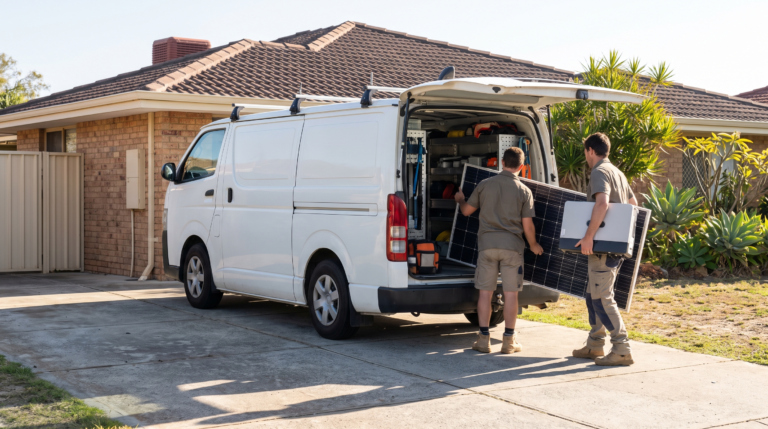
Step 1: Get a licensed electrician to disconnect and remove it
Don’t pull panels off the roof yourself. A rooftop system is connected to your switchboard, and panels produce DC voltage whenever light hits them. In WA, electrical work can only be done by people with the right licence under the Electricity (Licensing) Regulations 1991. You can check any business on the Building and Energy licence search.
If you’re upgrading, removal of the old system is normally part of the new installation. Ask your installer, in writing, what happens to the old gear after it comes down.
Step 2: Solar panels to a recycler or reuse buyer
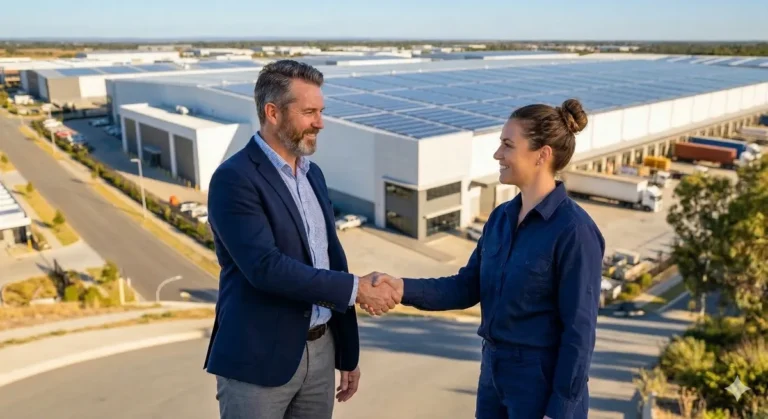
WA has a small number of panel recyclers. Cyber Recycling received a WA Government grant in 2023 to buy automated solar panel recycling equipment. Its website says it provides “solar panel disposal in Darwin and Perth”, but its solar service is pitched at commercial buildings, warehouses and solar farms. Homeowners should ask whether they take residential quantities and what it costs.
You can also ask your local council’s waste team. Some transfer stations accept e-waste, and acceptance of panels varies. The WA Government’s Recycle Right “find my nearest” tool at recycleright.wa.gov.au lists drop-off points by item and suburb.
Step 3: Inverters as e-waste
An old string inverter is an electronic product with circuit boards, copper and aluminium. Treat it like other e-waste: don’t put it in a kerbside bin, and take it to an e-waste drop-off point or recycler. Microinverters and optimisers that come off with the panels should go with them.
Step 4: Batteries need the most care
Lithium-ion batteries can catch fire if they’re crushed or exposed to heat or moisture in bins, rubbish trucks and waste facilities. WA Consumer Protection lists solar power backup storage among the lithium-ion products that carry fire risks, and its advice is simple: never bin a battery.
- Small loose batteries (from monitoring gear, remotes, tools): take them to a battery drop-off point. Recycle Right lists supermarkets, hardware stores, libraries and council sites.
- Damaged, swollen or leaking batteries: don’t take them to a normal collection point. Put them in a clear plastic bag or container and take them to a Household Hazardous Waste facility.
- A home battery system: these are heavy, wired into your switchboard and hold a lot of stored energy. Have a licensed electrician disconnect it, and ask the installer or the battery’s manufacturer how it will be collected and recycled.
Quick tip: Keep any battery you’re waiting to recycle somewhere cool and dry, away from anything that burns, and stop using it if it swells, leaks or gets hot.
Are your old panels worth keeping instead?
Often, yes. Panels age slowly. Most tier-one manufacturers guarantee their panels will keep most of their output for 25 years or more. For example, LONGi’s module warranty promises at least 98% of rated output in year one, then a drop of no more than 0.55% a year, leaving at least 84.8% at year 25. Many quality panels lose around 0.5% a year in practice.
So a working 10-year-old panel may still produce most of what it did when new. Recycling a healthy panel early isn’t the greenest choice. The better question is whether the whole system still suits your home.
| Situation | Usually makes sense to… |
|---|---|
| Output roughly in line with normal ageing, no faults | Keep the panels; service or replace parts as needed |
| Inverter has failed, panels are fine | Replace the inverter, keep the panels |
| Output 15–20% or more below what it should be, with no shading or weather reason | Get the system inspected; replacement may be worth it |
| Cracked glass, burn marks, water inside or damaged wiring | Remove the damaged panels; they shouldn’t stay in service |
| System is small (say 1.5–3 kW) and your power use has grown | Consider a full replacement with a larger system |
Our guide to upgrading an old solar system in Perth walks through repair, add-on and full replacement options. For how panels age over time, see what happens to solar panels after 25 years.
Can you sell or reuse second-hand panels?
You can, but go in with your eyes open. Reuse keeps working panels out of the waste stream, and buyers often use them on sheds, caravans or off-grid setups. There are a few catches:
- No new STCs. The Clean Energy Regulator says replacement panels and inverters must be new, with no previous STC claims, to earn small-scale technology certificates. Swapping in some panels on an existing system is not eligible.
- Grid-connected work must be compliant. Installers must re-certify the whole system when they change it, and upgrade any parts that no longer meet current requirements. Old panels may not match the inverter or current standards.
- Warranty cover may not carry over. Check the manufacturer’s terms before you buy or sell.
- Safety first. Only sell panels with no cracks, burn marks or damaged cables, and be upfront about their age. Installing them on a home connected to the grid is a job for a licensed electrician.
What happens to your old system when you upgrade with Talk Energy?
On a full replacement, taking the old panels and inverter off the roof is part of the job. Talk Energy’s in-house SAA-accredited electricians disconnect the old system safely before the new one goes in. Ask us what happens to your old equipment after removal when you get your quote, so it’s written down before work starts.
If your panels are still healthy, we’ll tell you. Sometimes a new inverter or a battery is a better spend than new panels. Talk Energy has been installing in Perth for 7+ years, with 5,000+ installations and 4.8 stars from 300+ Google reviews. We hold WA electrical contractor licence EC15564, and our work comes with a 20-year workmanship warranty.
Wondering what a replacement would cost? As a rough guide, most Perth homes pay around $5,000–$7,500 for a 6.6 kW system or $8,000–$11,000 for a 10 kW system after STCs in 2026. Your price depends on roof type, panel and inverter choice, and switchboard work. See our solar panel cost guide for Perth for more detail.
Get a free, fixed quote or call (08) 6255 5914. We’ll tell you honestly whether a replacement makes sense for your home.
Frequently asked questions
Is it illegal to put solar panels in landfill in WA?
No, not as at October 2026. WA’s e-waste to landfill ban started on 1 July 2024, but its initial phase does not include solar panels. The WA Government has said future phases are expected to capture photovoltaic systems, but no date has been set. Recycling or reuse is still the better option.
Is there a free solar panel recycling program in Perth?
Not yet for households. A $24.7 million national pilot with around 100 collection sites was announced in January 2026, and WA has budgeted $13 million for solar panel collection and recycling pathways. Neither was running for households as at mid-2026. For now, ask your installer, a recycler or your council.
What happens to old solar panels when they are recycled?
They are taken apart and the materials are recovered. The aluminium frame and glass are removed and repurposed. More advanced processes also recover the silicon, silver and copper. How much is recovered depends on the recycler’s equipment.
How do I dispose of an old solar battery in Perth?
Never put it in a bin, because lithium-ion batteries can catch fire in bins and rubbish trucks. A home battery system should be disconnected by a licensed electrician, then collected through the installer, manufacturer or a recycler. Damaged batteries should go in a clear plastic bag or container to a Household Hazardous Waste facility.
Should I replace my solar panels just because they are old?
Not always. Quality panels typically lose around 0.5% of their output a year, and many warranties guarantee over 80% output at 25 years. If your system works and suits your power use, keeping it is often the better choice. Replacement makes more sense when output has dropped well below normal, panels are damaged, or the system is too small for your home.