Where Can a Home Battery Go? Installation Location Rules for Perth Homes (2026)
Quick answer: In most Perth homes a battery goes on a garage wall, an outside wall that is shaded and sheltered, or under a carport. It can’t go in a bedroom or other living area, a ceiling space, a wall cavity, under the stairs or in an escape route. It also has to sit well clear of doors, windows that open, vents and other appliances. Your electrician must follow the Australian Standard AS/NZS 5139 and the battery maker’s installation manual, and they make the final call on site.
You have probably worked out what size battery you want and roughly what it costs. Then the installer asks where it should go, and it turns out the spot you had in mind won’t work. That’s common. A battery stores a lot of energy, and the location rules are stricter than most people expect. Here they are in plain English.
Where can a home battery be installed in Perth?
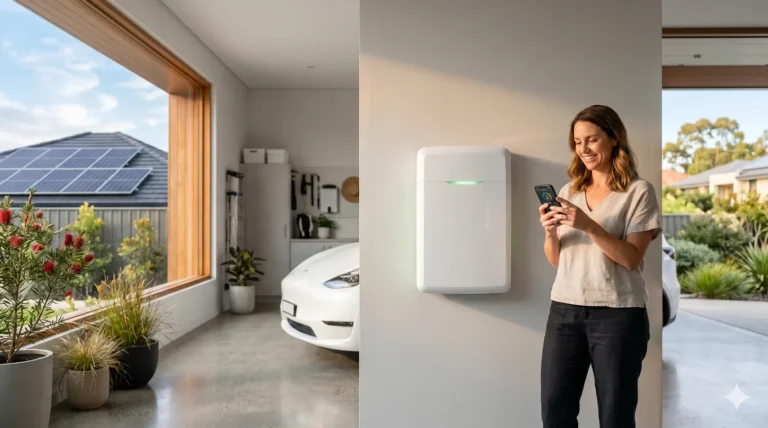
Most Perth home batteries end up in one of three places: a garage wall, a sheltered outside wall, or a carport. These spots usually meet the location rules, keep the cable run to the switchboard and inverter short, and give the electrician room to work.
Australia’s electrical regulators treat a home battery as a possible source of ignition. So the Standard keeps it away from where people sleep and live, and from the routes they’d use to escape a fire.
| Location | Usually suitable? | What the electrician checks |
|---|---|---|
| Garage wall | Often yes | Car-impact protection, space to walk past, what’s on the other side of the wall |
| Outside wall (side or rear of the house) | Often yes | Distance from doors, windows and vents; afternoon sun; rain; access path |
| Carport | Often yes | Car-impact protection, shade, weather exposure |
| Laundry or storeroom | Sometimes | Not a habitable room, but exits, appliances and the manufacturer’s manual still apply |
| Bedroom, living room, kitchen, study | No | These are habitable rooms |
| Ceiling space, wall cavity, under the stairs | No | Restricted locations under AS/NZS 5139 |
| Hallway, side path used as an exit | No, if it’s an escape route | Escape routes have to stay clear |
Worth knowing: the ideal spot is often a trade-off. A shady south-facing wall might be great for heat but sit too close to a bedroom window. A garage might be ideal but need a bollard. Your electrician weighs these points against the rules at the site visit.
Where can’t a home battery go?
A home battery can’t be installed in a habitable room, a ceiling space, a wall cavity, under stairs or walkways, on most roofs, or in an escape route. These are called “restricted locations” in AS/NZS 5139:2019, the Australian and New Zealand Standard for battery systems connected to inverters. Government guidance written for installers lists the following as restricted:
- Habitable rooms. Bedrooms, living, lounge and family rooms, kitchens and dining rooms, studies, playrooms, sunrooms and entertainment rooms.
- Ceiling spaces. No batteries in the roof cavity.
- Wall cavities. A battery can’t be set into the wall frame. A recess fully sealed off from the cavity with non-combustible material is treated differently.
- Roofs. Not allowed unless the roof has a permanent ladder or staircase for access.
- Under stairways and access walkways. Smoke and heat from a fire below could cut off the way out above.
- Escape routes, exits and passageways.
- Near gas. Hazardous areas around gas cylinders and gas relief vents are off limits.
- Anywhere a switchboard isn’t allowed under the wiring rules (AS/NZS 3000).
- Anywhere the battery maker rules out in its installation manual.
The habitable-room rule surprises a lot of people. A spare bedroom you use for storage still counts, because it could be a bedroom again later. Guidance for installers says to think about what a room may be used for in future, not just how it’s used today.
Important: the list above is a plain-English summary of regulator and government guidance. A December 2025 amendment to AS/NZS 5139 reworded these clauses, and your electrician applies the current text to your home.
How far does a battery need to be from doors, windows and appliances?
The commonly cited clearance is 600 mm to the side and 900 mm below doors, opening windows and vents into habitable rooms, and other appliances. In practice that means a battery usually can’t go directly under a bedroom window or right beside the back door. These distances come from regulator guidance on AS/NZS 5139; the 2025 amendment updated the diagrams, so your electrician checks the exact zones on site.
| Nearby feature | Commonly cited clearance |
|---|---|
| Exit or doorway | No battery within 600 mm to the side or 900 mm below |
| Opening window or vent to a habitable room | No battery within 600 mm to the side or 900 mm below |
| Hot water unit, air conditioner, heat pump, stove or other appliance not part of the battery system | Kept 600 mm to the side and 900 mm above the battery (the inverter that charges the battery is excluded) |
| Wide opening such as a garage door | Enough room for a person to pass more than 1 m from the battery |
| Escape route | At least 1 m clear around the battery for safe exit |
What if a living area is on the other side of the wall?
If the battery is mounted on, or sits within 300 mm of, a wall with a habitable room behind it, the wall needs a non-combustible barrier behind the battery. This slows the spread of fire. Under the regulator guidance, the barrier extends at least 600 mm past each side of the battery and 900 mm above it. If the battery is within 900 mm of the ceiling, the ceiling needs protecting too.
This is good news for many Perth homes. Brick, masonry and concrete count as non-combustible, and so do fibre-cement sheeting and ceramic or clay tiles. A double-brick wall usually needs no extra barrier. Plasterboard, timber panelling and particle board don’t count, even when painted. In a framed home or a garage lined with plasterboard, the electrician may need to fit a cement-sheet panel behind the battery.
Quick tip: before the site visit, note where your bedroom windows, back door, hot water unit and air conditioner are. Spots about a metre clear of all of them are worth showing the installer.
Can you put a home battery in the garage?
Yes. A garage is one of the most common places for a home battery in Perth, as long as the battery is protected from being hit by a car and doesn’t block the way out. It’s out of the weather and often close to the switchboard, but it brings two extra checks.
1. Protection from your car
The rules say a battery must not go where damage from things like a vehicle can be expected, unless that risk is dealt with. Usually that means a fixed steel bollard, or a position the car physically can’t reach. Victorian government guidance for installers gives an example: a battery tucked into the front corner of a standard 6 m garage, behind a solid brick pillar, may not need a bollard, but one set further back along the wall, where a car could clip it, does.
Shelving, workbenches and cabinets don’t count as protection, because they can be moved.
2. Room to get out
A battery can’t sit in a path people use to leave the building. Near a wide opening like a roller door, the guidance says a person must be able to pass more than 1 m from the battery. The internal door from the garage into the house is an exit too, so the same doorway clearances apply around it.
Worth knowing: many Perth garages share a wall with a living room, kitchen or bedroom. If yours does, check whether that wall is brick. If it is, a barrier is usually not needed. If it’s a framed wall lined with plasterboard, budget for a non-combustible panel behind the battery.
Bigger batteries need more wall space, so size matters here too. Our guide on what size battery your Perth home needs helps you work out capacity first.
How does Perth’s heat affect where a battery should go?
Heat is the biggest practical issue for Perth batteries, so a shaded, sheltered spot is better than a wall that cops the full afternoon sun. Every battery has an operating temperature range set by its maker. Building and Energy WA lists “environmental conditions (such as temperature)” as one of the things an electrician must consider when choosing the location.
For example, Sigenergy lists the SigenStor battery modules with an operating range of -20°C to 55°C. But a battery on a west-facing wall in full sun on a 40-degree February afternoon gets much hotter than the air in the shade, and batteries make some heat of their own while they work.
Batteries are designed to protect themselves when they get too hot, which can mean less power until they cool down. A cool location keeps the battery working at full output on the days you need it most: hot evenings with the air con running.
- Pick shade. South- and east-facing walls, garages and carports usually stay cooler than west-facing walls.
- Use eaves and awnings. Even a battery rated for outdoor use lasts better out of direct sun and rain.
- Leave air space. Follow the manual’s clearances so heat can escape. Don’t box the battery into a tight cupboard.
- Avoid low spots. Keep clear of places where water pools or sprinklers hit the wall.
Can a battery go outside?
Yes, if the battery and inverter are rated for outdoor use and the spot meets the clearance rules. Look for the IP (ingress protection) rating on the datasheet. The second digit shows water protection; a rating like IP65 or IP66 means the unit is sealed against dust and water jets. Sigenergy lists SigenStor at IP66 and says it can be installed indoors or outdoors. Its Australian installation guide still recommends a sheltered place, away from direct sunlight, rain and standing water. That’s sensible advice for any brand in Perth.
Comparing brands? Each one sets its own temperature range, IP rating and clearances. Our comparison of solar batteries for Perth homes covers the main options.
Who decides where your battery goes in WA?
Your licensed electrician decides, based on AS/NZS 5139 and the manufacturer’s installation manual. You can tell them your preferred spot, but they can’t install a battery somewhere the rules don’t allow. In Western Australia, Building and Energy (part of the Department of Energy, Mines, Industry Regulation and Safety) regulates this work.
Here is what WA requires:
- A licensed electrical contractor. Building and Energy says battery systems must be installed by licensed electrical contractors.
- The current Standard. Amendment 1 to AS/NZS 5139:2019 was published on 19 December 2025. After a six-month transition, WA electrical licence holders have had to comply with it in full since 19 June 2026. The amendment reworded the restricted-location rules and updated the barrier rules for walls next to habitable rooms.
- Notifiable work. Installing a battery is notifiable work. Notices go to the network operator (Western Power in Perth), and you should receive an electrical safety certificate when the job is done.
- SAA accreditation for rebates. To claim the WA Residential Battery Scheme rebate, the installer needs Solar Accreditation Australia (SAA) battery accreditation.
Important: the manufacturer’s manual can be stricter than the Standard. A manual can set its own clearances, mounting options and spacing between units. Your electrician has to meet whichever rule is tighter. Installing outside the maker’s instructions can also put the product warranty at risk.
How Talk Energy chooses the right spot for your battery
At Talk Energy Solar & Battery, the battery location is assessed at the site visit. One of our in-house SAA-accredited electricians walks the property with you. They check the switchboard, measure the clearances from doors, windows, vents and appliances, look at what’s behind each wall, and note where the afternoon sun hits. If a garage install needs a bollard or a cement-sheet barrier, you’ll know before you sign, not on install day.
We install Sigenergy SigenStor batteries, which are rated IP66 for indoor or outdoor use. We still prefer a shaded, sheltered spot. You can read more about the system in our SigenStor guide for Perth homes, or see how we approach solar battery installation in Perth.
- 7+ years in business and 5,000+ installations across Perth
- 4.8 stars from 300+ Google reviews
- In-house SAA-accredited electricians, no subcontractors (WA electrical contractor licence EC15564)
- 20-year workmanship warranty and a 48-hour fix-or-replace guarantee
Not sure if your garage or outside wall will work? Get a free, fixed quote, or call us on (08) 6255 5914. We’ll tell you where the battery can go, and why.
Frequently asked questions
Can a home battery be installed inside the house?
Not in any room people live or sleep in. AS/NZS 5139 rules out habitable rooms such as bedrooms, living rooms, kitchens, dining rooms and studies, as well as ceiling spaces, wall cavities and the space under stairs. Most Perth homes use a garage, carport or sheltered outside wall instead.
Can I put a solar battery in my garage?
Yes, a garage is one of the most common battery locations in Perth. The battery must be protected from being hit by a car, usually with a fixed bollard or a position the car can’t reach. It also can’t block the way out. If a habitable room is on the other side of the wall and the wall isn’t brick or another non-combustible material, a non-combustible barrier goes behind the battery.
How far does a battery need to be from a window or door?
Regulator guidance on AS/NZS 5139 commonly cites 600 mm to the side and 900 mm below an exit, or an opening window or vent into a habitable room. The same 600 mm and 900 mm zones apply to appliances such as hot water units and air conditioners. The 2025 amendment to the Standard updated the clearance diagrams, so your electrician checks the exact zones on site.
Can a home battery be installed outside in Perth?
Yes, if the battery and inverter are rated for outdoor use and the spot meets the clearance rules. Check the IP rating and operating temperature range on the datasheet. In Perth, a shaded spot out of the afternoon sun and rain works well, such as a south- or east-facing wall under the eaves.
Who is responsible for making sure my battery location is compliant?
The licensed electrical contractor who installs it. In WA, battery installation is notifiable work regulated by Building and Energy, and installers must comply with AS/NZS 5139:2019 as amended in 2025. You should receive an electrical safety certificate when the job is finished.