How Much Can You Save with Solar in Perth? Real Numbers for 2026 Based on Your Usage
Perth is one of the best places on the planet to put solar panels on a roof. With more peak sunshine hours than any other Australian capital city and a Synergy electricity tariff that has climbed 2.5% annually for years, the financial case for solar has never been clearer. But most households want a specific answer, not a vague promise: how much will I actually save?
This guide uses real 2026 numbers — Synergy’s confirmed tariff rates, Perth solar generation averages, and the current Distributed Energy Buyback Scheme (DEBS) feed-in rates — to show you exactly what solar can do for your bill, depending on the size of your household.
Key numbers for 2026:
- Synergy Home Plan (A1) usage rate: 32.37c/kWh (effective 1 July 2025)
- Daily supply charge: $1.16/day (unchanged by solar)
- DEBS feed-in tariff: 10c/kWh peak (3pm–9pm), 2c/kWh off-peak
- Perth average peak sun hours: 5.3–5.5 hours/day
- 6.6kW system average daily output: ~28 kWh/day
One in three Perth households already generates its own electricity from rooftop solar. The households that are saving the most are not just exporting everything to the grid — they are maximising self-consumption. Here is why that distinction matters, and what it means for your bill.
Why Self-Consumption Drives Your Savings
Before running the numbers for each household size, it is worth understanding the single most important lever in your solar savings: whether you use the power yourself or export it.
Every kilowatt-hour of solar you consume directly replaces grid electricity at 32.37c/kWh. Every kilowatt-hour you export to the grid earns you, at best, 10c/kWh during peak hours (3pm–9pm) under Synergy’s Distributed Energy Buyback Scheme (DEBS), and just 2c/kWh at all other times.
The self-consumption advantage: Using 1 kWh yourself saves 32.37c. Exporting that same kWh earns 2–10c. The gap between those two outcomes is where most of your savings live.
A solar-only household (no battery) in Perth typically self-consumes around 35% of its solar generation during daylight hours. The rest is exported at low DEBS rates. Adding a battery changes that equation dramatically, lifting self-consumption to around 65–70% by storing midday surplus for use during the evening peak.
What This Means in Practice
| Scenario | Self-Consumption Rate | Effective Value of Solar |
|---|---|---|
| Solar only, daytime use | ~35% | Mix of 32c savings + 2–10c export |
| Solar + load shifting (dishwasher, washing at noon) | ~45–50% | Higher savings, no extra hardware |
| Solar + home battery | ~65–70% | Majority at 32c value |
The calculations below reflect realistic self-consumption rates for each household type, based on typical Perth usage patterns and time-of-day behaviour.
Worked Example 1: Small Household (2 People, ~10 kWh/Day)
A two-person household in Perth uses approximately 10–14 kWh per day, according to Australian Energy Regulator consumption data. For this example, we use 12 kWh/day — a realistic figure for a couple with a split-system air conditioner, fridge, dishwasher, and standard appliances.
Recommended System: 3kW–5kW
A 3kW system generates roughly 15–16 kWh/day in Perth’s climate. A 5kW system produces around 26 kWh/day. For a 2-person home, a 3kW system is often sufficient, though a 5kW system gives more room for future load growth (EV, heat pump hot water).
We’ll model a 5kW system for this scenario.
Assumptions:
- Daily usage: 12 kWh
- Solar generation: 26 kWh/day (5kW × 5.3 peak sun hours, with efficiency losses)
- Self-consumed: 35% of generation = ~9.1 kWh/day
- Exported: 16.9 kWh/day (mostly off-peak at 2c, some peak at 10c)
Annual Savings Breakdown
| Saving Type | Calculation | Annual Value |
|---|---|---|
| Grid electricity avoided | 9.1 kWh × 32.37c × 365 | $1,076 |
| DEBS export credits (est.) | 16.9 kWh/day × avg ~3c × 365 | $185 |
| Total annual saving | ~$1,260 |
Without battery: A small household saves around $1,100–$1,300 per year, depending on daytime usage habits. Bill reduction from roughly $1,420/year to under $200/year is achievable for a couple who runs appliances during daylight.
With a battery (10 kWh): Self-consumption rises to ~65%. The 5kW system now covers virtually all of this household’s needs — grid bills can drop to near zero for usage charges, leaving only the daily supply charge of $1.16/day ($423/year). Total saving climbs to approximately $1,400–$1,600/year.
Worked Example 2: Medium Household (4 People, ~20 kWh/Day)
A four-person Perth household is the most common solar customer profile. The Australian Energy Regulator puts average daily consumption for a four-person household at around 21 kWh/day. With Perth’s warmer climate and heavy air-conditioning use in summer, 20–25 kWh/day is a realistic working range. We use 20 kWh/day as our base.
Recommended System: 6.6kW
The 6.6kW system is the most popular size in Perth for good reason: it generates approximately 28 kWh/day on annual average, comfortably exceeding the needs of a typical family home. According to Talk Energy’s own sizing guide, Perth’s 6.6kW systems produce around 10,200 kWh per year — or roughly 28 kWh per day.
Assumptions:
- Daily usage: 20 kWh
- Solar generation: 28 kWh/day
- Self-consumed: 40% of generation = ~11.2 kWh/day (slightly higher than small household due to more daytime activity)
- Exported: 16.8 kWh/day
- Remaining grid draw: 8.8 kWh/day (evenings and early mornings)
Annual Savings Breakdown
| Saving Type | Calculation | Annual Value |
|---|---|---|
| Grid electricity avoided | 11.2 kWh × 32.37c × 365 | $1,324 |
| DEBS export credits (est.) | 16.8 kWh/day × avg ~3c × 365 | $184 |
| Total annual saving | ~$1,508 |
Without battery: Annual savings of $1,400–$1,700, with the family still paying a grid bill for evening consumption. At 20 kWh/day usage, the pre-solar annual electricity cost (excluding supply charge) is approximately $2,370. Solar cuts that to roughly $870 in usage charges, plus the $423 supply charge — a total bill of around $1,290/year vs the previous $2,790.
With a battery (10–13.5 kWh): Self-consumption climbs to 65–70%. The family now self-consumes approximately 18.2 kWh/day, drawing only 1.8 kWh from the grid. Annual savings jump to $2,000–$2,300, with grid usage costs reduced to under $215/year. The supply charge remains, but the usage bill is nearly eliminated.
Key insight: For a 4-person Perth household, adding a battery to a 6.6kW system can increase annual savings by $500–$800 compared to solar alone — a meaningful uplift that shortens the battery payback period when stacked with the WA Battery Scheme rebate.
Worked Example 3: Large Household (5+ People, ~28 kWh/Day)
Large households with five or more occupants, or homes with a pool, ducted reverse-cycle air-conditioning, or an EV charger, sit in a different category entirely. The Australian Energy Regulator records average daily consumption for households of five or more at 25.4 kWh/day. Add a pool pump (2–4 kWh/day) or EV charging (5–8 kWh/day) and daily usage easily reaches 30–35 kWh.
We use 28 kWh/day as our base — a large family home with ducted AC and a pool, but no EV.
Recommended System: 10kW–13.3kW
A 6.6kW system will not cover this household’s consumption. A 10kW system generates approximately 53 kWh/day in Perth’s climate (10kW × 5.3 hours), though export limits of 5kW single-phase mean oversizing requires either a three-phase connection or a battery to capture surplus. For most large homes, a 10kW system paired with a 10–15 kWh battery is the optimal configuration.
Assumptions (10kW system, no battery):
- Daily usage: 28 kWh
- Solar generation: 53 kWh/day (theoretical), but export-limited to ~40 kWh/day effective capture
- Self-consumed: 45% of effective generation = ~18 kWh/day (high daytime activity: pool pump, AC, dishwasher)
- Exported: ~22 kWh/day
- Remaining grid draw: 10 kWh/day
Annual Savings Breakdown
| Saving Type | Calculation | Annual Value |
|---|---|---|
| Grid electricity avoided | 18 kWh × 32.37c × 365 | $2,129 |
| DEBS export credits (est.) | 22 kWh/day × avg ~3c × 365 | $241 |
| Total annual saving | ~$2,370 |
Without battery: A large household saves $2,200–$2,600/year with a 10kW system. Pre-solar, this home’s usage bill runs approximately $3,310/year. Solar reduces that to around $1,180 in grid usage costs — still meaningful, but the evening draw remains expensive.
With a battery (13.5 kWh): Self-consumption rises to ~68%, with approximately 27.2 kWh self-consumed daily. Grid draw falls to under 1 kWh/day for usage. Annual savings reach $3,000–$3,400/year, and the household’s usage bill effectively disappears. Only the supply charge remains.
The pool pump advantage: Running a pool pump during solar hours (9am–3pm) on a timer adds roughly 2–3 kWh of self-consumed solar per day, worth an additional $237–$355/year in avoided grid costs. It costs nothing to implement and is one of the fastest ways to improve solar ROI in a large home.
Summary: Perth Solar Savings at a Glance
The table below consolidates all three scenarios. All figures use Synergy’s confirmed 2025–26 tariff of 32.37c/kWh and DEBS rates of 10c/kWh peak and 2c/kWh off-peak.
| Household | Daily Usage | System Size | Annual Saving (Solar Only) | Annual Saving (Solar + Battery) |
|---|---|---|---|---|
| Small (2 person) | 12 kWh | 5kW | ~$1,260 | ~$1,500 |
| Medium (4 person) | 20 kWh | 6.6kW | ~$1,508 | ~$2,150 |
| Large (5+ person) | 28 kWh | 10kW | ~$2,370 | ~$3,200 |
Important caveats to keep in mind:
- The $1.16/day supply charge ($423/year) is not reduced by solar — it is a fixed grid connection fee.
- Savings are higher for households with more daytime electricity use (home office workers, retirees, shift workers).
- Seasonal variation is significant: Perth solar output in summer can be 60–80% higher than winter output, so quarterly savings are uneven.
- These figures do not account for system degradation (typically 0.3–0.5% per year for quality panels), which is negligible in the first 10 years.
How Talk Energy’s Monitoring Tools Protect Your Savings
Installing solar is the first step. Protecting those savings over the long term requires knowing when your system is underperforming, and acting quickly when it does.
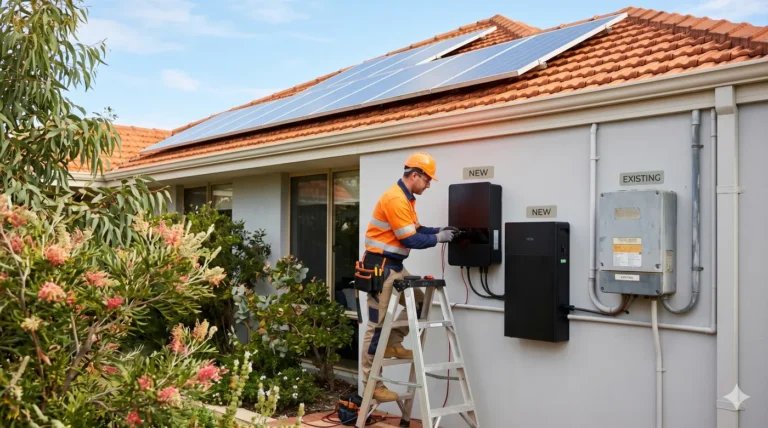
Talk Energy installs systems with inverter-level monitoring as standard, giving you real-time visibility into:
- Daily generation (kWh produced, compared to expected output for the day’s conditions)
- Self-consumption vs export split (so you can see exactly how much you are saving vs earning)
- Grid import (tracking how much you are still drawing from Synergy)
- Battery state of charge (for households with storage)
This data matters for two reasons. First, a system generating 15% below its expected output could indicate a panel fault, inverter issue, or shading problem — all of which silently erode your savings. Second, monitoring lets you adjust behaviour: if you can see that your household imports 8 kWh every evening, that is a clear signal that a battery would pay off quickly.
Talk Energy’s solar aftercare services include remote system diagnostics and a 48-hour fix or replace guarantee. If something goes wrong, the monitoring data is the first thing the team reviews — it tells them what failed, when, and how much generation was lost. For households relying on $1,500–$3,000 in annual savings, that kind of aftercare is not a nice-to-have; it is part of the investment.
Get Your Personalised Savings Estimate
The worked examples above give you a solid starting point, but your actual savings depend on your specific roof orientation, shading, usage patterns, and whether you are home during the day. A north-facing roof with no shading in Perth’s climate will outperform a west-facing roof by 10–15% annually — a difference of $150–$400/year in real savings.
The most accurate way to get your number is through Talk Energy’s solar savings calculator, which factors in your actual Synergy bill data, roof orientation, and local irradiance. Alternatively, Talk Energy’s team can provide a free, no-obligation quote with a full savings projection based on your specific property.
Three things to have ready when you get a quote:
- Your last Synergy bill (or your average quarterly spend)
- Your roof orientation (north, west, or east-facing panels)
- Whether you are typically home during the day
With Synergy tariffs at 32.37c/kWh and rising at 2.5% annually, the cost of waiting is measurable. A household that delays solar by 12 months pays an additional $730–$1,000 in avoidable electricity costs — money that could have been building toward payback instead.
Talk Energy has 250+ five-star reviews and installs solar across Perth metro and regional WA, with in-house SAA-accredited electricians and a 20-year workmanship warranty. Get a free quote today or explore the solar and battery cost guide to understand system pricing before you call.
Frequently Asked Questions
How much does the average Perth household save with solar in 2026?
A typical four-person Perth household with a 6.6kW solar system saves between $1,400 and $1,700 per year without a battery, and $2,000–$2,300 per year with a 10–13.5 kWh battery. Savings are calculated against Synergy’s Home Plan (A1) tariff of 32.37c/kWh, effective 1 July 2025.
What is the current Synergy feed-in tariff rate in Perth?
Synergy pays solar households under the Distributed Energy Buyback Scheme (DEBS). As of 1 July 2025, the rates are 10c/kWh during peak hours (3pm–9pm) and 2c/kWh at all other times. These rates apply to the first 50 kWh exported per day. For most Perth households, export credits average out to under 3c/kWh across the full day.
Does adding a battery significantly increase solar savings in Perth?
Yes. In Perth’s market, where the off-peak DEBS export rate is just 2c/kWh, a battery is particularly valuable. It lifts household self-consumption from around 35% to 65–70%, converting exported solar (worth 2c) into self-consumed solar (worth 32.37c). For a medium household, this translates to an additional $500–$800 in annual savings compared to solar alone.
How much solar does a Perth home generate per day?
Perth averages 5.3–5.5 peak sun hours per day — the highest of any Australian capital city. A 6.6kW system generates approximately 28 kWh per day on an annual average, with summer output reaching 30–32 kWh/day and winter output dropping to 15–20 kWh/day.
Does solar reduce the Synergy daily supply charge?
No. The daily supply charge of $1.16/day ($423/year) is a fixed grid connection fee paid regardless of how much electricity you consume or generate. Solar reduces your usage charges, not your supply charge. Going fully off-grid is the only way to eliminate the supply charge, but this requires a significantly larger battery system and is rarely cost-effective for Perth metro homes.
How do I know if my solar system is performing correctly?
Talk Energy installs inverter-level monitoring on all systems, giving you real-time visibility into generation, self-consumption, and grid import. If your system is generating less than expected, Talk Energy’s aftercare team can diagnose issues remotely and dispatch an in-house electrician within 48 hours under the workmanship warranty.