How to Evaluate a Solar Company’s Reputation Before You Buy: A Perth Homeowner’s Checklist
Choosing a solar company in Perth is not like buying a TV. A bad TV costs you a few hundred dollars. A bad solar installation can cost you a 25-year relationship with a company that no longer answers its phone, a system that underperforms, and a warranty that evaporates the moment something goes wrong.
The Perth solar market is competitive and, in places, noisy. Dozens of companies advertise on the same platforms, use the same stock photos, and make the same promises. The challenge is not finding a solar company; it is finding one you can actually trust.
This guide gives you a practical checklist. It covers where to find reliable reviews, how to read them critically, what accreditations actually mean, the questions that separate serious installers from sales operations, and the red flags that should stop you in your tracks. At the end, we publish Talk Energy’s own transparency data so you can hold any company, including us, to the same standard.
What this checklist covers
- Which review platforms are trustworthy and why
- How to read negative reviews without being misled
- What solar installer accreditation means in 2026
- The five questions that reveal a company’s true quality
- Red flags that should end the conversation immediately
- Talk Energy’s transparency report: scores, accreditations, and complaint resolution
Which Review Platforms Should You Actually Trust?
Not all review platforms are equal. Some are gamed easily; others have verification mechanisms that make manipulation difficult. Here is how the main platforms compare for solar research in Perth.
SolarQuotes
SolarQuotes is a widely used solar-specific review platform in Australia. Reviews are only accepted from homeowners who received a quote through the platform, which creates a meaningful barrier to fake reviews. Scores are broken down into sub-categories: value for money, quality of system, installation, and customer service. This granularity is useful. A company might score 4.8 on installation but 3.9 on value for money, which tells you something specific.
The limitation: because SolarQuotes generates its own quote leads, smaller or newer installers who don’t participate in the platform will have fewer reviews, even if they’re excellent.
ProductReview
ProductReview.com.au is a general consumer review site with a solar category. It is useful as a cross-reference, but the verification standards are lower than SolarQuotes. Look for review patterns rather than individual scores: a company with 12 five-star reviews posted in a single month, then nothing for a year, is a warning sign.
Google Reviews
Google is the most transparent indicator of ongoing reputation. Reviews are tied to Google accounts, and the platform makes it difficult to bulk-delete negative reviews. Look for:
- 100+ reviews minimum. A company with 20 reviews does not have enough data to draw conclusions.
- 4.5 stars or higher. The Perth market is competitive enough that quality companies consistently achieve this.
- Recent reviews. A 4.8 average built over five years but with no reviews in the past six months may indicate the company has scaled back, changed ownership, or stopped following up with customers.
- Response to negative reviews. This is the most revealing signal of all (see next section).
Your Solar Quotes
YourSolarQuotes.com.au operates similarly to SolarQuotes with verified customer reviews. It is less widely used but worth checking as a secondary source, particularly for smaller Perth-based installers.
Key takeaway: Use at least two platforms when researching any installer. Consistent scores across multiple independent platforms are far more meaningful than a perfect score on one.
How to Read Negative Reviews Without Being Misled
Negative reviews are not automatically disqualifying. Every company that installs enough systems will eventually receive one. What matters is the pattern and the response.
What a good negative review response looks like
A company with genuine quality standards will respond to negative reviews promptly, acknowledge the issue specifically, and describe what was done to resolve it. Generic deflection (“We’re sorry you feel this way, please contact our team”) is not a resolution; it is a public relations exercise.
Look for responses that:
- Name the specific issue raised
- Describe the concrete action taken (replacement, refund, revisit)
- Are signed by a named person, not just “The Team”
- Are posted within a few days, not weeks
Red patterns in negative reviews
When reading negative reviews, look for these recurring themes rather than isolated incidents:
| Pattern | What it signals |
|---|---|
| Multiple reviews mentioning subcontractors | The company does not use in-house electricians |
| Complaints about post-installation contact | Aftercare is not a priority once payment is received |
| Disputes about what was included in the quote | Pricing transparency is poor |
| System underperforming vs. quoted output | Sizing was inaccurate or equipment was substituted |
| Warranty claims going unanswered | The warranty is not backed by real resources |
The 5% rule
No company with more than 100 reviews will have a perfect record. A negative review rate under 5% combined with genuine resolution responses is actually a sign of a healthy, accountable business. A company with zero negative reviews and fewer than 50 total reviews should raise more questions than one with 200 reviews and a handful of resolved complaints.
The real question is not whether a company has had problems. It is whether they fix them.
What Accreditation Actually Means in 2026
This is an area where the industry has recently changed, and many homeowners are working with outdated information.
CEC to SAA: what changed
For over a decade, the Clean Energy Council (CEC) operated Australia’s installer accreditation scheme. In February 2024, the Clean Energy Regulator approved Solar Accreditation Australia (SAA) as the new accreditation scheme operator under the Small-scale Renewable Energy Scheme. The CEC’s installer accreditation services formally ceased in May 2024.
What this means for homeowners: the standard you should now verify is SAA accreditation, not CEC accreditation. The requirements are equivalent, but the issuing body has changed. Any installer who has not transferred their CEC accreditation to SAA is no longer eligible to create the Small-scale Technology Certificates (STCs) that fund your federal solar rebate.
Why accreditation matters to your wallet
STCs are the mechanism behind Australia’s federal solar rebate, worth roughly $1,750 to $3,680 depending on system size and your location. An unaccredited installer cannot legally create STCs on your behalf. That means you miss the rebate entirely, or the paperwork is fraudulent, which creates its own legal exposure.
How to verify: Search the installer’s business name or individual accreditation number at solaraccreditation.com.au. Every accredited installer has a unique ID. If a company cannot provide this, walk away.
Beyond SAA: additional credentials worth checking
SAA accreditation is the floor, not the ceiling. Look for these additional credentials:
- NETCC (New Energy Tech Consumer Code) Approved Seller: Indicates the retailer has signed up to a consumer protection code for selling solar and batteries. WA Battery Scheme vendors must be approved sellers (or become one within three months).
- Battery manufacturer training: Some battery makers require installers to complete their own training before they can install and commission their systems. Ask which brands the installer is trained on.
- WA Battery Scheme accredited vendor: Necessary if you want to claim the WA state battery rebate (up to $1,300 for Synergy customers, up to $3,800 for Horizon Power customers). The installing electrician must also hold SAA battery accreditation.
A company holding all of these credentials has been vetted by multiple independent bodies, which is a meaningful signal of operational quality. You can read more about approved sellers versus accredited installers and why the distinction matters for your contract.
Five Questions That Reveal a Company’s True Quality
Most companies will tell you they are the best. These five questions force them to prove it.
1. Do your installers work directly for you, or do you use subcontractors?
This is the single most important question. Companies that subcontract installations have limited control over workmanship quality and are often difficult to hold accountable when problems arise. The subcontractor may not even be contactable after the job is done. An in-house team means one company is responsible for the entire job, from quote to grid connection. For a deeper look at why this matters, see our guide on why in-house electricians matter for solar installation.
2. What does your workmanship warranty cover, and what is the response time if something fails?
A vague answer here is a red flag. A quality company should be able to tell you exactly what is covered (mounting, wiring, waterproofing, switchboard work), for how long, and what the guaranteed response time is. The industry standard for workmanship warranties is 5 to 10 years. Anything shorter is below par.
3. Can you provide your SAA accreditation number so I can verify it?
A legitimate installer will provide this without hesitation. Hesitation, redirection, or a claim that “our company is accredited” without providing an individual number should concern you. SAA accreditation is held by individual installers, not just the business entity.
4. Who handles warranty claims if the manufacturer is overseas?
Most solar panels and inverters are manufactured in China. If a panel fails, someone needs to manage the warranty claim with the manufacturer on your behalf. Ask directly: does the installer manage that process, or are you on your own? Companies with genuine aftercare programmes handle this for you. Those without one will point you to a 1300 number and wish you luck.
5. Can you show me a sample of a completed installation certificate?
After every grid-connected solar installation in WA, the installer is legally required to provide a Certificate of Electrical Compliance (CEC, separate from the Clean Energy Council acronym). Asking to see a sample certificate confirms the company understands its legal obligations and completes the paperwork correctly. A company that cannot or will not show you one is a concern.
Red Flags That Should End the Conversation
Some signals are not ambiguous. If you encounter any of the following, stop the process and get quotes elsewhere.
- Pressure to sign today. Legitimate solar companies do not use expiring discounts or same-day pricing tactics. These are sales techniques designed to prevent you from doing due diligence.
- No physical address. Every reputable Perth solar company has a verifiable street address. A PO box or no address at all means there is no accountability if something goes wrong.
- Cannot provide SAA accreditation details. As covered above, this is non-negotiable.
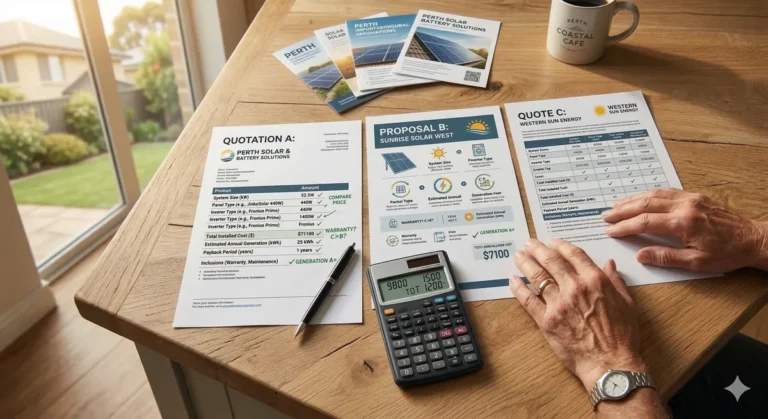
- Quote that is significantly cheaper than all others. As a rough guide, most Perth homes pay around $5,000 to $7,500 for a 6.6kW solar system after the STC discount in 2026. A quote significantly below this range almost always means inferior panels, an unaccredited installer, or hidden costs that appear later. You can use our solar panel cost guide for Perth 2026 as a reference point.
- Vague or verbal-only warranty promises. If the warranty is not in writing with specific terms, it does not exist in any meaningful sense.
- No mention of grid connection paperwork. In WA, connecting a solar system to the Synergy or Horizon Power grid requires formal approval and paperwork. A company that does not mention this process either does not handle it for you, or is not familiar with the regulatory requirements.
- Reviews that all sound identical. Genuine customer reviews use different language, reference specific staff members, and describe individual experiences. A cluster of reviews using similar phrasing or posted within a short period is a sign of review manipulation.
Talk Energy’s Transparency Report
We wrote this guide because we believe every Perth homeowner deserves to make an informed decision, regardless of which company they choose. In that spirit, here is our own data, published openly so you can apply the same checklist to us.
Review scores across platforms
| Platform | Rating | Reviews |
|---|---|---|
| 4.8 stars | 300+ reviews | |
| YourSolarQuotes.com.au | 5.0 stars | 33 reviews (100% five-star) |
| SolarQuotes | 4.6 overall | 4 reviews (4.8 value, 5.0 installation, 4.5 service) |
Our customer reviews page is publicly accessible. We do not selectively display reviews or gate access to our feedback.
Accreditations and credentials
- SAA (Solar Accreditation Australia) accredited installers on every job
- NETCC approved for commercial-grade electrical contracting
- WA Battery Scheme approved installer (Synergy and Horizon Power)
- ABN: 95 658 733 594 (verifiable on the ABN Lookup register)
- Physical address: 16 Ogilvie Rd, Mount Pleasant WA 6153
How we handle complaints
Every installation is completed by in-house qualified electricians. No subcontractors. If a fault occurs, our 48-hour fix or replace guarantee means a qualified technician is on-site within two business days. We manage all manufacturer warranty claims on behalf of our customers; you do not need to contact the panel or inverter manufacturer directly.
Our 20-year workmanship warranty is documented in full on our website. The specific inclusions, exclusions, and claim process are published so there are no surprises.
We publish this data not to close a sale, but because we think transparency should be the industry standard, not the exception. Apply this same checklist to every company you consider.
Your Reputation Checklist: A Quick Reference
Use this as a one-page reference when evaluating any solar company in Perth.
Before you contact them
- Check Google Reviews: 100+ reviews, 4.5+ stars, recent activity
- Cross-reference on SolarQuotes or YourSolarQuotes
- Read the negative reviews and the company’s responses
- Verify a physical address exists and is findable
When you speak to them
- Ask whether installers are in-house or subcontracted
- Ask for their SAA accreditation number (verify at solaraccreditation.com.au)
- Ask what the workmanship warranty covers and the response time guarantee
- Ask who manages manufacturer warranty claims on your behalf
- Ask about grid connection paperwork and who handles it
When you review the quote
- Warranty terms are in writing, not verbal
- Quote specifies exact panel brand, model, and inverter model
- STC rebate is itemised and applied correctly
- No pressure to sign immediately
If a company passes all of these checks, you are dealing with a professional operation. If they fail more than two, keep looking. Perth has enough quality solar installers that you do not need to accept a company that cannot meet a basic transparency standard.
When you are ready to compare quotes from a company that publishes its data openly, Talk Energy offers a free, no-obligation quote with a price match guarantee on comparable systems.
Frequently Asked Questions
How do I verify a solar company’s accreditation in Perth?
Visit solaraccreditation.com.au and search by the company name or individual installer name. Since May 2024, installer accreditation has been managed by Solar Accreditation Australia (SAA), not the Clean Energy Council. Every accredited installer has a unique SAA number. If a company cannot provide this number, they may not be eligible to create the STCs that fund your federal solar rebate.
What is a good number of Google reviews for a Perth solar company?
A minimum of 100 reviews with a 4.5-star average or higher is a reasonable baseline for confidence. Below 50 reviews does not provide enough data to draw reliable conclusions. More important than the total number is the recency: look for companies with consistent review activity over the past 12 months, which indicates an active and ongoing business.
Is the cheapest solar quote the worst option?
Not always, but often. As a rough guide, most Perth homes pay around $5,000 to $7,500 for a 6.6kW solar system after the STC discount in 2026. Quotes significantly below this range typically reflect cheaper panels, unaccredited installers, or costs that are added later. The cheapest quote is worth investigating carefully, not dismissing outright, but the questions in this guide should reveal whether the low price reflects genuine efficiency or hidden compromises.
Does CEC accreditation still apply in 2026?
No, not for installer accreditation. The Clean Energy Council ceased operating its installer and designer accreditation scheme in May 2024. The relevant accreditation is now issued by Solar Accreditation Australia (SAA). The CEC still operates in other capacities (advocacy, approved retailer programmes), but individual installer accreditation is now an SAA function.
What questions should I ask a solar company before signing?
The five most important questions are: (1) Are your installers in-house or subcontracted? (2) What is your SAA accreditation number? (3) What does your workmanship warranty cover and what is the response time? (4) Who manages manufacturer warranty claims on my behalf? (5) Who handles the grid connection paperwork with Synergy or Horizon Power? A quality company will answer all five without hesitation.
What is a workmanship warranty and why does it matter?
A workmanship warranty covers the quality of the installation itself: the mounting, wiring, waterproofing, and switchboard connections. It is separate from the panel manufacturer’s product warranty and the inverter warranty. The industry standard in Perth is 5 to 10 years. Some companies, including Talk Energy, offer 20-year workmanship warranties with a 48-hour fix or replace guarantee. This is the warranty that protects you if the installation itself causes a problem, not just the equipment.