How Long Does Solar Installation Take in Perth? Talk Energy’s Step-by-Step Process Explained
Most Perth homeowners are surprised to learn that the physical installation of a solar system takes just one day. The crew arrives in the morning, panels go on the roof, the inverter gets wired up, and by mid-afternoon the system is sitting ready. So why does the whole process take two to six weeks from first enquiry to a live, exporting system?
The answer is Western Power. Grid connection approval is a regulatory step that every installer in Western Australia must go through, and it is entirely outside the hands of the company fitting your panels. That is the context missing from any conversation about solar installation timelines in Perth, and it is the most important thing to understand before you start comparing installers.
The short answer: Talk Energy’s end-to-end process takes two to six weeks from initial consultation to your system being live on the grid. The physical installation takes four to eight hours. The rest of the time is paperwork, approvals, and scheduling — most of which runs in parallel.
This guide walks through every stage of Talk Energy’s process, with honest timeframes at each step and a clear explanation of where delays can occur and why.
The Full Timeline at a Glance
Before diving into each stage, here is a summary of the complete process:
| Stage | What Happens | Typical Timeframe |
|---|---|---|
| 1. Initial consultation | Site assessment, energy audit, system recommendation | Days 1–3 |
| 2. System design & quote | Custom design, STC rebate calculated, quote issued | Days 3–5 |
| 3. CEC approval | Accreditation checks, design compliance confirmed | Concurrent with Stage 2 |
| 4. Western Power application | Grid connection approval lodged and processed | 1–15 business days (85% within 24 hours) |
| 5. Installation day | Panels, inverter, wiring, mounting — full physical install | 4–8 hours |
| 6. Metering & commissioning | Meter reconfiguration, system activated, export enabled | 1–5 business days post-install |
| 7. Final sign-off | CEC compliance certificate, warranty documentation issued | Same day or within 48 hours |
Total: two to six weeks for most Perth metro homes. Complex systems, network-constrained suburbs, or larger commercial installations can take longer — but that is driven by the approval process, not the installer.
Stage 1: Initial Consultation and Site Assessment (Days 1–3)
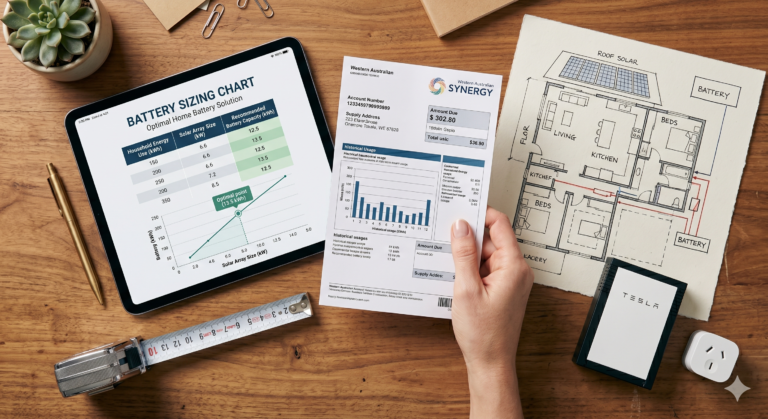
The process starts with a conversation, not a sales pitch. Talk Energy’s consultants conduct a detailed energy audit before recommending any system size. This means reviewing your electricity bills, understanding how your household uses power across different times of day, and identifying whether a battery makes financial sense alongside the panels.
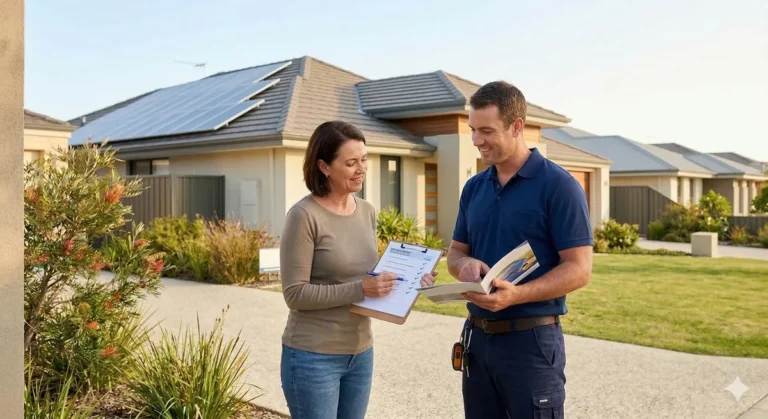
The site assessment follows, either in person or via satellite imagery depending on your location. The team checks:
- Roof orientation and pitch — north-facing roofs at 15–30 degrees are optimal for Perth’s latitude, but east/west splits can still deliver strong results
- Available roof space — accounting for obstructions like skylights, vents, and ridge lines
- Shading analysis — trees, neighbouring structures, and chimneys that could reduce output at certain times of day
- Switchboard condition — older boards may need an upgrade before a modern inverter can be safely connected
- Phase type — single-phase vs three-phase affects inverter sizing and export capacity
This stage typically wraps up within one to three days. For straightforward metro homes, it is often completed in a single visit or remote assessment.
Stage 2: System Design and CEC Approval (Days 3–7)
Once the site data is in hand, Talk Energy’s design team puts together a custom system layout. This is not a generic package pulled off a shelf — panel placement, string configuration, and inverter sizing are all tailored to your specific roof and usage profile.
The quote includes a full breakdown of the system components, the Small-Scale Technology Certificate (STC) rebate already applied to the price, and projected annual savings based on your actual consumption data.
What CEC Accreditation Means for Your Installation
All Talk Energy installations are carried out by Clean Energy Council (CEC) accredited installers. This is a legal requirement for accessing the STC rebate, but it also matters for quality: accredited installers must design systems to Australian standards and sign off on compliance documentation before the grid connection application can be lodged.
Talk Energy holds both CEC Approved Retailer and CEC Approved Installer status. This matters because it means the company is accountable end-to-end — from the quote through to the compliance certificate — rather than outsourcing installation to subcontractors who may not carry the same obligations.
Design and CEC compliance checks typically run concurrently, completing within three to five days of the initial assessment.
Stage 3: Western Power Grid Connection Application (1–15 Business Days)
This is the stage that accounts for the majority of the overall timeline, and it is the one that no installer in Western Australia can fast-track. Before any solar system can export electricity to the grid, Western Power must approve the connection. This is a regulatory requirement, not a process Talk Energy or any other company controls.
Talk Energy lodges the application as soon as the system design is finalised — not after installation, which is a common mistake among less experienced installers that adds unnecessary weeks to the process.
What Western Power Actually Reviews
According to Western Power’s own published data, the approval timeline breaks down like this:
- 85% of applications are approved within 24 hours — straightforward systems in suburbs with available network capacity
- 15% require further review, which can take up to 15 business days — these are applications where Western Power needs to assess whether the local network has sufficient capacity to safely accept additional solar exports
The 15% that require review are not a reflection of the installer’s performance. They are triggered by network conditions in specific suburbs, particularly older areas with high existing solar saturation or constrained distribution infrastructure. Some parts of Perth’s inner suburbs and established coastal areas fall into this category.
What Talk Energy Does to Minimise Approval Delays
- Pre-lodging paperwork before installation day — the application goes in as soon as design is approved, not after the crew has been on your roof
- Dedicated project managers — each job has a named contact who tracks the application status and follows up with Western Power if a review is taking longer than expected
- Design compliance from the outset — systems are designed to meet Western Power’s technical requirements before submission, reducing the chance of a rejection or resubmission that resets the clock
- Updated for May 2026 requirements — from 1 May 2026, new WA Government technical standards apply to all new solar and battery installations on the SWIS network, including CSIP-AUS connectivity for remote monitoring. Talk Energy’s systems already meet these requirements, so customers are not facing any additional delays as a result of the regulatory change.
The real-world result: most Talk Energy customers in Perth metro move from contract signing to installation day within two to four weeks, with the Western Power approval process running in the background throughout that period.
Stage 4: Installation Day (4–8 Hours)
For most Perth homes, this is the stage that surprises people most. After weeks of paperwork and approvals, the physical installation itself is over in less than a working day.
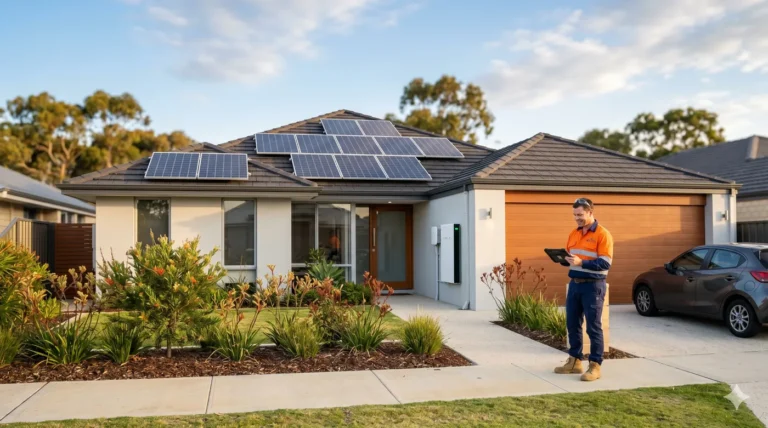
Talk Energy’s crews are in-house electricians, not subcontractors. This is a meaningful distinction: the people on your roof are Talk Energy employees who have worked on hundreds of Perth installations, and they are directly accountable to the same company that sold you the system and will service it under the 20-year workmanship warranty.
What Happens on the Day
A typical residential installation follows this sequence:
- Safety setup and roof access — the crew assesses the roof, sets up ladder safety equipment, and confirms the final panel layout against the design drawings
- Mounting rail installation — aluminium rails are fixed to the roof structure at engineered anchor points; this is the most time-intensive part of the job on complex or tiled roofs
- Panel installation — panels are clipped to the rails and wired into strings according to the approved design
- Inverter installation — the inverter is mounted (typically in the garage or on an exterior wall), wired to the panel strings, and connected to the switchboard
- DC and AC wiring — all cabling is run through the roof cavity and walls, labelled, and secured to Australian standards
- Switchboard connection — the system is integrated with your existing electrical setup, and safety switches are installed or verified
- System test — the crew powers up the system, checks output readings, and confirms all strings are producing as expected
The whole sequence takes four to eight hours depending on system size, roof complexity, and whether any switchboard work is required. A standard 6.6 kW system on a single-storey home with a straightforward roof is typically done in four to five hours.
One thing to note: the system is physically complete at the end of installation day, but it will not be exporting to the grid until metering is confirmed. The panels will be generating and powering your home from the moment the system is switched on.
Stage 5: Metering, Commissioning, and Final Sign-Off (1–5 Business Days)
The final stage closes the loop between your new system and the grid. Once installation is complete, Talk Energy notifies Synergy (your electricity retailer) that the system is ready to export. Synergy then arranges for the meter to be reconfigured to record both consumption and export — this is what enables you to receive the Distributed Energy Buyback Scheme (DEBS) feed-in tariff for any excess energy you send back to the grid.
What “Commissioned” Actually Means
A commissioned system is one that is:
- Generating power from the panels and supplying your home
- Exporting surplus generation to the grid (once metering is confirmed)
- Monitored via the inverter’s app or web portal, so you can see real-time production and consumption data
- Covered under all applicable warranties from the date of commissioning
The meter reconfiguration by Synergy typically takes one to five business days. During this window, your system is already working and saving you money on daytime consumption — you just will not yet receive payment for exports until the meter is updated.
Final Documentation
Talk Energy issues the following at sign-off:
- Certificate of Electrical Compliance — the licensed electrician’s sign-off confirming the installation meets Australian wiring standards
- CEC Installer Declaration — required for STC rebate processing and grid connection records
- Warranty documentation — covering the 20-year workmanship warranty, plus manufacturer product and performance warranties for panels and inverter
- System handover guide — explaining how to read your monitoring app, what normal generation looks like, and who to call if anything changes
From this point, Talk Energy’s aftercare team takes over. The 48-hour fix or replace guarantee means that if anything goes wrong with the installation workmanship, a qualified electrician will be on-site within two business days.
Why Timelines Vary: Factors Outside Any Installer’s Control
Understanding the honest causes of timeline variation is important, because they are almost never the installer’s fault. Here are the most common factors that extend the two-to-six-week window:
Network-Constrained Suburbs
Perth has some suburbs where the distribution network is already carrying significant solar load. In these areas, Western Power may require a full network assessment before approving a new connection. This assessment can take up to 15 business days and in rare cases longer. The suburbs most commonly affected tend to be established inner-city and coastal areas where solar uptake has been high for many years.
There is nothing an installer can do to override this process. Any company that promises a guaranteed short turnaround regardless of your suburb is either uninformed or not being straight with you.
Switchboard Upgrades
If your home has an older switchboard that does not meet current Australian standards, it will need to be upgraded before a modern inverter can be safely connected. This adds cost and typically one to two additional days to the installation schedule. Talk Energy identifies switchboard issues during the initial site assessment, so there are no surprises on installation day.
System Size and Complexity
Larger systems (above 10 kW), three-phase setups, or installations requiring additional structural work on the roof take longer on installation day and may require more detailed Western Power assessment. The timeline table above reflects standard residential systems; commercial or larger residential jobs should allow additional time.
Heritage and Strata Properties
Homes in heritage overlay areas or strata-titled properties may require council or body corporate approval before installation can proceed. This is an additional step that runs before the Western Power application and can add one to four weeks depending on the approval body’s processing times. Talk Energy’s team flags this at the consultation stage for any property where it may apply.
The bottom line: a two-to-six-week timeline is accurate for the vast majority of Perth metro homes. When a job takes longer, the cause is almost always one of the above factors — not the installer dragging their feet.
Ready to Get Started?
Talk Energy installs solar across Perth metro and regional Western Australia, with in-house CEC-accredited electricians handling every job from consultation through to final sign-off. The process outlined above is the same for every customer — transparent, documented, and managed by a dedicated project manager from day one.
If you want to know how long your specific installation is likely to take based on your suburb, system size, and roof type, the best starting point is a free consultation. Talk Energy’s team can give you a realistic timeline at the assessment stage, before you have committed to anything.
Get a free solar quote from Talk Energy — or call the team directly on 08 6255 5914.