Commercial Solar in Perth: What Every Business Needs to Know Before Installing in 2026
Commercial electricity rates in Western Australia are sitting between 28 and 35 cents per kWh in 2026. For a mid-sized Perth business consuming 80,000 kWh annually, that’s $22,400 to $28,000 walking out the door every year, before a single dollar of profit is made. Solar doesn’t just reduce that number. For most businesses, it eliminates the majority of it.
But commercial solar is not the same decision as residential solar. The system sizes are larger, the grid connection rules are different, the incentive structure has a hard deadline, and the wrong installer can cost you far more than the system itself. Before you request a quote, this guide covers the five things every Perth business owner needs to understand.
Key Facts for 2026
- Federal STC rebates decrease each year and expire in 2030, meaning a 2026 install earns fewer certificates than a 2025 install
- Perth commercial solar pricing currently ranges from $10,390 (10kW) to $82,360 (100kW) after STC discounts
- Most Perth commercial systems pay back in 3 to 5 years, with 20 to 25 years of essentially free electricity after that
- WA businesses on the SWIS must comply with Western Power’s inverter and export limits for commercial connections
How Commercial Solar Differs from Residential Installs
Most guides treat commercial solar as a scaled-up version of a home install. It isn’t. The differences are technical, regulatory, and financial, and they matter before you even pick up the phone to a solar company.
Scale and Three-Phase Power
Residential systems in Perth typically sit between 6.6kW and 13.2kW. Commercial systems start at 20kW and routinely reach 100kW or beyond. Most commercial premises in WA run on three-phase power, which is a requirement for systems above roughly 15kW. Three-phase connections allow larger inverter configurations, better load balancing, and more flexibility in panel placement across multiple roof orientations.
If your premises are on single-phase supply, a three-phase upgrade may be necessary before a large commercial system can be installed. This is a cost and timeline factor that residential guides never mention.
Grid Connection Complexity
Commercial connections in WA go through Western Power and involve a more detailed application process than a residential connection. Export limits are common, particularly for systems over 30kW. In some industrial zones, export may be restricted entirely, meaning the system must be sized to match daytime consumption rather than maximise generation.
This is why a commercial installer must review your energy profile, not just your roof space.
Structural and Engineering Requirements
Commercial roofs, particularly on warehouses and industrial buildings, require a structural load assessment before panels are mounted. Older roofs may need reinforcement. This is a step that residential installs rarely require, and it adds both time and cost to the project scoping phase.
Different Incentive Eligibility
The incentive structures for commercial and residential solar diverge significantly above the 100kW threshold, which is covered in detail in the incentives section below.
| Factor | Residential | Commercial |
|---|---|---|
| Typical system size | 6.6kW to 13.2kW | 20kW to 500kW+ |
| Power supply | Single-phase | Three-phase (usually) |
| Grid connection | Standard residential | Western Power commercial application |
| Export limits | Less common | Common above 30kW |
| Structural assessment | Rarely needed | Often required |
| Incentive scheme | STCs (under 100kW) | STCs under 100kW, LGCs above |
| Instant asset write-off | N/A | Available to eligible businesses |
Sizing a Commercial Solar System: What Perth Businesses Actually Need
The most common mistake Perth businesses make is choosing a system size based on roof space rather than energy consumption. Roof space is a constraint, not a starting point. The correct methodology works in reverse: start with your energy bill, identify your daytime load profile, then determine the system size that maximises self-consumption.
The Rule of Thumb
A rough starting point is to divide your average daily kWh consumption by Perth’s average peak sun hours (roughly 5.5 to 6 hours per day) to get a ballpark system size in kW. A business consuming 300 kWh per day would need approximately a 50 to 55kW system to offset most of its daytime load.
But this is a starting point only. Shift work, refrigeration cycles, HVAC demand charges, and peak tariff windows all affect whether a larger or smaller system makes more financial sense.
Size Benchmarks by Business Type
| Business Type | Typical Monthly Bill | Recommended System Size | Approx. Perth Cost (after STCs) |
|---|---|---|---|
| Small office / cafe | Under $2,000 | 20kW to 30kW | $18,000 to $27,000 |
| Warehouse / light industrial | $2,000 to $5,000 | 30kW to 100kW | $27,000 to $82,000 |
| Manufacturing / distribution | $5,000 to $10,000 | 100kW to 250kW | $82,000 to $200,000+ |
| Large industrial / multi-site | $10,000+ | 250kW to 5MW | Quote required |
The 100kW Threshold: A Critical Decision Point
Systems under 100kW access upfront STC rebates, which reduce the purchase price immediately. Systems over 100kW shift to Large-scale Generation Certificates (LGCs), which provide ongoing revenue but no upfront discount.
This creates a genuine strategic decision. If your load justifies a 120kW system, it may be worth staging the installation: install 99kW first to capture the STC rebate, then expand the remaining capacity in a second stage to access LGCs. A good commercial installer will model both scenarios before recommending a path.
What Your Energy Bill Needs to Show
Before any commercial solar company can properly size a system, they need at minimum:
- 12 months of electricity bills (to capture seasonal variation)
- Your tariff structure (flat rate vs. time-of-use vs. demand tariff)
- Your operating hours (daytime-only businesses benefit most from solar)
- Any planned changes to your load (new equipment, EV fleet, expansion)
Businesses that operate predominantly during daylight hours — typically retail, hospitality, manufacturing, and offices — will see the strongest ROI from solar. Businesses with heavy overnight loads need to factor in battery storage or accept that solar will only offset a portion of their bill.
Available Incentives for Perth Businesses in 2026
The incentive landscape for commercial solar in WA is genuinely strong in 2026, but two of the most valuable programs are time-limited.
Small-scale Technology Certificates (STCs)
STCs are the federal government’s upfront rebate mechanism for solar systems under 100kW. When your system is installed, a set number of certificates are generated based on the system’s size and the number of years remaining until the scheme ends in 2030. Each certificate represents 1 MWh of expected generation and trades at around $35 to $38 on the open market.
In practice, your installer applies the STC value as a point-of-sale discount, so you never see the certificates. You simply pay a lower price for the system.
The 2026 urgency: The STC formula reduces each year as 2030 approaches. A 99kW system in Perth generated an STC rebate worth approximately $31,472 in 2025. The same system installed in 2026 generates a rebate of approximately $26,226 — a reduction of over $5,000 for doing nothing except waiting. By 2029, the rebate will be close to zero.
Large-scale Generation Certificates (LGCs)
For systems above 100kW, the STC scheme no longer applies. Instead, these systems generate LGCs on an ongoing basis — one certificate for every megawatt-hour of electricity actually produced. LGCs are sold to electricity retailers who need them for compliance under the Renewable Energy Target.
A 200kW commercial solar system in Perth generating approximately 300 MWh per year would produce around 300 LGCs annually. At current market rates of roughly $22 to $48 per certificate, that represents $6,600 to $14,400 in annual certificate revenue, on top of the electricity savings.
Unlike STCs, LGC revenue comes in over time, not upfront. The trade-off is that larger systems benefit from economies of scale in hardware and installation costs.
Instant Asset Write-Off
The Australian Taxation Office allows eligible businesses to immediately deduct the full cost of a solar system as a business asset. This can significantly improve the after-tax economics of a commercial solar investment, particularly for businesses in higher tax brackets. Confirm eligibility with your accountant, as thresholds and rules have changed in recent years.
What WA Does Not Offer
Western Australia does not have a state-level business solar rebate (unlike Victoria and the ACT). The DEBS feed-in tariff applies to eligible households, schools, and not-for-profits, but not standard commercial businesses. Most commercial solar in WA is therefore sized to maximise self-consumption rather than grid export.
Key takeaway: The combination of STCs plus instant asset write-off is the strongest commercial solar incentive stack available to Perth businesses in 2026. Both are available now. The STC component reduces every year. Waiting is a quantifiable financial decision, not a neutral one.
ROI and Payback Timelines: What Perth Businesses Are Actually Seeing
The standard industry claim is a 3 to 5 year payback period for commercial solar. That range is accurate for Perth, but it masks significant variation depending on system size, energy tariff, and self-consumption rate.
The Core Calculation
Payback period = (Net system cost after incentives) / (Annual electricity savings + any LGC revenue)
For a Perth business on a 32 cent per kWh tariff:
- A 30kW system costing approximately $27,000 after STCs, generating 45,000 kWh per year, saves roughly $14,400 annually. Payback: under 2 years.
- A 100kW system costing approximately $82,000 after STCs, generating 150,000 kWh per year, saves roughly $48,000 annually. Payback: under 2 years.
- A 200kW system (LGC scheme, no upfront rebate) costing approximately $160,000 to $200,000, generating 300,000 kWh per year, saves roughly $96,000 annually plus LGC revenue. Payback: 2 to 3 years.
These figures assume a self-consumption rate of 80% or above, which is achievable for businesses operating during daylight hours.
What Affects Your Specific ROI
- Tariff rate: Perth commercial tariffs vary. Businesses on demand tariffs benefit significantly from solar paired with demand management or battery storage.
- Self-consumption rate: A warehouse running machinery from 7am to 5pm will self-consume almost all of its solar generation. A business with significant overnight loads will export more and see slower payback.
- System quality: Premium panels and inverters degrade at 0.3% to 0.5% per year. Budget equipment can degrade at 1% or more annually. Over a 25-year system life, that difference compounds significantly.
- Installer workmanship: A poorly installed system with shading losses, incorrect string configurations, or substandard cabling can underperform by 10 to 20% from day one.
After Payback
Once a commercial solar system is paid off, the electricity it generates is effectively free for the remainder of its 25 to 30 year lifespan. For a business spending $50,000 per year on electricity and offsetting 70% of that with solar, the post-payback value is $35,000 per year in avoided costs. Over 20 years, that’s $700,000 in savings from a single capital investment.
The real business case: Commercial solar is not a sustainability initiative. It is a capital allocation decision with a quantifiable return that most financial instruments cannot match. A 3 to 5 year payback on an asset that generates returns for 25 years is exceptional by any measure.
What to Look for in a Commercial Solar Installer in Perth
Commercial solar is a long-term infrastructure investment. The installer you choose will affect your system’s performance for the next 25 years, not just the installation day.
Clean Energy Council (CEC) Accreditation
All solar designers and installers in Australia must be accredited by the Clean Energy Council to legally install systems that qualify for STCs. For commercial projects, look specifically for installers with CEC-accredited designers on staff, not just installers. A well-designed commercial system performs significantly better than a poorly designed one, even with identical hardware.
In-House Electricians vs. Subcontractors
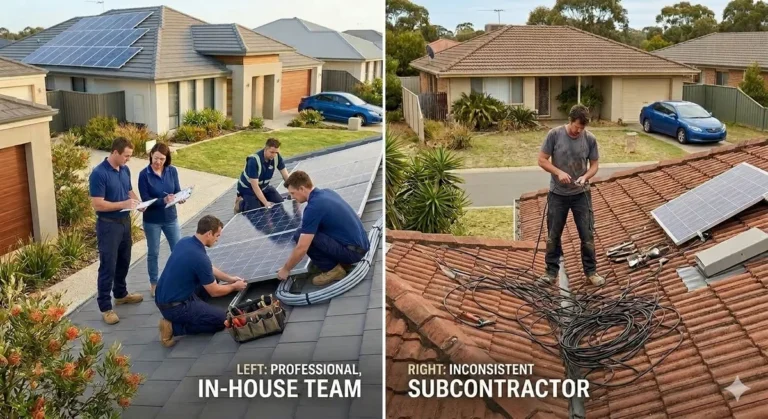
Many solar companies in Perth use subcontracted electricians for installation. This creates accountability gaps: if something goes wrong after installation, the company that sold you the system may point to the subcontractor, and the subcontractor may no longer be available. For a commercial system worth $50,000 to $200,000, this is a meaningful risk.
Installers with in-house licensed electricians carry direct accountability for the work. They also tend to maintain consistent installation standards across every job.
Commercial Project Experience
Residential and commercial solar are different disciplines. A company that primarily installs 6.6kW home systems is not automatically qualified to design and commission a 100kW three-phase commercial array. Ask specifically about their commercial project history: how many commercial systems have they installed, what sizes, and can they provide references from business clients?
Workmanship Warranty
Panel manufacturers typically offer 25-year performance warranties. Inverter manufacturers offer 5 to 10 years. The workmanship warranty, covering the installation itself, is where installers diverge dramatically. Industry standard is 5 to 10 years. Some installers offer 20 years with a guaranteed fix-or-replace commitment. For a commercial system, the workmanship warranty is arguably more important than the panel warranty, because installation faults are the most common cause of early underperformance.
What Talk Energy Brings to Commercial Projects
Talk Energy is a Perth-based installer with in-house licensed electricians, CEC accreditation, and a 20-year workmanship warranty backed by a 48-hour fix-or-replace guarantee. The team services metro and regional Western Australia and has experience across residential and commercial installations of varying sizes.
For Perth businesses comparing commercial solar installers, the key differentiators to weigh are in-house vs. subcontracted installation, warranty depth, and whether the company has a dedicated aftercare process once the system is commissioned. Talk Energy’s model is built around all three.
Frequently Asked Questions
How much does commercial solar cost in Perth in 2026?
After STC rebates, Perth commercial solar pricing ranges from approximately $10,390 for a 10kW system to $82,360 for a 100kW system. Larger systems above 100kW typically cost $160,000 to $200,000+ but access ongoing LGC revenue instead of upfront STC discounts. A small office might spend $18,000–$27,000 for a 20–30kW system, while a warehouse could invest $27,000–$82,000 for 30–100kW.
What is the payback period for commercial solar in Perth?
Most Perth commercial systems pay back in 2 to 5 years depending on system size, electricity tariff, and self-consumption rate. A 30kW system on a 32c/kWh tariff with 80%+ self-consumption can pay back in under 2 years. After payback, the system generates effectively free electricity for the remaining 20–25 years of its lifespan.
What happens with systems above 100kW?
Systems above 100kW shift from STCs (upfront rebates) to LGCs (ongoing certificate revenue). A 200kW system generating 300 MWh per year produces approximately 300 LGCs annually, worth $6,600 to $14,400 in revenue at current market rates. Some businesses strategically stage installations: 99kW first to capture STCs, then expand to access LGCs.
Can Perth businesses claim the instant asset write-off for solar?
Yes. Eligible businesses can immediately deduct the full cost of a solar system under the ATO’s instant asset write-off provisions. This significantly improves the after-tax economics of a commercial solar investment, particularly for businesses in higher tax brackets. Confirm current eligibility thresholds with your accountant, as rules have changed in recent years.
Why are STC rebates decreasing every year?
The STC scheme is legislated to end in 2030. The rebate formula factors in the number of years remaining until that end date, so each year that passes reduces the number of certificates generated per system. A 99kW system installed in 2025 earned approximately $31,472 in STCs; the same system in 2026 earns approximately $26,226 — a reduction of over $5,000 simply for waiting one year.
The Bottom Line: What Perth Businesses Should Do Before the End of 2026
Commercial solar in Perth has never been cheaper in real terms, and the incentive stack has never been more favourable. But the STC scheme is winding down on a fixed schedule, and every year of delay reduces the upfront rebate by a measurable amount.
Before requesting quotes, prepare the following:
- 12 months of electricity bills
- Your operating hours and shift patterns
- Your current tariff structure (ask your energy retailer if unsure)
- Roof plans or building drawings if available
- Any planned equipment upgrades or load changes in the next 3 years
A qualified commercial solar installer can turn this information into a detailed savings and payback model within a few days. The assessment costs nothing. The decision to delay, however, has a price that increases every year.
Get a free commercial solar quote from Talk Energy
Talk Energy: Perth’s most trusted solar and battery installer, with 250+ five-star reviews and a 20-year workmanship warranty.