Solar Price Matching in Perth: What It Is, How It Works, and How to Get the Best Deal
If you’ve been collecting solar quotes in Perth, you’ve probably noticed something: the prices vary wildly. Two companies quoting a 10kW system with similar-sounding specs can come in $2,000 or even $3,000 apart. That gap isn’t random. It’s the solar market doing what markets do — and price matching is how you use that to your advantage.
This guide covers everything you need to know about solar price matching in Perth: what it actually means, how to get comparable quotes, what a fair price for a 10kW system looks like right now, and the red flags that should send you running in the other direction.
The short version: price matching is a commitment from your installer to beat or equal a legitimate competing quote. Done right, it saves you thousands. Done wrong (by the wrong company), it’s a bait-and-switch waiting to happen.
What Is Solar Price Matching?
Solar price matching is exactly what it sounds like: you bring a written quote from one installer to another, and they agree to match or beat that price for an equivalent system. It’s a common practice in Perth’s competitive solar market, and when you know how to use it, it’s one of the most effective ways to ensure you’re not overpaying.
The key word there is “equivalent.” Price matching only works as a genuine comparison when the two quotes are for the same (or very similar):
- Panel brand and model (e.g. Jinko 440W vs Jinko 440W, not Jinko vs a no-name brand)
- Inverter brand and capacity (e.g. Sungrow 10kW vs Sungrow 10kW)
- System size in kW
- Number of panels
- Warranty terms (product warranty, performance warranty, workmanship warranty)
- Installation inclusions (scaffolding, switchboard upgrades, monitoring systems)
A reputable installer won’t match a quote that uses inferior components just to win your business. If they do, that’s actually a red flag, not a win.
Worth knowing: The STC (Small Technology Certificate) rebate for a 10kW system in Perth is approximately $2,773 for 2026 installations. This rebate is already baked into every legitimate quote you receive as a point-of-sale discount, so you’re comparing post-rebate prices when you shop around.
What Does a 10kW Solar System Actually Cost in Perth Right Now?
Before you can use price matching effectively, you need a realistic anchor. Here’s what Perth homeowners are actually paying for a 10kW system in 2026, after the STC rebate is applied:
| System Tier | Panel/Inverter Example | Installed Price (Post-Rebate) |
|---|---|---|
| Budget | Risen/Jinko + Sungrow | $7,000 – $9,500 |
| Mid-range | Canadian Solar + Fronius or SMA | $9,500 – $11,500 |
| Premium | REC, SunPower, or Q Cells + Fronius | $11,500 – $14,000+ |
According to data from SolarQuotes, the national average paid for a 10kW system across 1,342 real customers was around $10,000 fully installed. Perth tends to come in slightly lower than the eastern states due to higher market competition and more installers per capita.
Why the price gap is so large
A $7,000 system and a $14,000 system can both be described as “10kW solar.” The difference comes down to:
- Panel quality and efficiency: Budget panels like Risen or Jinko cost roughly $130 per panel. Premium panels like SunPower can exceed $290 each. For a 10kW system using 22-24 panels, that’s a $3,600+ difference in panel cost alone.
- Inverter brand: A Sungrow inverter is reliable and cost-effective. A Fronius or SMA commands a premium for European engineering and local service networks.
- Workmanship and warranty: A company offering a 20-year workmanship warranty has skin in the game. One offering 2 years does not.
- Installer overhead: Companies with in-house licensed electricians typically cost more upfront but provide better accountability post-installation.
The rule of thumb from SolarQuotes: budget approximately $1,000 per kW installed for a decent quality system. For 10kW, that’s a $10,000 baseline. Anything significantly below that warrants closer scrutiny of the components being quoted.
Why Some Solar Companies Resist Price Matching
Not every installer in Perth will match a competitor’s price, and that’s not always a bad sign. Understanding why companies resist it helps you read the situation correctly.
Legitimate reasons to decline
Some companies won’t match because they genuinely can’t without compromising quality. If their quote uses Tier 1 panels with a 25-year product warranty and a Fronius inverter, they can’t drop $2,000 off their price without swapping out components. That’s actually a sign of integrity.
A quality installer will often say: “We can’t match that price on this equipment, but here’s why our system is worth the difference.” That’s a conversation worth having.
Red-flag reasons to decline
The more concerning refusals sound like this:
- “Our prices are already the lowest in Perth” (no evidence provided)
- “That quote must be using cheap panels” (said without seeing the competing quote)
- “We don’t need to match because we’re the best” (confidence without substance)
- Pressure to sign immediately before you “lose the deal”
These responses are designed to prevent you from shopping around. A company that’s confident in its value proposition welcomes the comparison.
The fake price match
This is the tactic that does the most damage. A company advertises “price matching” but then:
- Claims the competing quote uses “inferior” products (without proof)
- Offers to match only if you upgrade to a more expensive package
- Matches the price but quietly removes inclusions (monitoring, switchboard work, extended warranty)
Genuine price matching is transparent. The installer shows you exactly what they’re matching and what (if anything) differs between the two quotes.
How to Get Quotes and Compare Them: Step-by-Step
Getting multiple quotes is the foundation of effective price matching. Here’s the process that actually works.
Step 1: Define your system requirements upfront
Before you contact anyone, know what you want. This stops installers from quoting different systems and making apples-to-oranges comparisons inevitable.
Decide on:
- System size (10kW is popular for larger Perth homes with high daytime usage)
- Panel preference (budget, mid-range, or premium tier)
- Battery storage (now or future-ready)
- Monitoring (app-based monitoring is standard on quality systems)
Step 2: Request at least 3 written quotes
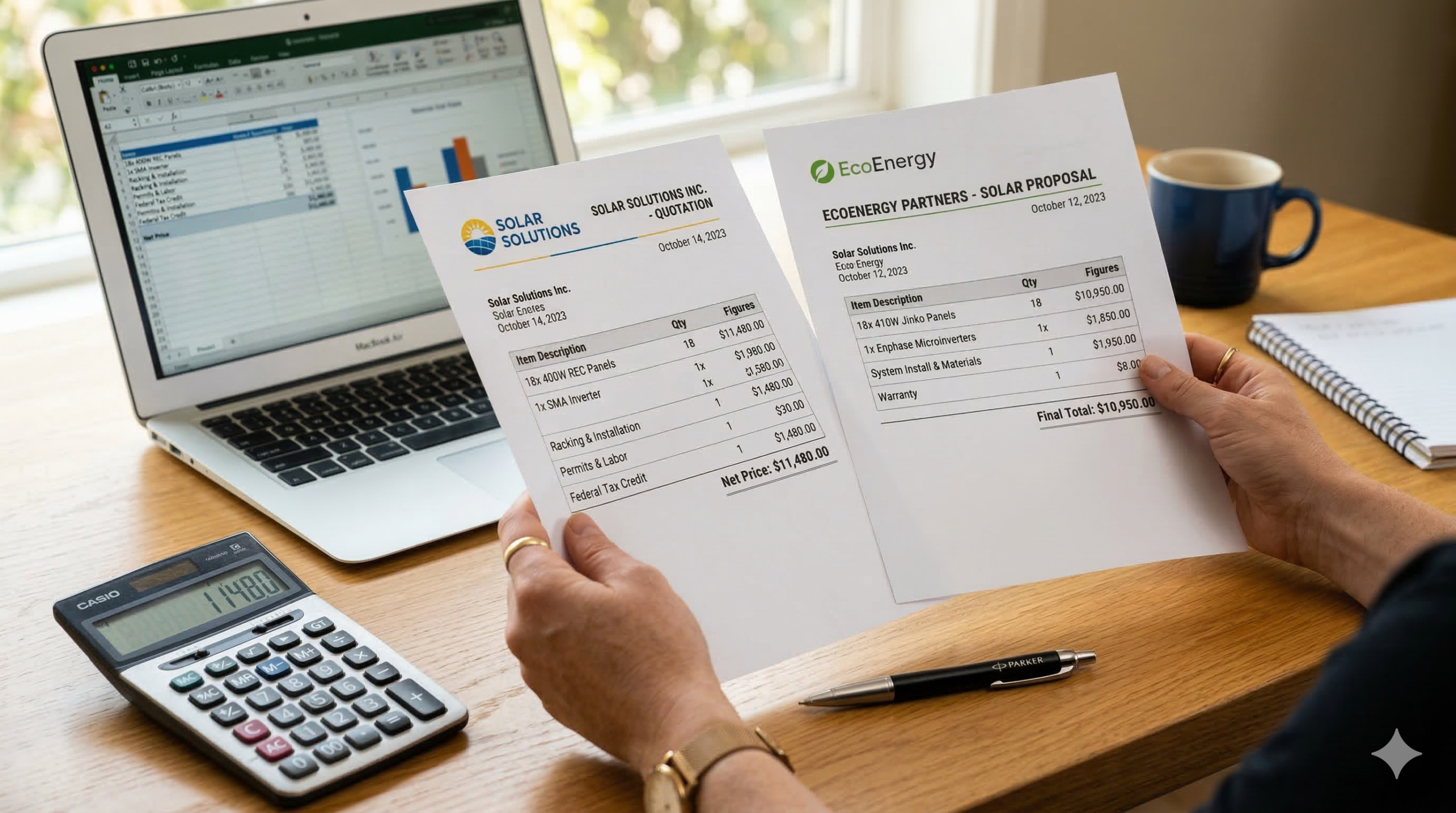
Verbal quotes are useless for price matching. You need written, itemised quotes that specify:
- Panel brand, model, wattage, and quantity
- Inverter brand, model, and capacity
- All warranty terms (product, performance, workmanship)
- What’s included in the installation (scaffolding, switchboard upgrade if needed, monitoring)
- Whether the STC rebate has been deducted from the displayed price
Use a comparison platform like SolarQuotes to get multiple quotes from vetted installers quickly. This gives you a baseline before approaching your preferred installer.
Step 3: Build a comparison table
Once you have 3 quotes, lay them out side by side. Here’s an example of what a filled comparison looks like — use this as your template:
| Item | Quote A | Quote B | Quote C |
|---|---|---|---|
| Total price (post-rebate) | |||
| Panel brand + model | |||
| Inverter brand + model | |||
| Workmanship warranty | |||
| Product warranty (panels) | |||
| In-house or subcontracted install | |||
| Monitoring included |
Step 4: Identify your preferred installer
Price is one factor, not the only factor. Consider:
- How long have they been operating in Perth?
- Do they use in-house electricians or subcontractors?
- What does their review history look like (Google, ProductReview)?
- Do they participate in WA battery schemes like the Synergy DEBS program?
Step 5: Present the competing quote
Bring your best competing quote to your preferred installer and ask them to match it. Be upfront: “I prefer to go with you, but I have this quote for the same spec at $X. Can you match it?”
A confident, quality installer will either match it, beat it, or clearly explain the difference in value. Any other response is a yellow flag.
Step 6: Get the match in writing
A price match isn’t real until it’s in a written quote. Make sure the matched quote specifies the same components, the same inclusions, and the same warranty terms as the competing offer. Don’t sign anything until you’ve verified this.
Red Flags to Watch for When Shopping Solar in Perth
Perth’s solar market has hundreds of installers, and not all of them operate with the same standards. These warning signs should make you pause before signing.
Prices that seem too good to be true. A 10kW system quoted at $5,500 or $6,000 installed is almost certainly cutting corners somewhere. The components alone at that price level will be from manufacturers with little to no Australian service presence, meaning warranty claims become a nightmare.
No itemised quote. If an installer won’t give you a written breakdown of every component, walk away. “10kW solar system – $8,200” is not a quote. It’s a number on a page.
High-pressure tactics. “This price is only available today” is a sales tactic, not a business practice. Quality installers don’t run flash sales. If you’re being rushed to sign, it’s because they don’t want you comparing.
Subcontracted installations. Some companies sell solar but outsource the actual installation to whoever is available. This creates accountability gaps when something goes wrong. Ask directly: “Are your installers your own employees, or do you subcontract?”
Vague or short workmanship warranties. The installation itself (roof penetrations, wiring, mounting) should be covered for at least 5 years, ideally 10-20. A 1-2 year workmanship warranty suggests the company doesn’t expect to be around long enough to honour a longer one.
No CEC accreditation. All legitimate solar installers in Australia must be accredited by the Clean Energy Council. Unaccredited installers cannot legally claim STCs on your behalf, meaning you’d lose the rebate entirely.
Quick check: Before signing anything, verify your installer’s CEC accreditation at the Clean Energy Council’s public register. It takes 30 seconds and could save you thousands.
How to Use Price Matching Effectively (Without Playing Games)
Price matching works best when you approach it honestly. Here’s how to get the most out of it without burning bridges or wasting everyone’s time.
Be upfront about what you’re doing
Tell installers from the start that you’re collecting multiple quotes and will be asking your preferred company to price match. This sets expectations, and quality companies will respect it. It also filters out installers who immediately go on the defensive.
Match like-for-like, not cheapest-to-best
The most common mistake is trying to get a premium system at a budget price by presenting a low quote from a company using inferior components. Installers see this immediately. A better approach: find two or three companies quoting similar quality equipment and use that comparison as genuine leverage.
Use the match as a relationship test
How an installer responds to a price match request tells you a lot about how they’ll handle a warranty claim two years from now. A company that engages professionally, explains their position clearly, and either matches or gives a solid reason why they won’t is demonstrating the kind of accountability you want in a long-term service relationship.
Don’t use price matching as your only filter
The cheapest matched price isn’t always the best outcome. A company that matches but has poor post-installation support, slow response times for service calls, or a history of unresolved complaints is still a bad choice at any price. Reviews on ProductReview.com.au and Google are worth checking before you commit.
The bottom line: price matching is a tool, not a strategy. Use it to ensure you’re paying a fair price for the quality level you’ve chosen. The goal is value, not the lowest number on a page.
Ready to Get a Price Match in Perth?
If you’ve got a competing quote and want to see if we can beat it, bring it to us. At Talk Energy, we offer genuine price matching on equivalent systems across Perth metro and regional WA. We use in-house licensed electricians, back our installations with a 20-year workmanship warranty, and have 250+ five-star reviews from Perth homeowners who’ve been through exactly this process.
We won’t match a quote that uses inferior components just to win your business. But if you’ve got a like-for-like quote from a reputable installer, we’ll look at it honestly and tell you where we stand.
Get in touch with our team to submit your competing quote and get a price match assessment. No pressure, no hard sell — just a straight answer.