String Inverters vs Microinverters vs Optimisers: Which Is Right for Your Perth Roof?
Quick Answer: For most Perth homes with unshaded, north-facing roofs, a quality string inverter (Fronius or Goodwe) offers the best value. Homes with shading or complex roof layouts benefit from microinverters (Enphase) or DC optimisers (SolarEdge). Expect to pay $1,000-$2,500 more for microinverters or optimisers on a 6.6kW system compared to a standard string inverter.
The inverter is the most important component decision in your solar system after the panels themselves. It converts the DC power your panels generate into the AC power your home uses. Get the wrong type for your roof and you’ll lose performance every single day for 25 years.
The Three Inverter Types Explained
String Inverters
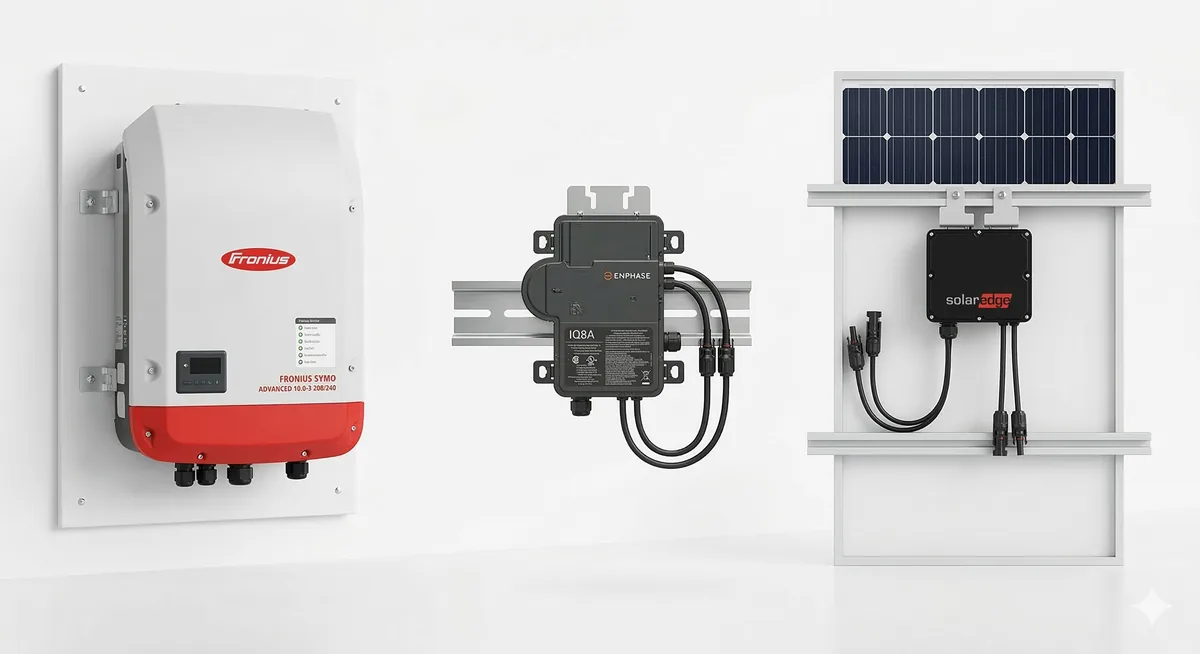
String inverters are the most common type in Perth. All panels on a ‘string’ feed into a single central inverter, usually mounted on your garage wall or next to the switchboard. Brands like Fronius (Austrian, premium), Goodwe (Chinese, excellent value), and Sungrow (Chinese, one of the world’s largest) dominate the Perth market.
- Best for: Unshaded roofs with consistent orientation (all panels facing the same direction)
- Pros: Lowest cost, proven technology, easy to service, excellent monitoring
- Cons: Entire string drops to the level of the worst-performing panel (shading kills output)
Microinverters
Microinverters are small inverters attached to each individual panel. Enphase is the dominant brand in Australia, with a 25-year warranty. Each panel operates independently, so shading on one panel doesn’t affect the others.
- Best for: Shaded roofs, multi-orientation roofs (panels on north AND west), complex roof layouts
- Pros: Panel-level optimisation, 25-year warranty, excellent monitoring per panel, no single point of failure
- Cons: Higher cost ($1,500-$2,500 more), harder to service (on the roof, not the wall)
DC Optimisers (Power Optimisers)
DC optimisers sit behind each panel but feed into a central SolarEdge inverter. They’re a middle ground — per-panel optimisation with a central conversion point.
- Best for: Partial shading, homes that want panel-level monitoring but prefer a central inverter
- Pros: Panel-level optimisation, better value than microinverters, strong monitoring
- Cons: Tied to SolarEdge ecosystem, central inverter is still a single point of failure
Cost Comparison for a 6.6kW System (Perth, 2026)
| Inverter Type | Typical Brands | Added Cost vs String | Warranty |
|---|---|---|---|
| String inverter | Fronius, Goodwe, Sungrow | Baseline | 10-12 years |
| Microinverters | Enphase IQ8+ | +$1,500-$2,500 | 25 years |
| DC Optimisers | SolarEdge | +$1,000-$1,800 | 12-25 years |
Which One Should You Choose?
Here’s a simple decision guide based on your roof:
- Clean, unshaded, single-orientation roof → String inverter (Fronius Primo or Goodwe DNS)
- Significant shading from trees, chimneys, or neighbouring buildings → Microinverters (Enphase IQ8+)
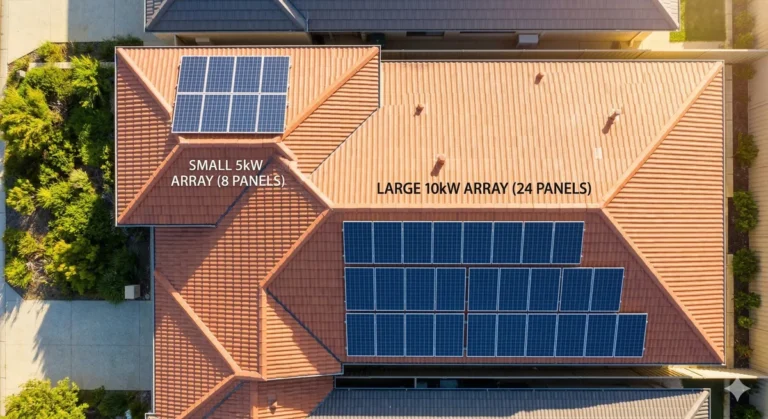
- Multiple roof faces (panels on north + west) → Microinverters or DC optimisers
- Want the longest warranty possible → Microinverters (25 years)
- Best value with some shading → DC optimisers (SolarEdge)
- Planning to add a battery later → Hybrid string inverter (Fronius Gen24 or SolarEdge Energy Hub)
Worth knowing: If you’re in an established Perth suburb with mature trees (Nedlands, Subiaco, Mount Lawley), shading analysis is critical. A good installer will use satellite imagery and shading simulation tools to recommend the right inverter technology for your specific roof.
Frequently Asked Questions
Are microinverters worth the extra cost?
For shaded roofs, absolutely — the performance gain typically pays for the extra cost within 2-3 years. For unshaded roofs, the financial case is weaker, but the 25-year Enphase warranty (vs 10-12 for string inverters) provides long-term peace of mind. In Perth’s market, microinverters add $1,500-$2,500 to a 6.6kW system. If your roof has even moderate shading during peak sun hours, microinverters are usually the smart choice.
Can I mix different inverter types on one system?
Generally, no — each inverter technology requires its own ecosystem. You can’t put Enphase microinverters on half your panels and a Fronius string inverter on the other half. However, if you’re expanding an existing system, your installer can add a second independent system with a different inverter type. This is sometimes the best approach for homes adding panels on a differently-oriented roof section.
Do I need a hybrid inverter if I want a battery?
Not necessarily. A hybrid inverter (Fronius Gen24, SolarEdge Energy Hub) is the most efficient option for a battery because it’s DC-coupled — the battery connects directly to the inverter with minimal conversion losses. But you can also add an AC-coupled battery to any existing string inverter system using a separate battery inverter. AC-coupling is slightly less efficient (2-5% conversion loss) but avoids replacing your existing inverter.
Talk Energy installs all three inverter types and recommends based on your roof, not on margin. Every installation includes a free shading analysis. Get a Free Quote or call (08) 6255 5914.
Talk Energy: Perth’s most trusted solar and battery installer, with 250+ five-star reviews and a 20-year workmanship warranty.