EV Charger Installation in Perth 2026: Charger Types, Solar Pairing and What to Check
If you have just bought an electric vehicle in Perth, you have probably discovered that the cable in the boot is slow. Charging from a standard 10A powerpoint delivers around 2.4 kW — enough to add maybe 15km of range an hour, which means most of a day to fill a mid-sized EV from low.
A dedicated home charger fixes that. Here is what is actually involved, what to specify, and the checks that catch people out.
The three levels of home charging
Standard powerpoint (~2.4 kW). The cable that came with the car. Fine for a plug-in hybrid or a very short commute, slow for anything else. It also runs a 10A circuit at close to full load for hours at a time, which is not what most household wiring was designed for.
Single-phase wall charger (up to 7.4 kW). The common residential upgrade, and the right answer for most Perth homes. Roughly three times the speed of a powerpoint — comfortably a full charge overnight for almost any EV.
Three-phase wall charger (up to 22 kW). Only possible if your home has three-phase supply. Around three times faster again. Genuinely useful for two-EV households, high-daily-mileage drivers, or anyone who needs a quick top-up between trips rather than an overnight fill.
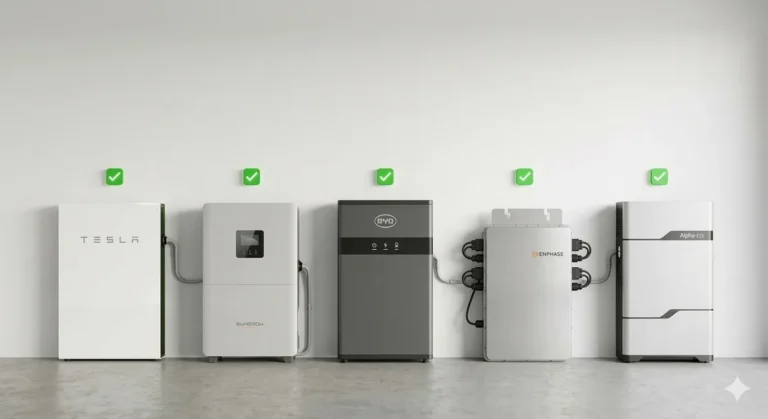
There is also DC charging, which most people only encounter at public fast-charging stations. It is now appearing in home systems too — the Sigenergy SigenStor offers optional DC charging up to 25 kW built into the battery stack, bypassing the car’s onboard converter entirely. See our SigenStor guide if that is of interest.
Do you have three phase?
This is the first question, and a lot of Perth homeowners do not know the answer.
Open your switchboard. One main switch running the whole house means single phase. Three main switches side by side, or a main switch noticeably wider than the others, usually means three phase.
Most Perth homes built before the 2000s are single phase. Larger and newer homes, and anything with ducted air conditioning plus a pool, are more often three phase.
If you are single phase and want 22 kW charging, upgrading to three phase is possible but it is a network-connection job with real cost attached. For most households, 7.4 kW single phase is sufficient — the question is whether the car is parked long enough overnight, and almost always it is.
Charging from your own solar
This is where an EV and a solar system become genuinely complementary, and it is worth understanding properly.
Exported solar earns very little in WA. Under the Distributed Energy Buyback Scheme, energy you send to the grid is paid at a low rate, particularly in the middle of the day when your panels produce most. Energy you buy back in the evening costs many times more.
So the most valuable thing you can do with surplus solar is use it yourself — and an EV is the largest single load most households can add.
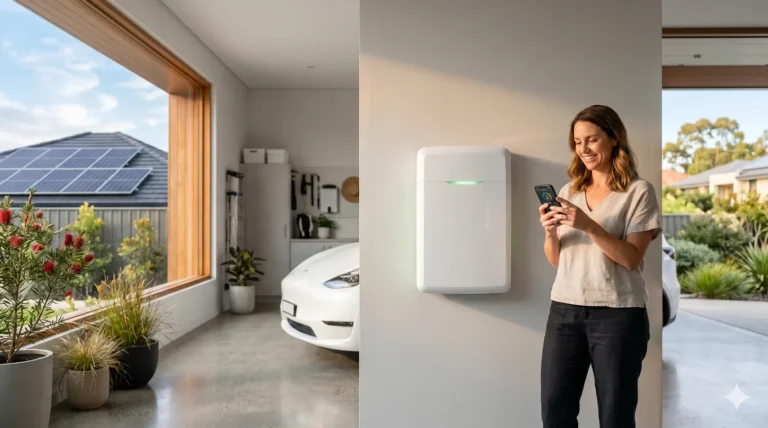
The practical implication: if your car is home during the day, charge it during the day. A charger with solar-aware functionality can be set to draw only surplus energy, ramping up when the panels are producing and backing off when they are not, so you are charging on your own generation rather than buying from the grid.
If your car is away during the day, the picture changes. Overnight charging on a discounted tariff is then the better option, and a home battery becomes the bridge — storing your midday surplus and releasing it to the car after dark.
There is more on the export economics in our self-consumption guide.
What to look for in a charger
Tethered or untethered. Tethered has the cable permanently attached — convenient, and one less thing to lose. Untethered has a socket you plug your own cable into — tidier, and more flexible if you change cars or have two with different connectors.
Load management. Important on older switchboards. A charger with dynamic load management monitors total household draw and reduces charging speed when the oven, air conditioner and kettle are all running, so you do not trip the main. Often the difference between needing a switchboard upgrade and not.
Solar integration. Not all chargers can follow your solar output. If daytime charging from surplus is part of the plan, confirm the specific model supports it.
Scheduling. Every worthwhile charger lets you set a charging window. Essential if you are on a time-of-use tariff.
OCPP compatibility. An open standard that keeps you free to change charging networks or management platforms later rather than being locked to one manufacturer’s app.
Weather rating. Perth sun is hard on outdoor electronics. If the charger is mounted on an exposed wall, check the IP rating and prefer a shaded position.
What the installation involves
A dedicated circuit. An EV charger needs its own circuit run from the switchboard — not a spur off an existing one. That is the bulk of the work, and the cost is driven mainly by cable run length and how difficult the route is.
Switchboard capacity. This is the most common surprise. Older Perth switchboards may not have a spare way, or may need an RCD upgrade to meet current standards. A charger with load management can sometimes avoid a full upgrade.
Network notification. Depending on charger size and your connection, Western Power may need to be notified. Your installer should handle this.
Placement. Think about where the car actually parks and which side its charge port is on. A charger on the wrong wall means running a cable across the driveway every night.
Doing it alongside solar or a battery
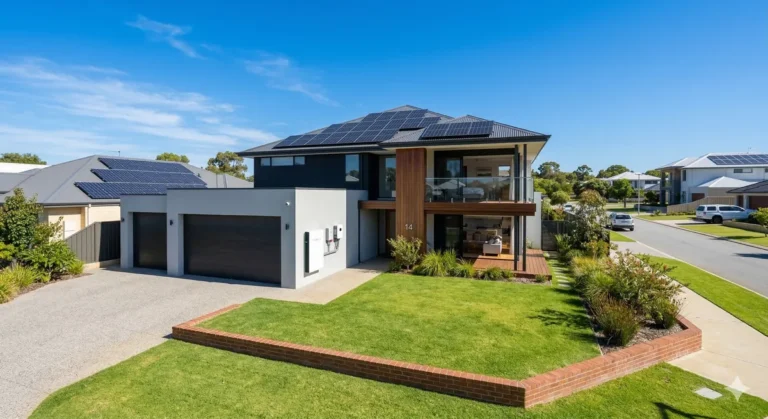
If you are adding solar, a battery and an EV charger, doing them together is meaningfully cheaper and simpler than in sequence — one switchboard visit, one set of network paperwork, one design that accounts for all three loads.
It also produces a better result. Sizing a solar array without accounting for a future EV usually means an array that is too small; adding the EV later then means either paying twice or living with a system that no longer fits the household.
If an EV is anywhere in your next few years, tell your solar installer now even if you are not buying the charger yet. It costs nothing to design for it.
Why the electrical work matters
An EV charger is one of the largest continuous loads in a home — several hours at close to full rated current, most nights, for years. That is a genuinely demanding duty cycle, and it is unforgiving of undersized cable, loose terminations or a marginal switchboard.
Talk Energy installs EV charging equipment alongside solar and battery systems using our own in-house SAA-accredited electricians — the same team that does the solar work, never subcontractors. Every installation carries our 20-year workmanship warranty and 48-hour fix-or-replace guarantee.
The short version
For most Perth homes, a 7.4 kW single-phase charger is the right answer — three times faster than a powerpoint and comfortably a full overnight charge. Go three phase only if you have the supply already and a genuine need for speed.
If the car is home during the day and you have solar, prioritise a charger that can follow your surplus generation. If it is away all day, look at a battery to bridge midday production to evening charging.
And if solar, storage or a charger are all on the horizon, plan them together rather than one at a time.
Talk to our team about EV-ready solar and charging: 08 6255 5914.