How to Choose a Commercial Solar Installer in Perth: 7 Things to Check
Choosing the wrong commercial solar installer in Perth can cost your business far more than the price on the quote. A system installed by an unlicensed or underqualified contractor can void manufacturer warranties, leave you ineligible for government rebates, and create safety and compliance risks that sit entirely on your shoulders.
The Perth commercial solar market is competitive, and not every company quoting for your job meets the same standard. Some use subcontracted labour with no in-house electricians. Others offer warranties that sound impressive until you read the fine print. A handful don’t hold the accreditations required to claim Small-scale Technology Certificates (STCs) on your behalf.
The good news: there are clear, verifiable criteria that separate credible commercial solar installation companies in Perth from the rest. Here are the seven things to check before you sign anything.
Key Takeaways
- SAA accreditation is mandatory for STC eligibility; always verify the accreditation number
- NETCC (New Energy Tech Consumer Code) Approved Seller status is the gold standard for retailer accountability
- In-house electricians reduce risk compared to subcontracted installation crews
- Workmanship warranties of 10+ years signal a company confident in its own work
- Financing options and price matching can significantly affect your upfront cost and ROI
1. SAA Accreditation and a Valid WA Electrical Licence
This is the non-negotiable starting point. Since February 2024, Solar Accreditation Australia (SAA) has replaced the Clean Energy Council as the official accreditation body for solar installers and designers under the federal Small-scale Renewable Energy Scheme (SRES). Any installer claiming STCs on your behalf must hold a current SAA accreditation number.
Why this matters for your business: STCs are the federal rebate mechanism that reduces the upfront cost of a commercial solar system. If your installer isn’t SAA accredited at the time of installation, your system is ineligible for those certificates. That’s a cost you absorb directly.
What to Verify
- Ask for the individual SAA accreditation numbers of the installers and designers assigned to your job
- Confirm accreditation is current (not expired or under review) via the SAA website
- Check that the company also holds a valid unrestricted electrical licence issued in Western Australia
In WA, a solar company does not legally need its own electrical contractors licence if it subcontracts to a licensed entity, but that arrangement shifts risk. If something goes wrong, accountability becomes murky. The safest scenario is an installer with in-house licensed electricians, where the company itself holds the relevant WA licence and the individual tradespeople are SAA accredited.
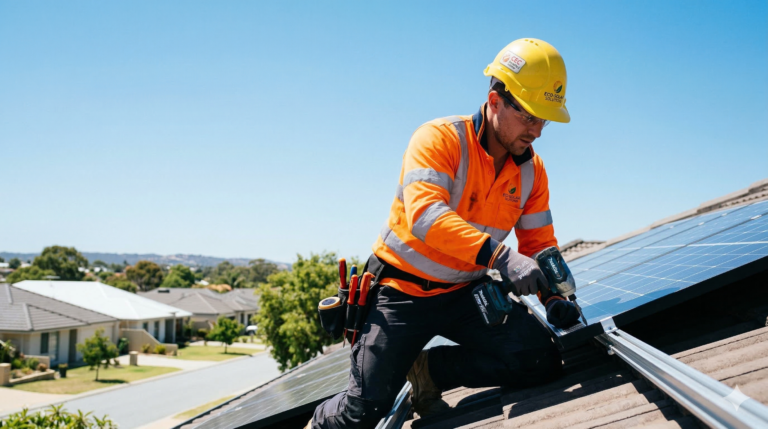
Talk Energy employs in-house electricians on every commercial job, meaning there is no subcontracting chain between the company responsible for your system and the people physically installing it.
2. NETCC Approved Seller Status
Beyond installer accreditation, there is a separate and equally important credential that applies to the company selling and contracting the system: New Energy Tech Consumer Code (NETCC) Approved Seller status.
The NETCC is administered by the Clean Energy Council and approved by the ACCC. It replaced the old CEC Approved Solar Retailer program in 2023 and now covers solar energy systems, batteries, and EV chargers. Companies that earn Approved Seller status have been assessed against a rigorous consumer protection framework covering ethical sales practices, transparent quoting, compliant installations, and comprehensive warranty obligations.
This matters for commercial buyers specifically because the NETCC also governs eligibility for WA government battery schemes.
What NETCC Approved Seller Status Guarantees
| Guarantee | What It Means in Practice |
|---|---|
| Proper installation | Work performed by SAA-accredited individuals |
| Safe and durable system | Free of faults, meets Australian Standards |
| Performance as described | System performs as the retailer stated |
| No hidden costs | No undisclosed debts or extra expenses |
| Repairs availability | Post-installation support must be accessible |
A company without NETCC Approved Seller status is operating outside this consumer protection framework. That is a meaningful risk for any commercial asset.
Talk Energy holds NETCC Approved Seller status, which means every commercial installation is backed by the consumer protections and accountability standards the code requires.
3. Workmanship Warranty Length and What It Actually Covers
Most solar installers in Perth will hand you a document listing three types of warranty: a panel product warranty, a panel performance warranty, and a workmanship warranty. The first two come from the manufacturer. The third comes from the installer, and it is the one that tells you the most about the company you are dealing with.
A workmanship warranty covers defects caused by the installation itself: incorrect wiring, improper mounting, roof penetrations that weren’t sealed properly, and any faults that trace back to how the system was put in rather than what it was made from. Industry standard sits at around five years. Companies confident in their work offer ten or more.
The Warranty Types Compared
| Warranty Type | What It Covers | Typical Term |
|---|---|---|
| Panel product warranty | Manufacturing defects in the panel | 10–25 years |
| Panel performance warranty | Minimum output (e.g. 80% after 25 years) | 25 years |
| Inverter warranty | Component defects in the inverter | 5–10 years |
| Workmanship warranty | Installation quality and defects | 5–10 years (10+ from premium installers) |
There is a critical question that goes beyond the length: who manages the warranty claim? If a panel fails five years from now, will the installer handle the process with the manufacturer on your behalf, or will you be left navigating an overseas support line yourself? For a commercial system, that distinction has real operational implications.
Talk Energy backs every commercial installation with a 20-year workmanship warranty, which is one of the longest in the Perth market. It also manages warranty claims on behalf of customers, so businesses are not left dealing with manufacturers directly.
4. In-House Electricians vs. Subcontracted Crews
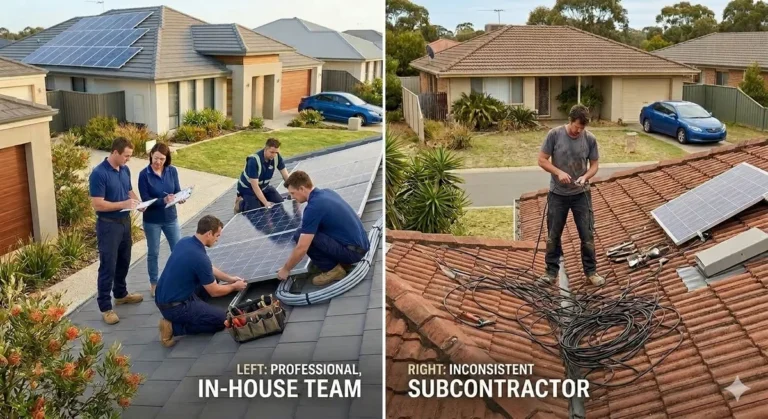
Many commercial solar companies in Perth operate as retailers or project managers rather than installation businesses. They sell the system, then subcontract the physical installation to a third-party crew. That model is legal in WA, and it is common. But it creates accountability gaps that can affect quality, timeline, and your warranty protection.
When a subcontractor installs your system, the company you contracted with is not the company doing the work. If something goes wrong during installation, resolving it can involve finger-pointing between the retailer and the subcontractor.
In-House vs. Subcontracted: The Practical Difference
In-house electricians:
- The same company quoting your job is accountable for the installation
- Consistent quality standards across every job
- Easier to resolve post-installation issues (one point of contact)
- Workmanship warranty is backed by the installer’s own team
Subcontracted crews:
- Variable quality depending on which crew is available
- Split accountability between retailer and installer
- Potential delays if the subcontractor’s schedule doesn’t align with yours
- Warranty responsibility can become disputed
The question to ask any installer is direct: “Will your own employed electricians be on site for every stage of this installation, or do you use subcontractors?” A credible company will answer clearly.
Talk Energy uses in-house electricians exclusively, which is why it can offer a 20-year workmanship warranty with confidence.
5. After-Care and Ongoing Support
A commercial solar system is a long-term asset, typically sized to run for 25 years or more. The quality of after-care support determines whether that asset performs at the level you were sold, or quietly underperforms for years without anyone flagging it.
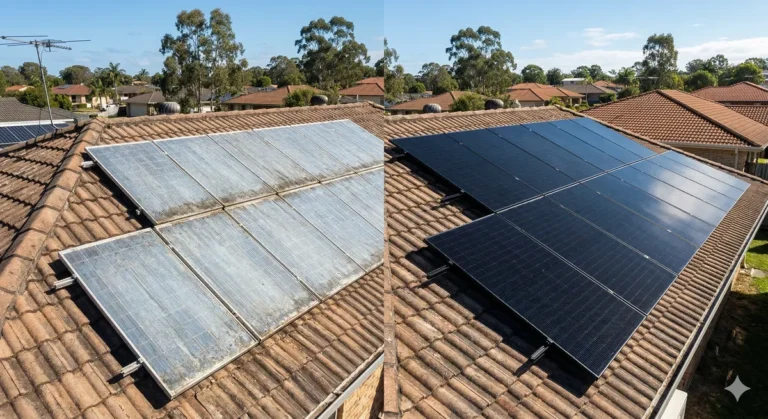
The most common failure mode is not dramatic. Panels don’t suddenly stop working. Inverters degrade. Shading from new structures reduces output. Monitoring data goes unreviewed. Over time, a system designed to cut your electricity bill by 40% might be delivering 25%, and without active support, you may not know.
What Good After-Care Looks Like
- System monitoring: Remote access to real-time generation data, ideally with alerts if output drops unexpectedly
- Responsive service calls: Clear SLAs for how quickly the company responds to a reported fault
- Warranty claim management: The installer handles manufacturer claims on your behalf, not just hands you a phone number
- Periodic performance reviews: Proactive check-ins, not just reactive responses to complaints
- Local presence: A Perth-based team that can be on site quickly, not a national company routing support calls through an interstate call centre
Ask any installer: “If my system stops performing as expected in three years, what is your process?” The answer will tell you a great deal about how seriously they take the relationship beyond settlement day.
Talk Energy is Perth-based with a local team, meaning aftercare support is handled by the same people who designed and installed your system.
6. Financing Options and Flexible Payment Structures
Commercial solar is a capital investment. For many Perth businesses, the upfront cost of a system sized appropriately for commercial energy consumption can run from $20,000 into six figures for larger sites. How an installer structures payment, and what financing options they offer, directly affects your cash flow and the speed at which the system pays itself back.
The right financing structure can make a commercial solar system cash-flow positive from day one, where the reduction in your electricity bill exceeds the repayment on any finance arrangement.
Questions to Ask About Financing
- Does the company offer in-house finance, or do they refer you to a third party?
- What are the repayment terms, and can they be structured around your business cash flow?
- Is the STC rebate deducted upfront from the quoted price, or do you need to claim it separately?
- Are there options to stage a larger system installation to spread capital expenditure?
Some commercial solar installation companies in Perth offer access to fast finance approvals, which matters if you want to lock in current STC values before they step down. STCs are calculated based on the Clean Energy Regulator’s deeming period, and the number of certificates available decreases each year as the scheme winds down toward 2030.
Talk Energy offers fast financing options with approvals designed to move at commercial speed, and all STC rebates are applied directly to your invoice.
7. Price Matching and Transparent Quoting
Commercial solar quotes in Perth can vary significantly for the same system size, and not all of that variation reflects genuine differences in quality. Some companies pad margins on components. Others strip out essential items (switchboard upgrades, monitoring systems, Western Power connection applications) and add them back as “extras” after you’ve committed.
A transparent quote itemises everything: panel brand and model, inverter brand and model, mounting system, labour, connection application fees, any required electrical upgrades, and the STC rebate being applied. If a quote is a single-line total with no breakdown, that is a warning sign.
The Price Matching Question
Price matching is a signal of confidence. A company willing to match a competitor’s written quote is telling you it believes its product and service quality justifies the price, and it would rather win your business than lose it to a lower-cost alternative.
What to check when comparing quotes for price matching:
- Are the panel and inverter brands equivalent? (A cheaper quote using lower-grade components is not a fair comparison)
- Are the warranty terms the same? (A 5-year workmanship warranty vs. a 20-year one represents a real difference in value)
- Is the installer’s accreditation status equivalent?
- Is aftercare support included or charged separately?
Talk Energy offers price matching on comparable commercial solar quotes. If you have received a written quote from another Perth installer for an equivalent system, Talk Energy will match it.
The Quick Checklist: What to Ask Every Installer
Before signing with any commercial solar installation company in Perth, run through this checklist. A credible installer will answer every question confidently and in writing.
| # | What to Check | What to Look For |
|---|---|---|
| 1 | SAA accreditation | Current accreditation number, verifiable on the SAA website |
| 2 | WA electrical licence | Unrestricted licence held by the company or in-house electricians |
| 3 | NETCC Approved Seller | Verified status on the New Energy Tech website |
| 4 | Workmanship warranty | 10 years minimum; 20 years from premium installers |
| 5 | In-house vs. subcontracted | In-house electricians for consistent accountability |
| 6 | After-care support | Local team, monitoring, responsive fault management |
| 7 | Financing and price matching | Upfront STC deduction, fast approval, price match on comparable quotes |
Frequently Asked Questions
What accreditation should a commercial solar installer in Perth have?
At minimum, a commercial solar installer must hold current Solar Accreditation Australia (SAA) accreditation to claim STCs on your behalf. The company should also be a NETCC Approved Seller, which provides consumer protection guarantees covering ethical sales, compliant installations, and warranty obligations. In WA, verify they hold a valid unrestricted electrical licence. Ask for individual accreditation numbers and verify them on the SAA website before signing.
Why does NETCC Approved Seller status matter for commercial solar?
NETCC Approved Seller status means the company has been assessed against a rigorous consumer protection framework covering ethical sales, transparent quoting, compliant installations, and comprehensive warranty obligations. It is administered by the Clean Energy Council and approved by the ACCC. Companies without this status operate outside these protections, which is a meaningful risk for a commercial asset worth $20,000 to $200,000+.
What workmanship warranty should a commercial solar installer offer?
Industry standard is 5 years, but quality installers offer 10 or more. The workmanship warranty covers installation defects — wiring, mounting, roof penetrations — not panel manufacturing faults. A 20-year workmanship warranty signals an installer confident in both their work quality and long-term business viability. Also ask who manages warranty claims: a good installer handles manufacturer claims on your behalf.
Should I choose an installer with in-house electricians or subcontractors?
In-house electricians provide consistent quality, single-point accountability, and straightforward warranty claims. Subcontracted crews create split accountability — if something goes wrong, the retailer and subcontractor may each point to the other. For a commercial system worth tens of thousands of dollars, in-house installation significantly reduces risk. Ask directly: “Will your own employed electricians do every stage of this installation?”
Do commercial solar installers in Perth offer price matching?
Some do. Price matching on comparable quotes is a signal of confidence — it means the installer believes their quality justifies the price and would rather compete on value than lose your business. When comparing quotes, ensure the panel and inverter brands are equivalent, warranty terms are the same, accreditation status is equal, and aftercare support is included. Talk Energy offers price matching on comparable commercial solar quotes.
Get a Free Commercial Solar Assessment
Talk Energy ticks every box on this list: SAA-accredited in-house electricians, NETCC Approved Seller status, a 20-year workmanship warranty, local Perth aftercare support, fast financing, and price matching on comparable quotes. With 250+ five-star reviews across metro and regional Western Australia, the track record is there to verify independently.
Contact Talk Energy for a free commercial solar assessment and itemised quote for your Perth business.
Talk Energy: Perth’s most trusted solar and battery installer, with 250+ five-star reviews and a 20-year workmanship warranty.