Grid-Tied vs Hybrid vs Off-Grid Solar: Which System is Right for Your Perth Home?
Perth sits in one of the sunniest corners of the planet. With more than 3,200 hours of sunshine per year and some of the lowest rooftop solar installation costs in the world, the question for most WA homeowners is no longer whether to go solar. It’s which type of system actually makes sense for their situation.
Grid-tied, hybrid, and off-grid systems are fundamentally different products with different price tags, different payback periods, and different levels of energy independence. Choosing the wrong one is an expensive mistake that takes years to correct.
The honest answer most installers won’t give you: for the majority of Perth metro homes, the right system in 2026 is not the cheapest option available. It’s the one that accounts for WA’s uniquely low feed-in tariff, rising electricity prices, and the new grid connection rules taking effect from 1 May 2026.
This guide breaks down how each system works, what it costs in WA right now, and the specific circumstances that make each one the right or wrong choice for your property.
What This Article Covers
- How grid-tied, hybrid, and off-grid solar systems work
- Real 2026 cost figures for Perth and regional WA
- WA-specific considerations: DEBS, Synergy vs Horizon Power, and the May 2026 rule changes
- Which system suits which type of property
- How to stack WA state and federal rebates to reduce your upfront cost
The Three System Types Explained
Before comparing costs and use cases, it helps to understand exactly what separates these three system types. They share the same core component (solar panels) but differ entirely in how they handle storage, grid connection, and backup power.
Grid-Tied Solar
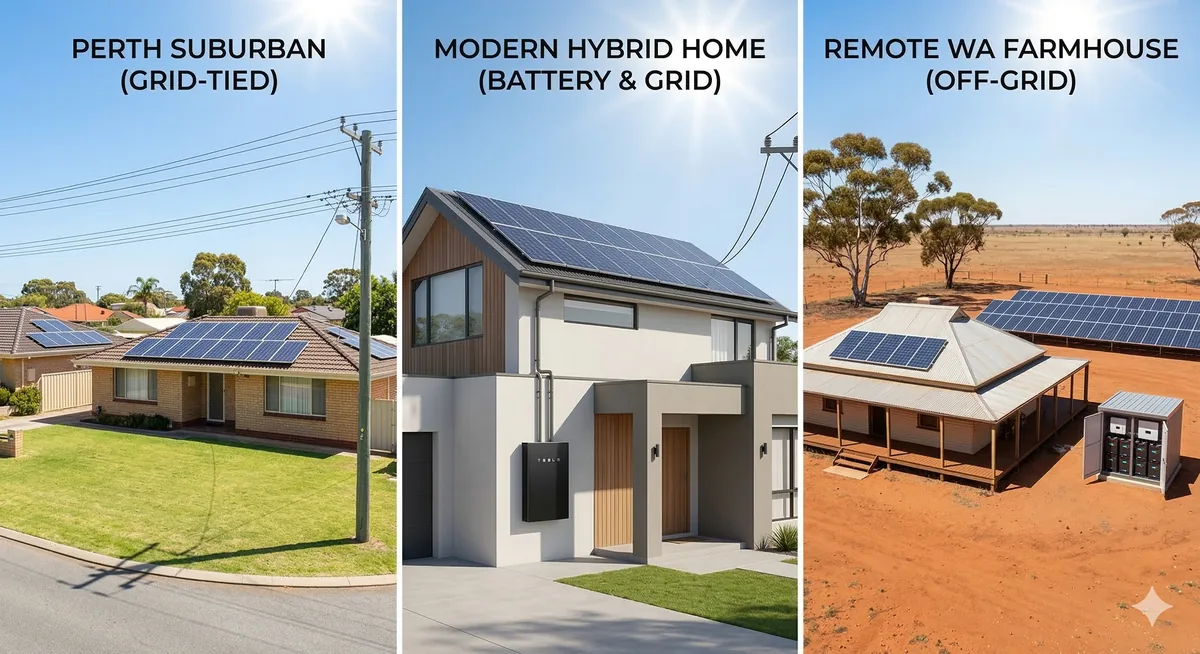
A grid-tied system connects your solar panels directly to the Western Power network via a grid-connect inverter. During daylight hours, your panels generate electricity that powers your home first. Any surplus is automatically exported to the grid, and you receive a credit under Synergy’s Distributed Energy Buyback Scheme (DEBS).
There is no battery storage. When the sun goes down, you draw power from the grid at standard tariff rates. Critically, grid-tied systems shut down during a blackout as a safety measure to prevent back-feeding electricity to lines that workers may be repairing.
Best for: Metro Perth homes wanting the fastest payback with minimal upfront cost.
Hybrid Solar
A hybrid system adds a battery to a grid-tied setup. Your panels charge the battery during the day; the battery powers your home at night or during peak tariff periods. The grid connection remains as a backup, so you never run out of power entirely.
Unlike a pure grid-tied system, a hybrid setup provides blackout protection. A correctly configured hybrid inverter will island your home during a grid outage, keeping essential circuits running from battery reserves.
Best for: Perth homeowners who want energy independence and blackout protection without cutting grid access entirely.
Off-Grid Solar
An off-grid system has no connection to the Western Power network at all. Your panels, a large battery bank, and typically a backup generator form a self-contained power station for your property. All energy needs are met on-site.
Off-grid systems must be sized to handle your worst-case scenario: the darkest, cloudiest week of the WA winter. That requirement drives up battery capacity significantly compared to a hybrid system of similar panel size.
Best for: Rural and remote WA properties where connecting to the grid is prohibitively expensive or simply unavailable.
| Feature | Grid-Tied | Hybrid | Off-Grid |
|---|---|---|---|
| Grid connection | Yes | Yes | No |
| Battery storage | No | Yes | Yes (large bank) |
| Blackout protection | No | Yes | Yes |
| Feed-in tariff (DEBS) | Yes | Yes | Not applicable |
| Upfront cost | Lowest | Moderate | Highest |
| Best suited for | Metro Perth | Metro/suburban Perth | Remote/rural WA |
What Does Each System Cost in Perth in 2026?
Cost is where many homeowners get a surprise. The sticker price difference between system types is significant, and the payback period varies considerably based on your usage profile and which WA grid zone you’re in.
Grid-Tied System Costs
A standard grid-tied system is the most affordable entry point to solar in Perth. After federal Small-scale Technology Certificate (STC) rebates, a typical residential installation costs:
- 6.6 kW system: $5,000 to $9,000 installed
- 10 kW system: $8,000 to $13,000 installed
- 13 kW system: $11,000 to $16,000 installed
Perth sits in STC Zone 3, which means the federal rebate for a 6.6 kW system is approximately $2,200 to $2,600. These figures are already reflected in the above prices from most reputable installers.
Payback periods for grid-tied systems in Perth typically sit between 3 and 6 years, depending on system size, household usage patterns, and how much of your solar generation you consume directly versus export.
Hybrid System Costs
Adding a battery to a grid-tied setup increases the upfront investment substantially. Current 2026 pricing for hybrid systems in Perth:
- 6.6 kW solar + 10 kWh battery: from approximately $15,000
- 10 kW solar + 20 kWh battery: from approximately $25,000
- 15 kW solar + 30 kWh battery: from approximately $30,000
The battery component is where most of the cost difference sits. A quality 10 kWh battery system adds roughly $8,000 to $12,000 to a standard grid-tied installation. However, the WA Residential Battery Scheme (launched July 2025) and the federal Cheaper Home Batteries Program can reduce this significantly.
Rebate stacking for Perth hybrid systems (Synergy customers):
- Federal Solar Rebate (STCs): ~$2,400
- Federal Battery Rebate (Cheaper Home Batteries): ~$3,300
- Synergy Battery Rebate: ~$2,000
- Total potential savings: up to $7,700
Off-Grid System Costs
Off-grid systems carry a significant premium because of the larger battery bank required and the complexity of a standalone power system. Typical 2026 figures for WA:
| System Size | Typical Use Case | Estimated Cost |
|---|---|---|
| 6 kW solar + 20 kWh battery | Average 3-bedroom home | $35,000 to $42,000 |
| 10 kW solar + 30 kWh battery | Large family home | $45,000 to $58,000 |
| 15 kW solar + 50 kWh battery | Farms, large properties | $70,000 to $85,000 |
A backup generator is an essential component of any off-grid system, adding $3,000 to $8,000 depending on capacity. While a generator typically only runs 6 to 12 times per year, it provides crucial redundancy during extended low-sun periods in winter.
The off-grid economics shift dramatically when grid connection costs are factored in. In remote WA, Western Power’s infrastructure extension charges can run from $30,000 to well over $100,000 depending on distance from the nearest connection point. In those cases, off-grid is often the cheaper option over a 10-year horizon.
The WA Factor: Why Perth Is Different to the Rest of Australia
Western Australia’s energy market operates differently to every other state, and those differences have a direct impact on which solar system makes the most financial sense for your home.
The DEBS Feed-In Tariff Problem
WA has the lowest solar feed-in tariff in Australia. Under the Distributed Energy Buyback Scheme (DEBS), Synergy customers in Perth and the south-west receive:
- 3pm to 9pm (peak): 10 cents per kWh exported
- 9pm to 3pm (off-peak): 2 cents per kWh exported
For most households, this averages out to under 3 cents per kWh across the day. Compare that to electricity you purchase from the grid, which costs around 30 cents per kWh. The maths are stark: every unit of solar you export earns you 2 to 3 cents, but every unit you buy back costs you 10 to 15 times more.
The implication for system choice is significant. A pure grid-tied system that exports large volumes of surplus solar is leaving money on the table. This is the single strongest argument for a hybrid system in Perth: storing your surplus and using it at night is worth roughly 10 times more than exporting it.
New Grid Connection Rules from 1 May 2026
Perth homeowners installing or upgrading solar after 1 May 2026 face new connection requirements under updated Western Power rules for the South West Interconnected System (SWIS). Every new system must be commissioned under one of two export pathways:
- Future-ready pathway: Full DEBS access, VPP participation eligibility, and flexible export limits. Requires communications-capable equipment and Wi-Fi at the inverter location. Your system must accept remote disconnection in genuine grid emergencies (rare).
- Fixed export pathway: Export capped at 1.5 kW. No remote disconnection required. Simpler, but significantly limits feed-in earnings.
Systems installed before 1 May 2026 are not affected. For new installs after that date, choosing an accredited installer who understands the CSIP-AUS commissioning requirements is critical.
Synergy vs Horizon Power: Regional WA Is Different
If your property is outside the SWIS (roughly Perth and the south-west corridor), your electricity provider is Horizon Power, not Synergy. This changes the rebate and feed-in picture considerably:
- Horizon Power battery rebates go up to $3,800 (versus $1,300 to $2,500 for Synergy customers)
- Some remote Horizon Power areas receive feed-in tariffs as high as 55.99 cents per kWh at peak times
- Combined federal and state battery rebates for Horizon Power customers can reach $6,800 to $7,500
For homeowners in regional WA towns, this makes hybrid systems exceptionally attractive. For truly remote properties where Horizon Power infrastructure is absent or unreliable, off-grid becomes the clear choice.
Which System Is Right for Your Property?
The right system depends on four variables: your location, your usage profile, your budget, and what you’re actually trying to achieve. Here is a direct breakdown.
Choose Grid-Tied If:
- You are in metro Perth and primarily want to reduce your Synergy bills as quickly as possible
- Your household uses most of its electricity during the day (work-from-home, stay-at-home households, or businesses with daytime operations)
- You have a limited budget and want the fastest payback period
- You are comfortable drawing from the grid at night and are not concerned about blackout protection
The honest caveat: given WA’s low DEBS rate, a grid-tied system works best when your self-consumption rate is high. If you are away from home during the day and exporting the majority of your solar generation, the financial case is weaker than it looks on paper.
Choose Hybrid If:
- You use most of your electricity in the evenings (the typical Perth household pattern)
- Blackout protection matters to you, whether for medical equipment, a home office, or simply peace of mind
- You want to future-proof your investment against rising electricity prices and declining DEBS rates
- You are eligible for the WA Residential Battery Scheme and can stack rebates to reduce the upfront cost
- You are installing after 1 May 2026 and want full DEBS access and VPP participation options
The strongest case for hybrid in Perth: DEBS rates have trended downward since the scheme launched, from 3 cents to 2 cents per kWh in the off-peak window. The trend suggests further reductions are possible. A battery means your exported volume shrinks, insulating you from future rate cuts.
Choose Off-Grid If:
- Your property is in rural or remote WA, and the cost of connecting to the Western Power network exceeds $30,000
- You have a lifestyle block, farm, or rural retreat where grid access is simply unavailable
- You want complete independence from the utility grid and are prepared for the higher upfront investment and ongoing maintenance requirements
- You have consistent high energy usage that justifies a large system
The misconception to correct: off-grid is not for Perth metro homeowners who want to “stick it to Synergy.” The economics do not support it. A metro household that could install a hybrid system for $18,000 to $25,000 would need to spend $40,000 to $60,000 for an off-grid equivalent, with no grid backup and a longer payback period. The motive is understandable; the numbers are not.
Quick Decision Guide
| Your Situation | Recommended System |
|---|---|
| Metro Perth, daytime usage, budget-focused | Grid-Tied |
| Metro Perth, evening usage, blackout protection wanted | Hybrid |
| Metro Perth, want maximum independence + VPP access | Hybrid |
| Regional WA town, Horizon Power customer | Hybrid (strong rebate case) |
| Rural/remote WA, grid connection cost $30k+ | Off-Grid |
| Remote property, no grid access available | Off-Grid |
What the Installation Process Looks Like
Understanding the installation timeline helps you plan around it and sets realistic expectations. The process differs slightly depending on system type, but the core steps are consistent for Perth residential installations.
Grid-Tied Installation: Typical Timeline
A standard grid-tied installation from quote to switch-on typically takes 2 to 6 weeks. Here is what that looks like in practice:
- Site assessment and quote (1 to 3 days): An accredited installer visits your property to assess roof orientation, shading, switchboard condition, and usage data. A detailed quote follows.
- Design and approvals (3 to 10 business days): Your installer submits a connection application to Western Power and Synergy. For straightforward metro installs, approval is often quick. Complex sites or larger systems may take longer.
- Installation day (4 to 8 hours): Panels are mounted, the inverter is installed, wiring is run, and the switchboard is upgraded if needed. Most residential grid-tied installs are completed in a single day by a team of 2 to 3 in-house electricians.
- Commissioning and meter upgrade (1 to 2 weeks post-install): Western Power installs or upgrades your smart meter to track both consumption and export. Your system cannot export to the grid until this step is complete.
From 1 May 2026, systems must also be commissioned using the CSIP-AUS protocol if you opt for the future-ready export pathway. Your installer handles this; it adds no meaningful time to the process with a prepared team.
Hybrid Installation: Typical Timeline
Hybrid systems follow the same process as grid-tied, with one addition: battery installation and configuration. Expect 3 to 8 weeks from quote to full commissioning.
Battery installation typically adds 2 to 4 hours to the installation day. If you are applying for the WA Residential Battery Scheme rebate, your installer must be listed on the approved vendor directory, and the application process should be initiated before installation day.
Off-Grid Installation: Typical Timeline
Off-grid systems are more complex and the timeline reflects that. Expect 4 to 12 weeks from initial quote to commissioning, with the variance driven by:
- Site remoteness and logistics (equipment transport to rural WA properties)
- System complexity (generator integration, larger battery banks, earthing requirements)
- Council or building permit requirements for some rural properties
A note on installer quality: off-grid systems have no grid backup to compensate for a poor design or substandard installation. Choosing a team with genuine off-grid experience, not just grid-tied installers who have done a handful of off-grid jobs, is essential.
What to look for in any installer: Clean Energy Council (CEC) accreditation, in-house licensed electricians (not subcontractors), a workmanship warranty of at least 10 years, and a clear process for post-installation support and monitoring. Talk Energy backs every installation with a 20-year workmanship warranty and uses in-house electricians across all system types.
Making Your Decision: The Bottom Line for Perth Homeowners
The solar decision in Perth in 2026 is more nuanced than it was five years ago. WA’s low feed-in tariff, the new May 2026 grid connection rules, and the improved economics of battery storage have shifted the calculation in a clear direction for most households.
The short version:
- Metro Perth, typical evening usage pattern: A hybrid system is now the strongest financial and practical choice for most homeowners. The rebate stacking available through the WA Battery Scheme and the federal Cheaper Home Batteries Program brings the effective cost of a 6.6 kW + 10 kWh system down to a level where the payback period is competitive with a grid-tied-only install from a few years ago.
- Metro Perth, high daytime usage: A grid-tied system still makes sense if your self-consumption is genuinely high during the day. Consider a battery-ready inverter so you can add storage later without replacing the inverter.
- Regional WA (Horizon Power): The rebate case for hybrid is even stronger than in metro Perth. With battery rebates up to $3,800 and feed-in tariffs that can reach 55.99 cents per kWh at peak in some areas, the financial case is compelling.
- Rural/remote WA: Off-grid is the practical and often the economically rational choice once grid connection costs are included in the comparison.
The right answer depends on your specific property, usage profile, and goals. A proper site assessment from an experienced, CEC-accredited Perth installer is the only way to get figures that actually reflect your situation.
Frequently Asked Questions
What is the difference between grid-tied, hybrid, and off-grid solar?
Grid-tied systems connect to the power grid with no battery storage and are the cheapest option. Hybrid systems add a battery for nighttime use and blackout protection while staying grid-connected. Off-grid systems have no grid connection at all and rely entirely on solar panels, a large battery bank, and typically a backup generator. Each suits different situations based on location, budget, and energy independence goals.
Which solar system type is best for Perth metro homes?
For most Perth metro homes with typical evening electricity usage, a hybrid system is the strongest choice in 2026. WA’s low DEBS feed-in tariff (2c/kWh off-peak) means exporting solar is worth very little, while storing it in a battery to use at night saves 30c/kWh. With rebate stacking of up to $7,700, the effective cost of a hybrid system has become competitive with grid-tied installations from a few years ago.
How much does an off-grid solar system cost in WA?
Off-grid systems in WA range from $35,000 to $85,000+ depending on system size. A 6 kW system with 20 kWh battery for an average home costs $35,000 to $42,000. Large farm properties with 15 kW solar and 50 kWh battery cost $70,000 to $85,000. A backup generator adds $3,000 to $8,000. Off-grid becomes economically rational when Western Power grid connection costs exceed $30,000.
What are the new WA solar grid connection rules from May 2026?
From 1 May 2026, new solar installations on the SWIS must be commissioned under either a future-ready pathway (full DEBS access, VPP eligibility, requires Wi-Fi and communications-capable equipment) or a fixed export pathway (export capped at 1.5 kW, simpler but limits earnings). Systems installed before this date are not affected. The future-ready pathway is recommended for most households.
Do Horizon Power customers get higher battery rebates than Synergy?
Yes. Horizon Power customers receive battery rebates of up to $3,800 under the WA Residential Battery Scheme, compared to $1,300 to $2,500 for Synergy customers. Combined with federal rebates, Horizon Power customers can access $6,800 to $7,500 in total battery incentives. Some remote Horizon Power areas also receive feed-in tariffs as high as 55.99c/kWh at peak times.
Get a Free Assessment for Your Property
Talk Energy services metro and regional Western Australia with in-house electricians, a 20-year workmanship warranty, and 250+ five-star reviews. Whether you need a grid-tied, hybrid, or off-grid system, our team can assess your property and provide a detailed quote tailored to your specific situation.
Contact Talk Energy for a free assessment and find out which system type delivers the best return for your home.
Talk Energy: Perth’s most trusted solar and battery installer, with 250+ five-star reviews and a 20-year workmanship warranty.