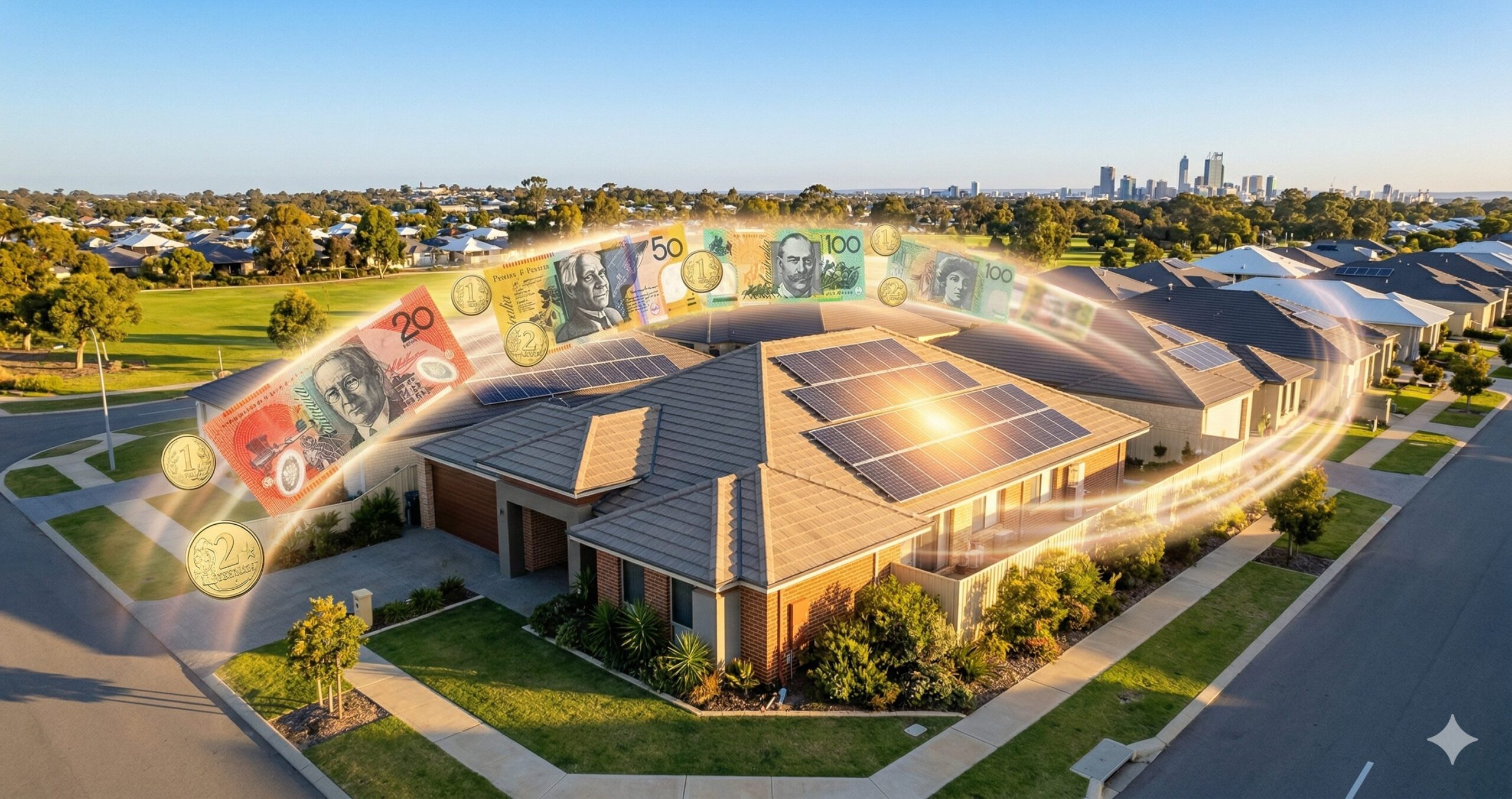
How Much Can You Save on Electricity Bills with Solar in Perth? 2026 Breakdown
Quick Answer: A 6.6kW solar system in Perth saves $1,600—$2,300 per year depending on your self-consumption rate. At Synergy’s confirmed 32.37c/kWh tariff and Perth’s 8 peak sun hours per day, payback sits at 3—4 years. After that, your electricity is essentially free for the remaining 20+ years of your system’s life.
Real Savings From a Real Perth Household
A Baldivis family came to Talk Energy in early 2025 with a bi-monthly Synergy bill sitting at $620. Their home ran reverse-cycle air conditioning, an electric hot water system, a pool pump, and the usual accumulation of modern appliances. Six weeks after a 6.6kW solar system was installed, their next bill arrived: $187. That is a saving of $433 in a single billing cycle, or roughly $2,600 annualised.
Their result is not an outlier. It is close to what the numbers predict for a Perth household at that consumption level. Perth’s combination of abundant sunshine, Synergy’s 32.37c/kWh retail tariff, and competitive system pricing creates one of the strongest solar savings cases of any capital city in Australia.
The honest answer to “how much will I save?” depends on three things: your system size, how much of the solar you use directly during the day (self-consumption), and what you export to the grid under Synergy’s Distributed Energy Buyback Scheme (DEBS). This guide breaks all three down with real numbers so you can estimate your own savings before requesting a quote.
Key Figures for 2026
- Synergy retail tariff: 32.37c/kWh
- DEBS peak export rate (3pm—9pm): 10c/kWh
- DEBS off-peak export rate (all other times): 2c/kWh
- Perth average peak sun hours per day: 8 hours
- Typical 6.6kW system annual savings: $1,600—$2,100
Savings by System Size
The table below uses Synergy’s confirmed 2025—26 tariff of 32.37c/kWh, real Perth system pricing after federal STC rebates, and two self-consumption scenarios: 50% (a typical working household where most usage is in the evening) and 65% (a household with at least one person home during the day, or appliances shifted to solar hours). For a detailed cost breakdown on larger systems, see our guide to 10kW solar system cost in Perth.
| System Size | Daily Generation | Annual Generation | Net Cost (After STCs) | Annual Savings (50% self-use) | Annual Savings (65% self-use) | Payback Period |
|---|---|---|---|---|---|---|
| 6.6kW | ~27—30 kWh | ~10,000 kWh | $4,750—$6,170 | ~$1,650—$1,900 | ~$2,000—$2,300 | 3—4 years |
| 10kW | ~40—45 kWh | ~15,000 kWh | $8,490—$10,560 | ~$2,400—$2,800 | ~$2,900—$3,300 | 3.5—4.5 years |
Savings include avoided grid costs at 32.37c/kWh plus DEBS export credits at a blended rate. System costs sourced from Talk Energy’s 2026 Perth solar pricing guide.
Why Self-Consumption Rate Changes Everything
This is the number most homeowners don’t think about when they get a quote, and it is the single biggest lever on your actual savings.
Every kilowatt-hour of solar you consume directly saves you 32.37c (the grid rate you avoid paying). Every kilowatt-hour you export earns you somewhere between 2c and 10c under DEBS. The difference is stark: self-consumed solar is worth 10 to 16 times more than exported solar during off-peak hours.
Dollar Terms for a 6.6kW System
- At 50% self-consumption: ~5,000 kWh self-consumed (saves ~$1,619) + ~5,000 kWh exported (earns $150—$250 in DEBS credits) = $1,769—$1,869/year
- At 65% self-consumption: ~6,500 kWh self-consumed (saves ~$2,104) + ~3,500 kWh exported (earns $105—$175) = $2,209—$2,279/year
The gap between those two scenarios is roughly $400 per year, simply from shifting when you run high-draw appliances. Pool pumps, dishwashers, washing machines, and hot water systems are the easiest wins. Running them between 9am and 3pm, when your panels are producing at peak output, converts what would be exported at 2c into avoided grid costs at 32c.
The DEBS Reality: Perth Has Australia’s Lowest Feed-In Tariff
It is worth being direct about this. Under the Distributed Energy Buyback Scheme (DEBS), Perth households on Synergy receive the lowest solar feed-in tariff of any state in Australia. The off-peak rate of 2c/kWh has declined from 3c/kWh since DEBS launched in 2020, and the direction of travel suggests further reductions are possible.
The implication is not that solar is a bad investment in Perth. Quite the opposite: Perth’s extraordinary solar irradiance and Synergy’s relatively high retail rate make self-consumed solar extremely valuable. The implication is that your savings strategy should be built around maximising daytime usage, not maximising panel count to generate more export income.
Why Perth Homeowners Save More Than Almost Anywhere Else in Australia
Three structural advantages combine to make Perth one of the best cities in the country for solar savings, regardless of the low feed-in tariff.
1. More Sun Hours Per Day
Perth averages 8 peak sun hours per day, compared to 4.5—5 hours in Sydney and 4—4.5 hours in Melbourne. This means a 6.6kW system in Perth generates roughly 27—30 kWh per day on average, where the same system in Melbourne might produce 18—22 kWh. More generation means more self-consumption opportunity and more export credits, compressing payback periods significantly.
2. A Retail Tariff That Makes Every kWh Count
Synergy’s Home Plan (A1) tariff is confirmed at 32.37c/kWh from 1 July 2025. That is the rate you avoid paying for every unit of solar you consume directly. At that price, a household self-consuming 15 kWh of solar per day saves $4.86 per day, or roughly $1,774 per year, from avoided grid costs alone. The retail rate has increased by approximately 37% over the past decade, and if that trend continues, your solar savings grow each year without any change to your system.
3. Competitive System Pricing
Perth’s solar market is mature and competitive. A quality 6.6kW system after federal Small-scale Technology Certificates (STCs) costs between $4,750 and $6,170, which is at or below the national average cost per watt. Perth homeowners access some of the lowest-cost rooftop solar in the world on a per-watt basis, which is a direct result of high installer competition and strong local demand. There are also attractive solar financing options in Perth that let you start saving without a large upfront payment.
The combined effect: a Perth household with a 6.6kW system, 60% self-consumption, and a $5,500 net system cost can expect payback in under four years. After that, the savings are effectively free electricity for the remaining 20-plus years of the system’s life.
How to Calculate Your Own Savings
You do not need to rely on an installer’s estimate. Here is a straightforward method using your Synergy bill and Perth’s solar generation data.
Step 1: Find Your Daily Consumption
Your bi-monthly Synergy bill shows total kWh consumed. Divide that figure by 60 to get your average daily consumption. A typical Perth household with air conditioning and a hot water system uses 20—30 kWh per day.
Step 2: Size a System Against Your Usage
A 6.6kW system in Perth generates roughly 27—30 kWh per day on average. If your daily consumption is 20—25 kWh, a 6.6kW system will comfortably cover your daytime usage and export the surplus. If your consumption is above 30 kWh per day, a 10kW system is worth modelling.
Step 3: Apply the Self-Consumption Multiplier
Estimate your self-consumption rate honestly:
- At home most of the day: 60—70% self-consumption is realistic
- Working household, out 9—5: 40—50% self-consumption is more typical
- With a battery: 80—90% self-consumption becomes achievable
Step 4: Run the Maths
Use this formula:
(Annual generation x self-consumption rate x $0.3237) + (Annual generation x export rate x blended DEBS rate) = Annual savings
For a 6.6kW system at 55% self-consumption:
- Self-consumed: 10,000 kWh x 55% x $0.3237 = $1,780
- Exported: 10,000 kWh x 45% x $0.03 (blended DEBS) = $135
- Total annual saving: ~$1,915
Talk Energy’s solar savings calculator does this automatically using your actual bill data and postcode. It takes about two minutes and gives you a personalised estimate before you commit to anything.
Does Adding a Battery Increase Your Savings?
Yes, but the mechanism is different from what most people expect. A battery does not generate more solar. What it does is capture the solar you would otherwise export at 2c/kWh and let you use it at night, displacing grid electricity you would otherwise buy at 32.37c/kWh. Choosing the right battery matters — see our comparison of the best batteries for solar in Perth.
For a working household exporting 50% of their solar generation, a 10kWh battery can shift a significant portion of that export into evening self-consumption. The result is typically an additional $600—$900 per year in savings on top of a solar-only system.
Battery Rebates Available in 2026
| Incentive | Amount | Notes |
|---|---|---|
| WA Residential Battery Scheme | Up to $1,300 | $130/kWh, capped at 10kWh. VPP enrolment required. |
| Federal Cheaper Home Batteries Program | ~$3,020 for 10kWh | STC Factor 8.4 at current spot prices. Applies as upfront discount. |
| Combined (Synergy customers, before 1 May 2026) | ~$4,320 | Federal STC factor steps down 1 May 2026, reducing to ~$3,820. |
The federal component steps down on 1 May 2026 and again every six months through to 2030. For Perth homeowners considering solar plus battery, the current rebate window is the best it will be for several years.
For a detailed ROI breakdown, Talk Energy’s WA Battery Scheme guide covers the full rebate stack, eligibility requirements, and payback modelling for common battery options including the Tesla Powerwall 3 and Sungrow.
What Affects Your Actual Savings: The Variables That Matter
Roof Orientation and Tilt
North-facing panels at a 20—30 degree tilt produce the most energy in Perth. West-facing panels produce about 10—15% less overall but generate more in the late afternoon, which aligns better with peak DEBS hours (3pm—9pm) and household usage patterns. East-facing panels generate well in the morning but export more during off-peak hours. A good installer will model your specific roof geometry rather than giving you a generic output estimate.
Shading
Shading from trees, chimneys, or neighbouring structures can reduce output significantly. Even partial shading on a single panel can affect a string inverter’s entire output. If your roof has shading, microinverters or DC optimisers are worth discussing. Talk Energy’s in-house electricians assess shading during the site visit as part of the design process.
Your Usage Timing
This is the variable most within your control. Households that shift dishwasher, washing machine, and pool pump cycles to between 9am and 3pm consistently achieve 60—70% self-consumption. Those who cannot shift loads tend to sit at 40—50%. The difference in annual savings is $300—$500 on a 6.6kW system.
Rising Electricity Prices
Synergy’s retail tariff has increased roughly 37% over the past decade. If prices continue rising, your solar savings increase proportionally each year without any change to your system.
Get an Itemised Savings Estimate for Your Home
The Baldivis household at the start of this guide saved $433 on a single bi-monthly bill. That result came from a well-sized system, a north-facing roof, and a household that runs the pool pump and dishwasher during the day. Not every home will hit those numbers, but most Perth households on a standard Synergy tariff will see annual savings in the $1,600—$2,300 range from a 6.6kW system, with payback inside four years.
The most reliable way to know your specific number is to get an itemised quote based on your actual bill, roof layout, and consumption patterns.
Talk Energy provides obligation-free, itemised quotes for Perth metro and regional WA. Every quote includes a site-specific savings projection, system design, and full rebate breakdown. There are no generic estimates and no pressure.
Talk Energy backs every installation with a 20-year workmanship warranty and a 48-hour fix-or-replace guarantee, so the savings you’re quoted are savings you can rely on long term.
Frequently Asked Questions
How much does a 6.6kW solar system save per year in Perth?
A 6.6kW solar system in Perth saves between $1,600 and $2,300 per year depending on your self-consumption rate. At 50% self-consumption (typical for a working household), annual savings are approximately $1,770—$1,870. At 65% self-consumption, savings rise to $2,200—$2,280. These figures use Synergy’s confirmed 2025—26 tariff of 32.37c/kWh and Perth’s average of 8 peak sun hours per day.
What is the payback period for solar panels in Perth?
The payback period for a quality 6.6kW solar system in Perth is typically 3—4 years. A 10kW system pays back in 3.5—4.5 years. These periods are among the shortest in Australia due to Perth’s high solar irradiance (8 peak sun hours), Synergy’s 32.37c/kWh retail tariff, and competitive system pricing after federal STC rebates. After payback, your solar electricity is essentially free for the remaining 20+ years.
Is it worth adding a battery to solar in Perth in 2026?
Adding a battery to your Perth solar system typically saves an additional $600—$900 per year by storing daytime solar for evening use instead of exporting at 2c/kWh. With combined rebates of up to $4,320 available before 1 May 2026 (WA Battery Scheme plus federal STCs), the economics are stronger than ever. The federal rebate steps down after May 2026, so the current window offers the best return for several years.
Get a Free Quote
Get a Free Quote or call (08) 6255 5914 to discuss your solar savings with the Talk Energy team.